

Painted Shell Valve, Russia (?) 17th - 18th Century
Large natural shell valve finely paintedpainted on its pearly surface, adorned with a particularly evocativeparticularly suggestive.
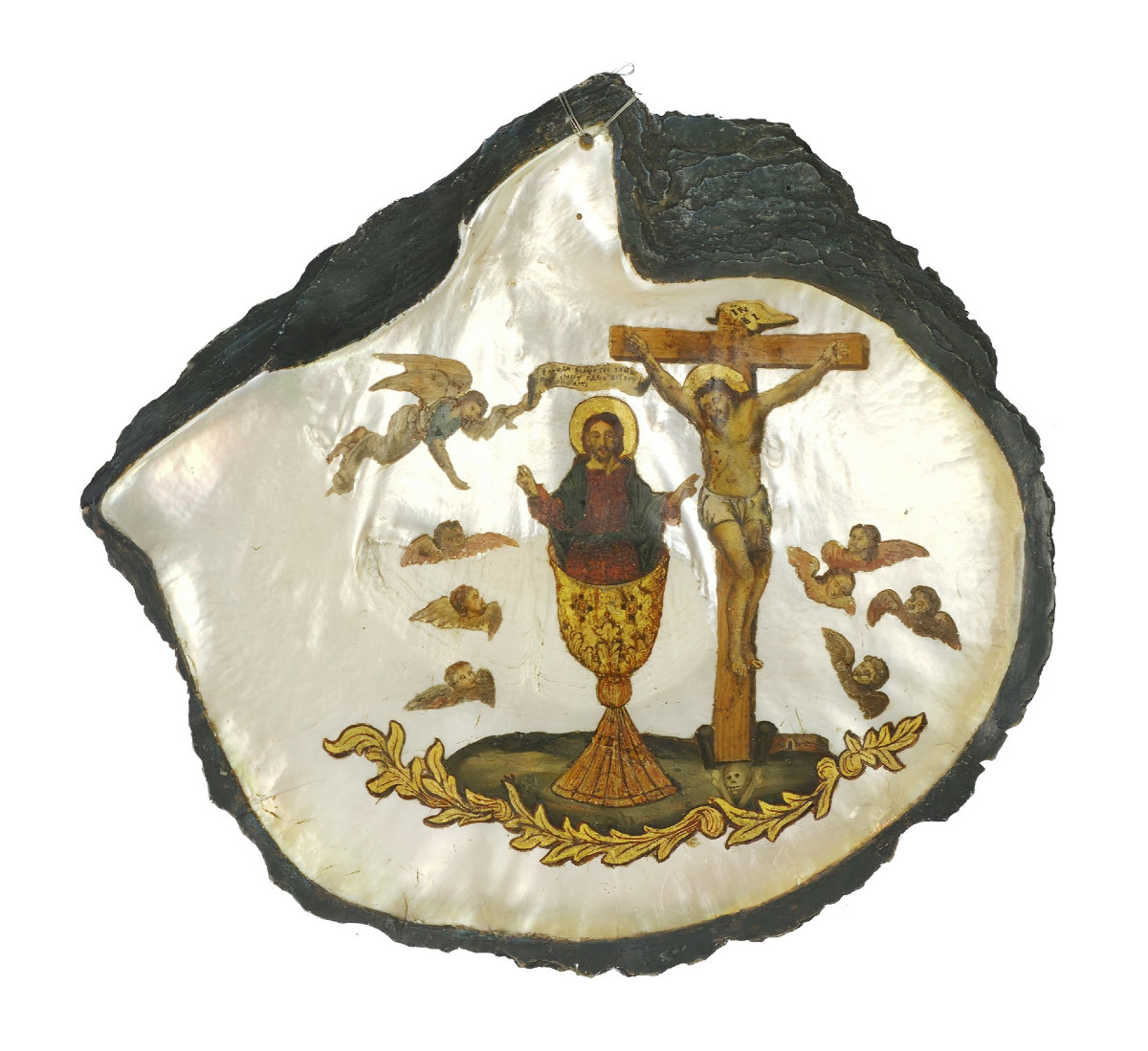
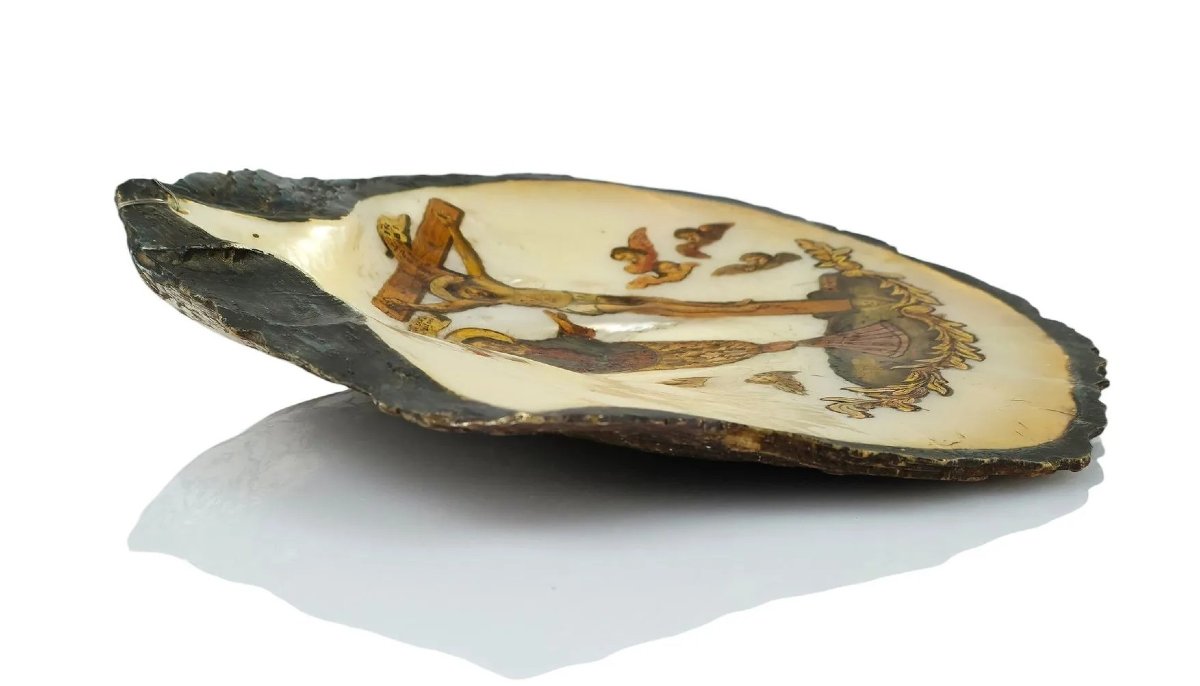
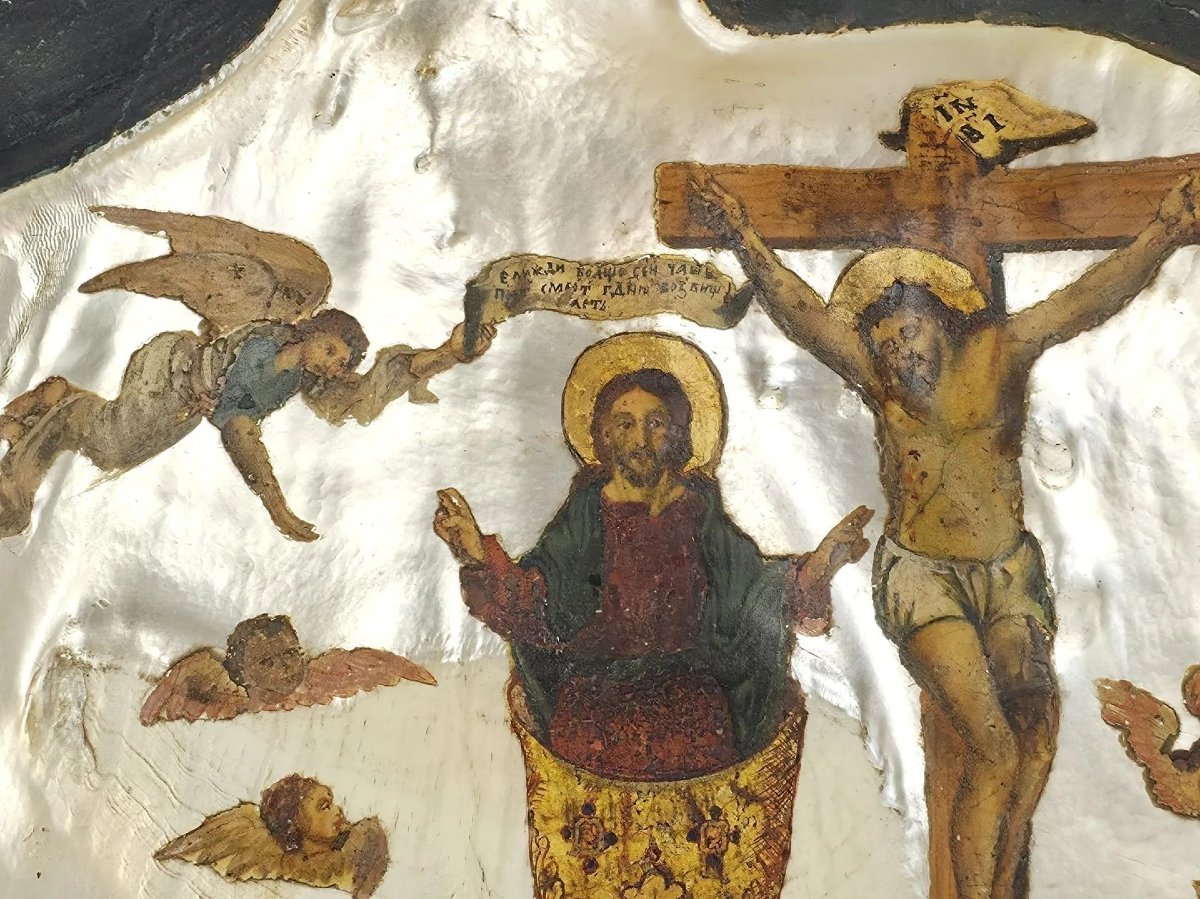
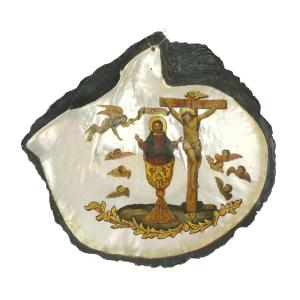
The shell, probably from a large bivalve, has been carefully polished on the inside to allow the painted scene to be executed, exploiting the natural iridescence of the mother-of-pearl as a luminous background. The composition, probably executed in oil or fatty tempera, with highlights of gilding gilding, depicts Christ on the cross in traditional Western iconography topped by the cartouche "INRI". In the center appears a highly symbolic image of Christ, blessing emerging from a Eucharistic chalice, a clear allusion to the mystery of sacrifice. Surrounding the scene are angels in flight and small cherub heads, in a decorative style evocative of tardo-mannerist Baroque sensibilities. At the base, an elegant gilded foliage motif the composition.
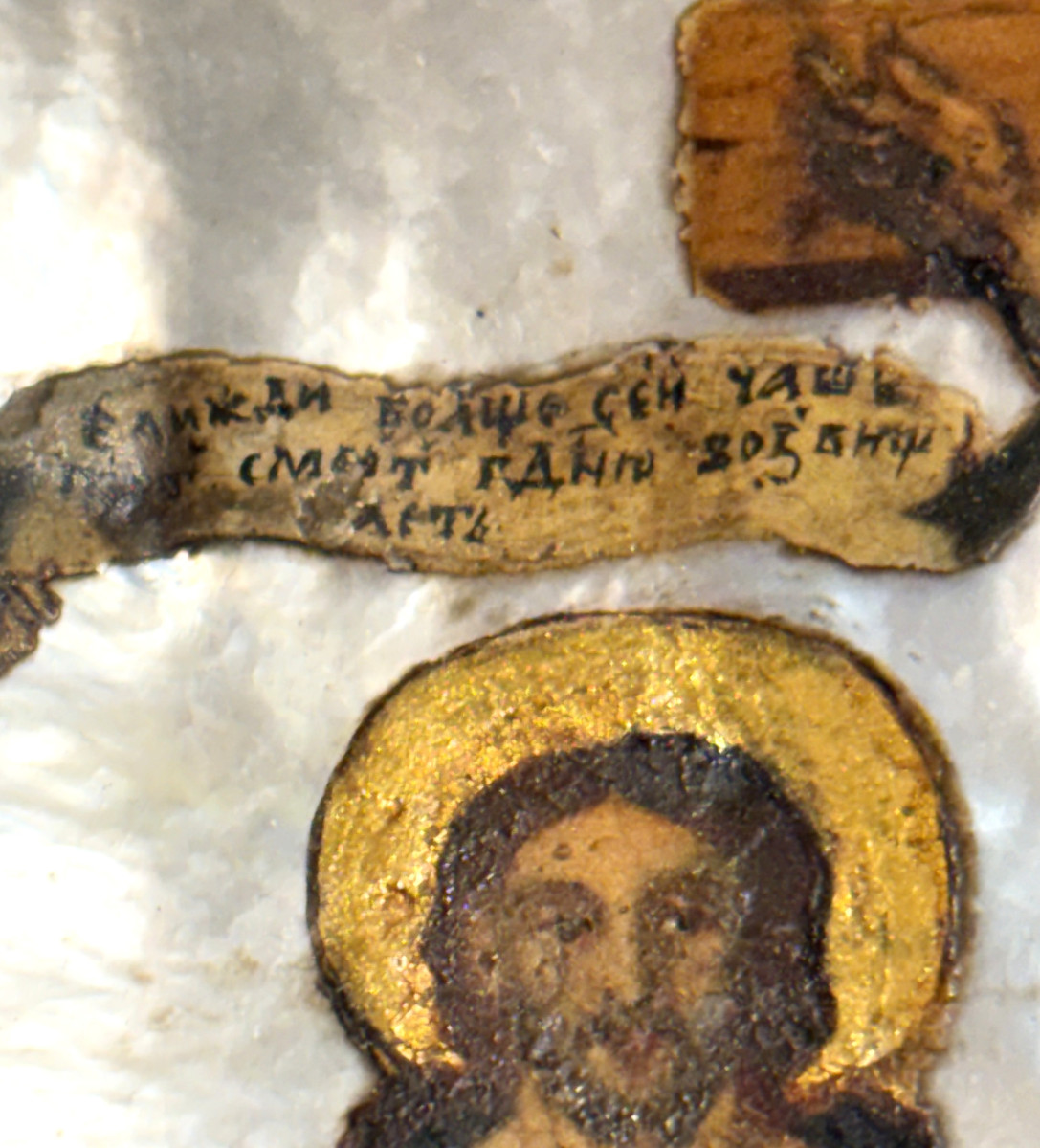
Particularly noteworthy is the phylactery held by an angel, inscribed in an inscription in Cyrillic characters, identifiable with church Slavonic: "Се Агнец Божий, вземляй грехи мира", i.e. "Behold the Lamb of God who takes away the sins of the world".
This element is of notable cultural interest , revealing a direct link with the Orthodox iconographic tradition, unexpected in an object whose structure and design could be considered Western context. The use of the shell as a pictorial support is part of a wider tradition, widespread in the 16th and 17th centuries, of devotional objects and naturalistic curiosities for private meditation Wunderkammer collections, where natural elements and artistic creation combine in hybrid works of high symbolic and aesthetic value.
According to its technical, stylistic and iconographic characteristics, the work can be placed in a European context around the 17th century, with a marked openness to models from Europe or the Balkan and Slavic regions. It's not out of the question production may have arisen from a context of cultural and commercial exchanges between East and West, or an object made directly in an Orthodox area but intended for wider distribution.
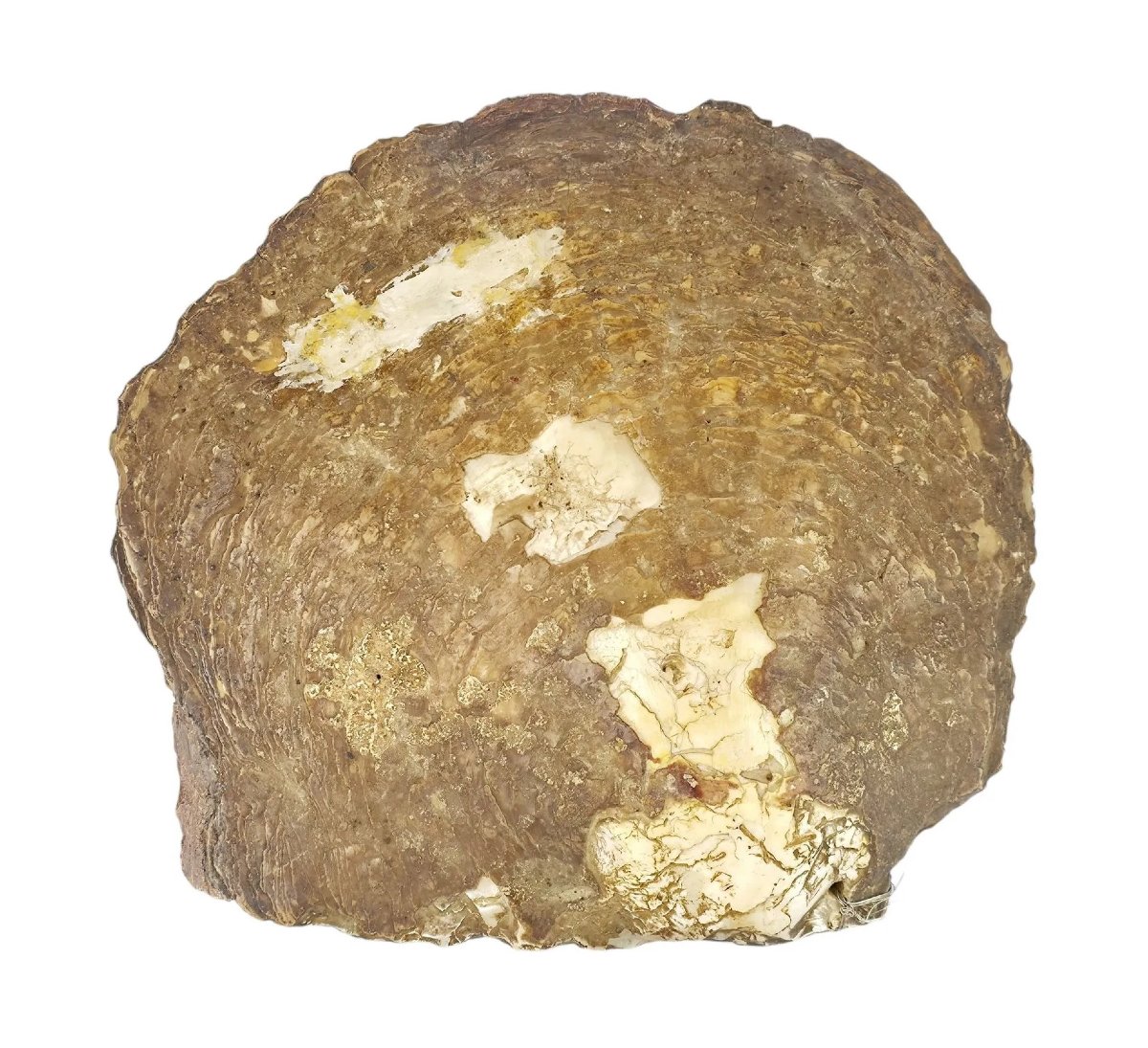
The state of preservation is excellent and in keeping with the object's age: the pictorial surface shows very minimal wear and loss, while the reverse retains the natural appearance of the natural appearance of the shell, with traces of work and deposits, contributing to the authentic, lived-in character.
Beautiful example of a devotional object of great charm and rare typology, where the naturalistic dimension is combined with acomplex iconographic elaboration of a sacred nature.
Dimensions: H. 22 × W. 23.5 × D. 3 cm.
The shell, probably from a large bivalve, has been carefully polished on the inside to allow the painted scene to be executed, exploiting the natural iridescence of the mother-of-pearl as a luminous background. The composition, probably executed in oil or fatty tempera, with highlights of gilding gilding, depicts Christ on the cross in traditional Western iconography topped by the cartouche "INRI". In the center appears a highly symbolic image of Christ, blessing emerging from a Eucharistic chalice, a clear allusion to the mystery of sacrifice. Surrounding the scene are angels in flight and small cherub heads, in a decorative style evocative of tardo-mannerist Baroque sensibilities. At the base, an elegant gilded foliage motif the composition.
Particularly noteworthy is the phylactery held by an angel, inscribed in an inscription in Cyrillic characters, identifiable with church Slavonic: "Се Агнец Божий, вземляй грехи мира", i.e. "Behold the Lamb of God who takes away the sins of the world".
This element is of notable cultural interest , revealing a direct link with the Orthodox iconographic tradition, unexpected in an object whose structure and design could be considered Western context. The use of the shell as a pictorial support is part of a wider tradition, widespread in the 16th and 17th centuries, of devotional objects and naturalistic curiosities for private meditation Wunderkammer collections, where natural elements and artistic creation combine in hybrid works of high symbolic and aesthetic value.
According to its technical, stylistic and iconographic characteristics, the work can be placed in a European context around the 17th century, with a marked openness to models from Europe or the Balkan and Slavic regions. It's not out of the question production may have arisen from a context of cultural and commercial exchanges between East and West, or an object made directly in an Orthodox area but intended for wider distribution.
The state of preservation is excellent and in keeping with the object's age: the pictorial surface shows very minimal wear and loss, while the reverse retains the natural appearance of the natural appearance of the shell, with traces of work and deposits, contributing to the authentic, lived-in character.
Beautiful example of a devotional object of great charm and rare typology, where the naturalistic dimension is combined with acomplex iconographic elaboration of a sacred nature.
Dimensions: H. 22 × W. 23.5 × D. 3 cm.
2 600 €
Period: 17th century
Style: Other Style
Condition: Excellent condition
Material: Nacre
Width: 23,5 cm.
Height: 22 cm.
Depth: 3 cm. env.
Reference (ID): 1746856
Availability: In stock
Print