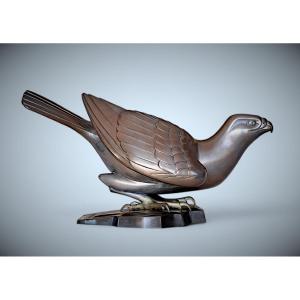


Japanese Bronze By Ogawa Eiho: Falcon
Artist: Ogawa Eiho 小川英鳳, (1896-1990)
Poised with quiet authority and distilled to its essential form, this elegant bronze hawk by Ogawa Eihō 小川英鳳, (1896-1990), embodies a remarkable synthesis ofJapanese sculptural refinement, decorative sophistication, and subtle Art Deco modernity. At once naturalistic and stylized, the work is conceived with a restraint that feels profoundly Japanese, yet its streamlined silhouette and rhythmic geometry also place it unmistakably within the broader aesthetic language of the early twentieth century. It is a sculpture in which tradition and modernity are held in perfect equilibrium.
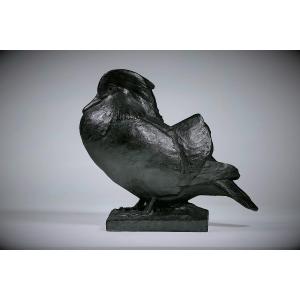
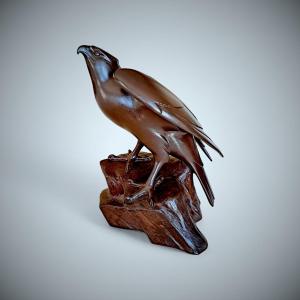
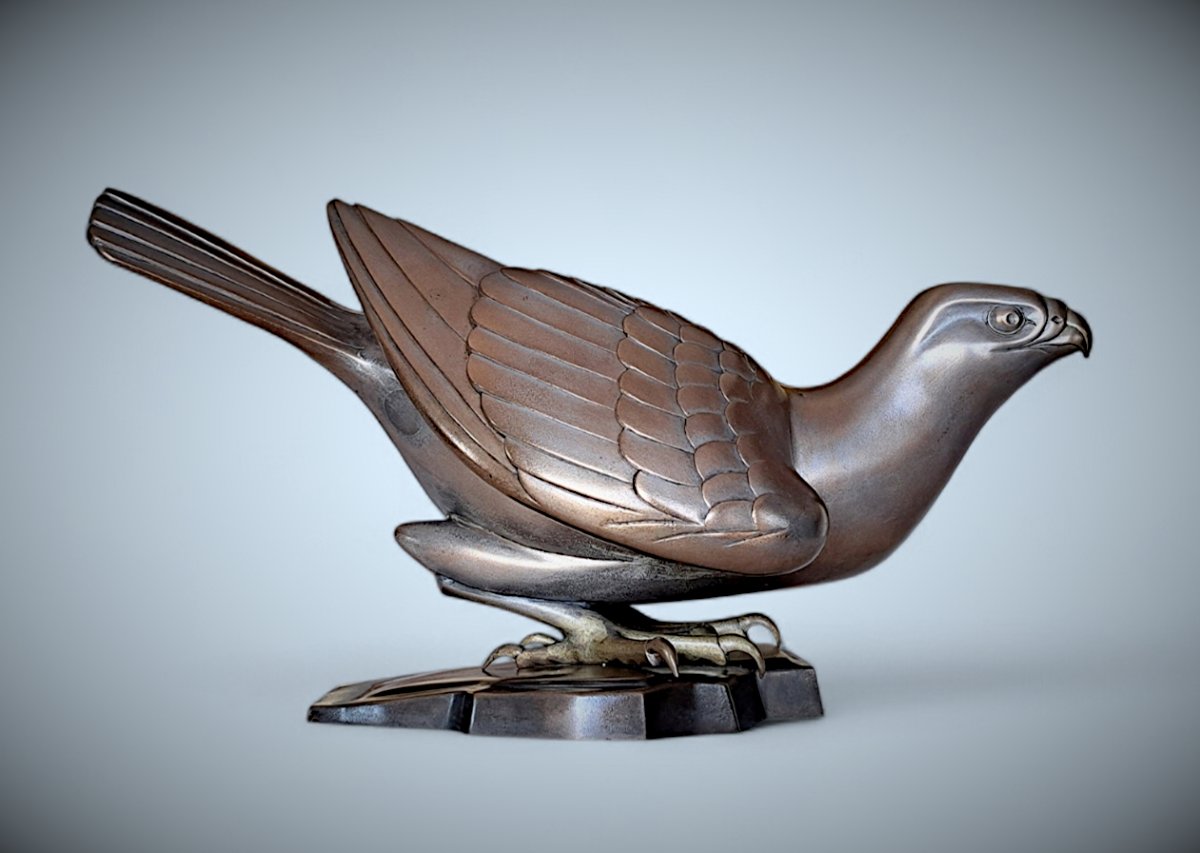
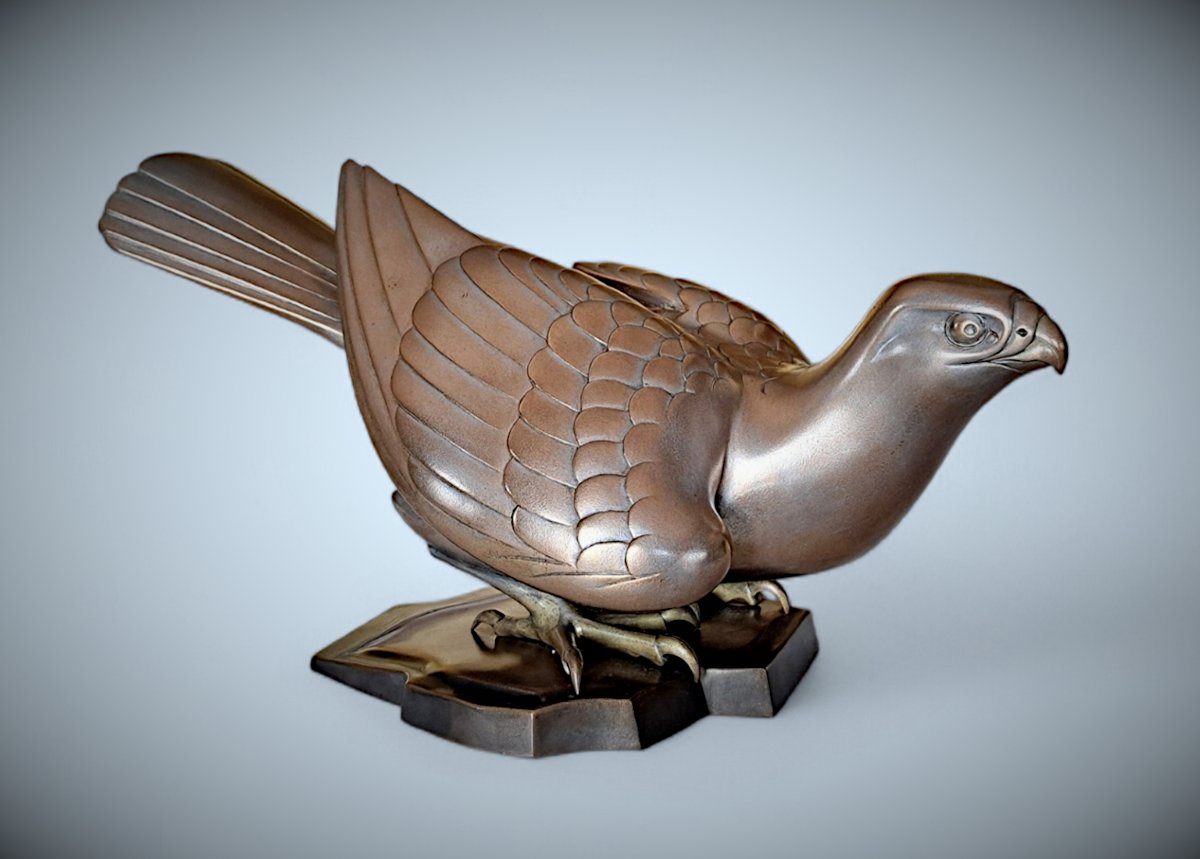
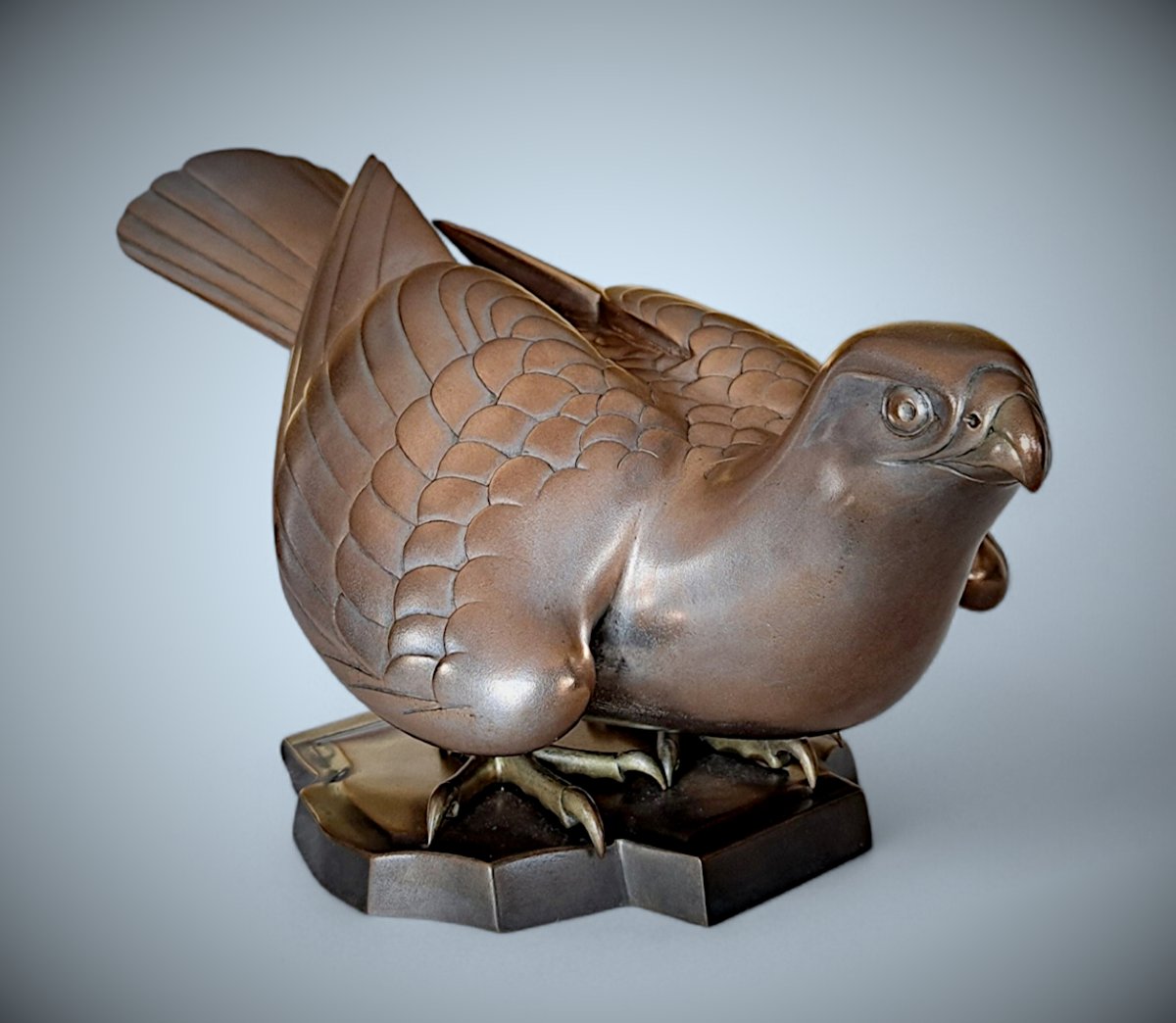
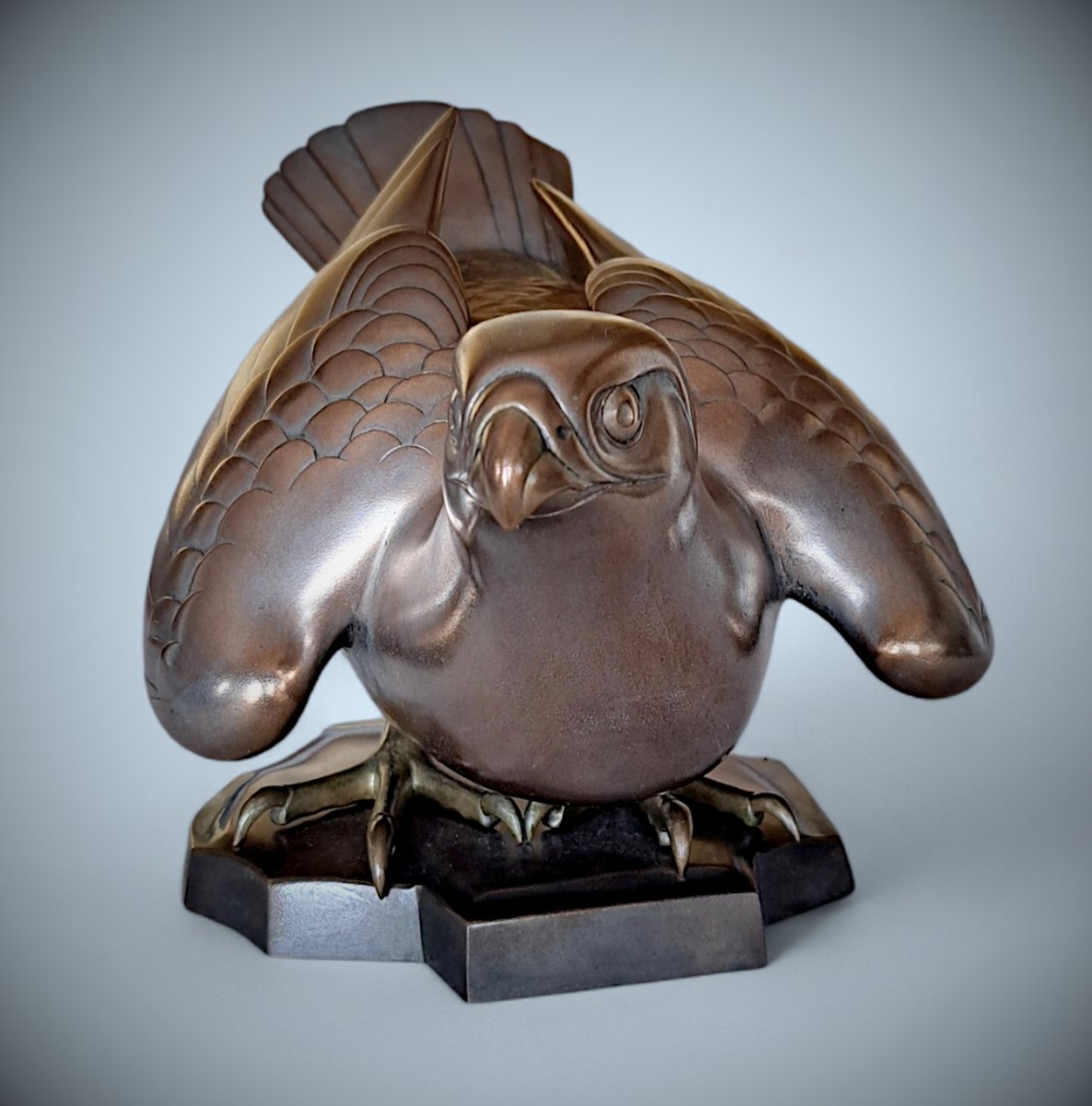
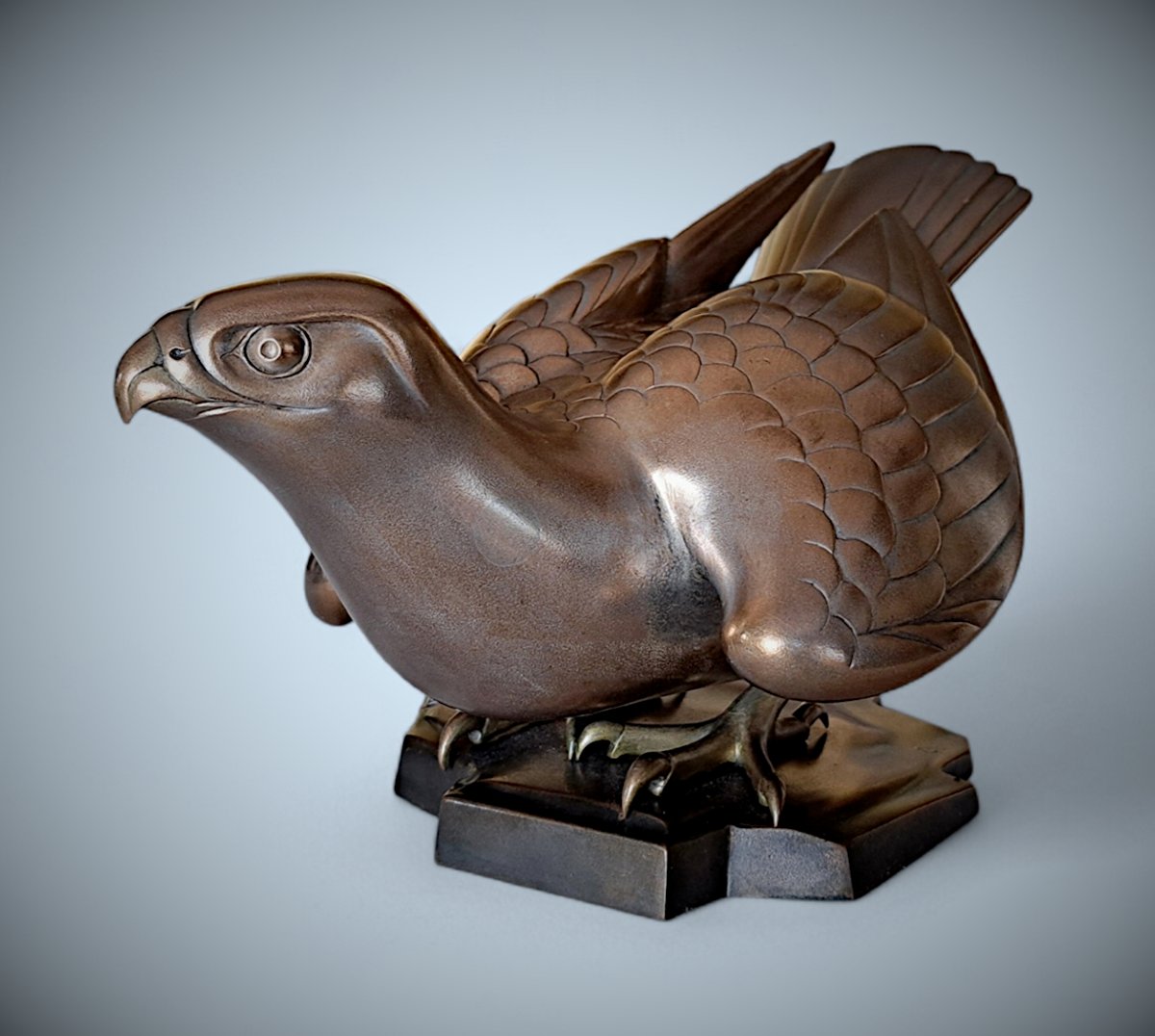
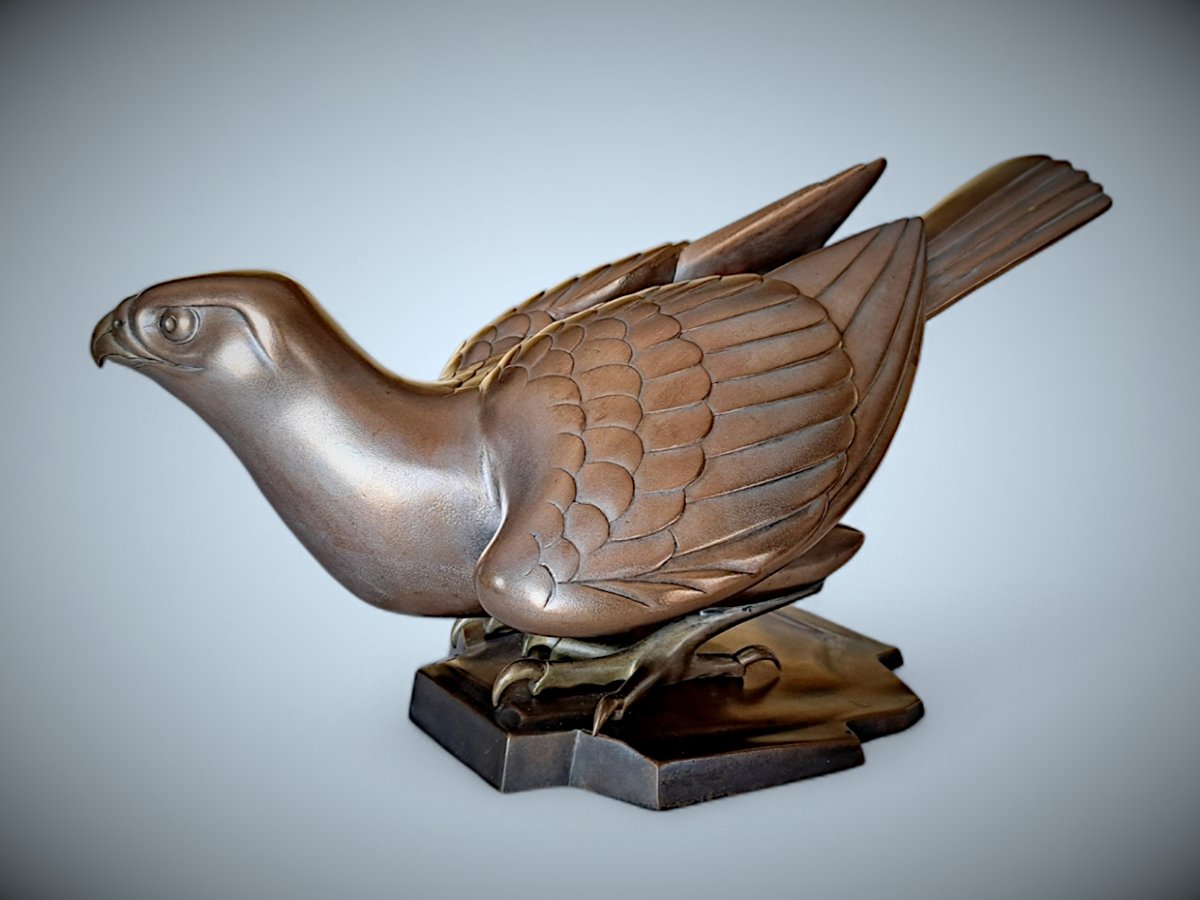
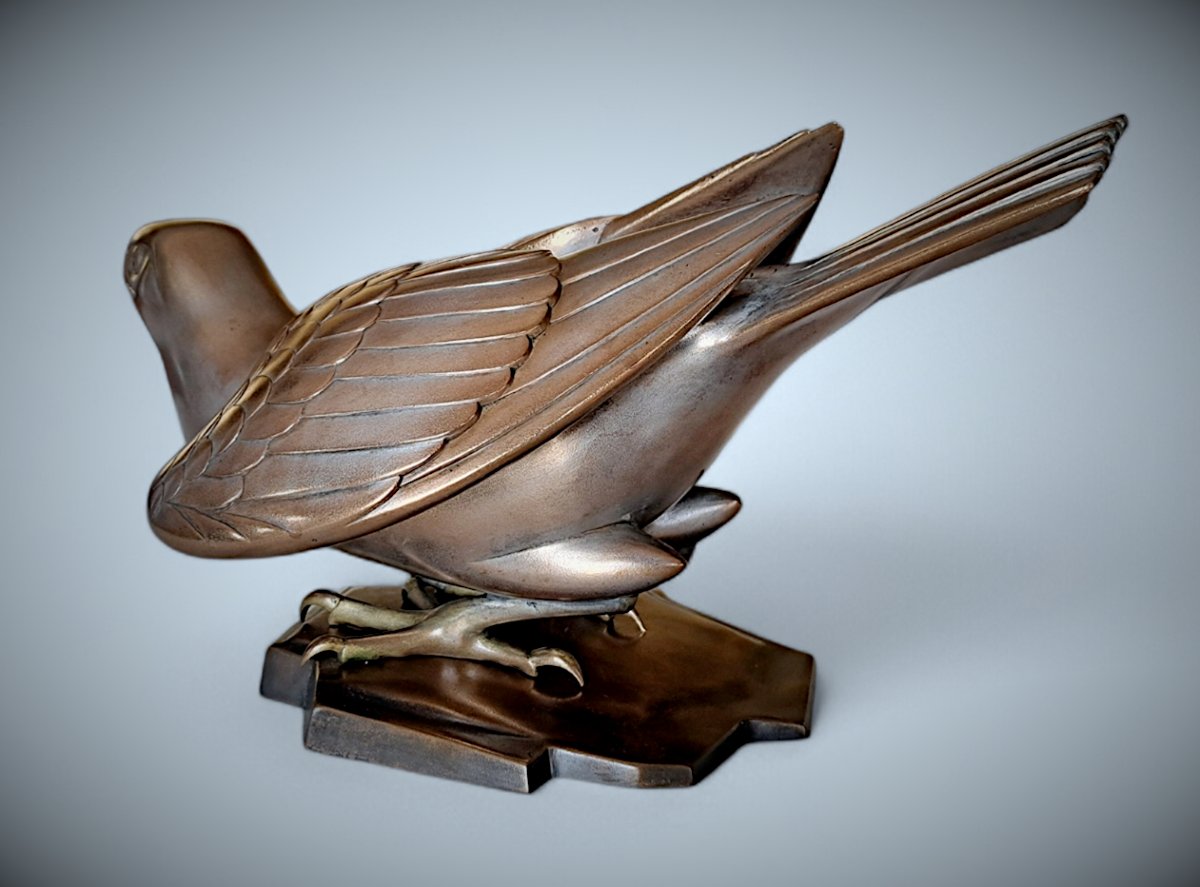
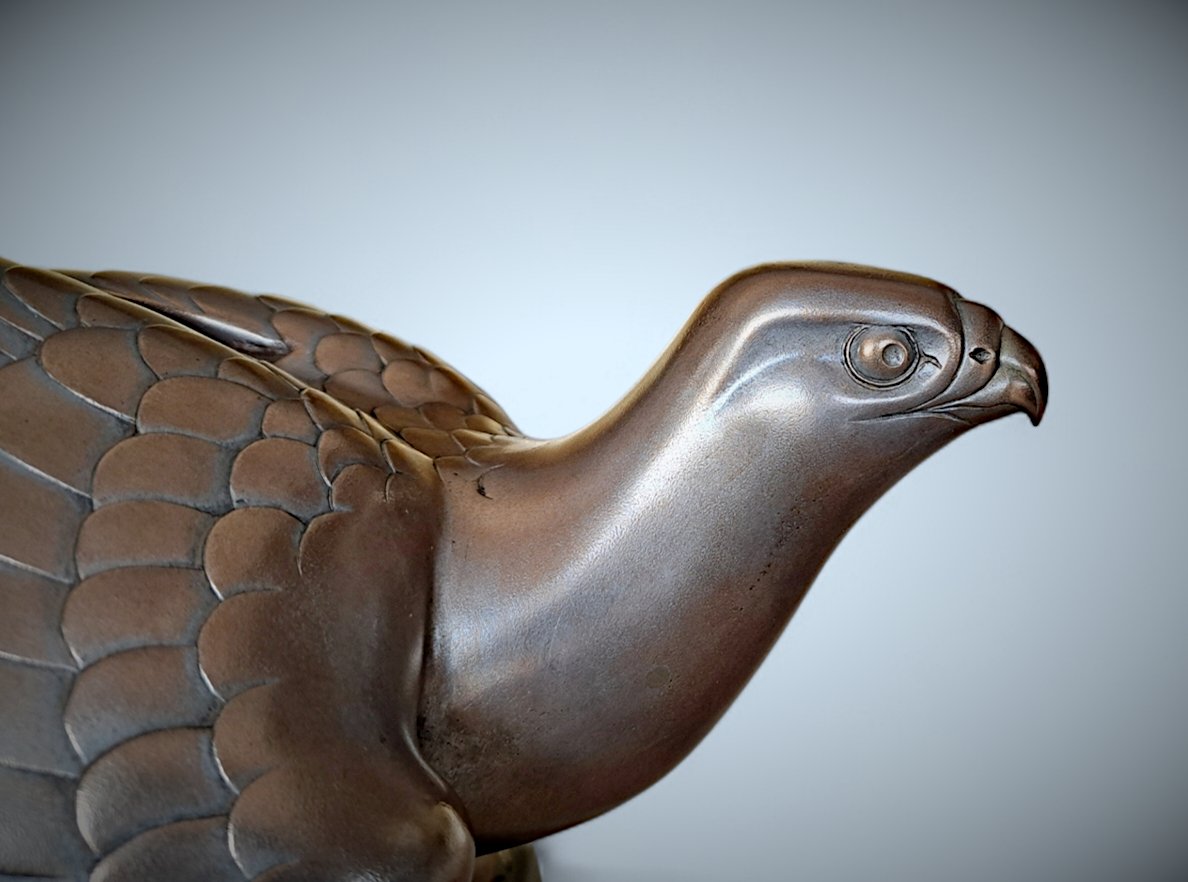
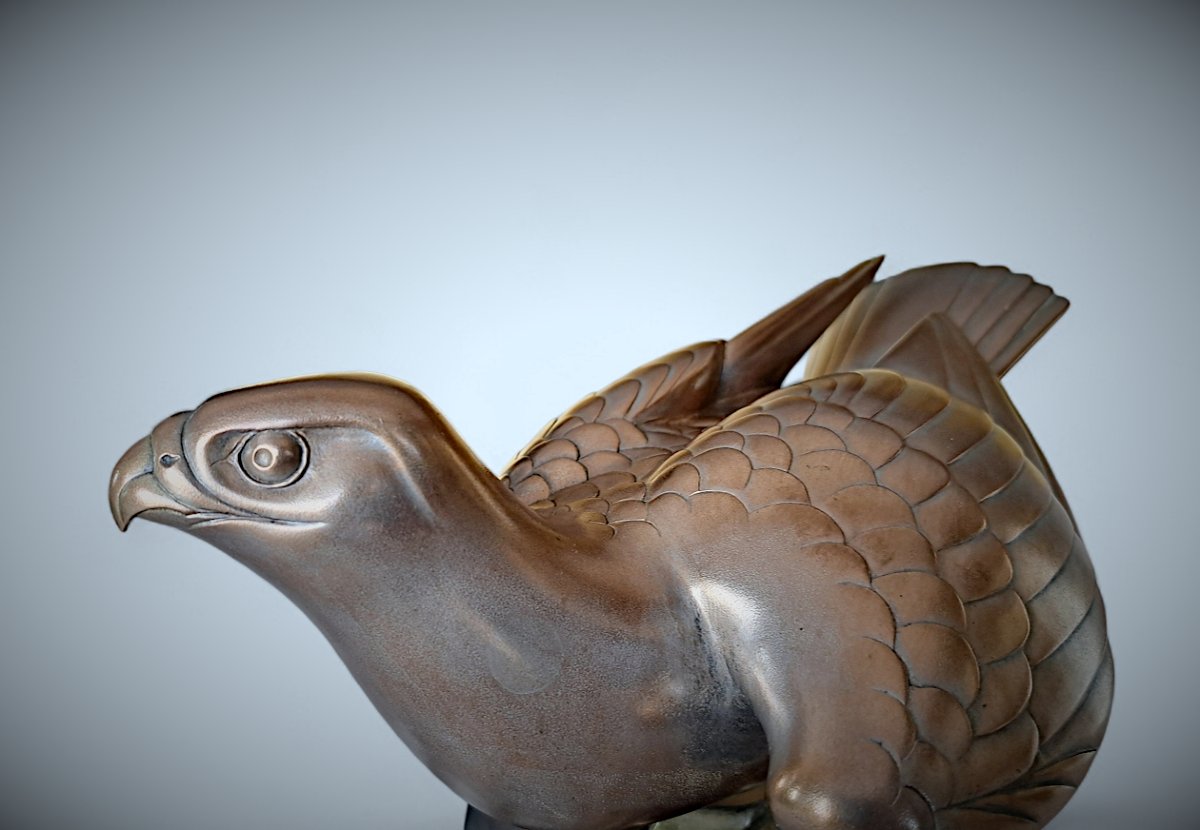
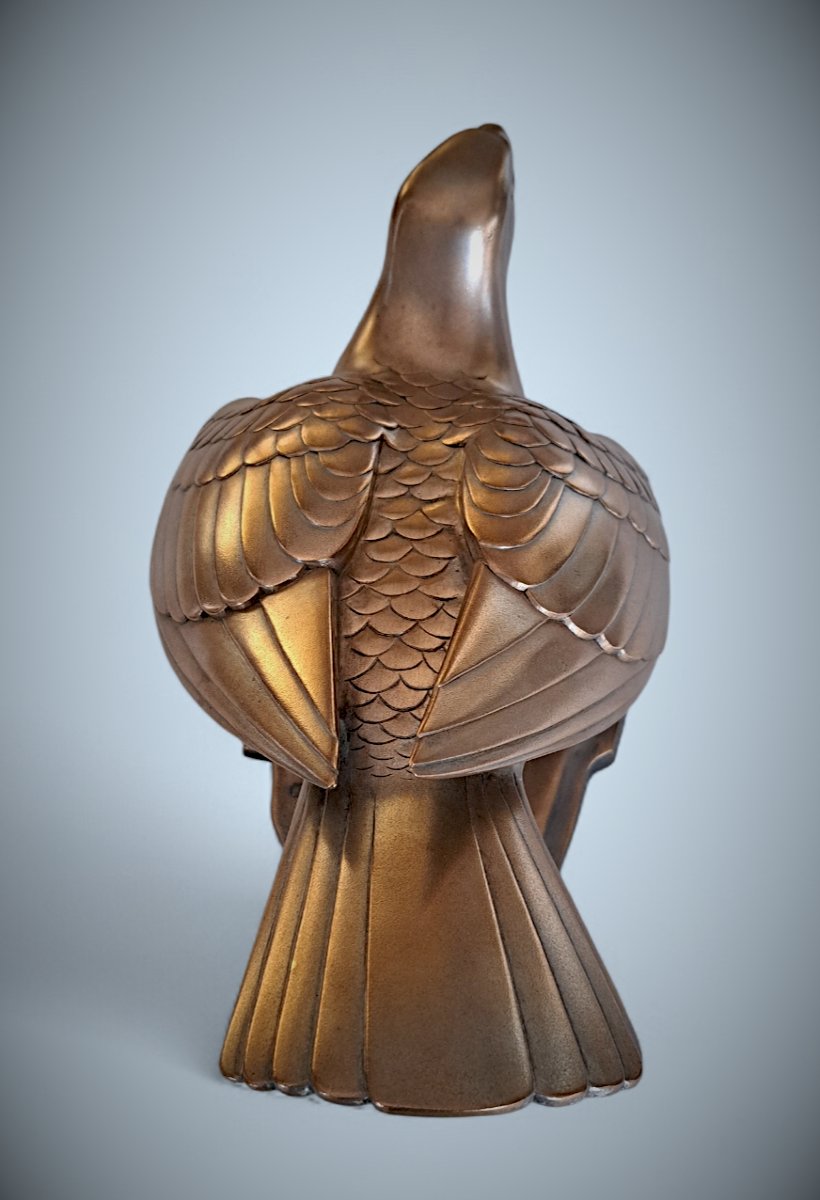
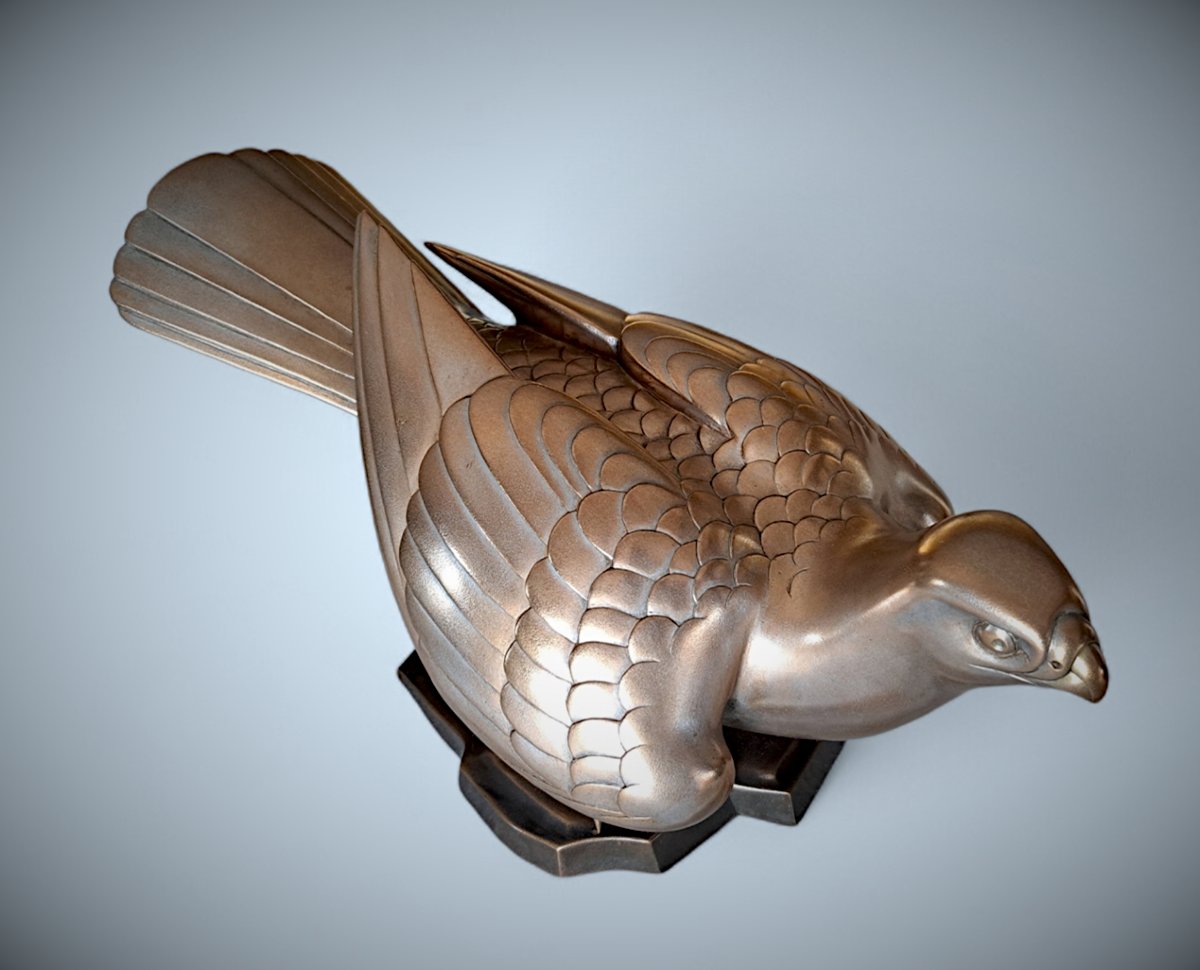
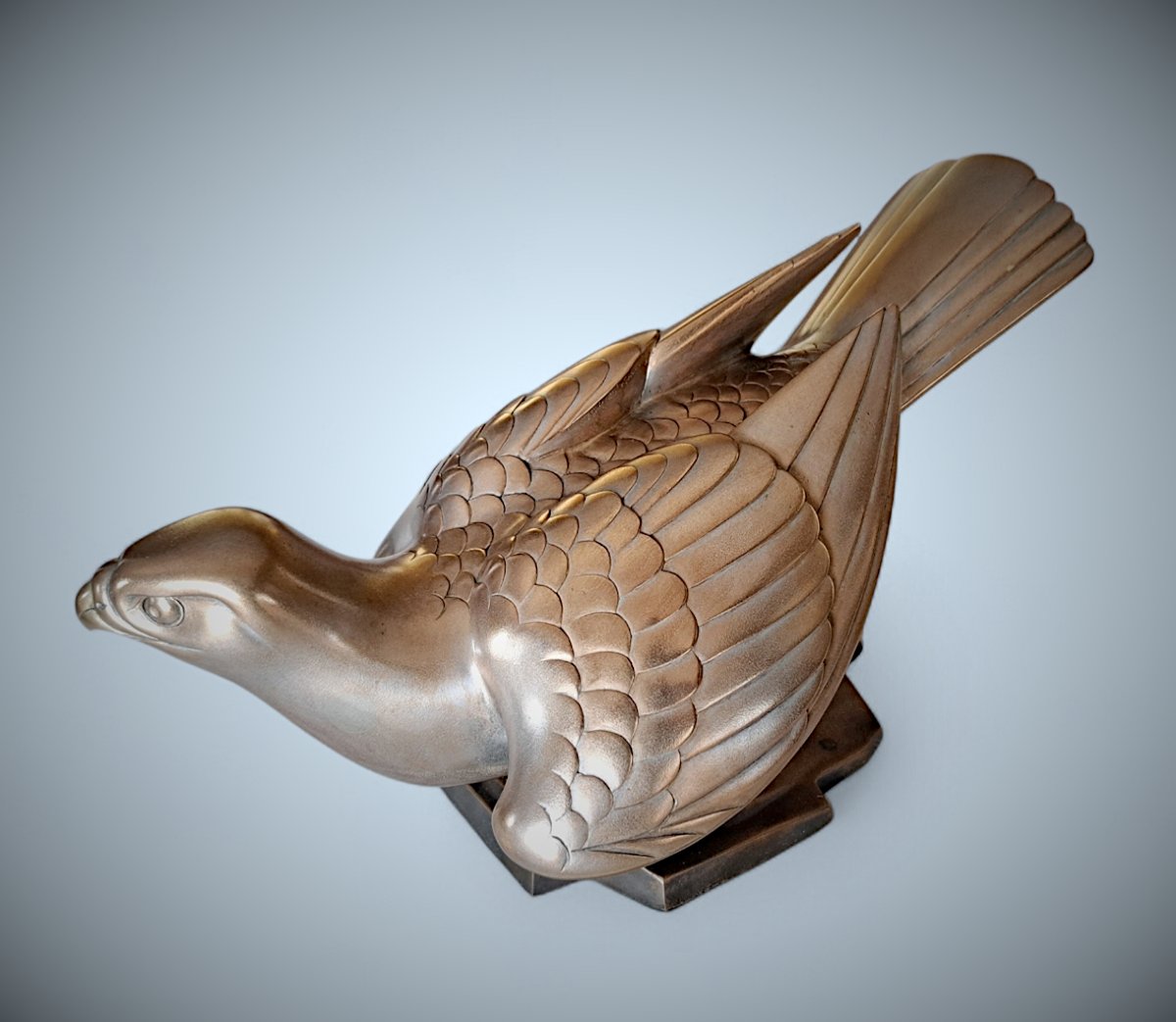
The hawk is shown at rest, yet unmistakably alert. Its body is compact and self-contained, the wings folded in a beautifully ordered rhythm ofoverlapping feathers, while the slightly extended neck and sharply observed eye convey vigilance, intelligence, and latent power. The long, tapering tail reinforces the elegant horizontality of the composition, giving the work a poised linear movement even in stillness. The talons, more delicately articulated in contrast to the smooth and controlled modelling of the body, anchor the sculpture with quiet realism. The result is a work of remarkable poise: not merely an image of a bird, but a distilled evocation of its character and presence.
What makes this sculpture especially compelling is the way Ogawa Eihō unites the poetic language of Japanese art metalwork with the formal elegance of Art Deco design. The treatment of the plumage is highly telling in this regard. Rather than pursuing soft naturalistic detail, Eihō organizes the feathers into repeated, almost architectural segments, creating a disciplined decorative rhythm across the surface. The contour of the body is simplified and aerodynamic, the profile crisp and controlled, and the composition possesses the kind of stylized balance and sculptural economy so admired in the finest Deco bronzes of the 1920s and 1930s. Yet unlike many Western Deco animal bronzes, which often seek theatrical speed or overt glamour, Eihō’s interpretation remains quieter, more meditative, and more refined — adistinctly Japanese response to modern design.
This fusion is entirely in keeping with the artist’s background. Ogawa Eihō was not simply a craftsman, but a highly accomplished and institutionally recognized metal artist, working within the prestigious exhibition culture of modern Japan. Born in Niigata Prefecture in 1896, he studied under Itō Katsuhide, and from an early stage established himself within the country’s leading official salons. He first exhibited at the 9th Teiten in 1928, and would go on to show at the Teiten, Shin Bunten, and later Nitten, the principal forums through which modern Japanese fine and decorative arts were judged and canonized. His standing was firmly confirmed in 1942, when he was awarded a Tokusen (Special Selection Prize) at the 5th Shin Bunten, one of the highest distinctions available within the official exhibition system. He later became an invited exhibitor at Nitten, then a full Nitten member, and eventually served as President of the Japan Chōkin Association. These are not incidental honors: they place Eihō among the serious artistic figures of twentieth-centuryJapanese metalwork, practitioners who moved beyond craftsmanship into the realm of sculptural and artistic authorship.
Seen in that context, this bronze hawk can be appreciated not merely as an attractive decorative object, but as a work that sits at the intersection of sculpture, design, and art metal. Eihō was particularly admired for his refined handling of surface and his ability to transform metal into a poetic visual field. Best known for elegant vases, boxes, trays, and ornamental objects decorated with birds, flowers, seasonal plants, and lyrical motifs from nature, he belonged to a tradition in which metal was treated not simply as a material, but as a medium for atmosphere, symbolism, and refined composition.
That sensibility is fully present here. The hawk is not rendered with excessive anatomical description, but with a selective clarity that heightens its expressive force. The smooth bronze planes are interrupted only where necessary by carefully incised feather divisions, creating a subtle play between polished simplicity and decorative articulation. This interplay between line, volume, and surface is one of the sculpture’s greatest strengths. It reveals the hand of an artist trained not only to model form, but to think interms of ornamental rhythm — a principle shared equally by Japanese decorative arts and by the finest Art Deco sculpture.
The choice of subject is equally significant. In Japanese artistic culture, the hawk has long carried associations of nobility, martial discipline, vigilance, and auspicious strength. It appears across Japanese painting, lacquer, sword fittings, and decorative arts as a symbol of cultivated power and aristocratic taste. In Eihō’s interpretation, these associations are preserved, yet translated into a more modern visual language.This is not the wild drama of a predator in motion, but rather a vision of contained force — disciplined, elegant, and self-possessed. It is precisely this restraint that gives the sculpture its authority.
The work also reflects a broader and highly desirable moment in Japanese art history: the period in which traditional craftsmanship began to engage with international modernism without losing its cultural identity. During the early Shōwa era, many of Japan’s most sophisticated metal artists, lacquerers, ceramicists, and designers absorbed aspects of modern European taste —including the clean lines and stylized refinement associated with Art Deco —while filtering them through Japanese aesthetics of asymmetry, stillness, and surface subtlety. This hawk is an eloquent example of that meeting point. It possesses the streamlined grace and decorative order of Deco, yet remains deeply rooted in Japanese sensibility.
Its warm bronze patina further enhances that impression. The surface has a soft richness that allows the sculpture to shift gently between object and silhouette depending on the light, emphasizing its beautifully resolve doutline. This sensitivity to profile is especially important in a work such as this: the sculpture is as much about the purity of its silhouette as about its modelling, another quality that aligns it with the best animal bronzes of the Deco period.
In this respect, the present work occupies a particularly attractive place for collectors. It belongs not only to the world of Japanese metalwork, but also speaks directly to collectors of Art Deco sculpture, animalier bronzes, and refined twentieth-century decorative arts. That crossover appeal is increasingly appreciated today. Eihō’s work offers something unusually compelling: the technical pedigree and poetic depth of Japanese exhibition metalwork, combined with a form language that resonates internationally.
In this bronze hawk, one finds all the qualities for which Ogawa Eihō is admired: clarity of form, disciplined composition, masterful metal craftsmanship, decorative intelligence, and a deeply poetic understanding of nature. At the same time, the sculpture possesses an unmistakable Art Deco elegance — one expressed not through extravagance, but through line, rhythm, stylization, and restraint. It is a work of unusual serenity and quiet authority: a bronze that speaks not through excess, but through refinement, balance, and timeless design.
This bronze comes with his original box (Tomobako).
The hawk is shown at rest, yet unmistakably alert. Its body is compact and self-contained, the wings folded in a beautifully ordered rhythm ofoverlapping feathers, while the slightly extended neck and sharply observed eye convey vigilance, intelligence, and latent power. The long, tapering tail reinforces the elegant horizontality of the composition, giving the work a poised linear movement even in stillness. The talons, more delicately articulated in contrast to the smooth and controlled modelling of the body, anchor the sculpture with quiet realism. The result is a work of remarkable poise: not merely an image of a bird, but a distilled evocation of its character and presence.
What makes this sculpture especially compelling is the way Ogawa Eihō unites the poetic language of Japanese art metalwork with the formal elegance of Art Deco design. The treatment of the plumage is highly telling in this regard. Rather than pursuing soft naturalistic detail, Eihō organizes the feathers into repeated, almost architectural segments, creating a disciplined decorative rhythm across the surface. The contour of the body is simplified and aerodynamic, the profile crisp and controlled, and the composition possesses the kind of stylized balance and sculptural economy so admired in the finest Deco bronzes of the 1920s and 1930s. Yet unlike many Western Deco animal bronzes, which often seek theatrical speed or overt glamour, Eihō’s interpretation remains quieter, more meditative, and more refined — adistinctly Japanese response to modern design.
This fusion is entirely in keeping with the artist’s background. Ogawa Eihō was not simply a craftsman, but a highly accomplished and institutionally recognized metal artist, working within the prestigious exhibition culture of modern Japan. Born in Niigata Prefecture in 1896, he studied under Itō Katsuhide, and from an early stage established himself within the country’s leading official salons. He first exhibited at the 9th Teiten in 1928, and would go on to show at the Teiten, Shin Bunten, and later Nitten, the principal forums through which modern Japanese fine and decorative arts were judged and canonized. His standing was firmly confirmed in 1942, when he was awarded a Tokusen (Special Selection Prize) at the 5th Shin Bunten, one of the highest distinctions available within the official exhibition system. He later became an invited exhibitor at Nitten, then a full Nitten member, and eventually served as President of the Japan Chōkin Association. These are not incidental honors: they place Eihō among the serious artistic figures of twentieth-centuryJapanese metalwork, practitioners who moved beyond craftsmanship into the realm of sculptural and artistic authorship.
Seen in that context, this bronze hawk can be appreciated not merely as an attractive decorative object, but as a work that sits at the intersection of sculpture, design, and art metal. Eihō was particularly admired for his refined handling of surface and his ability to transform metal into a poetic visual field. Best known for elegant vases, boxes, trays, and ornamental objects decorated with birds, flowers, seasonal plants, and lyrical motifs from nature, he belonged to a tradition in which metal was treated not simply as a material, but as a medium for atmosphere, symbolism, and refined composition.
That sensibility is fully present here. The hawk is not rendered with excessive anatomical description, but with a selective clarity that heightens its expressive force. The smooth bronze planes are interrupted only where necessary by carefully incised feather divisions, creating a subtle play between polished simplicity and decorative articulation. This interplay between line, volume, and surface is one of the sculpture’s greatest strengths. It reveals the hand of an artist trained not only to model form, but to think interms of ornamental rhythm — a principle shared equally by Japanese decorative arts and by the finest Art Deco sculpture.
The choice of subject is equally significant. In Japanese artistic culture, the hawk has long carried associations of nobility, martial discipline, vigilance, and auspicious strength. It appears across Japanese painting, lacquer, sword fittings, and decorative arts as a symbol of cultivated power and aristocratic taste. In Eihō’s interpretation, these associations are preserved, yet translated into a more modern visual language.This is not the wild drama of a predator in motion, but rather a vision of contained force — disciplined, elegant, and self-possessed. It is precisely this restraint that gives the sculpture its authority.
The work also reflects a broader and highly desirable moment in Japanese art history: the period in which traditional craftsmanship began to engage with international modernism without losing its cultural identity. During the early Shōwa era, many of Japan’s most sophisticated metal artists, lacquerers, ceramicists, and designers absorbed aspects of modern European taste —including the clean lines and stylized refinement associated with Art Deco —while filtering them through Japanese aesthetics of asymmetry, stillness, and surface subtlety. This hawk is an eloquent example of that meeting point. It possesses the streamlined grace and decorative order of Deco, yet remains deeply rooted in Japanese sensibility.
Its warm bronze patina further enhances that impression. The surface has a soft richness that allows the sculpture to shift gently between object and silhouette depending on the light, emphasizing its beautifully resolve doutline. This sensitivity to profile is especially important in a work such as this: the sculpture is as much about the purity of its silhouette as about its modelling, another quality that aligns it with the best animal bronzes of the Deco period.
In this respect, the present work occupies a particularly attractive place for collectors. It belongs not only to the world of Japanese metalwork, but also speaks directly to collectors of Art Deco sculpture, animalier bronzes, and refined twentieth-century decorative arts. That crossover appeal is increasingly appreciated today. Eihō’s work offers something unusually compelling: the technical pedigree and poetic depth of Japanese exhibition metalwork, combined with a form language that resonates internationally.
In this bronze hawk, one finds all the qualities for which Ogawa Eihō is admired: clarity of form, disciplined composition, masterful metal craftsmanship, decorative intelligence, and a deeply poetic understanding of nature. At the same time, the sculpture possesses an unmistakable Art Deco elegance — one expressed not through extravagance, but through line, rhythm, stylization, and restraint. It is a work of unusual serenity and quiet authority: a bronze that speaks not through excess, but through refinement, balance, and timeless design.
This bronze comes with his original box (Tomobako).
2 300 €
Period: 20th century
Style: Art Deco
Condition: Excellent condition
Material: Bronze
Length: 33 cm
Height: 19 cm
Reference (ID): 1738571
Availability: In stock
Print