


Japanese Bronze Vase By Murata Hiroshi: Flying Cranes
Artist: Murata Hiroshi 村田宏, (°1936)
This elegant bronze vase is a refined work by Murata Hiroshi (村田宏, born 1936), a distinguished artist from
Takaoka, the great historic center of Japanese bronze casting in Toyama
Prefecture. Combining sculptural restraint with decorative precision, the piece
exemplifies the postwar continuation of the Takaoka dōki tradition, in which
technical mastery and refined design are brought into perfect equilibrium.
Murata Hiroshi was born in 1936 in Takaoka City, a place whose identity has for centuries been inseparable from the art of metal. He studied under Murata Yoshio, a senior figure associated with the Nitten (Japan Fine Arts Exhibition), and developed an early specialization in the highly demanding fields of prototype and mold-making — disciplines that lie at the heart of sophisticated bronze production. He was active at the Takaoka City Metal Technical Guidance Center, where he contributed not only to his own artistic practice but also to the broader transmission of casting knowledge and design culture within the city’s renowned bronze industry. His talent was recognized at an early stage, receiving the Takaoka Mayor’s Prize in 1958, and he later exhibited repeatedly at the Nitten, as well as at the Japan Contemporary Arts and Crafts Exhibition, confirming his place within the most respected circles of postwar Japanese metal art. Japanese dealer material also records him as a Nitten artist particularly admired for his exceptional finesse in detailed prototype creation.
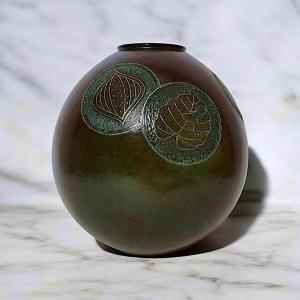
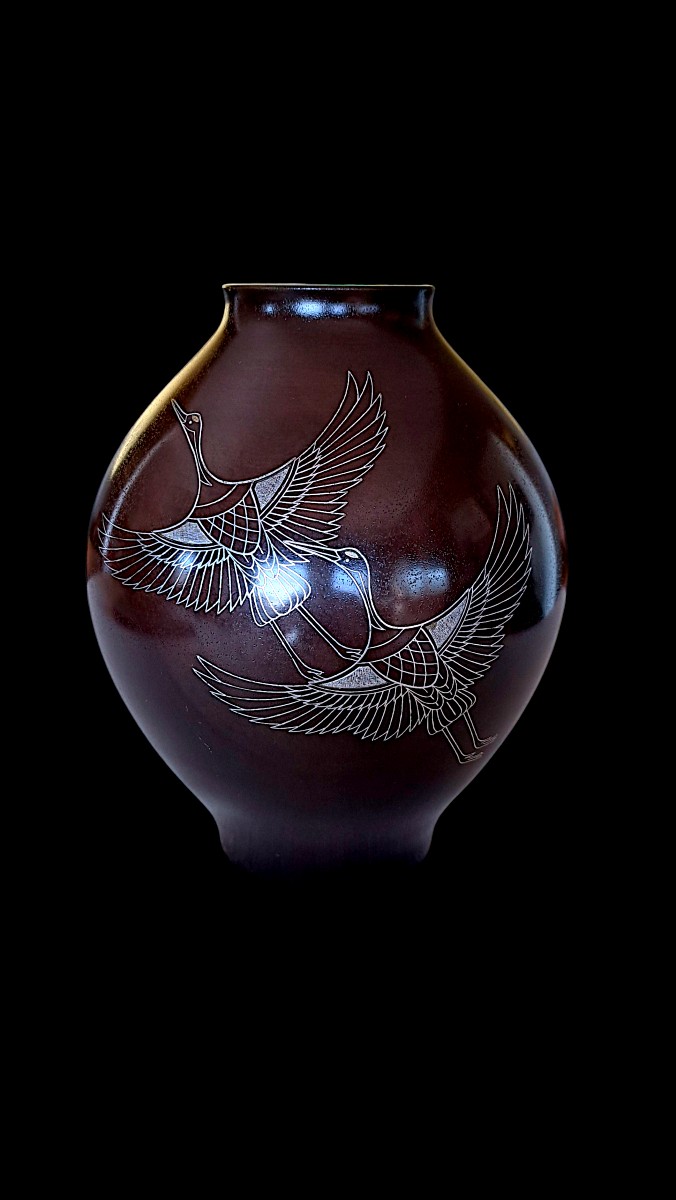
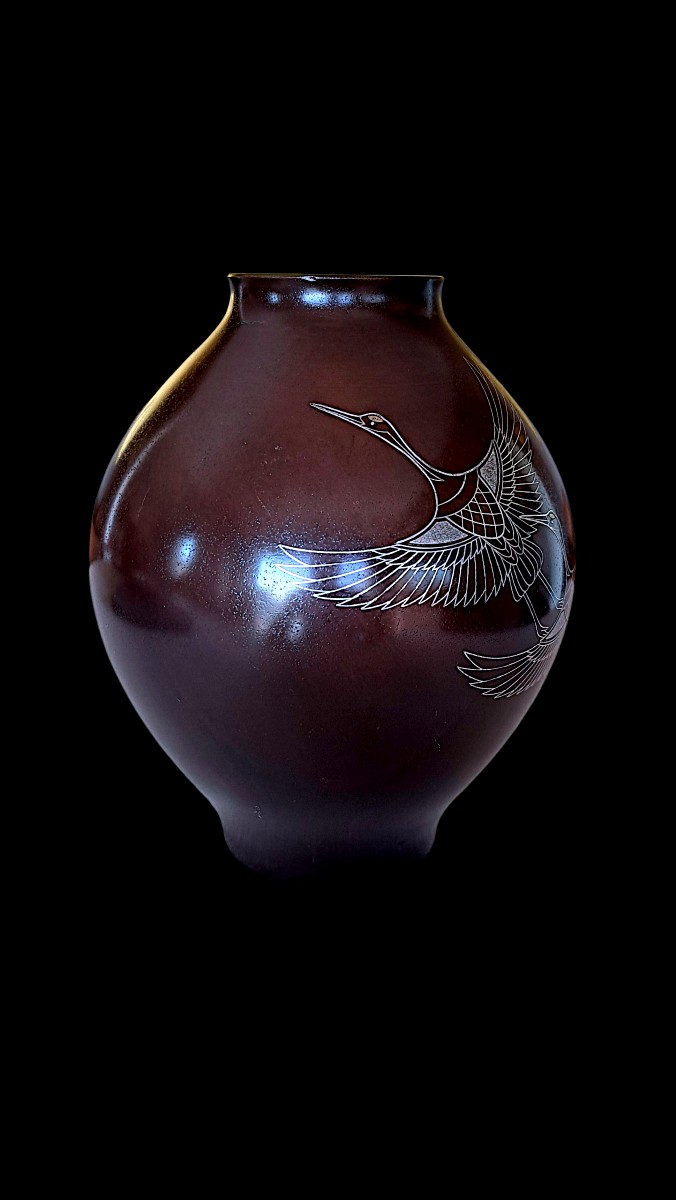
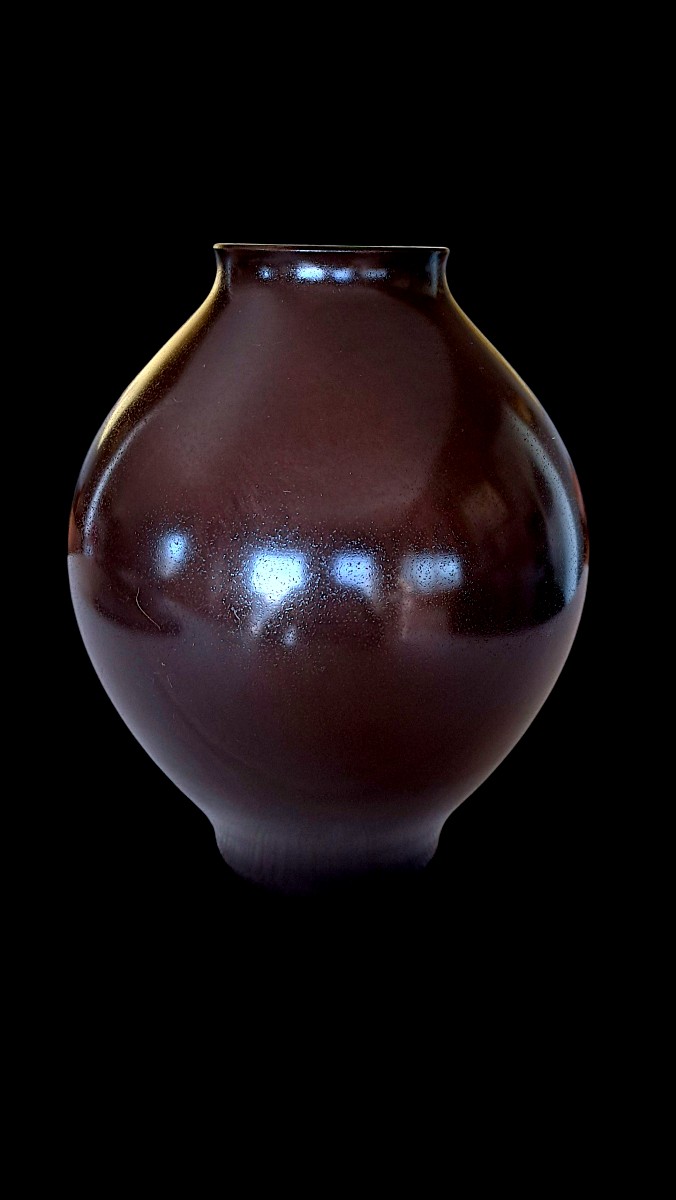
The present vase is especially successful in its union of volume, surface, and line. Of generous rounded form, the body rises with quiet assurance from a subtly tapered foot to broad shoulders and a short, slightly everted neck, creating a silhouette of exceptional balance and calm. The shape is at once substantial and weightless: full in mass, yet softened by an almost architectural clarity. Such formal restraint is characteristic of the finest modern Japanese decorative bronzes, where the vessel is conceived not merely as a utilitarian container but as a self-sufficient sculptural presence.
Set against a rich, dark brown patina of deep and velvety warmth, the decoration consists of two cranes in flight, rendered in delicate silver-toned linework of remarkable precision. Their wings are fully extended, their long necks elegantly curved, and their bodies articulated through a finely controlled interplay of incised contour and patterned infill. The composition is beautifully judged: the birds do not sit upon the vase as applied ornament, but seem instead to move with the form, their outstretched wings following the natural breadth of the body and activating its surface with a quiet, rhythmic energy.
The treatment of the cranes is particularly characteristic of Murata’s decorative intelligence. Rather than pursuing overt naturalism, he distills the birds into a language of clarified line, stylized structure, and measured ornament, allowing the motif to remain poised between representation and design. This approach gives the vase a distinctly modern Shōwa sensibility: elegant, controlled, and free of excess, yet deeply rooted in Japanese visual tradition.
In Japanese art, the crane (tsuru) is among the most enduring and auspicious of motifs, associated with longevity, fidelity, prosperity, and elevated grace. Here, that symbolism is handled with notable refinement. The birds are not simply decorative emblems; they animate the vessel with a sense of uplift and spaciousness, lending the bronze an atmosphere of quiet nobility. The contrast between the dark patinated ground and the luminous silvery decoration enhances this effect beautifully, allowing the motif to emerge with both clarity and softness.
Murata Hiroshi is especially admired for works in which craftsmanship is never allowed to become ostentatious. The present vase demonstrates precisely that quality. Its success lies not in theatricality, but in the discipline of its proportions, the subtlety of its patina, and the precision of its decorative drawing. It is a work of measured elegance — one that reveals its sophistication gradually, through balance, surface, and the harmony of its design.
As such, this vase stands as an excellent example of postwar Japanese bronze art, uniting the long technical heritage of Takaoka with a distinctly modern decorative sensibility. At once sculptural and poetic, it is a highly attractive work for collectors of Japanese bronzes, modern decorative arts, and objects in which symbolism, material, and form are brought together with uncommon restraint and refinement.
Murata Hiroshi was born in 1936 in Takaoka City, a place whose identity has for centuries been inseparable from the art of metal. He studied under Murata Yoshio, a senior figure associated with the Nitten (Japan Fine Arts Exhibition), and developed an early specialization in the highly demanding fields of prototype and mold-making — disciplines that lie at the heart of sophisticated bronze production. He was active at the Takaoka City Metal Technical Guidance Center, where he contributed not only to his own artistic practice but also to the broader transmission of casting knowledge and design culture within the city’s renowned bronze industry. His talent was recognized at an early stage, receiving the Takaoka Mayor’s Prize in 1958, and he later exhibited repeatedly at the Nitten, as well as at the Japan Contemporary Arts and Crafts Exhibition, confirming his place within the most respected circles of postwar Japanese metal art. Japanese dealer material also records him as a Nitten artist particularly admired for his exceptional finesse in detailed prototype creation.
The present vase is especially successful in its union of volume, surface, and line. Of generous rounded form, the body rises with quiet assurance from a subtly tapered foot to broad shoulders and a short, slightly everted neck, creating a silhouette of exceptional balance and calm. The shape is at once substantial and weightless: full in mass, yet softened by an almost architectural clarity. Such formal restraint is characteristic of the finest modern Japanese decorative bronzes, where the vessel is conceived not merely as a utilitarian container but as a self-sufficient sculptural presence.
Set against a rich, dark brown patina of deep and velvety warmth, the decoration consists of two cranes in flight, rendered in delicate silver-toned linework of remarkable precision. Their wings are fully extended, their long necks elegantly curved, and their bodies articulated through a finely controlled interplay of incised contour and patterned infill. The composition is beautifully judged: the birds do not sit upon the vase as applied ornament, but seem instead to move with the form, their outstretched wings following the natural breadth of the body and activating its surface with a quiet, rhythmic energy.
The treatment of the cranes is particularly characteristic of Murata’s decorative intelligence. Rather than pursuing overt naturalism, he distills the birds into a language of clarified line, stylized structure, and measured ornament, allowing the motif to remain poised between representation and design. This approach gives the vase a distinctly modern Shōwa sensibility: elegant, controlled, and free of excess, yet deeply rooted in Japanese visual tradition.
In Japanese art, the crane (tsuru) is among the most enduring and auspicious of motifs, associated with longevity, fidelity, prosperity, and elevated grace. Here, that symbolism is handled with notable refinement. The birds are not simply decorative emblems; they animate the vessel with a sense of uplift and spaciousness, lending the bronze an atmosphere of quiet nobility. The contrast between the dark patinated ground and the luminous silvery decoration enhances this effect beautifully, allowing the motif to emerge with both clarity and softness.
Murata Hiroshi is especially admired for works in which craftsmanship is never allowed to become ostentatious. The present vase demonstrates precisely that quality. Its success lies not in theatricality, but in the discipline of its proportions, the subtlety of its patina, and the precision of its decorative drawing. It is a work of measured elegance — one that reveals its sophistication gradually, through balance, surface, and the harmony of its design.
As such, this vase stands as an excellent example of postwar Japanese bronze art, uniting the long technical heritage of Takaoka with a distinctly modern decorative sensibility. At once sculptural and poetic, it is a highly attractive work for collectors of Japanese bronzes, modern decorative arts, and objects in which symbolism, material, and form are brought together with uncommon restraint and refinement.
450 €
Period: 20th century
Style: Design 50's and 60's
Condition: Excellent condition
Material: Bronze
Height: 26 cm
Reference (ID): 1731882
Availability: In stock
Print