THIS OBJECT WAS SOLD
16th Century Short Sword

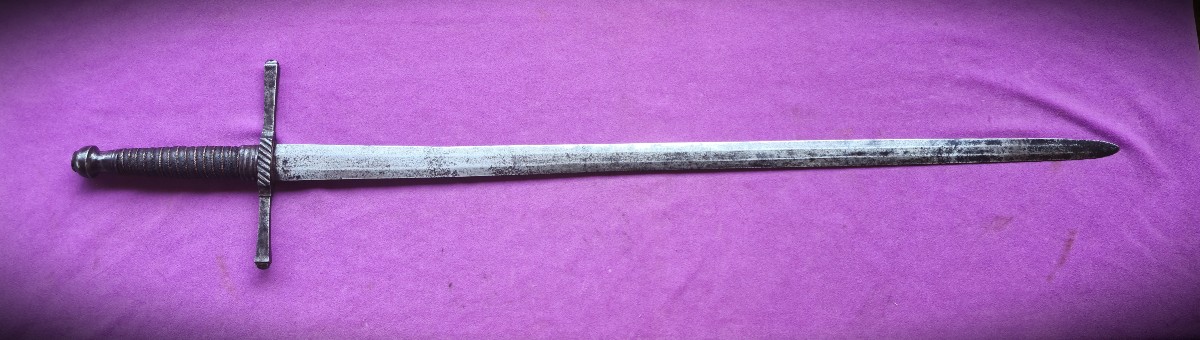
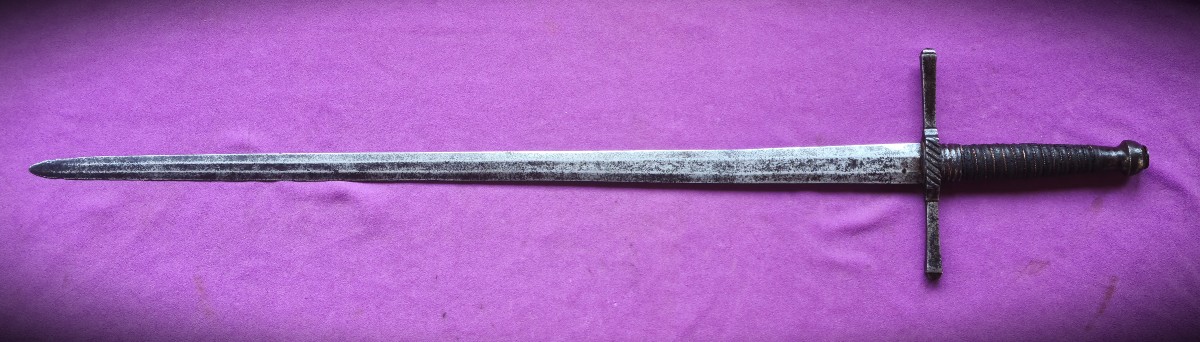


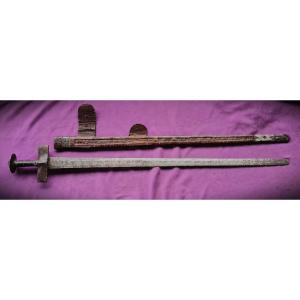
This type of sword is often called a "city sword" in French, and by Anglo-Saxon authors it is a "short sword." It can be dated to the 16th century.
These swords were designed for use inside palaces and castles, where long, hand-and-a-half swords would have been cumbersome. But they were also used in war, and can be compared to the short "katzbalgers" used by the Landsknechts.
The name "town swords" comes from the use of these weapons for protection during nighttime travel in dark alleyways, where, in the event of an attack by brigands, even the fencing masters of the time admitted that the dagger and the short sword were much more effective than long rapiers, thrusting swords, or bastard swords, due to the lack of space and time for the elegant technique that could be practiced on the lawn among gentlemen...
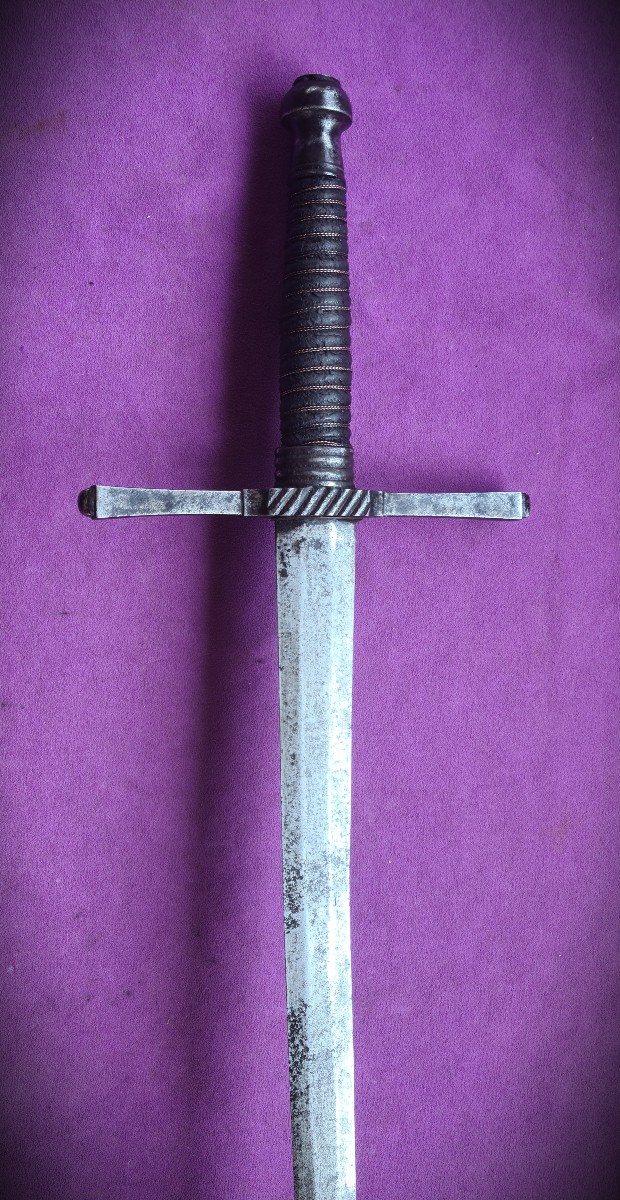
BLADE: It is double-edged, with a flattened hexagonal cross-section. This shape is typical of the first quarter of the 16th century. One of Emperor Charles V's favorite swords has a very similar blade shape. Approximately 15 cm from the guard, there is a lateral indentation (at one of the edges) which is a deformation of the blade due to a violent blow in combat. This is barely noticeable and does not alter the overall shape of the weapon. There are small, discreet chips and battle marks along the edges.
The overall appearance of the blade, with its traces of oxidation, could, if desired, be significantly improved by careful polishing. A small, modern leather tie has been placed at the base of the blade. I have left it in place.
Blade length = 75.3 cm, width near the guard = 3.4 cm, thickness near the guard = 7 mm, balance point = 10 cm from the guard. CROSS GUARD : This is the classic cross-shaped guard, which comes directly from earlier periods and remained in use until the end of the 16th century. The central section is diagonally fluted, and the quillons are straight. They have four faces and widen towards their ends, where they terminate in a pyramid shape with four rounded corners.
POMMEL : This is a strangely shaped pommel, reminiscent of model no. 57 in Norman's classification ("the rapier & small swords"). It is mushroom-shaped. This type of pommel is particularly rare. The pommel ends curiously with what appears to be an enormous, flattened rivet button (perhaps filed down?), the likes of which I have never seen, and which is not a single piece with the pommel.
GRIP : It is old, and the leather shows deep cracks; it is very likely the original leather. It is surrounded by twisted red copper wire. A particularly imposing iron ferrule joins the cross guard to the grip. Here too, it's a rarity, and I know of no other example of this type of construction.
In conclusion, it's a so-called "town" or "indoor" sword. The blade and guard (and probably the grip) date from the first quarter of the 16th century. The pommel, due to its design, may be slightly later, although its patina is consistent with the rest of the sword, but this is very difficult to determine.
The renowned specialist Ewart Oakeshott said that attempting to describe all the varieties of 16th and 17th-century "short swords" would be an undertaking equivalent to describing all the rivets on the Eiffel Tower (and just as tedious), so we shouldn't be surprised to find undescribed models
Ref I2Y-2630
Shipping costs: France €30, Europe €40
These swords were designed for use inside palaces and castles, where long, hand-and-a-half swords would have been cumbersome. But they were also used in war, and can be compared to the short "katzbalgers" used by the Landsknechts.
The name "town swords" comes from the use of these weapons for protection during nighttime travel in dark alleyways, where, in the event of an attack by brigands, even the fencing masters of the time admitted that the dagger and the short sword were much more effective than long rapiers, thrusting swords, or bastard swords, due to the lack of space and time for the elegant technique that could be practiced on the lawn among gentlemen...
BLADE: It is double-edged, with a flattened hexagonal cross-section. This shape is typical of the first quarter of the 16th century. One of Emperor Charles V's favorite swords has a very similar blade shape. Approximately 15 cm from the guard, there is a lateral indentation (at one of the edges) which is a deformation of the blade due to a violent blow in combat. This is barely noticeable and does not alter the overall shape of the weapon. There are small, discreet chips and battle marks along the edges.
The overall appearance of the blade, with its traces of oxidation, could, if desired, be significantly improved by careful polishing. A small, modern leather tie has been placed at the base of the blade. I have left it in place.
Blade length = 75.3 cm, width near the guard = 3.4 cm, thickness near the guard = 7 mm, balance point = 10 cm from the guard. CROSS GUARD : This is the classic cross-shaped guard, which comes directly from earlier periods and remained in use until the end of the 16th century. The central section is diagonally fluted, and the quillons are straight. They have four faces and widen towards their ends, where they terminate in a pyramid shape with four rounded corners.
POMMEL : This is a strangely shaped pommel, reminiscent of model no. 57 in Norman's classification ("the rapier & small swords"). It is mushroom-shaped. This type of pommel is particularly rare. The pommel ends curiously with what appears to be an enormous, flattened rivet button (perhaps filed down?), the likes of which I have never seen, and which is not a single piece with the pommel.
GRIP : It is old, and the leather shows deep cracks; it is very likely the original leather. It is surrounded by twisted red copper wire. A particularly imposing iron ferrule joins the cross guard to the grip. Here too, it's a rarity, and I know of no other example of this type of construction.
In conclusion, it's a so-called "town" or "indoor" sword. The blade and guard (and probably the grip) date from the first quarter of the 16th century. The pommel, due to its design, may be slightly later, although its patina is consistent with the rest of the sword, but this is very difficult to determine.
The renowned specialist Ewart Oakeshott said that attempting to describe all the varieties of 16th and 17th-century "short swords" would be an undertaking equivalent to describing all the rivets on the Eiffel Tower (and just as tedious), so we shouldn't be surprised to find undescribed models
Ref I2Y-2630
Shipping costs: France €30, Europe €40
Explore similar pieces and discover your ideal find:
Edged Weapons