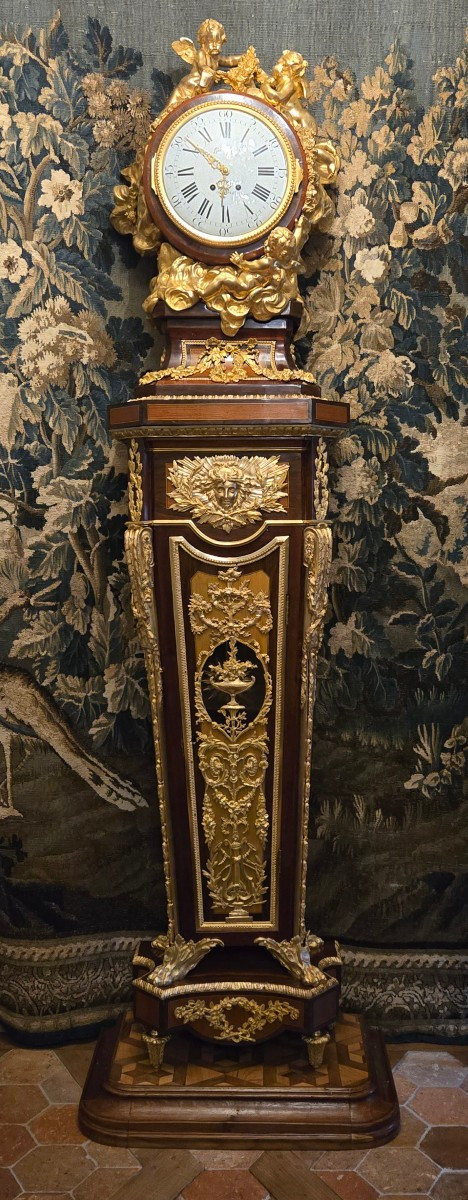
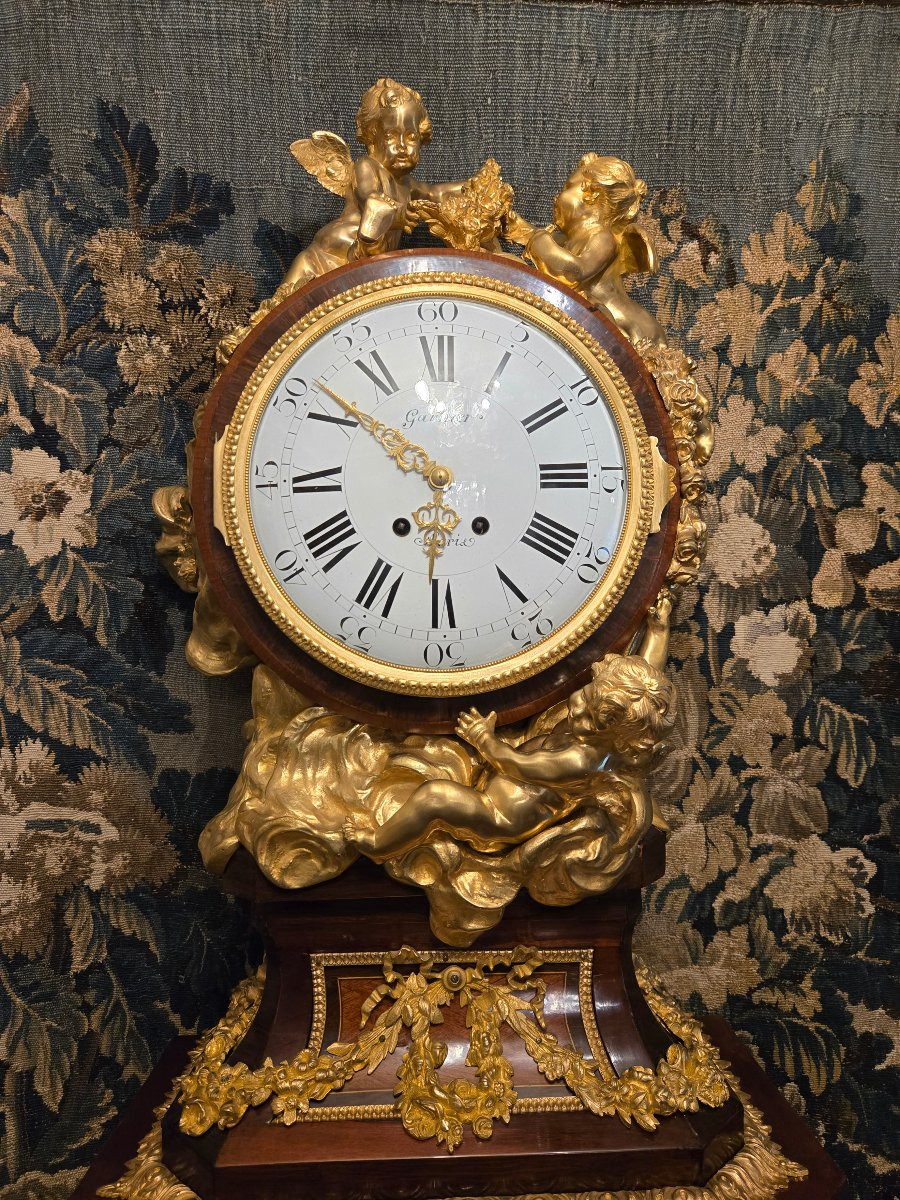
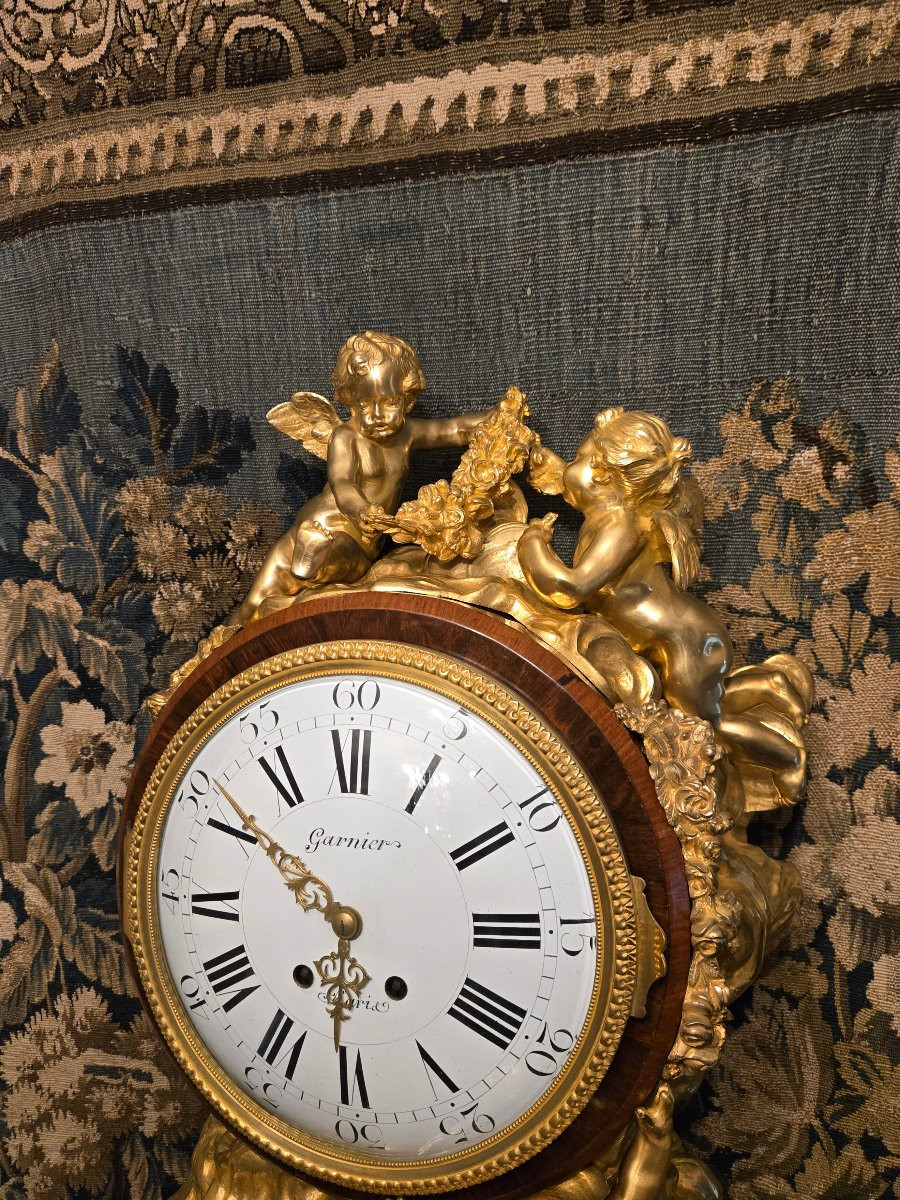
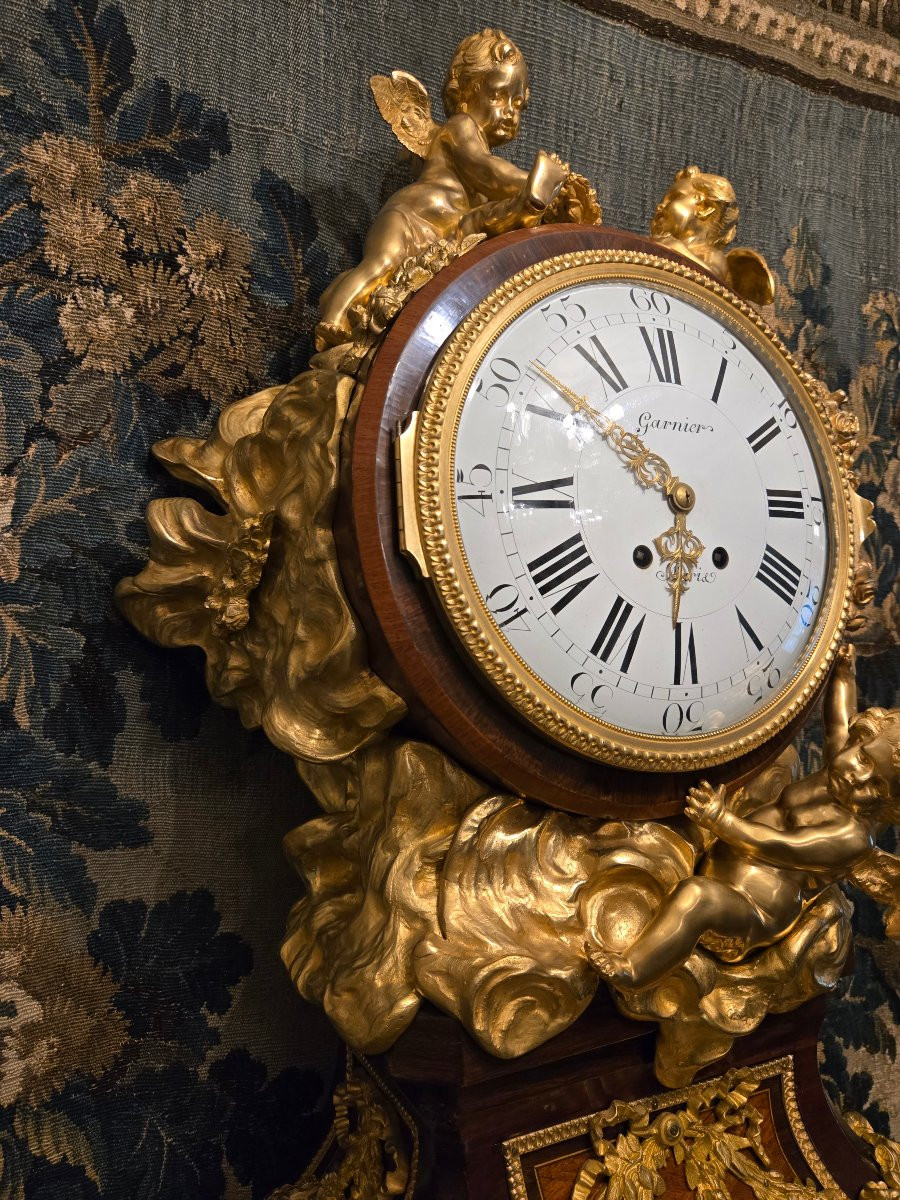
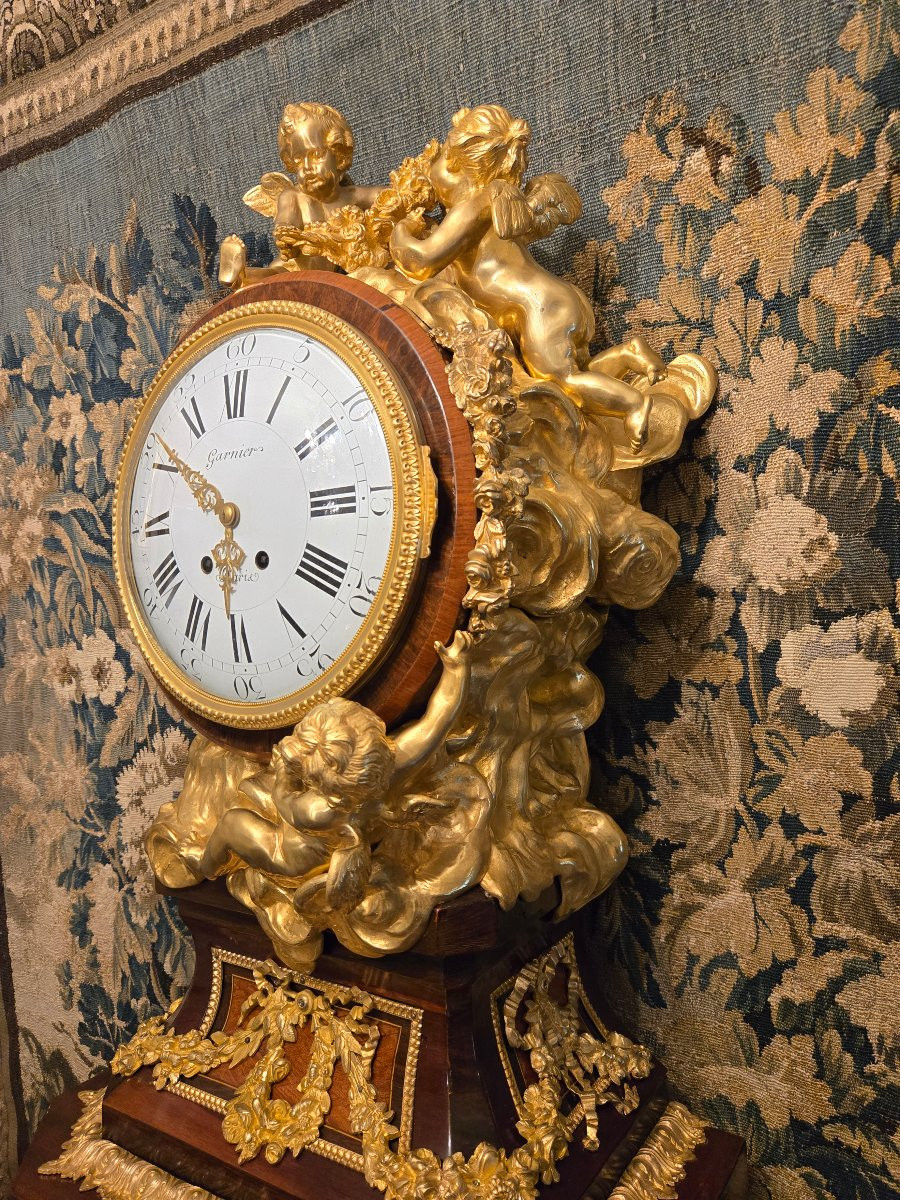
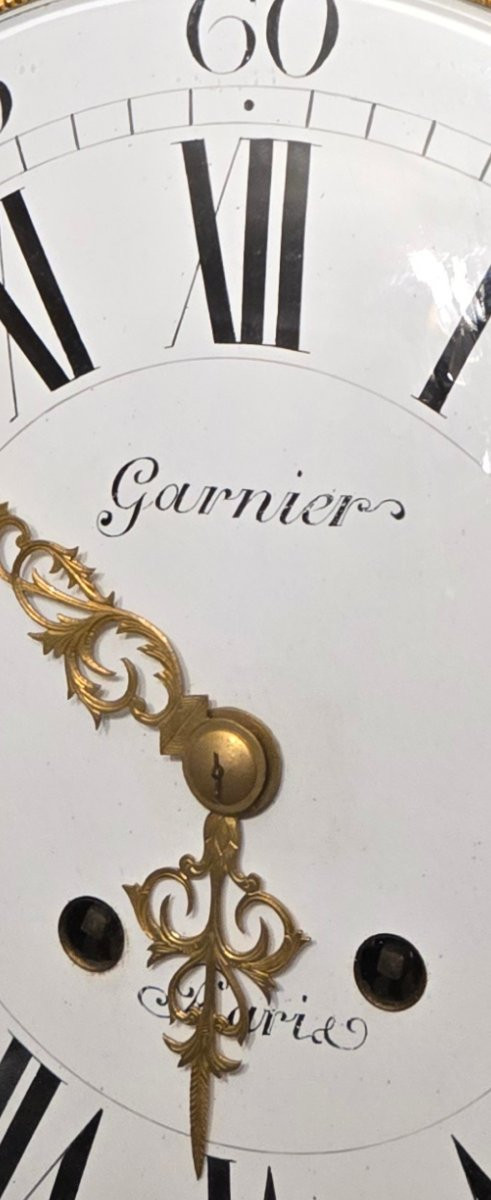
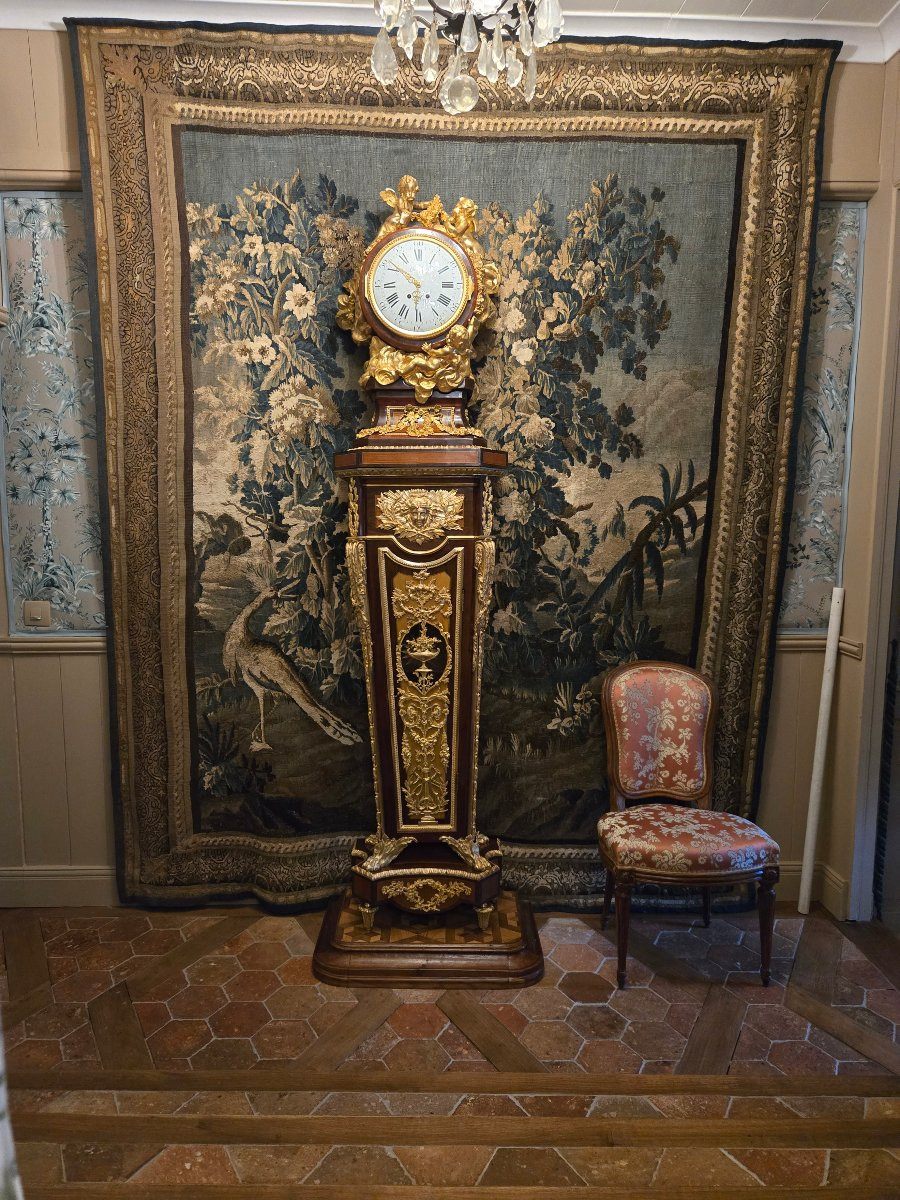
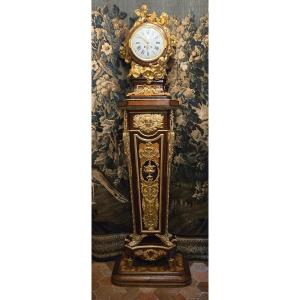


"Floor Regulator, After Jh Riesener, Movement By P. Garnier, Second Empire Period."
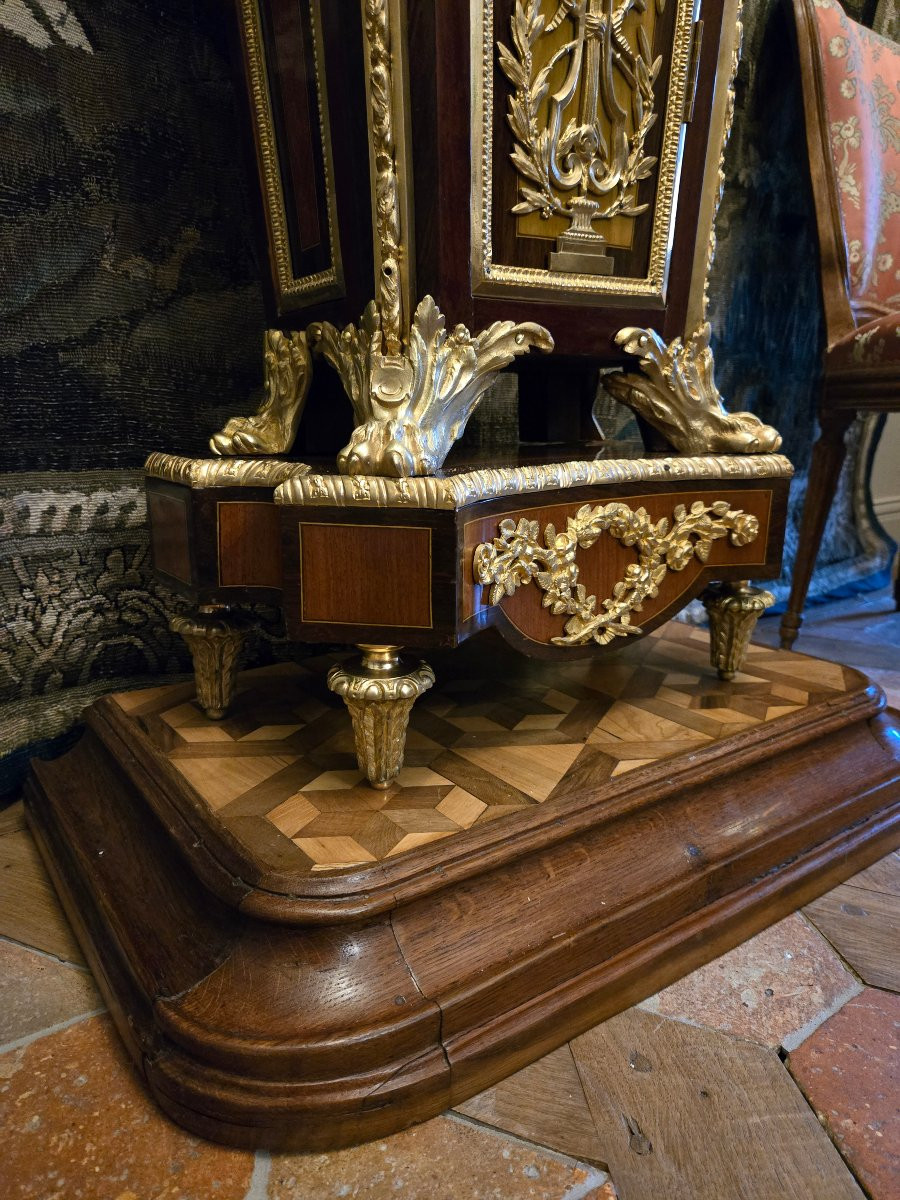
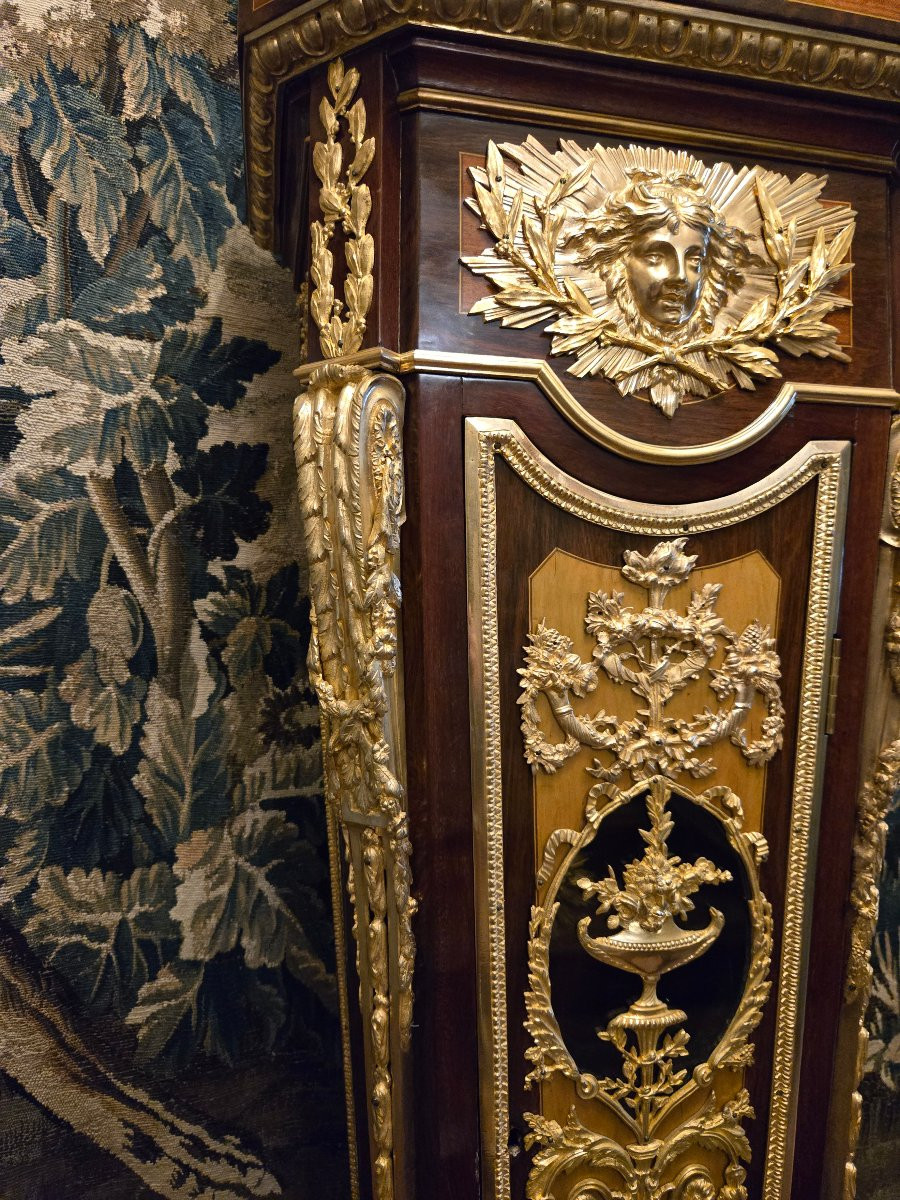
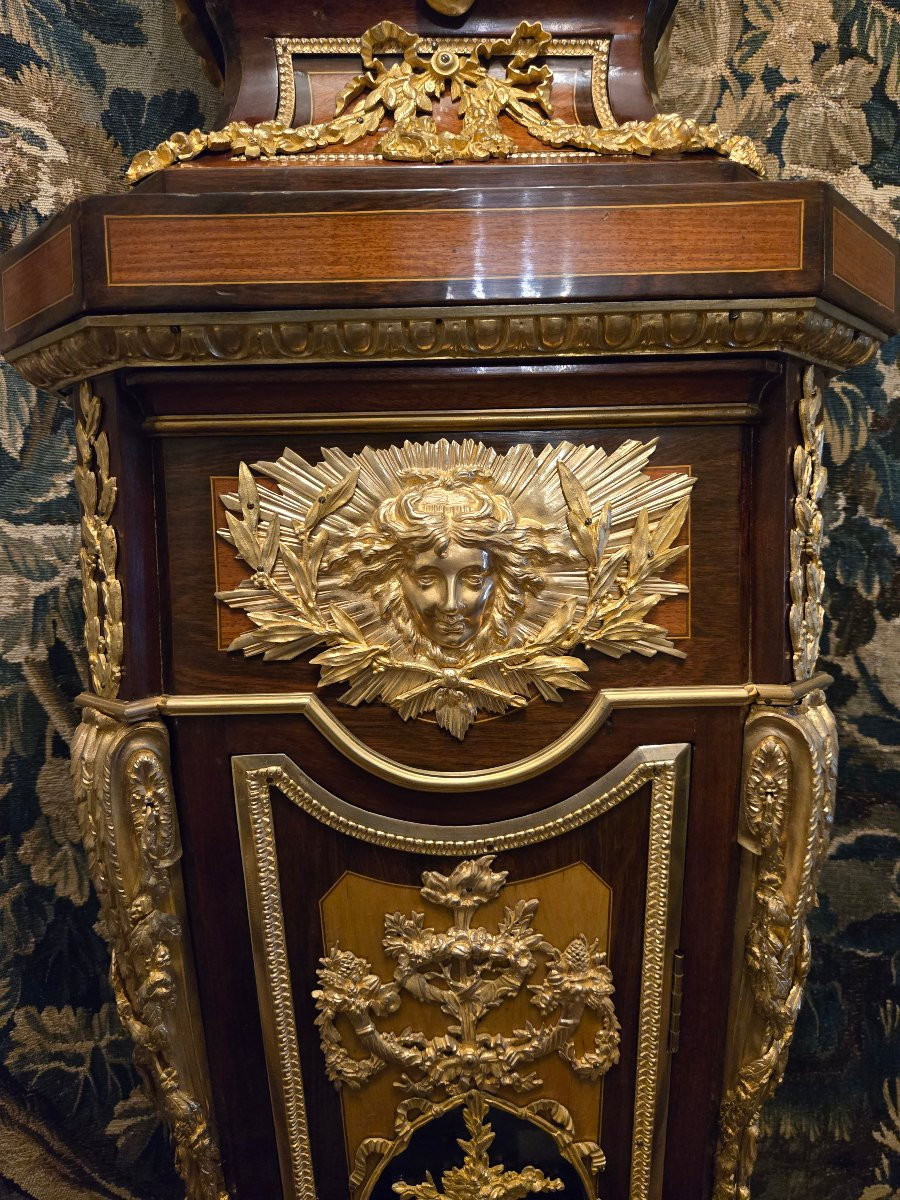
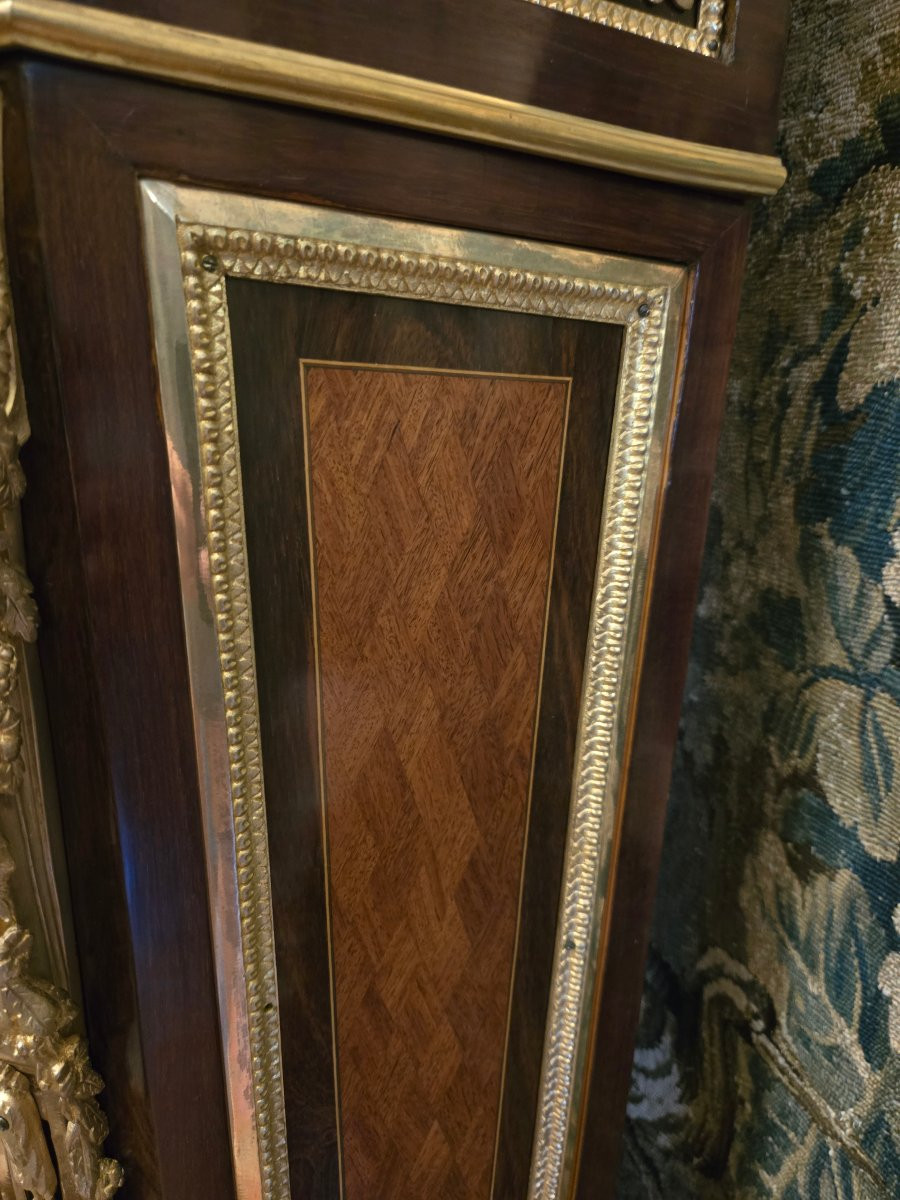
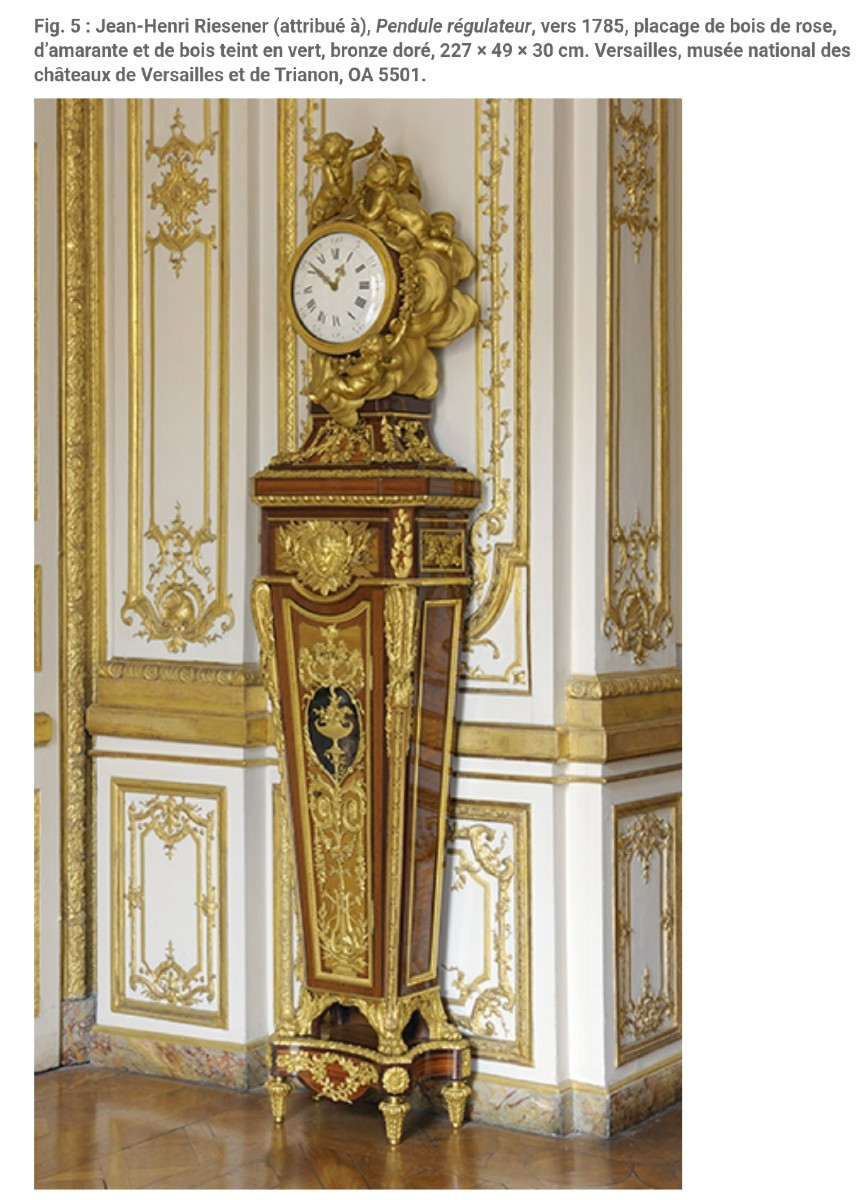
An important Parisian clock regulator in a sheathed case, made during the Second Empire, after the famous model circa 1785 attributed to Jean-Henri Riesener, now in the Louvre Museum (inv. OA 5501) and currently on loan to the Palace of Versailles. This emblematic example of Neoclassical furniture from the end of Louis XVI's reign, associated with the taste of Marie Antoinette, was rediscovered and admired in the 19th century, particularly during the Second Empire, a period marked by a genuine enthusiasm for the 18th-century style, as well as during the Third Republic. Description: The circular white enamel dial, signed Garnier in Paris, features Roman numerals for the hours and Arabic numerals for the minutes. It is surrounded by a finely beaded gilt-bronze bezel. It is surmounted by a substantial gilt-bronze group depicting three winged putti moving among clouds and holding a floral garland, a composition directly inspired by the 18th-century model. The truncated conical sheathed case rests on a marquetry base with geometric decoration. The veneer is a refined combination of satinwood, amaranth, rosewood, and green-stained maple. This subtle polychromy creates an elegant contrast between the dark woods and lighter backgrounds, in the spirit of Louis XVI productions and respectful of the original model. The rich gilt-bronze ornamentation includes: a radiant mask of Apollo, a vase of flowers in a cartouche, scrolling foliage and garlands, acanthus leaf drops, and tapered legs with claw feet. The bronzes are distinguished by the quality of their casting and chasing: finely veined foliage, expressive modeling of the Apollo mask, and powerful, well-defined volumes. They retain their original gilding, revealing a warm and nuanced patina. The movement is signed Paul Garnier (1801–1869), clockmaker to the King and the Navy, a major figure in 19th-century French watchmaking. Trained in the grand Parisian watchmaking tradition, Garnier distinguished himself particularly through his work on precision escapements and scientific regulators. The original, unmodified movement starts but requires a minor overhaul for optimal performance. Original balance wheel retained. Condition: The clock has undergone a respectful restoration: complete disassembly and cleaning of the bronze components, preservation of the original gilding, cleaning of the plating, and refinishing and reapplication of the varnish. Very good overall condition. Dimensions: Height: 224 cm Width: 50 cm Depth: 34 cm Provenance: Private collection, northern France. 








 Le Magazine de PROANTIC
 TRÉSORS Magazine
 Rivista Artiquariato