




Empire Period
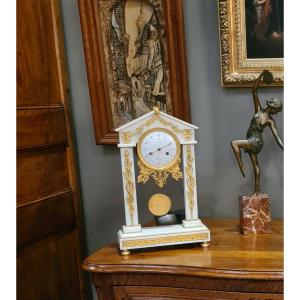
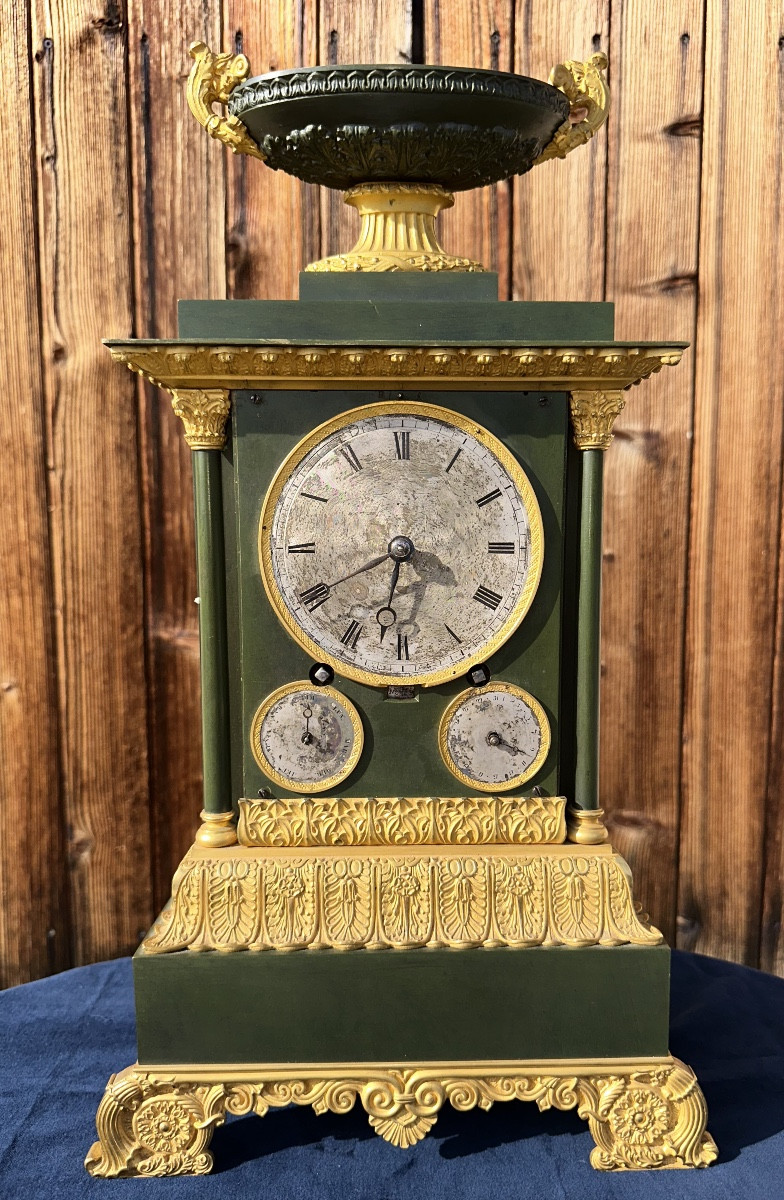
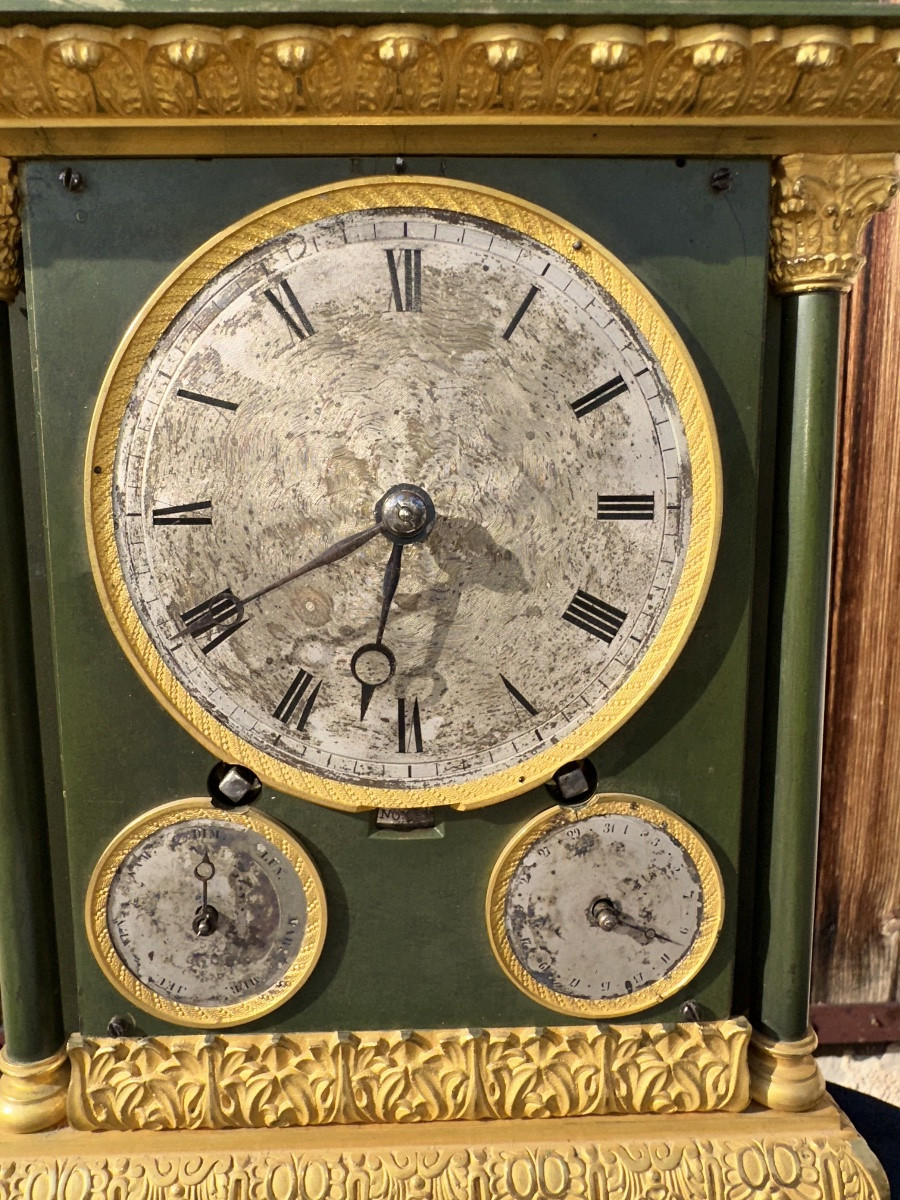
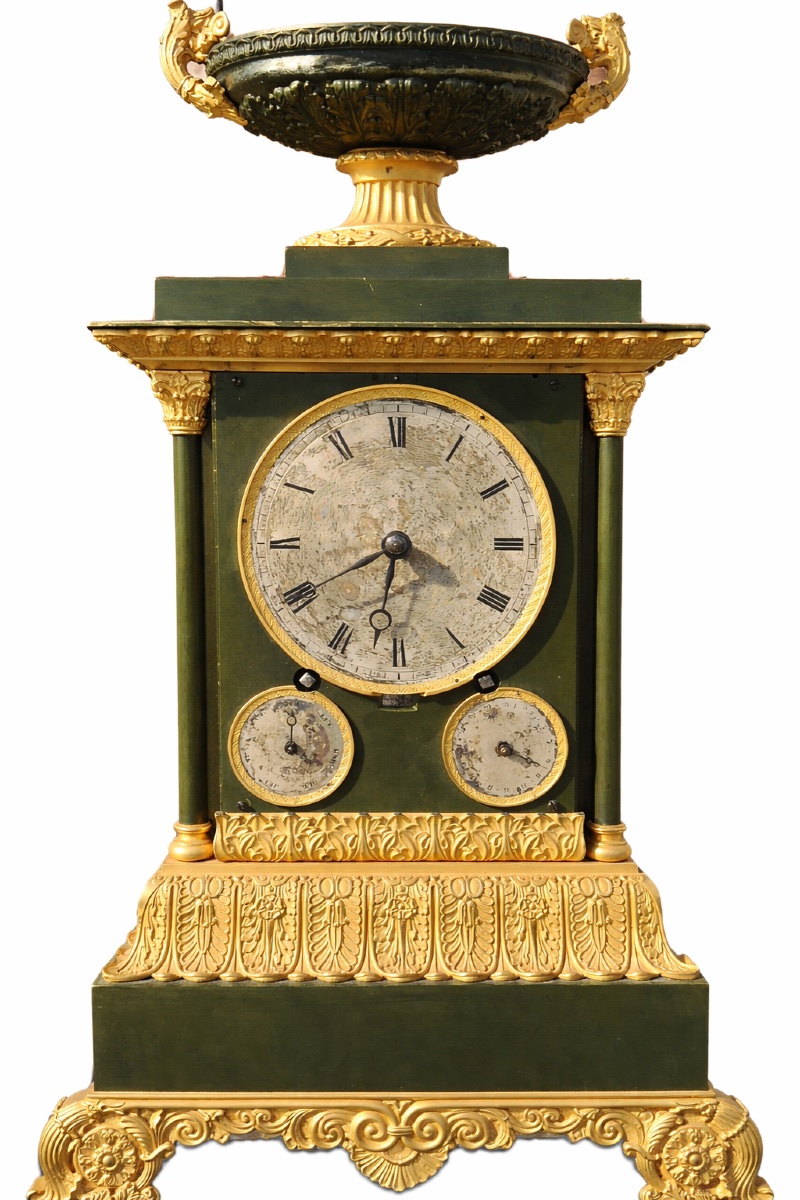
Empire – Empire period, late Empire/early Restoration transition, circa 1810–1815. An important architectural clock in patinated antique green bronze and finely mercury-gilt bronze, resting on a rectangular base with scrolled foliate feet. The case, conceived as a miniature architectural structure, adopts a rigorous neoclassical composition, structured by two front columns adorned with small gilt-bronze Corinthian capitals, supporting an entablature punctuated by friezes of palmettes, water leaves, and classical moldings, characteristic of Parisian production of the late Empire period. The upper section is surmounted by a decorative patinated bronze cup with foliate handles, resting on a gilt pedestal, accentuating the vertical balance of the whole. The main circular dial, in silvered bronze, features painted Roman numerals for the hours, with a peripheral minute track. Below this, a rotating disc indicates the month. Two subsidiary dials, also in silvered bronze, complete the set: on the left, the day of the week, and on the right, the date from 1 to 31. The surface of the dials, now patinated, testifies to an original, unrestored silvering, deliberately preserved for its authenticity and historical consistency. The clock is powered by a French wire-driven movement, occupying almost the entire rear case, revealing a dense, complex, and high-quality construction. The complexity of the mechanism is enhanced by the presence of a striking bell located at the top of the movement, ensuring the striking of the hours and half-hours, a characteristic feature of high-end Parisian clocks. The movement is complete, with all parts present; it requires servicing, as the springs are currently stuck, with no apparent breakage or missing parts. By combining three distinct horological complications—day of the week, date, and month—along with a bell chime, this clock belongs to the category of true complication clocks, technically accomplished pieces intended for discerning collectors. The quality of the bronzes, the rigor of the architecture, and the overall integrity make it a genuine collector's item, sought after by collectors of complication clocks and enthusiasts of Parisian clockmaking from the Empire period. Historical Context: The Empire period spans from 1804 to 1814, corresponding to the reign of Napoleon I and the establishment of a rigorous neoclassical style inspired by Antiquity. The Restoration began in 1814 with the return of Louis XVIII and continued until 1830, marking a gradual stylistic transition. Dated circa 1810–1815, this clock belongs to a transitional phase between the end of the Empire and the beginning of the Restoration, while retaining the major characteristics of the imperial aesthetic. Dimensions: Height: 43.5 cm Width: 21.5 cm Depth: 9.5 cm Condition: Antique green patinated bronze case in good condition. Original mercury gilding, well preserved. Silvered bronze dials with consistent patina from use. Complete movement, needs servicing (springs are stuck). Price: €5,800, firm, non-negotiable. Shipping: Careful packaging and shipping throughout France offered by Galerie De Cicco.
5 800 €
Period: 19th century
Style: Consulat, Empire
Condition: Some repairs
Material: Bronze
Width: 21,5
Height: 43,5
Depth: 9,5
Reference (ID): 1705814
Availability: In stock
Print