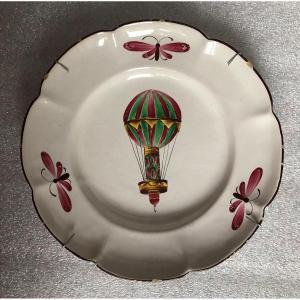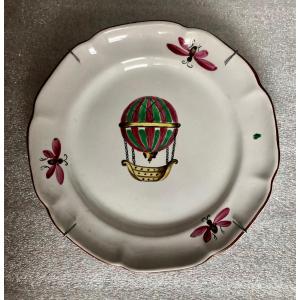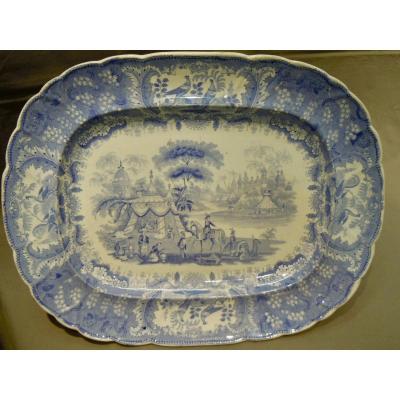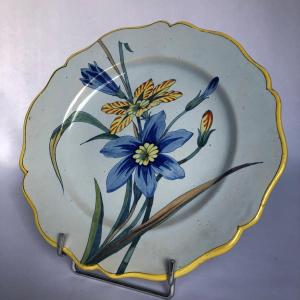

Plate Decorated With Ixias - Alfred Beau - Porquier Beau Factory - Brittany
Artist: Alfred Beau
Polychrome earthenware, circa 1890.
From the botanical series.
Alfred Beau (1829-1907) :
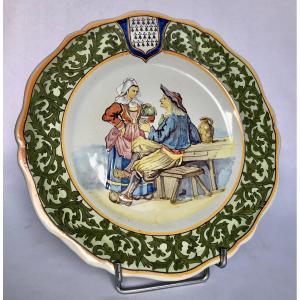
Alfred Beau Paints Mr. LuzelAlfred Beau was born in Morlaix. Trained in drawing and watercolor, Alfred Beau began his career as a photographer before turning to painting and ceramics. He notably drew inspiration from the teachings of Camille Flers and Eugène Isabey. Sensitive to the revival of decorative arts under the Second Empire, he became a painter on earthenware and exhibited dishes and platters with varied designs.After 1870, he joined the Porquier earthenware factory in Quimper as artistic director, and later became its manager. The establishment then became the Porquier-Beau earthenware factory, whose production he profoundly renewed. Alfred Beau created numerous designs inspired by Breton life—genre scenes, fairs, markets, religious festivals, weddings—as well as botanical decorations influenced by Japanese prints. He took illusionism to the extreme, creating musical instruments out of earthenware, including a cello that won a silver medal at the Universal Exhibition of 1878.
From the botanical series.
Alfred Beau (1829-1907) :
Alfred Beau Paints Mr. LuzelAlfred Beau was born in Morlaix. Trained in drawing and watercolor, Alfred Beau began his career as a photographer before turning to painting and ceramics. He notably drew inspiration from the teachings of Camille Flers and Eugène Isabey. Sensitive to the revival of decorative arts under the Second Empire, he became a painter on earthenware and exhibited dishes and platters with varied designs.After 1870, he joined the Porquier earthenware factory in Quimper as artistic director, and later became its manager. The establishment then became the Porquier-Beau earthenware factory, whose production he profoundly renewed. Alfred Beau created numerous designs inspired by Breton life—genre scenes, fairs, markets, religious festivals, weddings—as well as botanical decorations influenced by Japanese prints. He took illusionism to the extreme, creating musical instruments out of earthenware, including a cello that won a silver medal at the Universal Exhibition of 1878.
420 €
Period: 19th century
Style: Napoleon 3rd
Condition: Excellent condition
Material: Earthenware
Diameter: 23 cm
Reference (ID): 1682735
Availability: In stock
Print