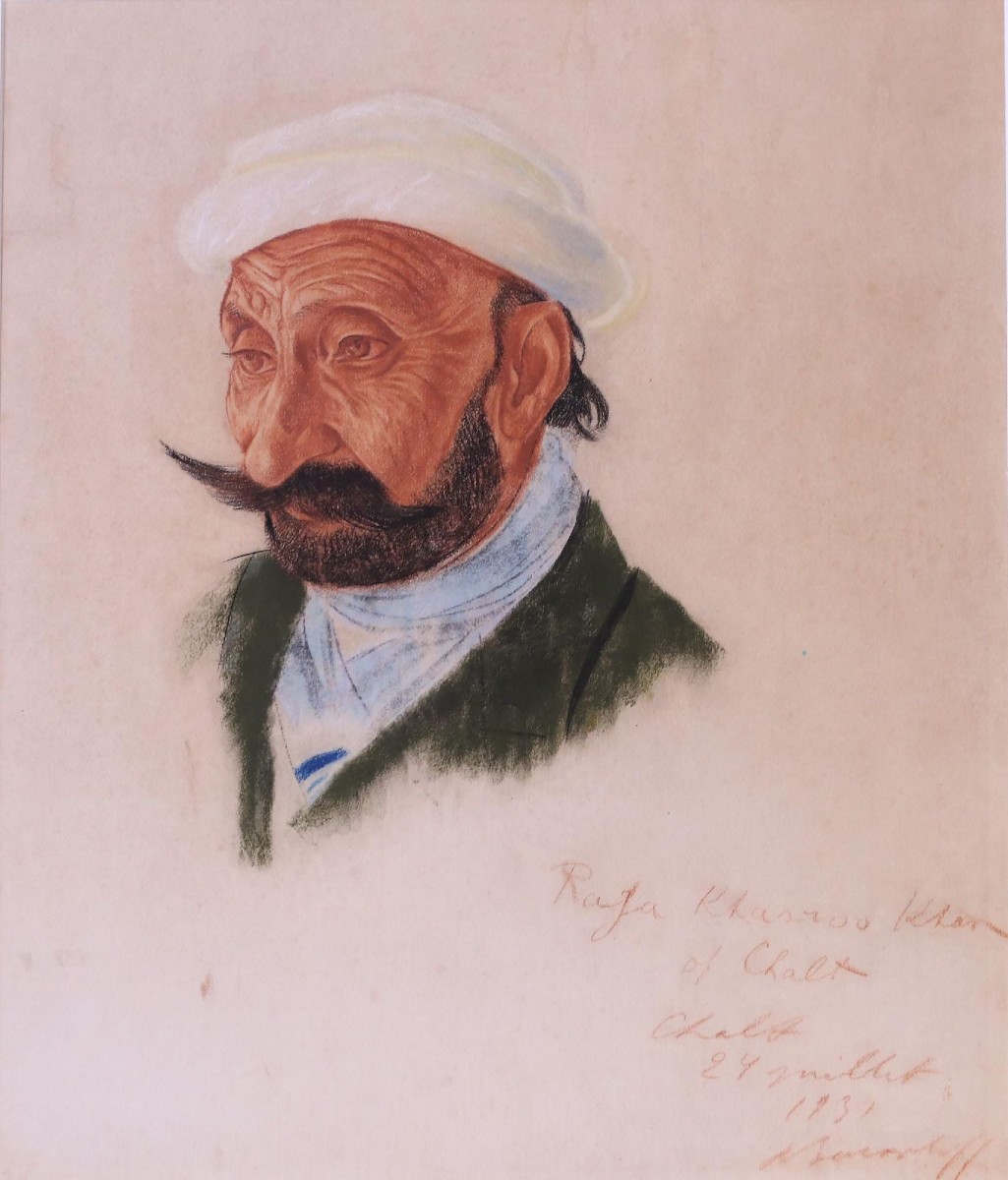
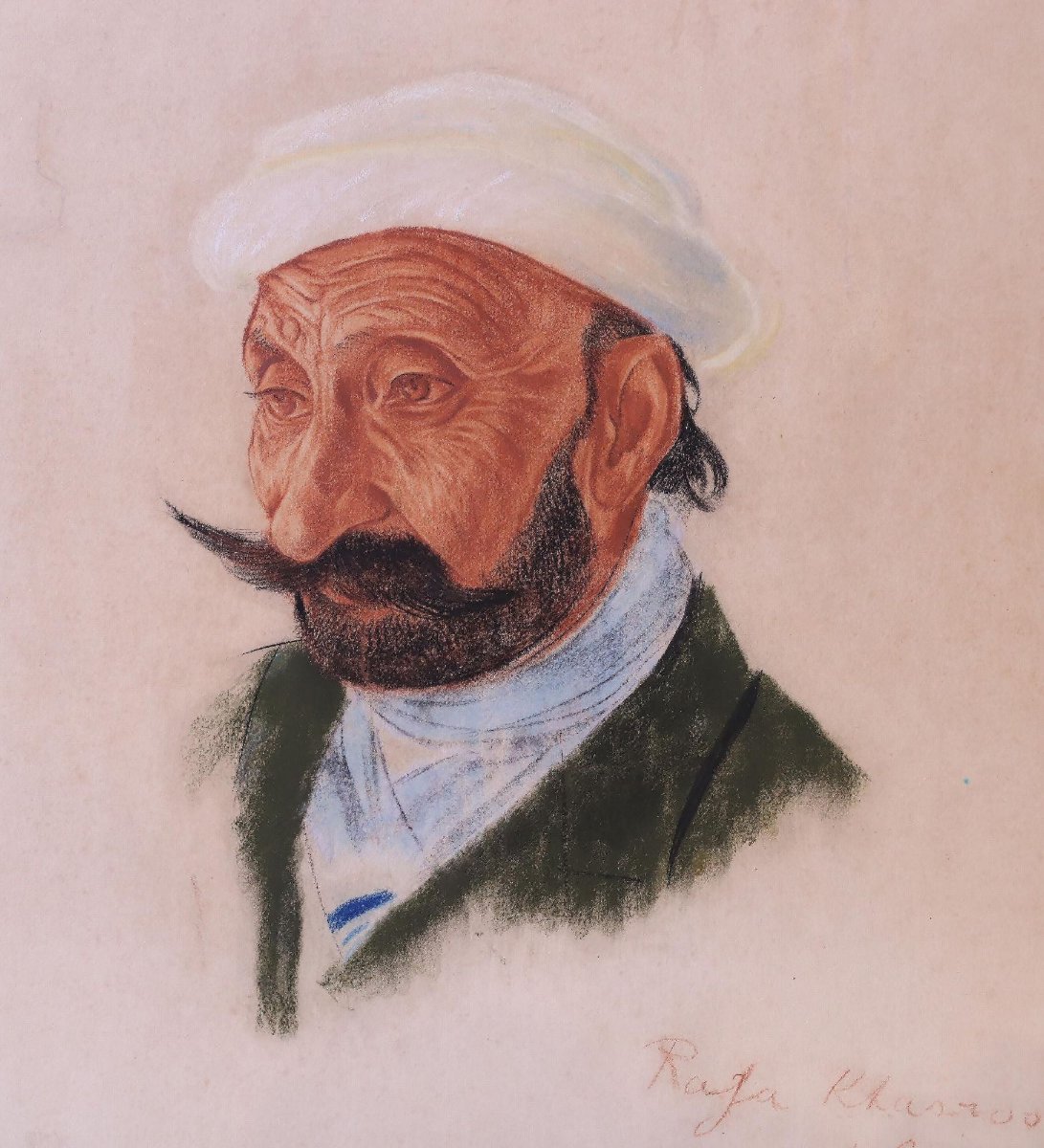


Iacovleff - Portrait Of Raja Khasroo Khan Of Chalt
Artist: Alexandre Iacovleff
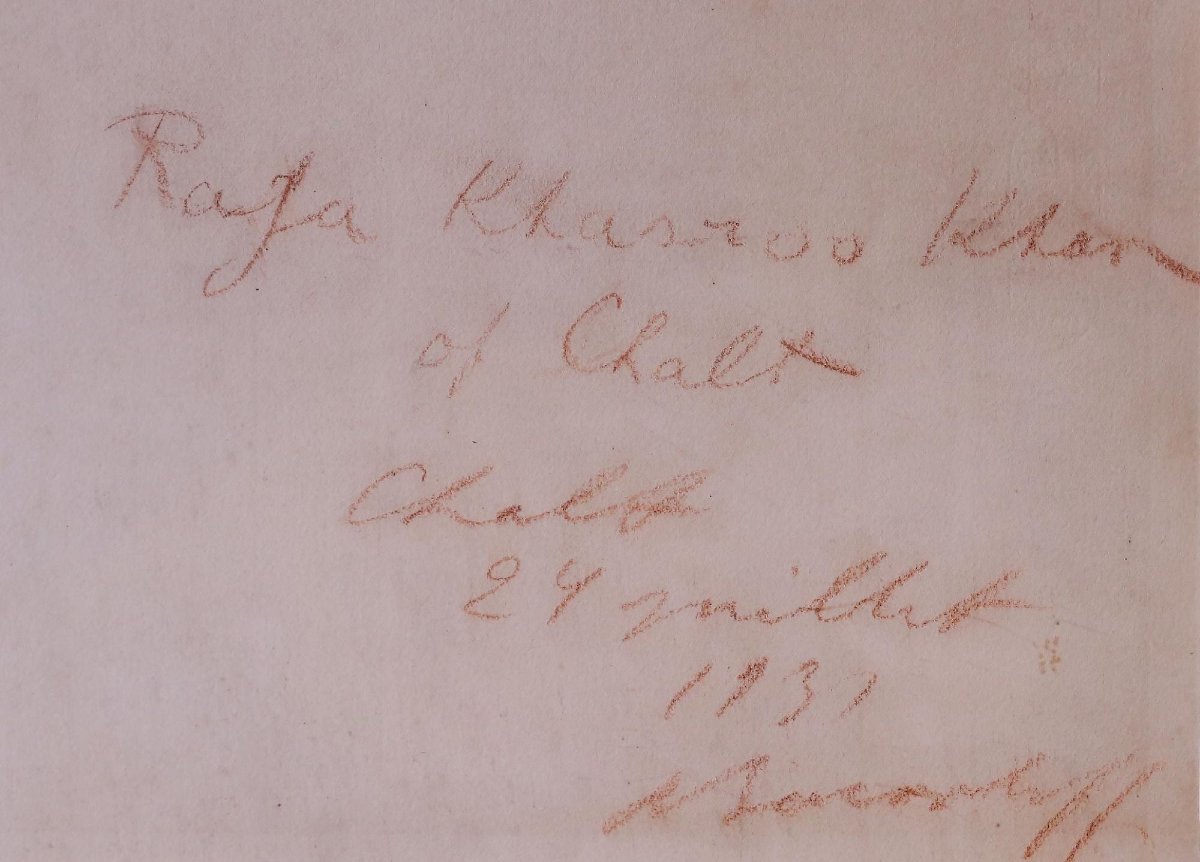
[YELLOW CRUISE]. IACOVLEFF, Alexandre. Original drawing - Portrait of Raja Khasroo Khan of Chalt. Chalt, July 24, 1931. Red chalk, charcoal, and pastel on paper watermarked "J. Perrigot Arches France". 60.5 x 50.5 cm. Named, located, dated, and signed lower right: "Raja Khasroo Khan/of Chalt/ Chalt/July 24/1931/A. Iacovleff". Restored tear and some foxing in the upper right of the drawing, not affecting the portrait. Item #4984: Superb portrait of one of the chiefs of Nagar (one of the princely states of the British Indian Empire, present-day Pakistan), painted by Iacovleff during the Yellow Expedition. Of Russian origin, Alexandre Iacovleff (Saint Petersburg, 1887 – Paris, 1938) is known for his extraordinary drawings and paintings brought back from the Black and Yellow Expeditions. Under the patronage of André Citroën, these scientific and artistic expeditions in half-track vehicles, led by Georges-Marie Haardt across Africa in 1924 and Asia in 1931, were a resounding success. As the official painter of both expeditions, Alexandre Iacovleff was commissioned by the Minister of Fine Arts to "capture, through his brush, the disappearing customs and traditions of the indigenous peoples." From each mission, Alexandre Iacovleff returned with over three hundred drawings, as well as a large number of sketches and studies. An accomplished draftsman, he created his portraits in sanguine—the medium that would bring him fame—charcoal, and sepia. Sometimes, he softened the lines with pastels. A subtle and creative colorist, the artist recomposed the nuances of his palette according to his travels. Georges Le Fèvre, the historian of the Yellow Cruise, wrote that he invented "a palm grove green, a spahi red, a minaret blue" (Georges Le Fèvre, La Croisière Jaune, Plon, 1933). In 1931, Alexandre Iacovleff belonged to the Pamir group of this famous Yellow Cruise, which linked Beirut to Beijing. The extreme conditions of the expedition made the painter's task difficult. However, deep in the heart of the Himalayas, he paints striking portraits, such as this one of Raja Khasroo Khan of Chalt, one of the rulers of Nagar, or that of his formidable rival, Mohammed Nazim Khan, the Mir of Hunza. At the end of the 19th century, the kingdom of Hunza, hidden behind the mountain wall of Chalt, was considered the most inaccessible stronghold in the Himalayas. Refusing all domination, the inhabitants of two small independent states, Nagar and Hunza, were notorious for terrorizing caravan traders with their raids. A centuries-old hatred divided them, only to transform into a formidable alliance in the face of external threats. In 1931, their conflicts were over, and the arrival of the Haardt group, which needed many porters and ponies, was a godsend for these petty kings. This drawing has belonged to several private collections since the 1930s and has never appeared on the market. Literature: IACOVLEFF, Alexandre. Drawings and Paintings of Asia, Road Sketches and Travel Notes, Third Mission of G.-M. Haardt-L. Audouin-Dubreuil. Paris: Lucien Vogel, 1934. Plate 25: Raja Khasroo Khan of Nagar. Chalt. Exhibition: Alexandre Iacovleff. Painter attached to the Citroën Central Asia Expedition, Third Mission of G.-M. Haardt-Audouin-Dubreuil. Exhibition of Drawings and Paintings. May 16 to June 4, 1933, Galerie Jean Charpentier. 76, rue du Faubourg Saint-Honoré, Paris, Catalogue no. 246, Raja Khosroo Khan of Tchal [sic]. A certificate of authenticity from Madame Caroline Haardt de La Baume, expert on the work of Alexandre Iacovleff, will be issued to the buyer. This portrait will be included in the forthcoming catalogue raisonné of Alexandre Iacovleff.
20 000 €
Period: 20th century
Style: Asian art
Condition: Good condition
Material: Paper
Reference (ID): 1652687
Availability: In stock
Print