



French School, 17th Century, Allegories Of The Four Elements
French School, 17th century
Allegories of the four elements
(4) Oil on oval copper, 10.5 x 13 cm
With frame, cm 36 x 46
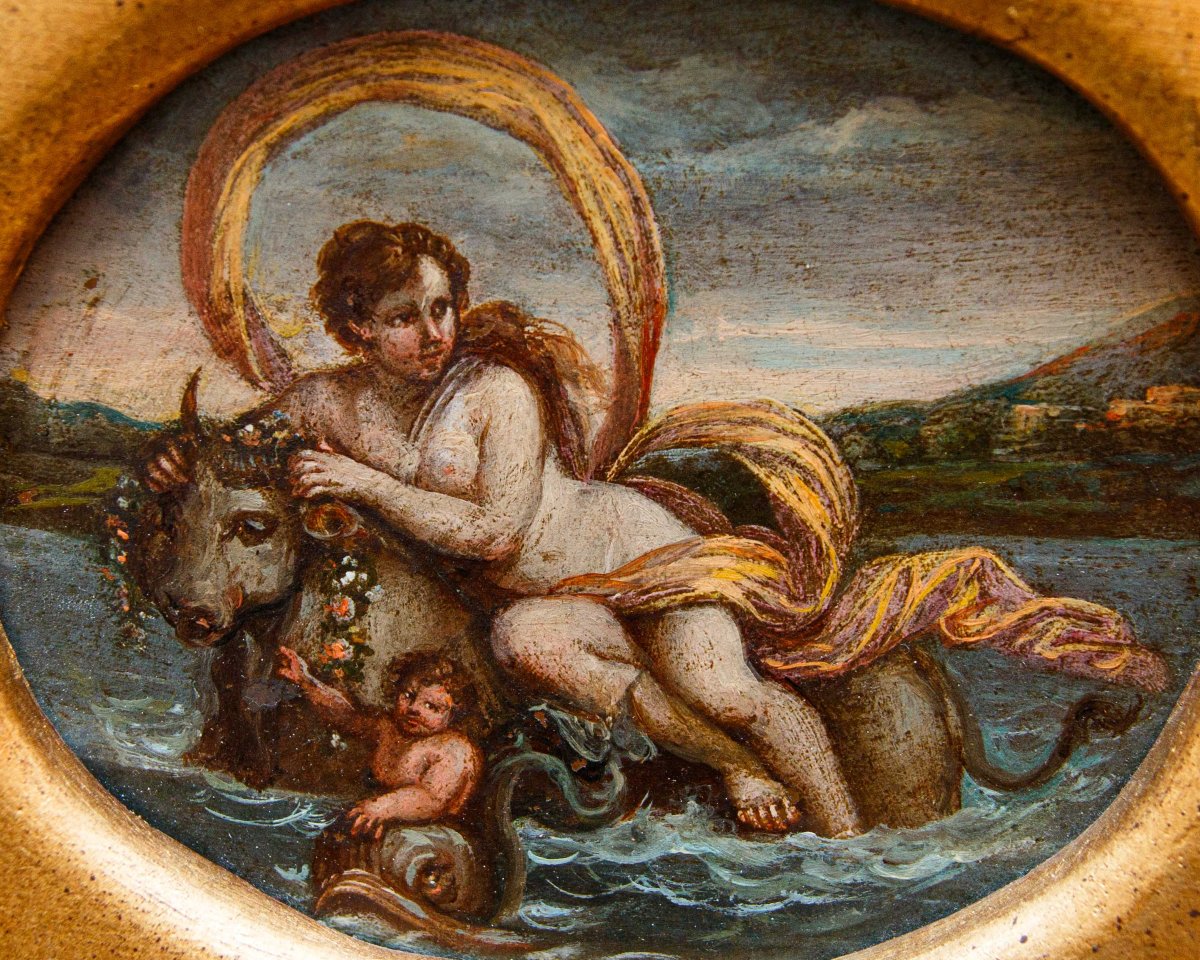
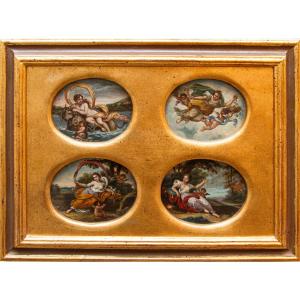
The four framed ovals under examination constitute a refined example of copper painting, a preferred medium for artists who sought particular brilliance and extreme finesse of detail. The work is a pictorial cycle that interprets in a highly original way the Allegory of the Four Elements (Water, Air, Earth and Fire) through the recovery of classical mythology and the decorative taste of the period, likely between the late seventeenth and early eighteenth centuries. In fact, they fit perfectly into that bourgeois taste that favored mythological and allegorical subjects treated with grace, sensuality, lively colors, often intended to decorate noble rooms or private cabinets.
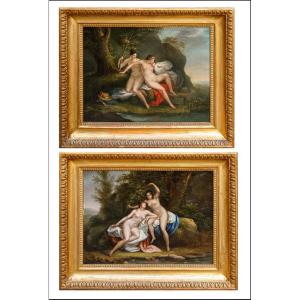
Each tondo takes up a mythological episode or a deity that traditionally symbolizes one of the four elements, following an iconographic scheme consolidated in European art. At the top left, we encounter the episode of the Rape of Europa, symbolizing Water: Jupiter, having fallen in love with the Phoenician princess Europa, depicted here half-naked, covered by a light, flowing drape and with loose hair, decided to transform into a beautiful white bull, kidnapping her and taking her with him across the sea. At the top right, however, we find Air, personified by the Nymphs or Hours, where a girl wrapped in light drapes is lifted and carried into the sky by a group of winged cherubs (often associated with Zephyrs), symbolizing the impalpability and transcendence of air itself. Descending, on the left, you then come across the Earth respectively: a female figure, most likely Ceres (goddess of agriculture) or Flora (goddess of spring), sits on a richly vegetated ground, also adorned with yellow drapery and a fluttering pink band, in the company of some cherubs intent on offering her gifts and festoons. The Earth is represented here through abundance (the rich draperies, the festoons) and lush vegetation, while the cherub in the foreground symbolizes life that arises and thrives from the earth element. Finally, in the last tondo at the bottom right, one can see Fire, the element whose personification is more ambiguous: the figure could, in fact, allude to a deity linked to fire such as Vesta or, given the setting and expression, to a myth of divine punishment or creation linked for example to Vulcan's forge or to Prometheus (who however are both male characters). In this case, the woman is draped in red, and her gesture is dramatic, facing the sky; a particular distinctive feature is the presence of flames or sparks at her feet.
Among those who attempted this allegorical pictorial cycle we find Francesco Albani, with his Four Elements preserved at the Galleria Sabauda in Turin.
Allegories of the four elements
(4) Oil on oval copper, 10.5 x 13 cm
With frame, cm 36 x 46
The four framed ovals under examination constitute a refined example of copper painting, a preferred medium for artists who sought particular brilliance and extreme finesse of detail. The work is a pictorial cycle that interprets in a highly original way the Allegory of the Four Elements (Water, Air, Earth and Fire) through the recovery of classical mythology and the decorative taste of the period, likely between the late seventeenth and early eighteenth centuries. In fact, they fit perfectly into that bourgeois taste that favored mythological and allegorical subjects treated with grace, sensuality, lively colors, often intended to decorate noble rooms or private cabinets.
Each tondo takes up a mythological episode or a deity that traditionally symbolizes one of the four elements, following an iconographic scheme consolidated in European art. At the top left, we encounter the episode of the Rape of Europa, symbolizing Water: Jupiter, having fallen in love with the Phoenician princess Europa, depicted here half-naked, covered by a light, flowing drape and with loose hair, decided to transform into a beautiful white bull, kidnapping her and taking her with him across the sea. At the top right, however, we find Air, personified by the Nymphs or Hours, where a girl wrapped in light drapes is lifted and carried into the sky by a group of winged cherubs (often associated with Zephyrs), symbolizing the impalpability and transcendence of air itself. Descending, on the left, you then come across the Earth respectively: a female figure, most likely Ceres (goddess of agriculture) or Flora (goddess of spring), sits on a richly vegetated ground, also adorned with yellow drapery and a fluttering pink band, in the company of some cherubs intent on offering her gifts and festoons. The Earth is represented here through abundance (the rich draperies, the festoons) and lush vegetation, while the cherub in the foreground symbolizes life that arises and thrives from the earth element. Finally, in the last tondo at the bottom right, one can see Fire, the element whose personification is more ambiguous: the figure could, in fact, allude to a deity linked to fire such as Vesta or, given the setting and expression, to a myth of divine punishment or creation linked for example to Vulcan's forge or to Prometheus (who however are both male characters). In this case, the woman is draped in red, and her gesture is dramatic, facing the sky; a particular distinctive feature is the presence of flames or sparks at her feet.
Among those who attempted this allegorical pictorial cycle we find Francesco Albani, with his Four Elements preserved at the Galleria Sabauda in Turin.
3 600 €
Period: 17th century
Style: Other Style
Condition: Good condition
Material: Oil painting on copper
Length: 13
Height: 10,5
Reference (ID): 1651431
Availability: In stock
Print