

Workshop Of José Leonardo (zaragoza, 1601–1653), The Birth Of The Virgin
Workshop of José Leonardo (Zaragoza, 1601–1653)
The Birth of the Virgin
Oil on canvas, 69 x 86 cm – with frame, 87.5 x 104 cm
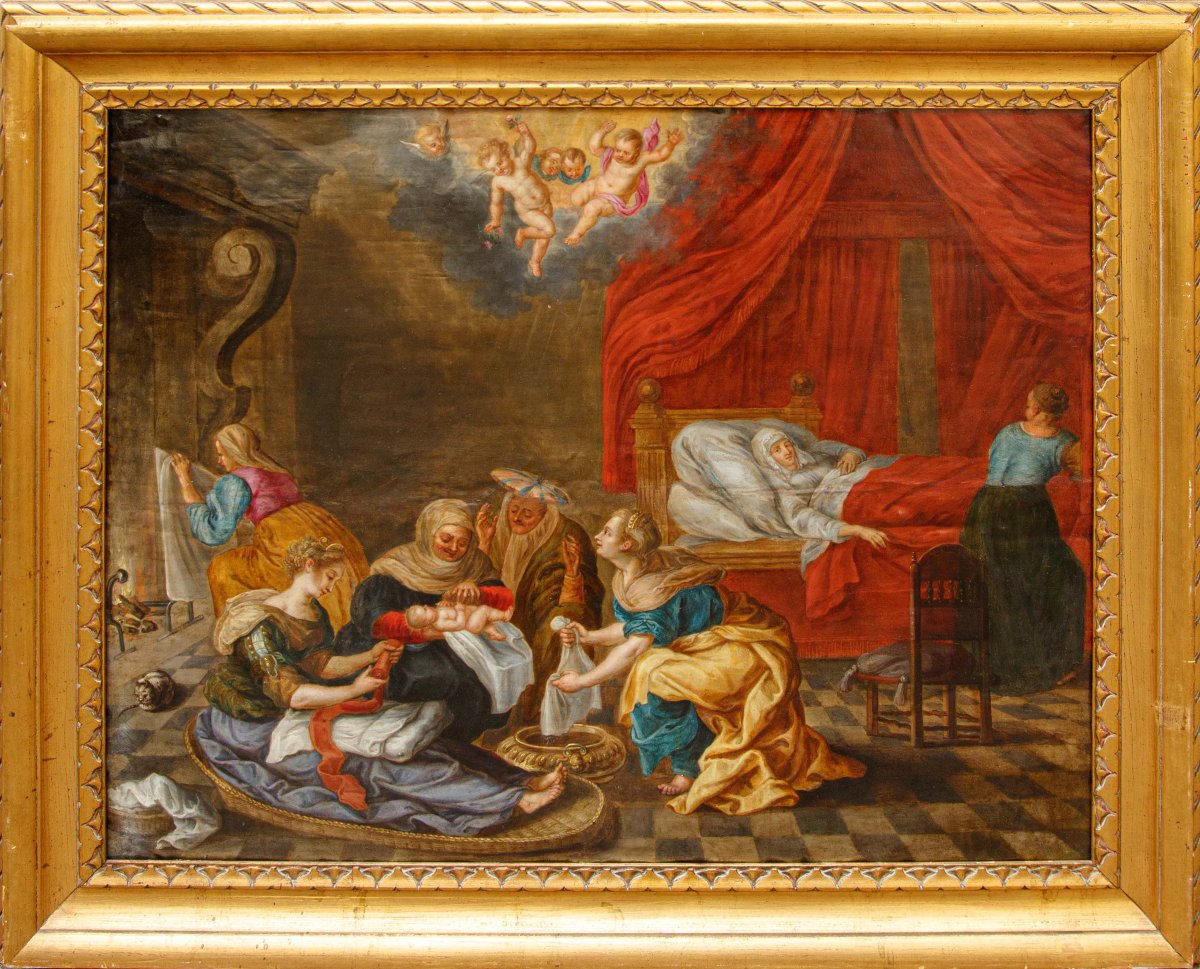
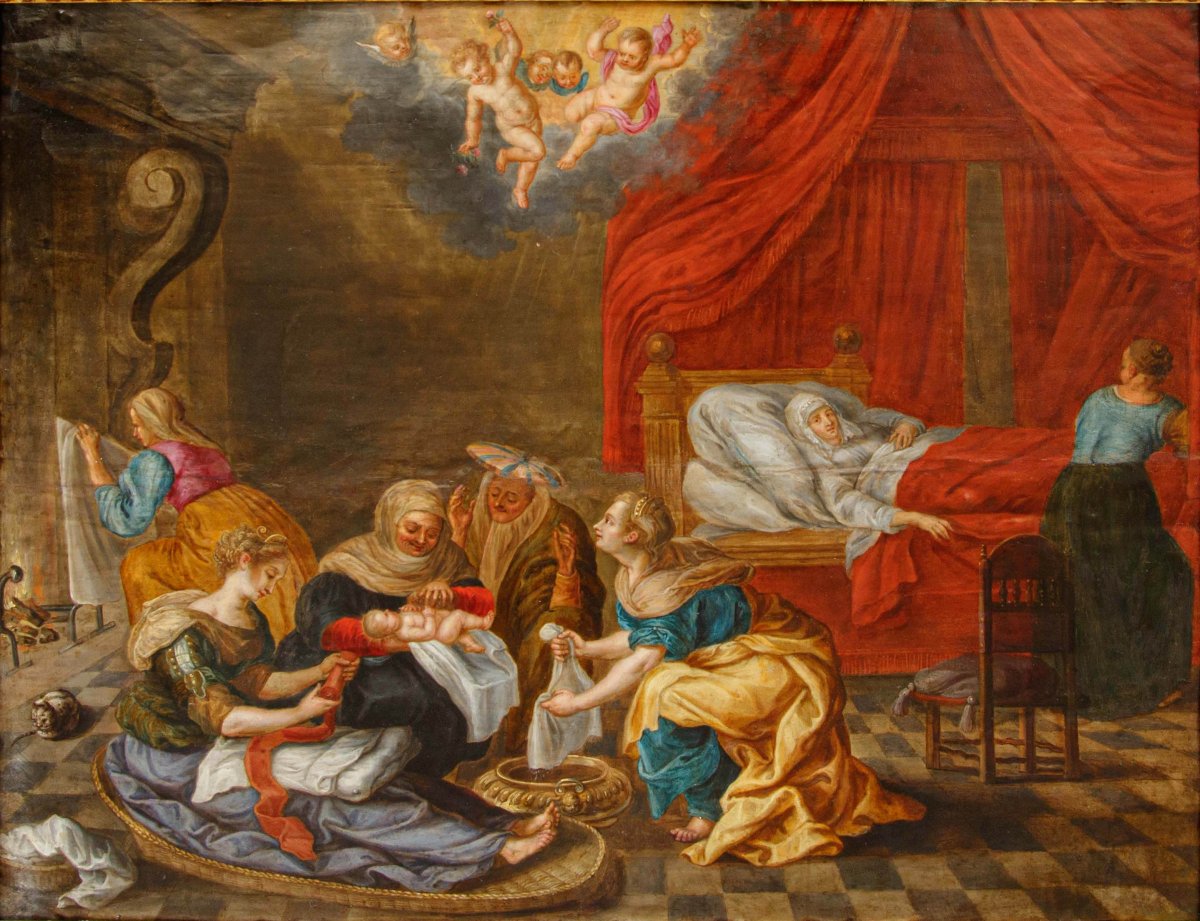
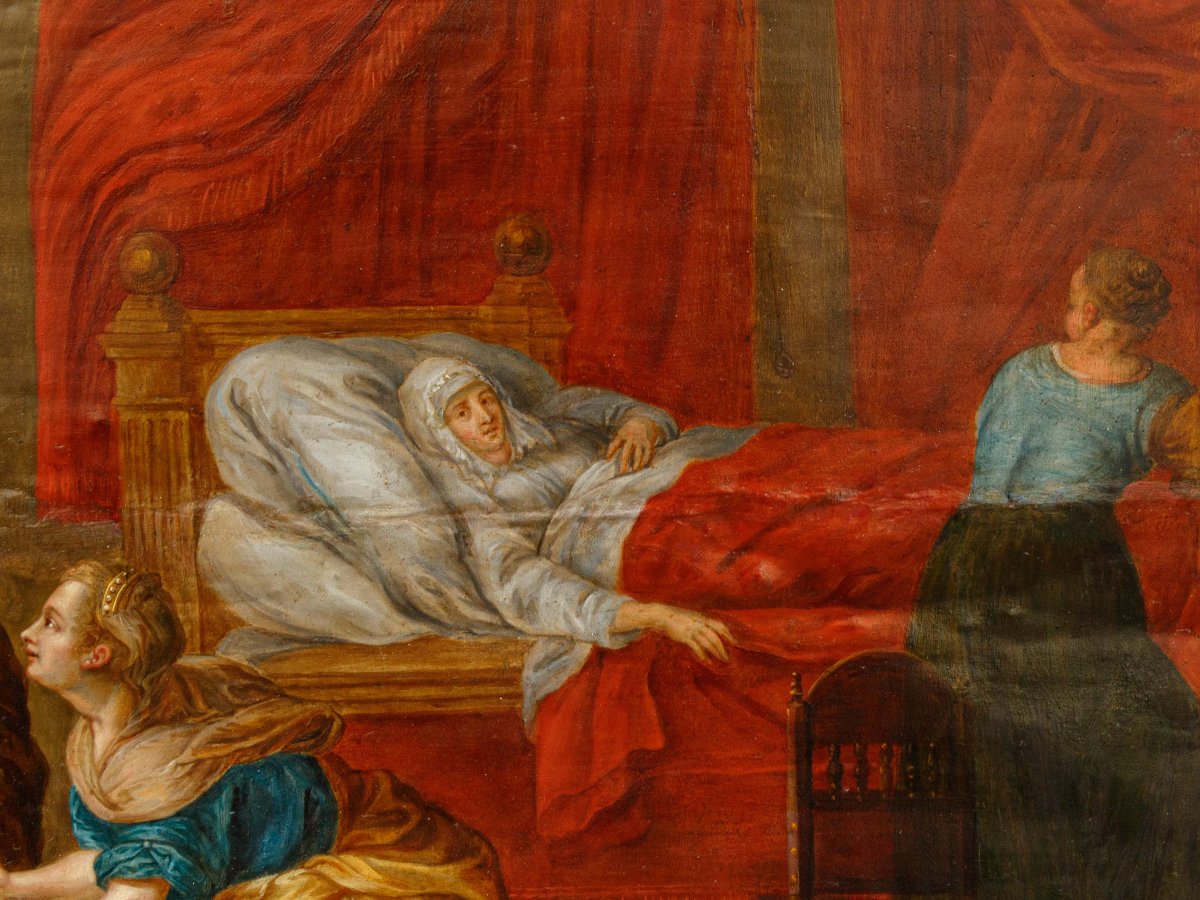
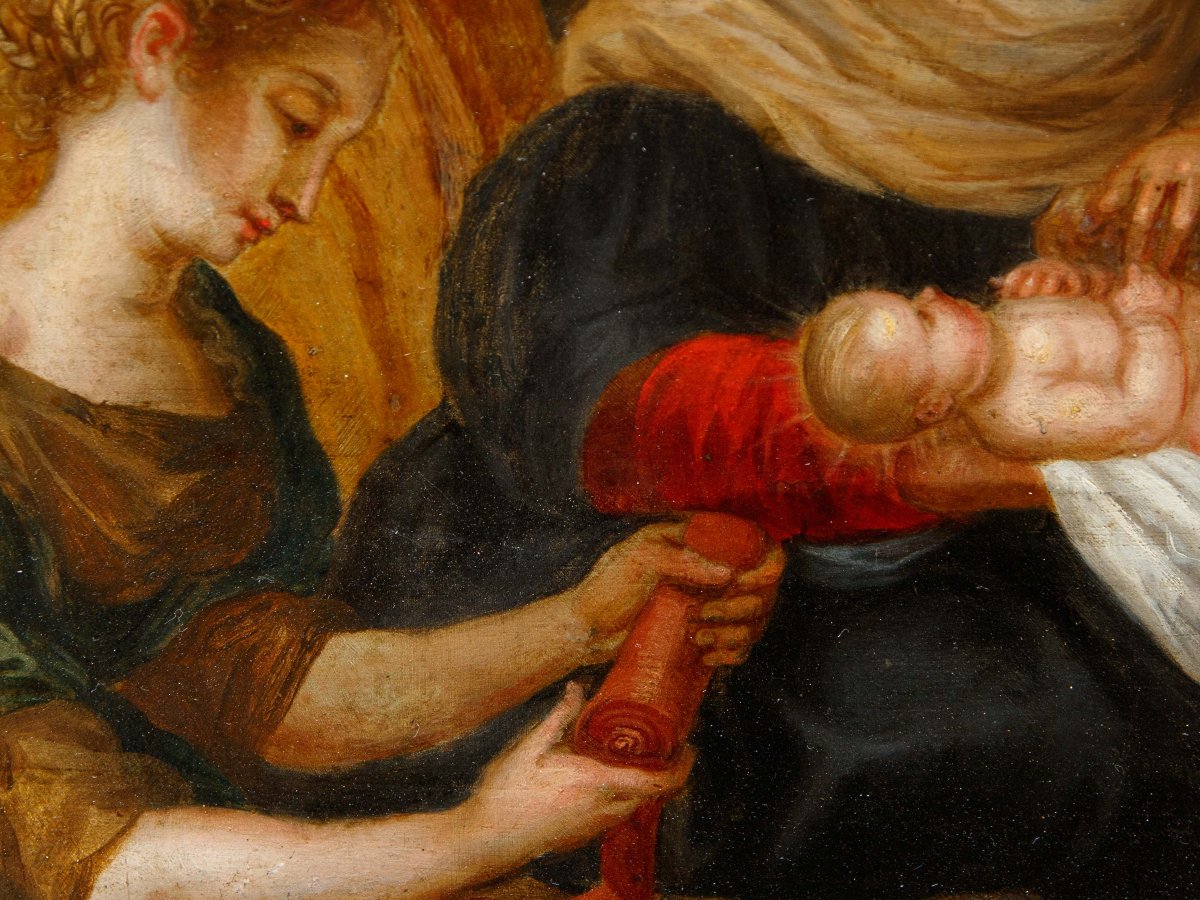
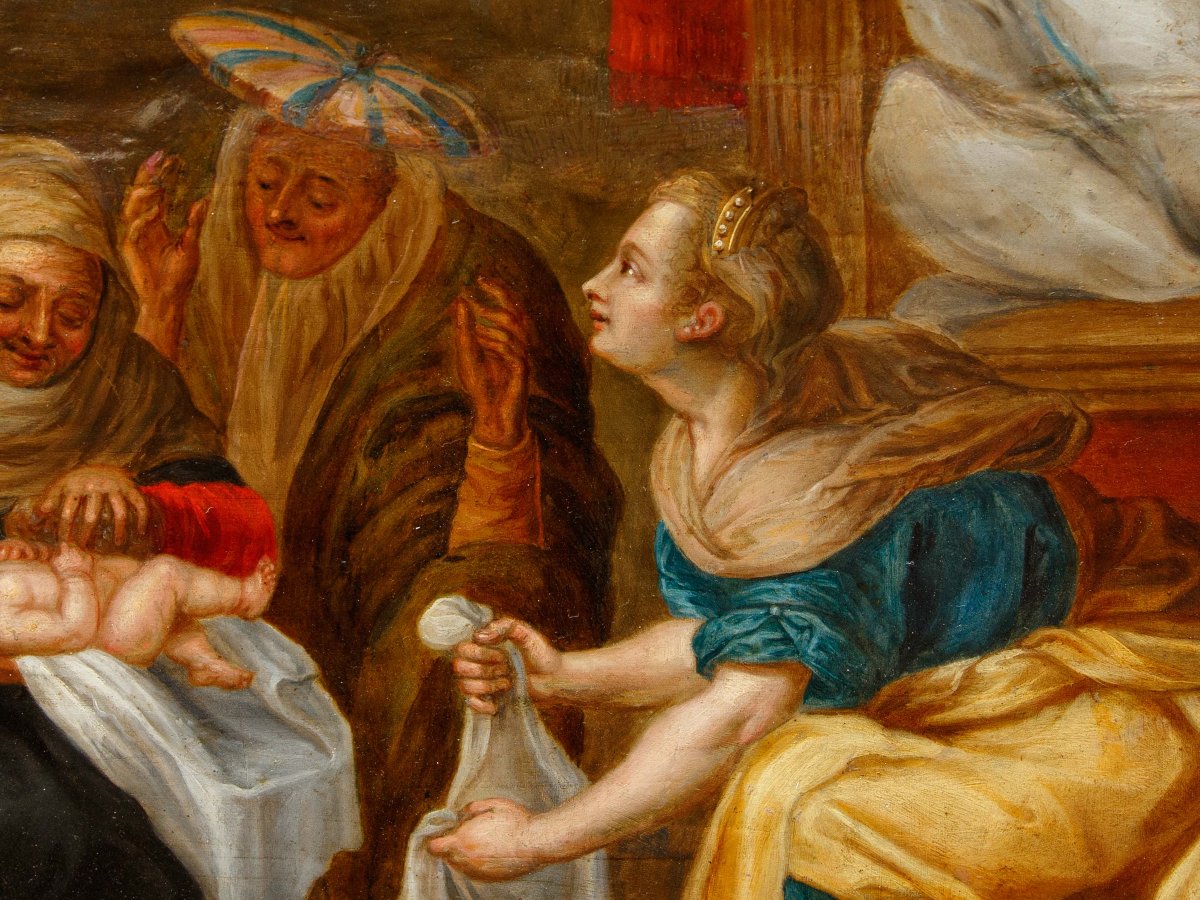
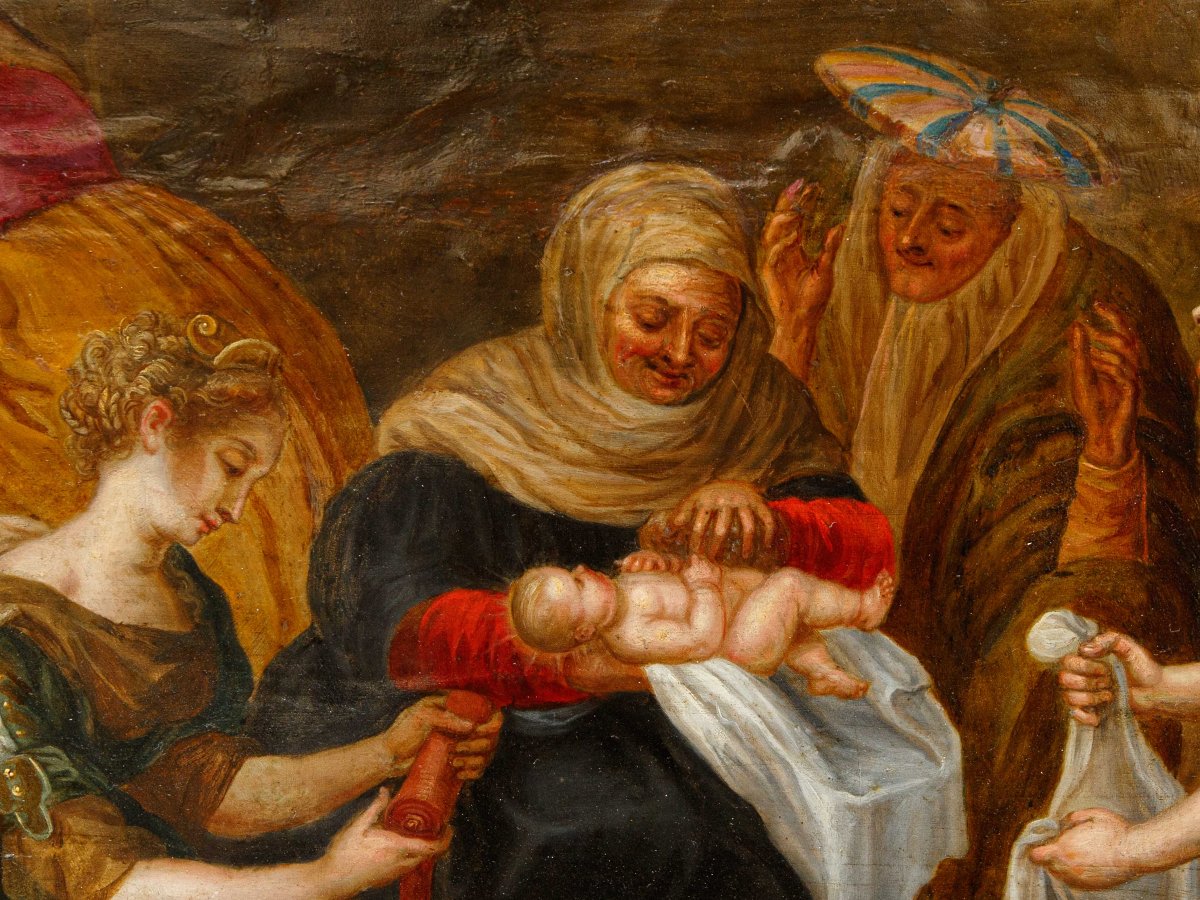
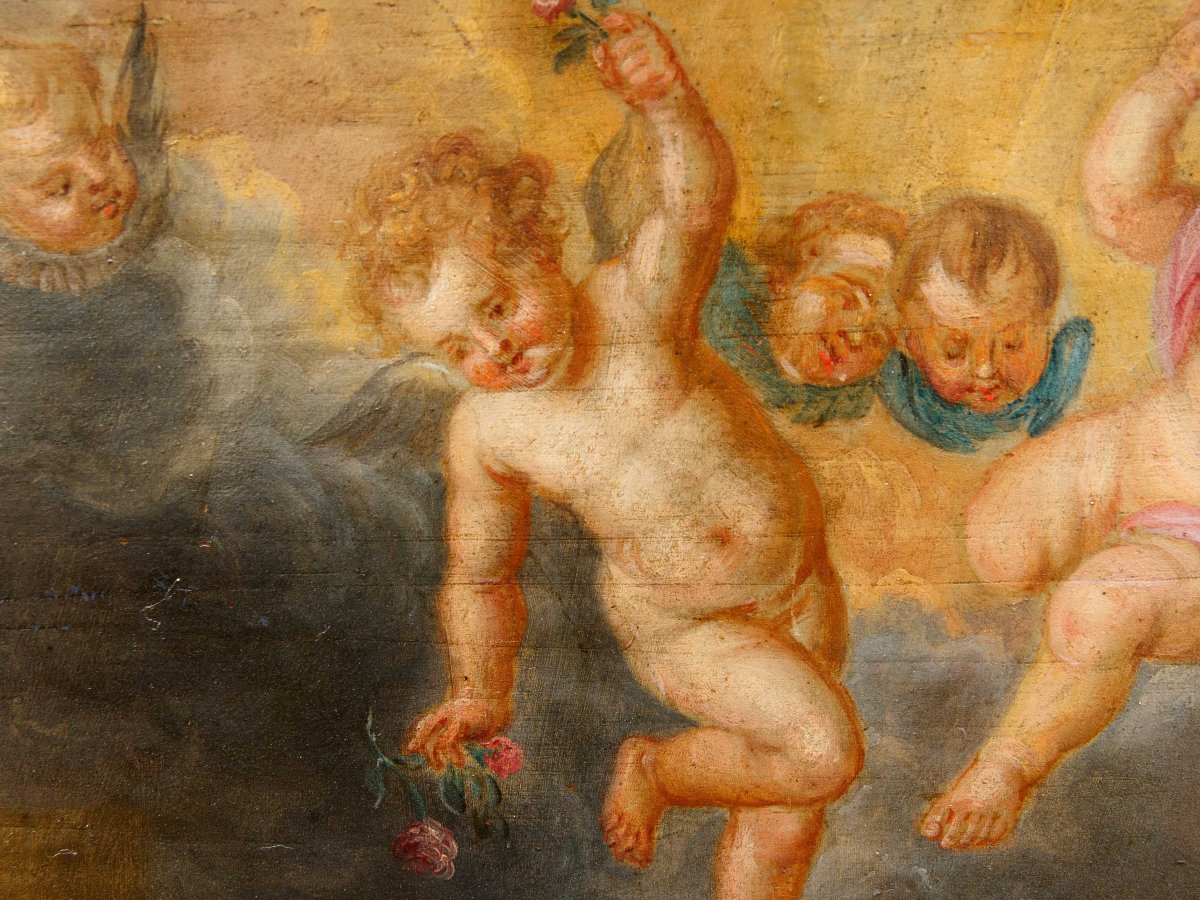
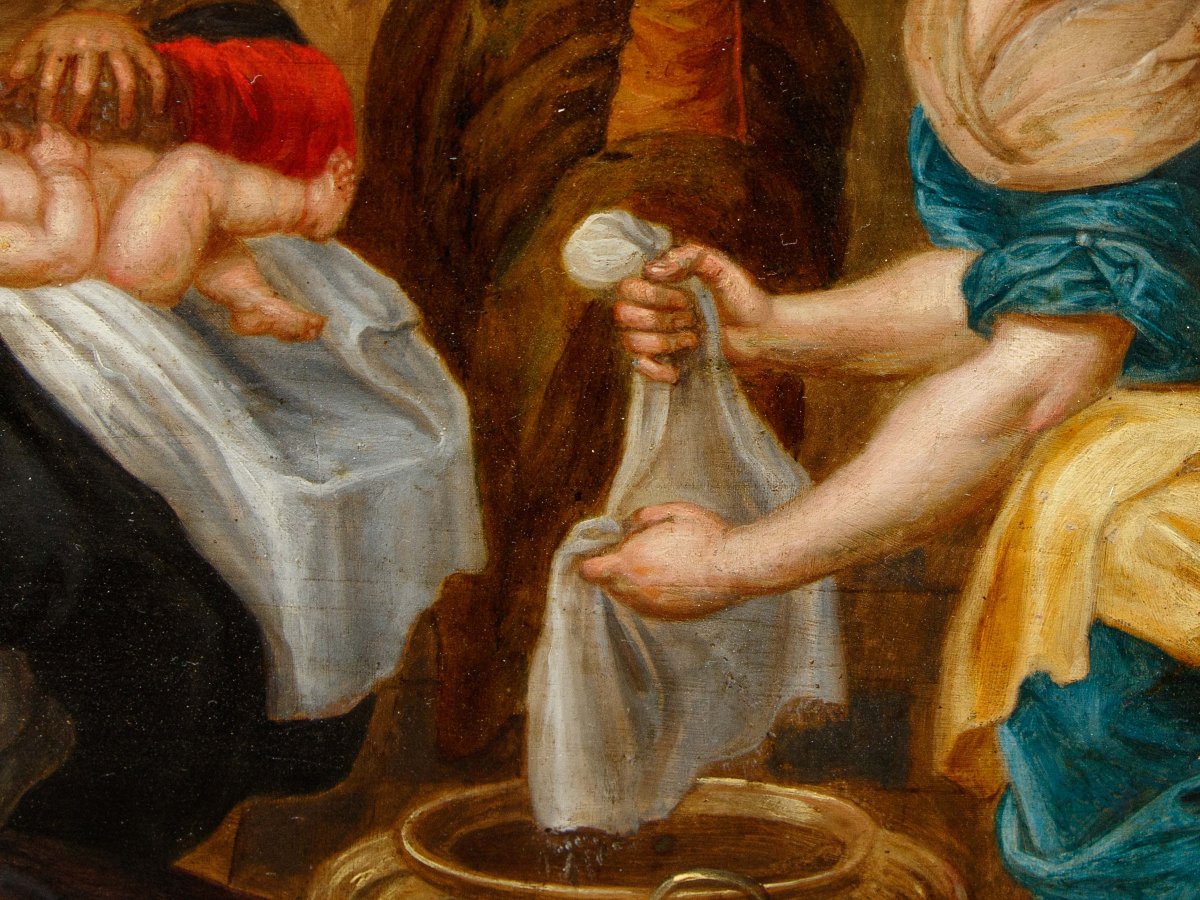
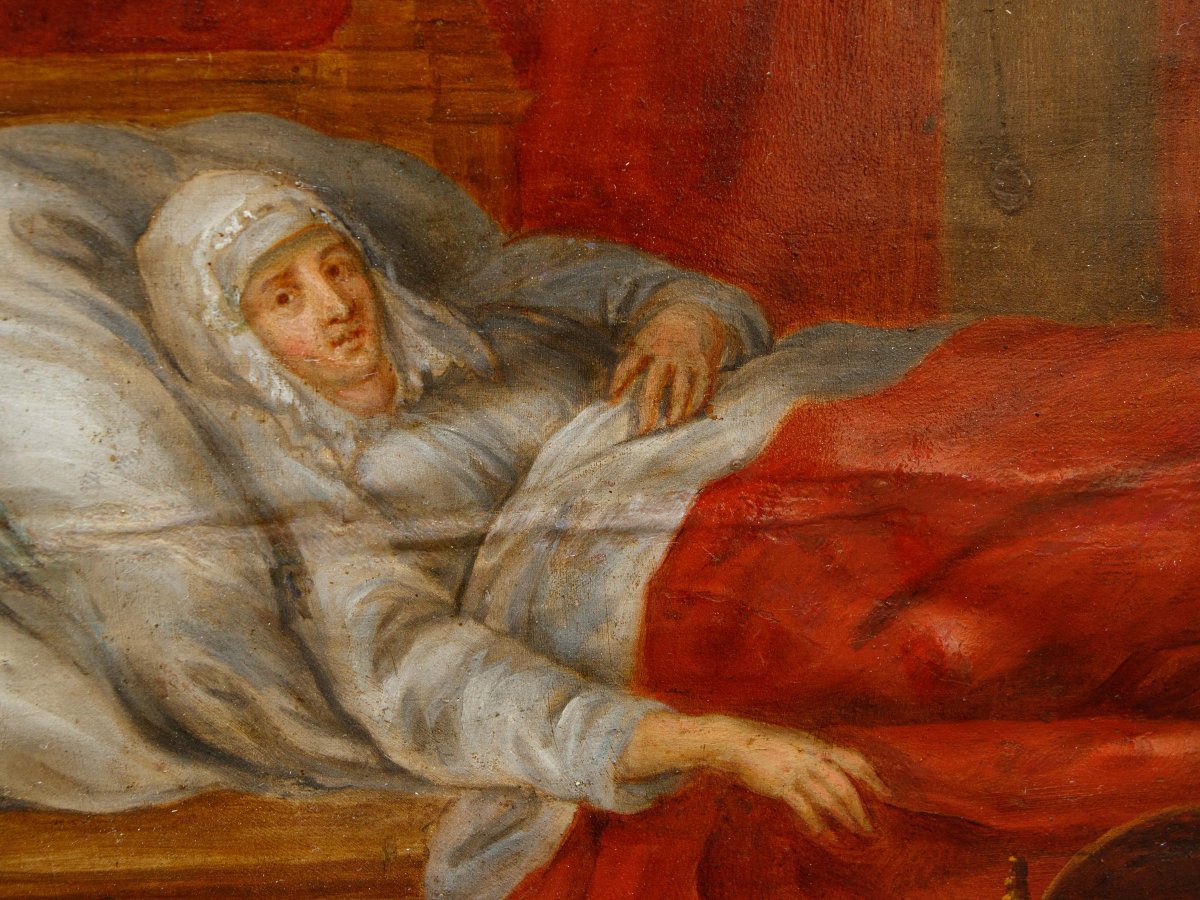
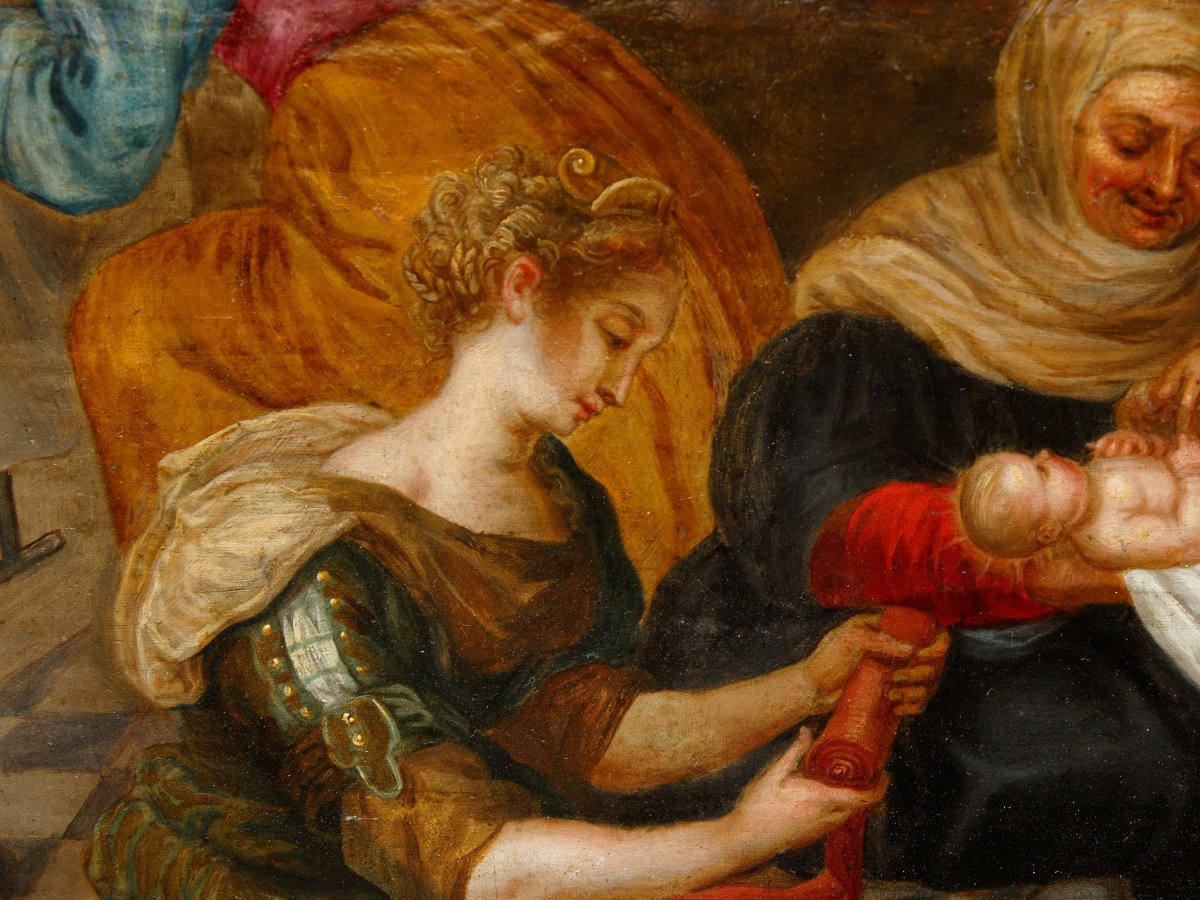
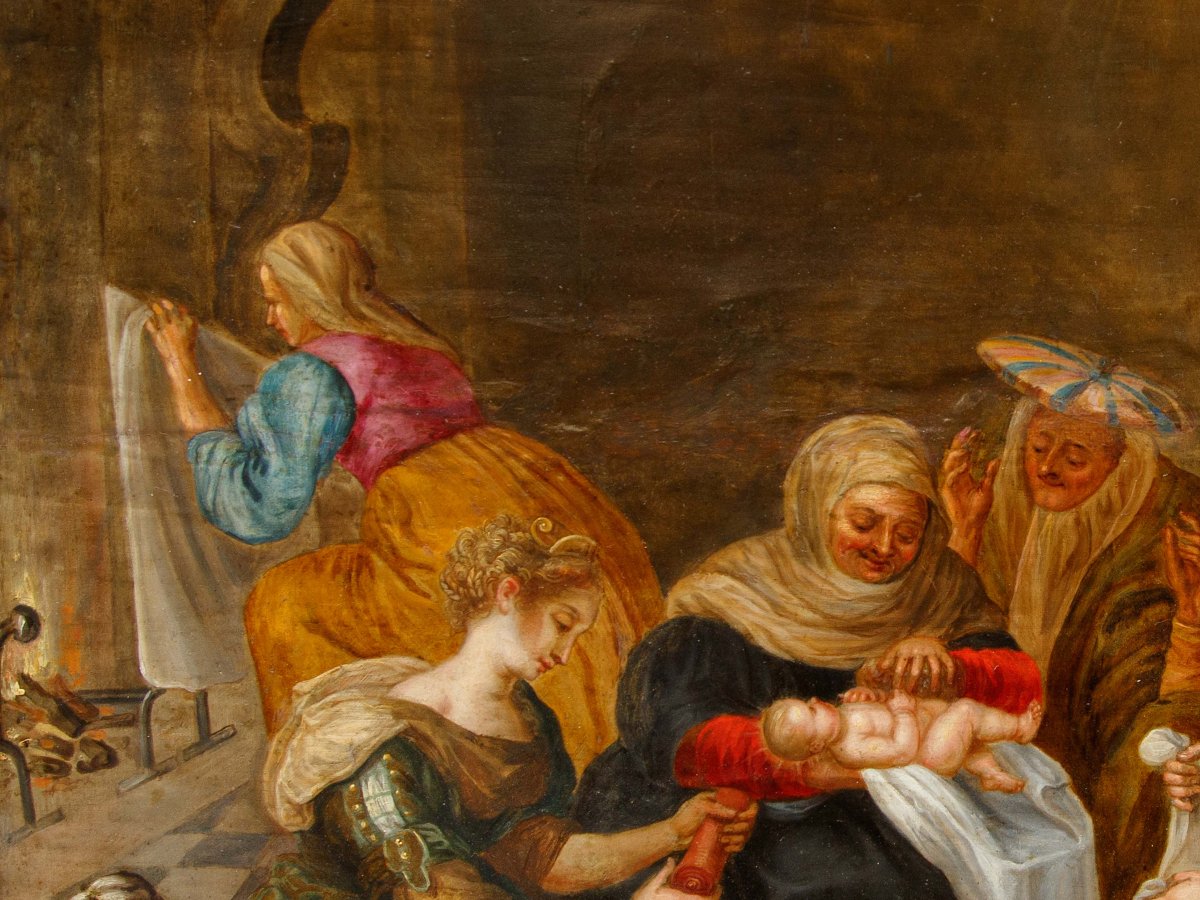
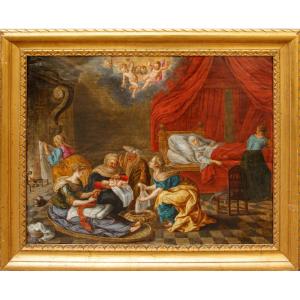
A lively domestic interior serves as the setting for the scene of the Birth of the Virgin, filled with numerous female figures busy assisting Anna in the moments following childbirth. On the right, the bed with red curtains holds the new mother reclining against the pillows, while in the foreground a group of women cares for the newborn Mary: some hold her in swaddling clothes, others prepare the towels for her bath, and still others hand over the linens. On the left, an elderly figure warms cloths by the fireplace—an everyday detail that anchors the sacred narrative in real life. Above, amid golden clouds, a group of winged cherubs introduces the heavenly dimension of the scene. The composition closely resembles that of the autograph painting by Jusepe Leonardo housed at the Prado Museum, dating to the early 1640s and considered one of the masterpieces of his oeuvre: there, too, we find the same arrangement of figures around the bed, the same crowd of women gathered around the newborn, and that attention to naturalistic detail that makes the sacred scene feel extraordinarily close to everyday life. It should also be noted that two additional versions of the subject have been attributed to the artist: a small-scale work from the collection of the Marquis of La Almunia—likely a preparatory sketch—and another housed in the Monastery of El Escorial, the latter’s attribution being more controversial and also linked to Valdés Leal.
To understand the atmosphere of Jusepe Leonardo’s Madrid workshop, it is helpful to compare this work with *The Metal Serpent*, now housed at the San Fernando Academy in Madrid, where we find the same ability to orchestrate crowded compositions with figures making broad, theatrical gestures, as well as that attention to the characters’ heads that betrays an familiarity with Velázquez’s teachings. The most significant compositional source for the subject of The Birth of the Virgin, however, remains Tintoretto’s famous painting, executed around 1590 and now housed at the Hermitage in St. Petersburg, whose scenographic layout—with the bed arranged diagonally and the swarm of female figures in the foreground— appears to have provided the direct model for this composition; nor should we overlook the possible role of Cornelis Cort’s prints on the same theme, which served as a vehicle for the dissemination of Venetian iconography throughout the Iberian Peninsula.
Born in Calatayud in 1601, Jusepe Leonardo moved to Madrid at a very young age, where he was a pupil of Pedro de las Cuevas, in whose home he lived between 1616 and 1621. His involvement in the decoration of the Buen Retiro Palace beginning in 1635 brought him into direct contact with court circles and with the paintings of Velázquez, an experience that further refined his already sophisticated chromatic sensibility. Spanish painting of the high 17th century, of which José Leonardo is a leading figure, draws precisely on this dialogue between the Venetian tradition—as embodied by Titian and Tintoretto— and Dutch influences disseminated through imported prints and paintings, fusing them into a naturalistic yet spectacular visual language capable of conveying, with free and fluid brushstrokes, both the solemnity of sacred narratives and the concreteness of domestic affections.
Period: 17th century
Style: Other Style
Condition: Good condition
Material: Oil painting
Width: 86
Height: 69
Reference (ID): 1798158
Availability: In stock