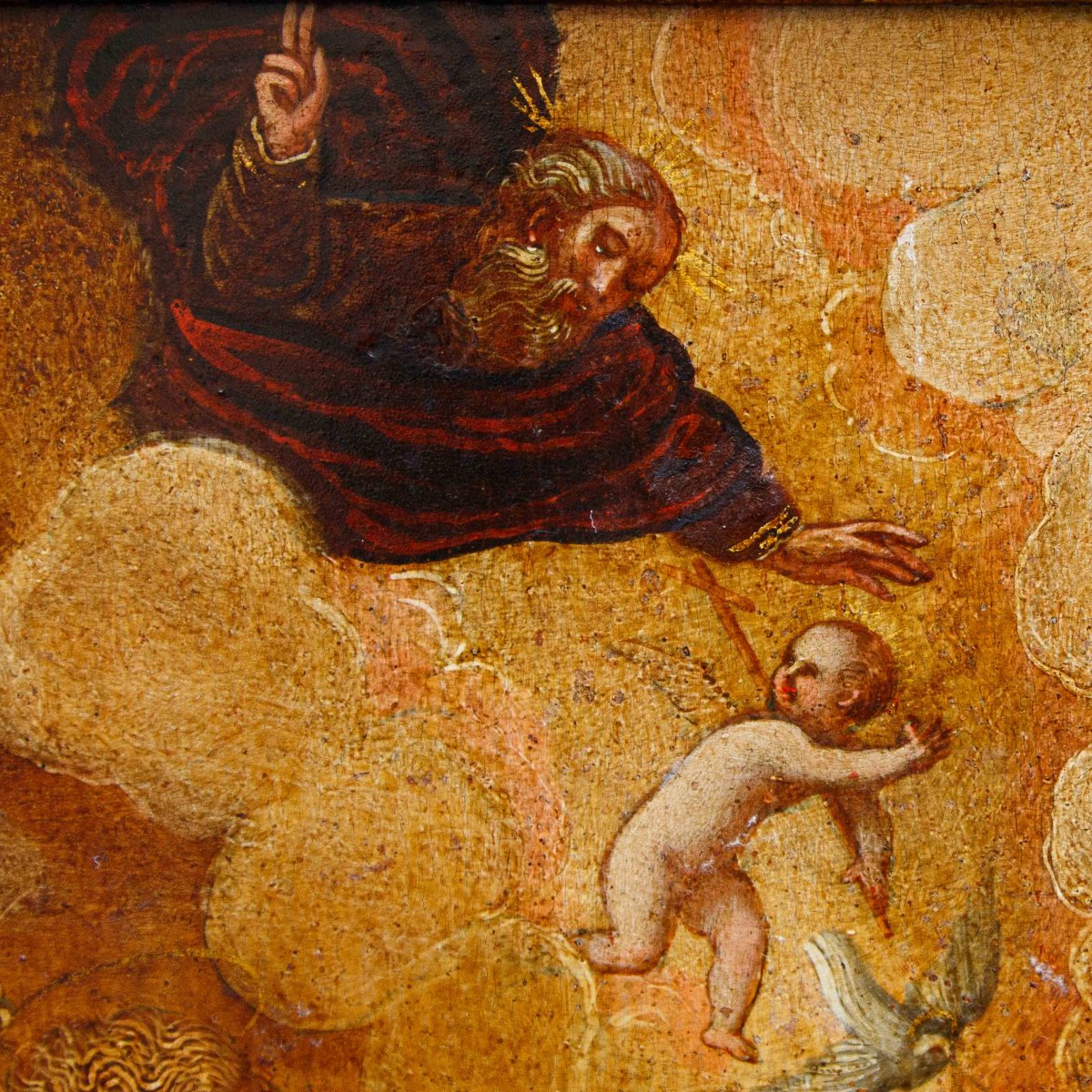


Dalmatian School, 17th Century, The Annunciation
Dalmatian School, 17th century
Annunciation
Oil on panel, 37 x 32 cm
With frame, 49 x 45 cm
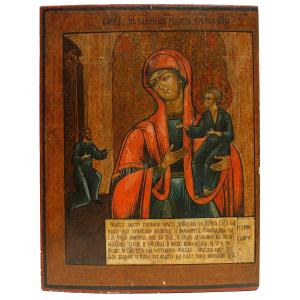
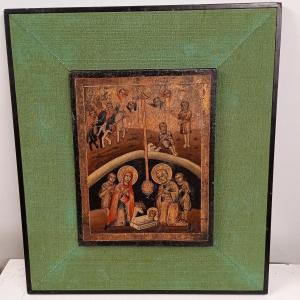
The panel in question highlights the distinctive characteristics of the artistic movement known as Venetian-Cretan, which spread from Venice to the coasts of Dalmatia and the Greek islands from the 13th to the 17th century. The term “Veneto-Cretan” refers to an area situated geographically and culturally between Venice—which politically controlled this vast Mediterranean region—and ancient Byzantium, the historic bridge between Europe and Asia, where Eastern influences prevailed at the time. The most striking example of this cultural and artistic fusion is undoubtedly Domenico Theotokopulos (1514–1614), known as El Greco, who, despite the future developments of his own art, maintained strong technical and figurative ties to the stylistic elements of this school, as evident in the various Annunciations he created throughout his career.
The Byzantine-inspired tradition, characterized by gilded ornamentation and the prevalence of line over volume, is grafted in this work onto Venetian Renaissance innovations: the explicit use of perspective, highlighted by the floor tiles and the vanishing point in the landscape background; the narrative flow of the story; the lively gestures of the figures; the green drape, typically Venetian, to the right of Mary; and the very arrangement of the figures within the Annunciation scene.
Although the warm colors of the panel feature a predominance of Byzantine gold in the background and in the clouds—where, as is typical in the iconography of the Annunciation in this school, the figures of God the Father, the Holy Spirit, and the Infant Jesus generate a descending diagonal toward the Virgin’s face, we also note their materiality, a product of Venetian tonalism, which redraws the contours—no longer as linear as in the Eastern tradition—and is capable of imparting volume, especially to the drapery. We thus observe a coexistence of the two traditions: both from a chromatic and spatial perspective—where perspective and two-dimensionality coexist between a background that recedes into the distance and figures compressed in the foreground—and in terms of expressiveness, with an attempt to reconcile the solemnity of the sacred figures with a more marked and natural characterization in their poses and faces.
Period: 17th century
Style: Other Style
Condition: Good condition
Material: Oil painting on wood
Width: 32
Height: 37
Reference (ID): 1744686
Availability: In stock