Pair Of Vases In Tortoiseshell Alabaster And Gilt Bronze, Rome, Late 18th Century, In The Style
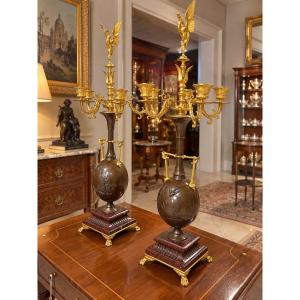
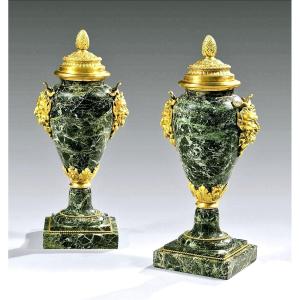
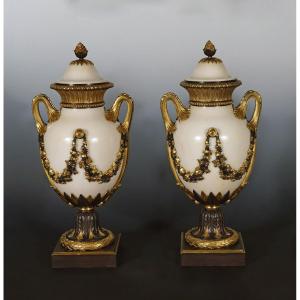
Magnificent pair of urn-shaped ornamental vases made of tortoiseshell alabaster and richly adorned with mercury-gilded bronze. These works are exemplary of the Roman neoclassical style and can be stylistically attributed to the circle of Luigi Valadier (Rome, 1726–1785), one of the finest goldsmiths and bronze-makers of the 18th century.
The ovoid bodies, carved in deeply veined warm-toned alabaster, rest on tall square plinths in alabaster and chiselled bronze. The bronze decorations feature knotted laurel wreaths and leaf garlands, symbolizing virtue and glory, finely cast and perfectly balanced in their placement.
The vertical handles are attached to idealized female heads in gilded bronze, likely referencing Vestals or allegorical figures such as the goddess Roma, crowned with laurel and adorned with neoclassical hairstyles.
A wide bronze frieze runs around the neck of each vase, featuring vine festoons interwoven with bacchic and apollonian masks, delicately executed and consistent with the formal vocabulary of Valadier’s workshop—where grace and symmetry coexisted with archaeological precision.
Each lid, shaped in alabaster, is topped by a gilt bronze pinecone, a symbol of fertility and protection. The base of each vase features an elegant acanthus leaf collar, connecting the vessel seamlessly to its pedestal.
This ensemble is closely related to the output of Luigi Valadier’s atelier, known for combining hardstones and gilt bronze in a style that merged archaeological classicism with refined Rococo elegance. The festoons, ideal heads, lidded tops and architectural bases are all motifs found in documented Valadier works, such as those now in the Louvre, the MET, the Galleria Borghese or the Villa Albani.
The high level of chiselling, volumetric precision and iconographic richness suggest a noble or international commission—perhaps for the French or English market, in line with the export activity of Valadier’s workshop during the second half of the 18th century.
Period: 18th century
Style: Louis 16th, Directory
Condition: Good condition
Material: Bronze
Length: 11
Width: 11
Height: 35,5
Reference (ID): 1591507
Availability: In stock