

Ichimonji Hira-jingasa (samurai Hat), Late Edo Period
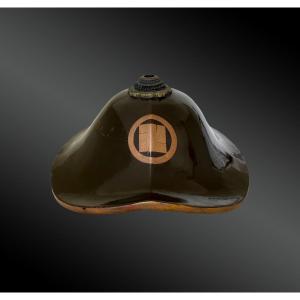
Very beautiful Ichimonji Hira-Jingasa (Samurai hat), from the end of the EDO period (19th century).
Price excluding shipping costs and sold without support.
The Jingasa (lit. "camp hat") was a type of hat worn by Japanese warriors when traveling or camping. This Jingasa, due to its decoration and quality, indicates that it is a Samurai Jingasa.
It includes:
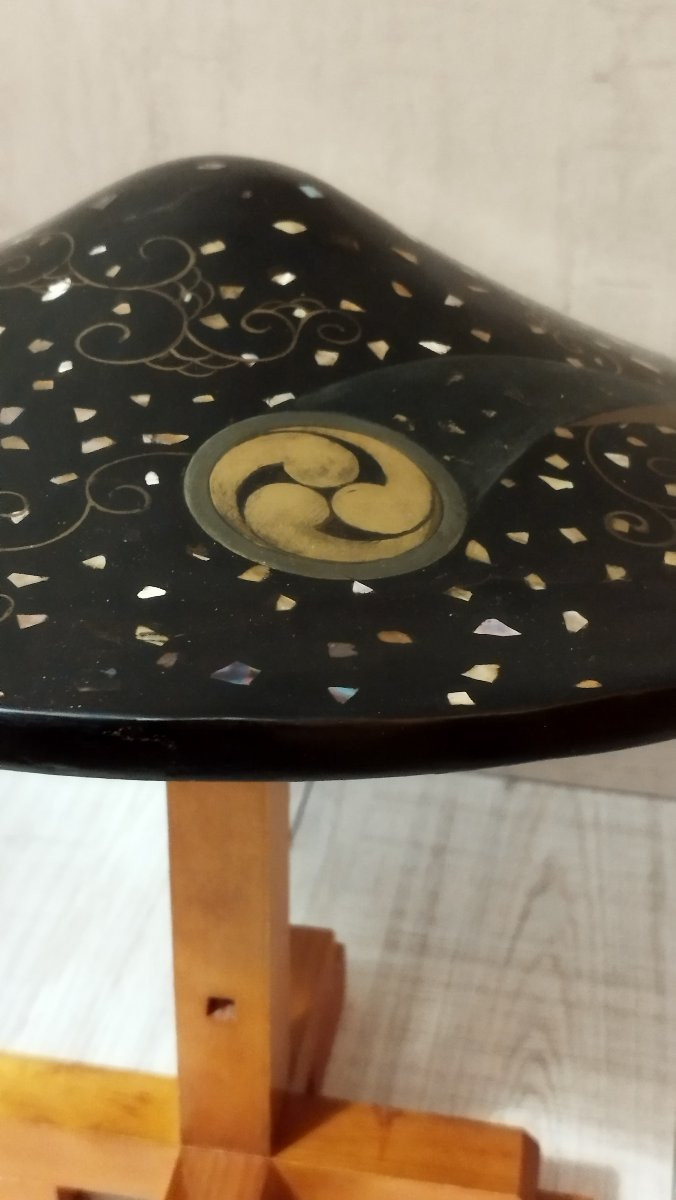
· 3 Kamon (Samurai clan emblem) "Tomoe", made with the Maki-e technique (gold powder). The Tomoe is an ancient heraldic symbol of Japan in the form of a Magatama (a protohistoric ornament of Japan whose shape evokes a pierced fang, a bear claw, a comma or a 9. This specific Tomoe is called Maru Ni Hidari Mitsudomoe, a triple Tomoe rotating to the left, within a circle, and is perhaps one of the most recognizable. The Tomoe was a symbol of auspiciousness and strength used by Samurai families and warrior clans.
· Arabesques, finely made with the technique of Maki-e (gold powder).
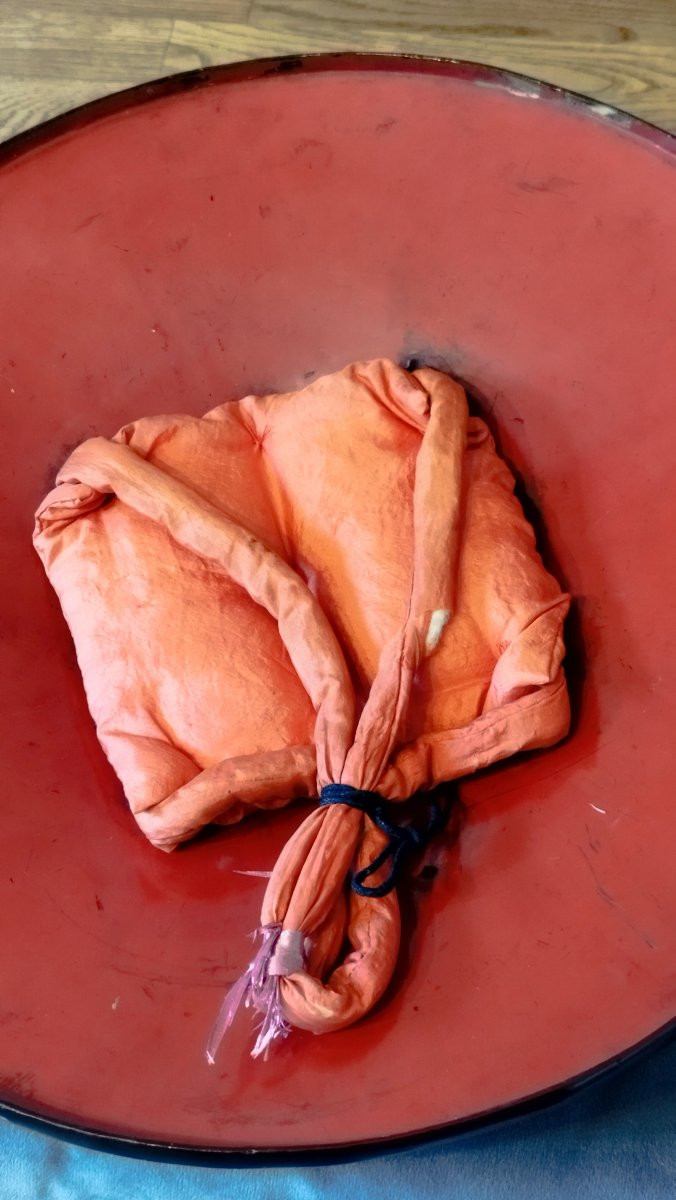
· The interior is composed of a Zabuton, a set including a cushion and a holding cord.
· It is made of black lacquered wood with abalone (mother-of-pearl) inlays on the outside and red lacquered on the inside.
· Dimensions : Diameter approximately 41.3 cm and Height approximately 9 cm.
· Condition : There are some scratches, scuffs, cracks and flaking in the lacquer, due to the age of the object.
Historically, the first JINGASA were mainly designed for the battlefield and worn by the ASHIGARU (Japanese infantrymen). There were, however, more refined Jingasa for the Samurai who preferred to wear something lighter, for daily obligations or in less official contexts. The Jingasa had the same function as the Kabuto, but provided less protection from arrows or sword blows.
The Jingasa was much more suitable for protection from rain or sun, and was also used in the daily life of the Samurai in peacetime, such as hunting, horseback riding, it was also worn by police officers. It demonstrated the social status of the Samurai.
For official ceremonies, the Daimyo wore armor and a Kabuto, but most of the time, it was a Jingasa that he wore (even if it was a golden Jingasa). Finally, the wearing of the Jingasa has not, however not limited to the Samurai.
Price excluding shipping costs and sold without support.
The Jingasa (lit. "camp hat") was a type of hat worn by Japanese warriors when traveling or camping. This Jingasa, due to its decoration and quality, indicates that it is a Samurai Jingasa.
It includes:
· 3 Kamon (Samurai clan emblem) "Tomoe", made with the Maki-e technique (gold powder). The Tomoe is an ancient heraldic symbol of Japan in the form of a Magatama (a protohistoric ornament of Japan whose shape evokes a pierced fang, a bear claw, a comma or a 9. This specific Tomoe is called Maru Ni Hidari Mitsudomoe, a triple Tomoe rotating to the left, within a circle, and is perhaps one of the most recognizable. The Tomoe was a symbol of auspiciousness and strength used by Samurai families and warrior clans.
· Arabesques, finely made with the technique of Maki-e (gold powder).
· The interior is composed of a Zabuton, a set including a cushion and a holding cord.
· It is made of black lacquered wood with abalone (mother-of-pearl) inlays on the outside and red lacquered on the inside.
· Dimensions : Diameter approximately 41.3 cm and Height approximately 9 cm.
· Condition : There are some scratches, scuffs, cracks and flaking in the lacquer, due to the age of the object.
Historically, the first JINGASA were mainly designed for the battlefield and worn by the ASHIGARU (Japanese infantrymen). There were, however, more refined Jingasa for the Samurai who preferred to wear something lighter, for daily obligations or in less official contexts. The Jingasa had the same function as the Kabuto, but provided less protection from arrows or sword blows.
The Jingasa was much more suitable for protection from rain or sun, and was also used in the daily life of the Samurai in peacetime, such as hunting, horseback riding, it was also worn by police officers. It demonstrated the social status of the Samurai.
For official ceremonies, the Daimyo wore armor and a Kabuto, but most of the time, it was a Jingasa that he wore (even if it was a golden Jingasa). Finally, the wearing of the Jingasa has not, however not limited to the Samurai.
900 €
Period: 19th century
Style: Asian art
Condition: Excellent condition
Material: Lacquer
Diameter: environ 41,3 cm
Height: environ 9 cm
Reference (ID): 1567943
Availability: In stock
Print