

Anepigraphic Scarab Amulet - Late Period
Anepigraphic scarab amulet - Late Period
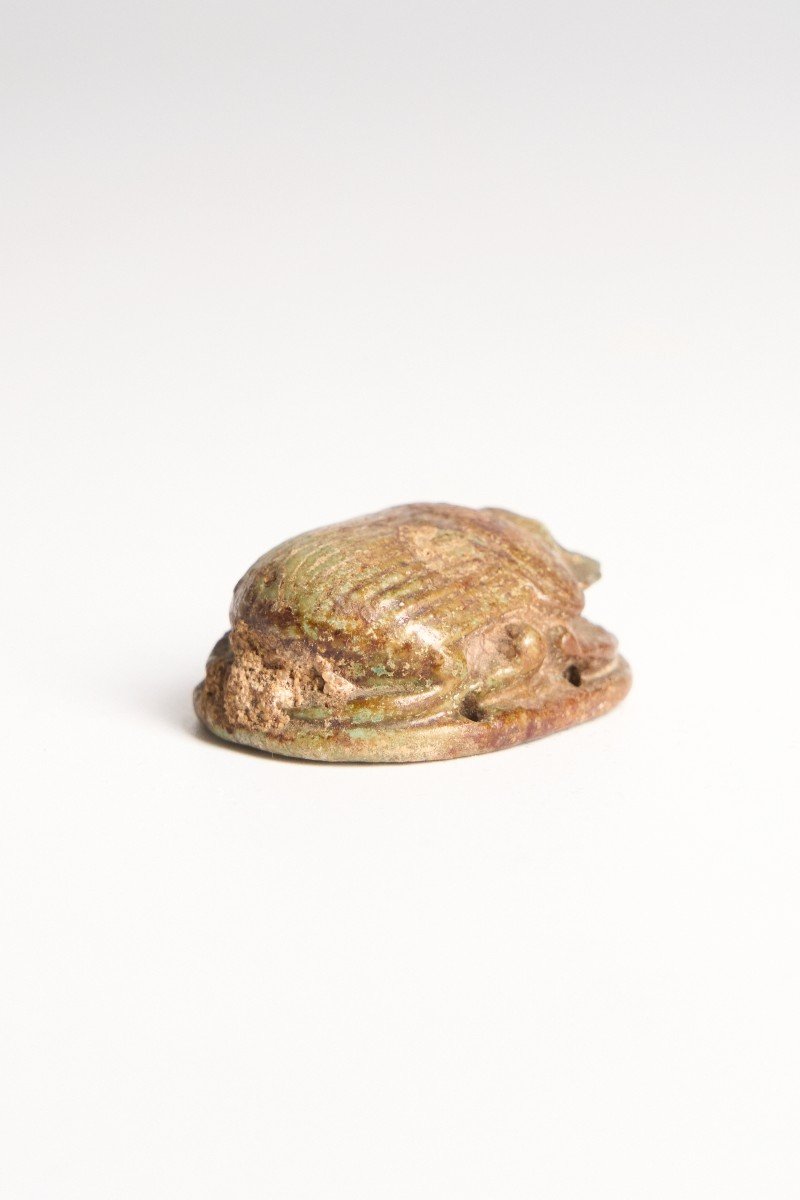
An anepigraphic scarab-shaped amulet from the Egyptian Late Period (664 to 332 BC). Made of siliceous faience, a material frequently used for amulets and votive objects, it has a stylized morphology. Incisions mark the main anatomical divisions of the scarab, including the head, thorax, and elytra.
The underside is smooth, without inscriptions or decorations. The object is in a good state of preservation, with a glaze showing a patina of use, probably due to burial.
Commonly used as funerary talismans, these amulets were associated with the symbolism of the scarab in Egyptian culture.
The insect, linked to the solar cycle and regeneration, was seen as a manifestation of the attributes of the god Khepri, the sun in the making.
Width: 3cm
An anepigraphic scarab-shaped amulet from the Egyptian Late Period (664 to 332 BC). Made of siliceous faience, a material frequently used for amulets and votive objects, it has a stylized morphology. Incisions mark the main anatomical divisions of the scarab, including the head, thorax, and elytra.
The underside is smooth, without inscriptions or decorations. The object is in a good state of preservation, with a glaze showing a patina of use, probably due to burial.
Commonly used as funerary talismans, these amulets were associated with the symbolism of the scarab in Egyptian culture.
The insect, linked to the solar cycle and regeneration, was seen as a manifestation of the attributes of the god Khepri, the sun in the making.
Width: 3cm
850 €
Period: Before 16th century
Style: Rome and Antic Greece
Condition: Good condition
Material: Earthenware
Length: 3cm
Reference (ID): 1507212
Availability: In stock
Print