



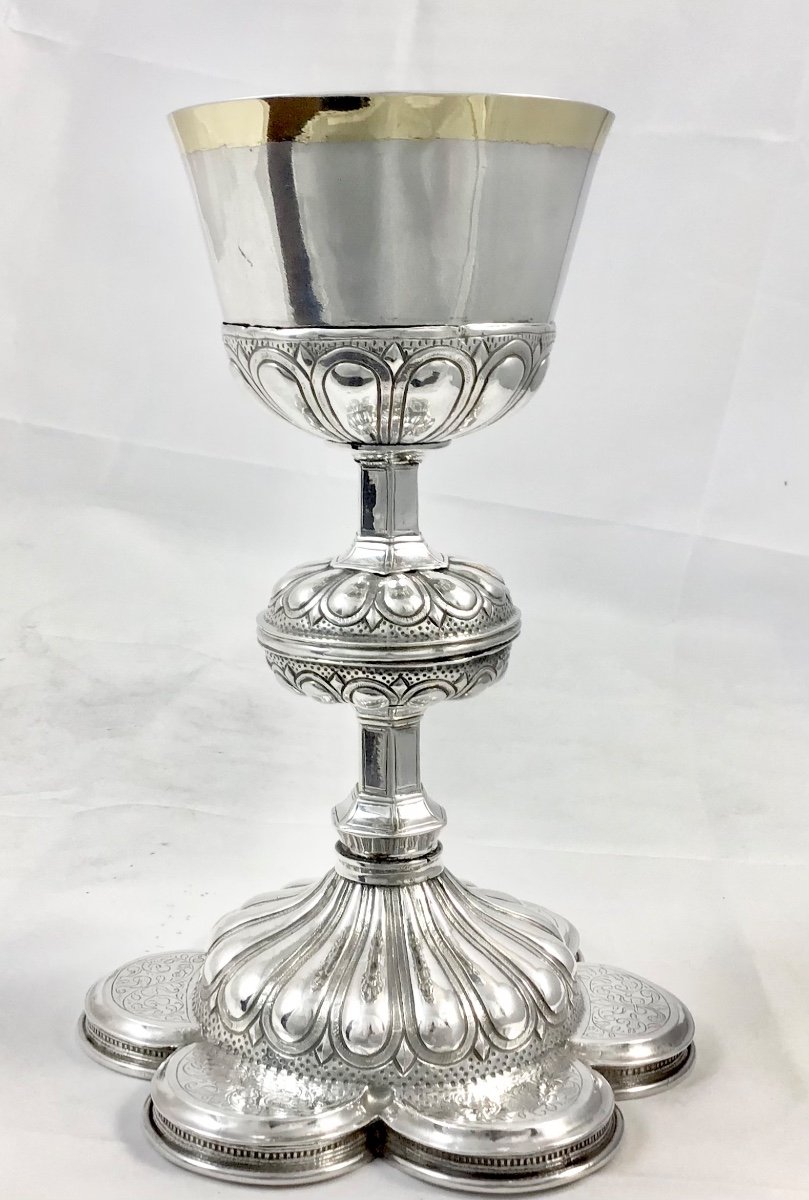


Bruges 1600-1620, Chalice, Solid Silver
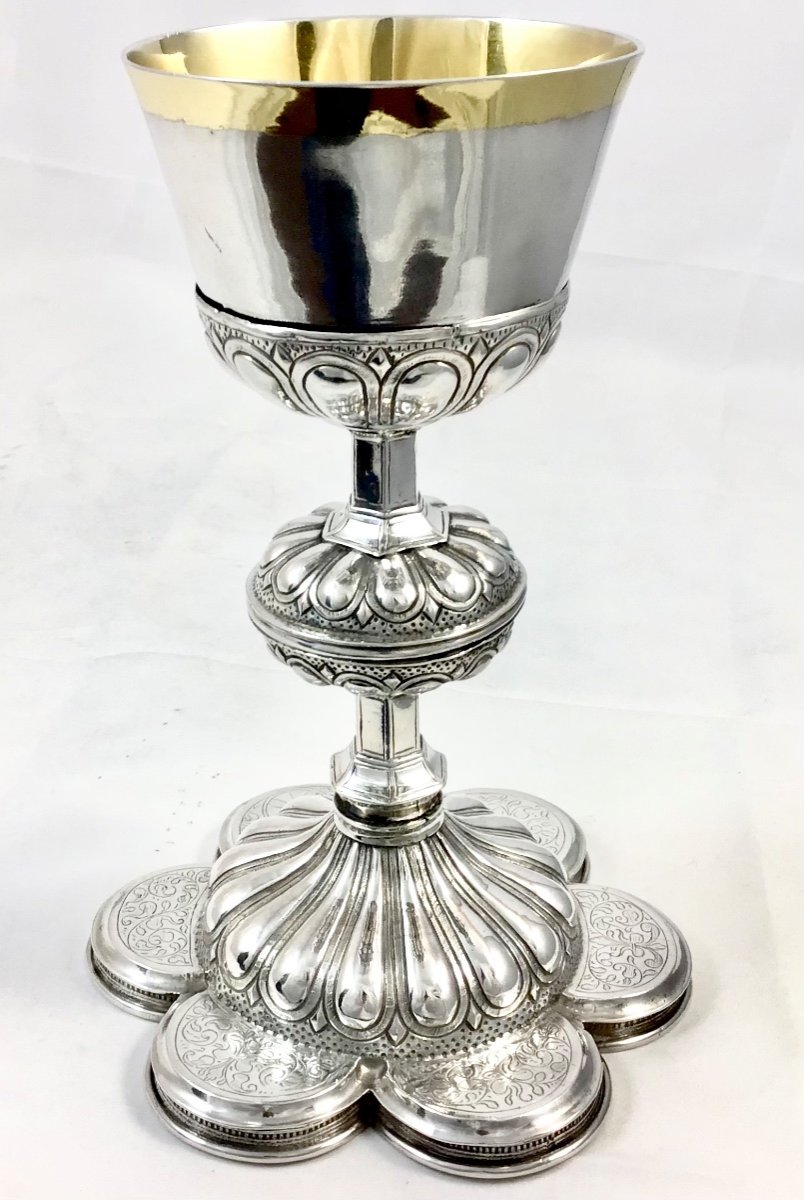
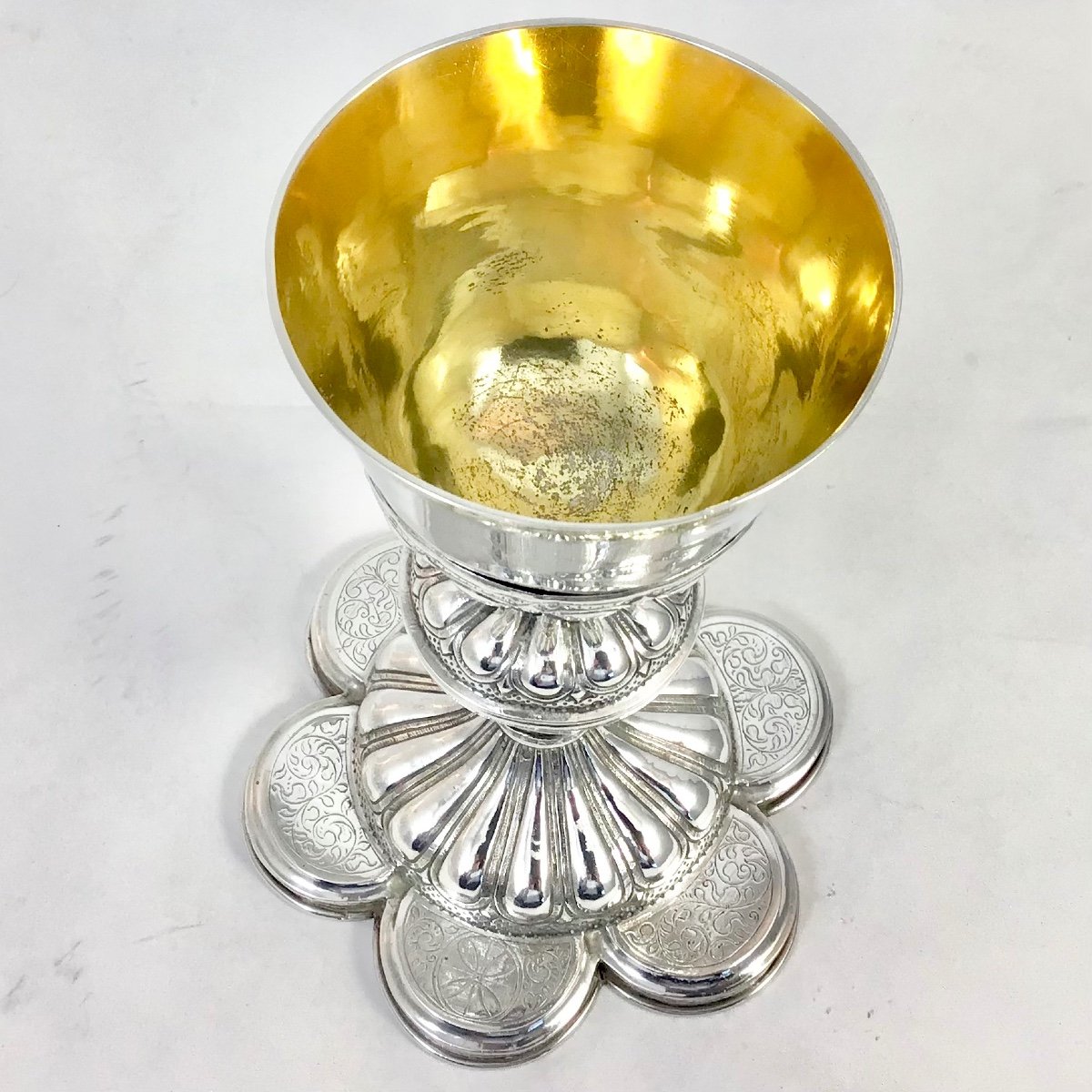
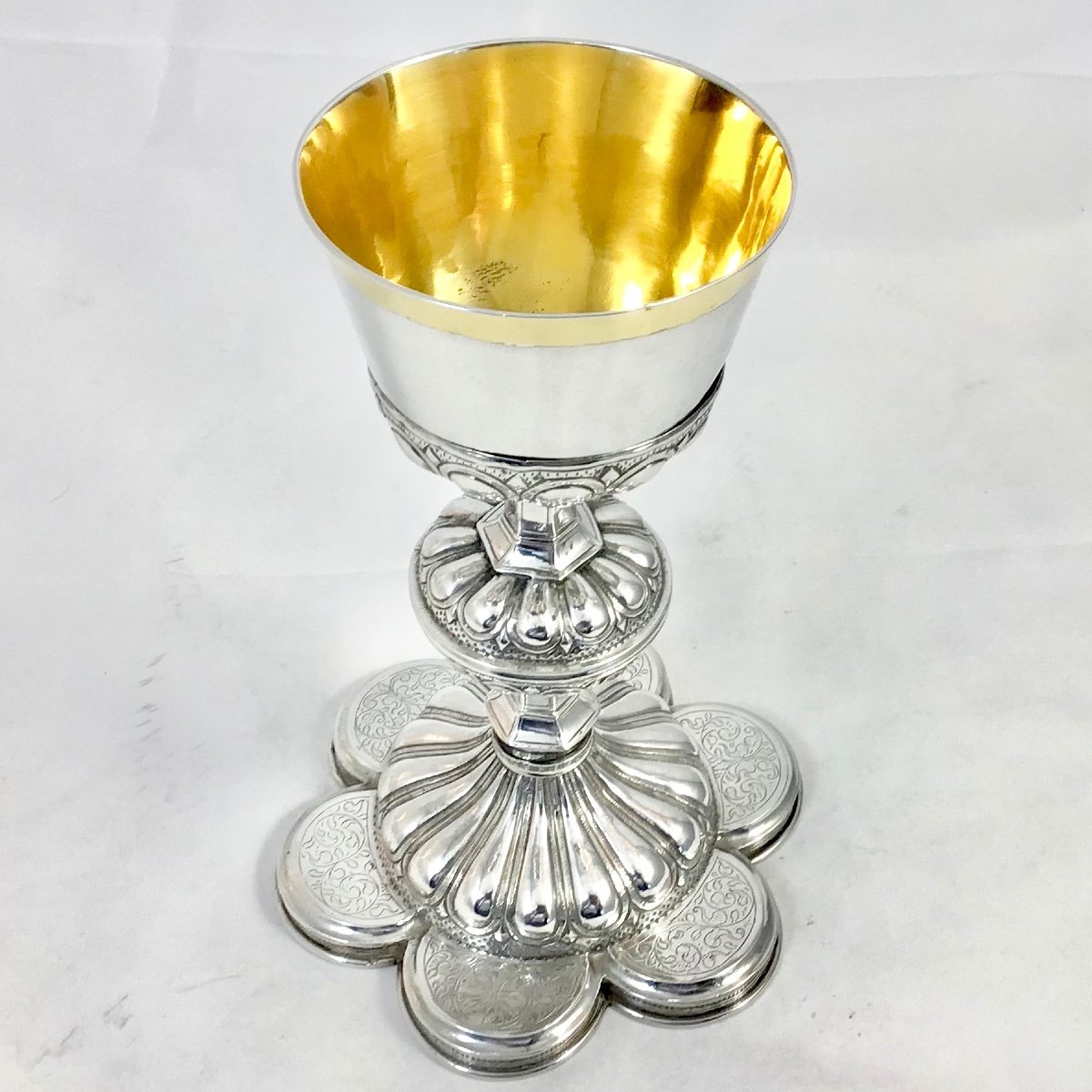
Rare partially gilt solid silver Mass chalice, Bruges, circa 1600–1620.
Attributed to Jacques De Cantere the Younger, admitted as a master silversmith in Bruges in 1617.
Solid silver – interior of the cup and outer rim gilt.
Height: 20 cm – diameter of the foot: 15 cm – weight: over 400 g.
No visible hallmarks.
This rare partially gilt solid silver Mass chalice rests on a six-lobed foot engraved with foliage. The strongly domed upper section of the foot is articulated with broad gadroons standing out against a finely stippled ground.
The hexagonal stem is interrupted by a prominent flattened spherical knop, likewise decorated with gadroons and encircled at its centre by a moulded band. The lower cup mount repeats the same gadrooned decoration on a stippled ground as the foot and knop, creating a remarkable unity of construction and ornament throughout the piece. The interior of the cup and its outer rim are gilt.
The chalice bears no visible hallmarks today. Its form, construction and decoration nevertheless allow it to be placed with considerable confidence within Bruges silverwork of the early seventeenth century.
The Wakken chalice
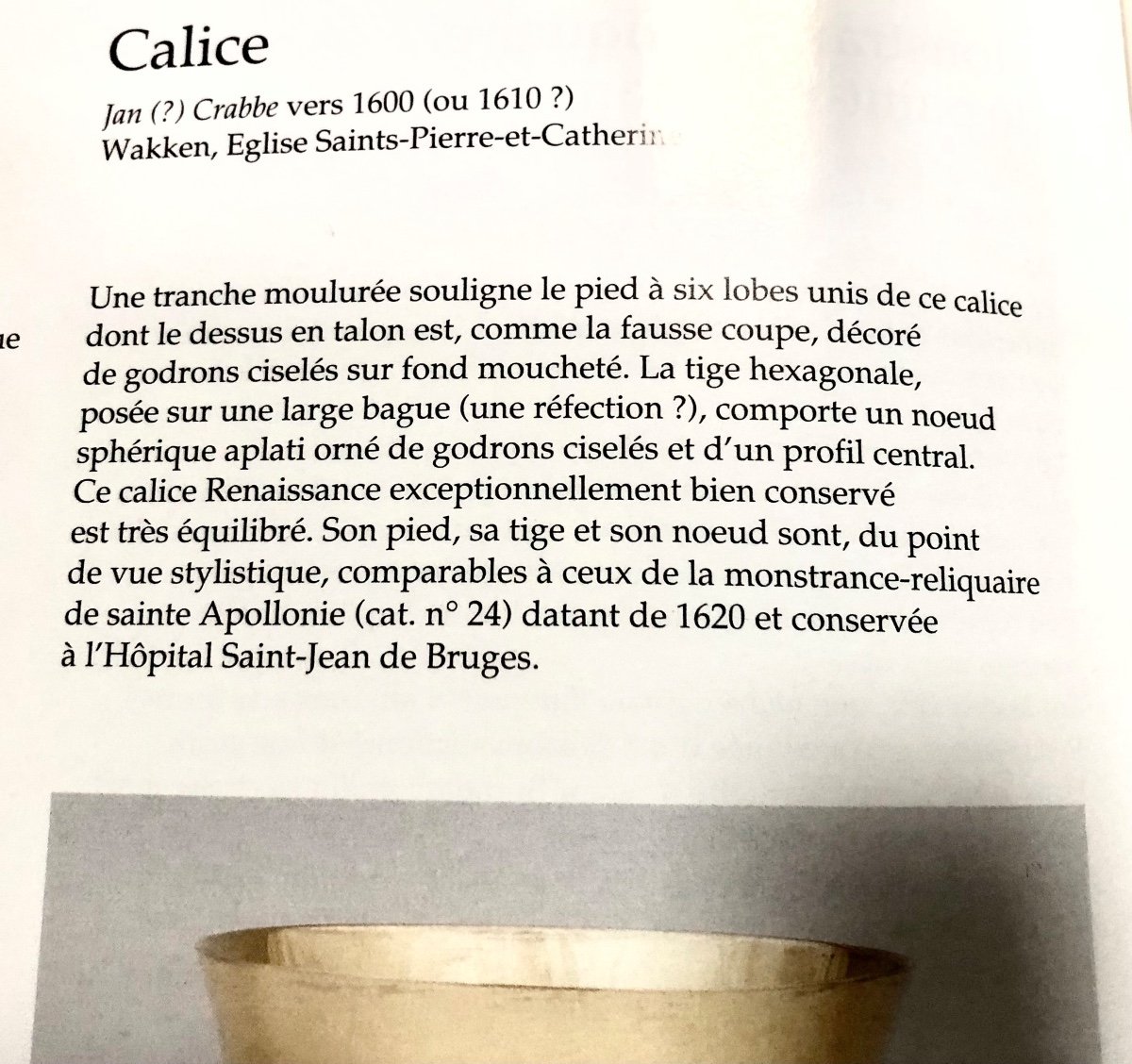
An important first point of comparison is provided by a Renaissance chalice preserved in the treasury of the Church of Saints Peter and Catherine at Wakken, traditionally attributed to Jan Crabbe, one of the leading Bruges silversmiths of the early seventeenth century.
This chalice, dated circa 1610–1611, is remarkably close in construction to the present example: a polylobed foot, a domed central section decorated with gadroons, a hexagonal stem, a flattened gadrooned knop and a lower cup mount employing the same decorative vocabulary.
The traditional attribution of the Wakken chalice to Jan Crabbe should, however, be considered in the context of the knowledge available at the time of the first major studies and exhibitions devoted to Bruges silver. The presence in the same treasury of other works associated with Crabbe certainly played a role in this attribution.
Jan Crabbe is extensively documented as one of the leading Bruges silversmiths of this period. Among his most important works are the monumental Reliquary of the Holy Blood, commissioned in 1614 and completed in 1617, and the reliquary of Saint Eligius in the Cathedral of Saint Saviour. Suzanne Collon-Gevaert includes both among the major achievements of Belgian silverwork of the early seventeenth century.
Jacques De Cantere and the reliquary of Saint Apollonia
An even more precise comparison can be made with the work of Jacques De Cantere the Younger, who was admitted as a master silversmith in Bruges in 1617.
Several works by this silversmith are preserved in the collections of the former Saint John’s Hospital in Bruges. The sources document his activity for the institution from 1619, while several reliquaries executed in 1619–1620 provide a particularly useful picture of the formal vocabulary employed in his workshop.
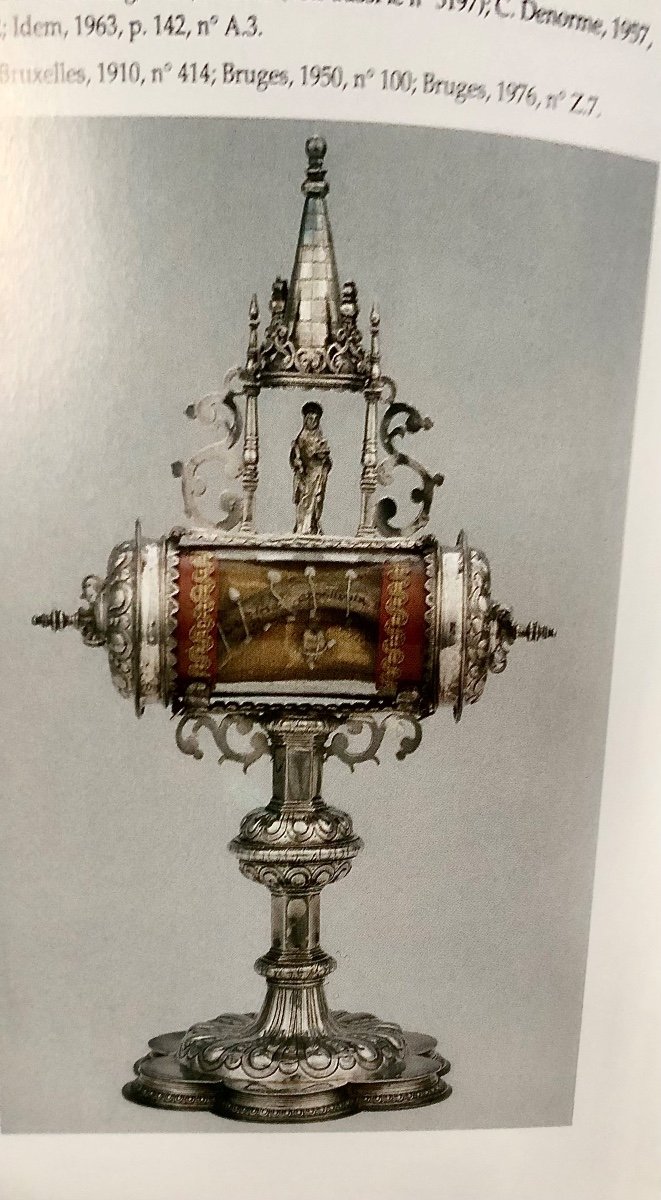
The most compelling comparison is with the cylindrical monstrance-reliquary of Saint Apollonia, made by Jacques De Cantere the Younger in Bruges in 1620.
The relationship with the present chalice is striking and extends far beyond a general stylistic resemblance. The reliquary displays the same type of six-lobed foot, the same strongly domed upper section articulated with broad gadroons, the same hexagonal stem and, above all, a flattened spherical gadrooned knop encircled by a moulded band, remarkably close to that of the present chalice.
The correspondence therefore concerns not merely the decoration, but the actual architecture and construction of the lower part of the object. This is particularly significant since the Saint Apollonia reliquary is a documented Bruges work by Jacques De Cantere, precisely dated to 1620.
Research into Bruges silver further confirms the presence of several works by Jacques De Cantere at the Sint-Janshospitaal in 1619–1620, precisely the period in which the present chalice should be situated.
Attribution to Jacques De Cantere
Comparison with these works therefore allows us to go beyond a merely geographical attribution.
The Wakken chalice provides an exceptionally valuable parallel for placing the present piece within Bruges production of the early seventeenth century. However, the considerably closer correspondence of its foot, stem and knop with the Saint Apollonia reliquary leads us to attribute the present chalice to Jacques De Cantere the Younger.
The absence of hallmarks naturally prevents this attribution from being confirmed by marks. Nevertheless, direct comparison with contemporary Bruges works, and particularly with the reliquary made by Jacques De Cantere in 1620, provides a particularly compelling argument in favour of this attribution and of a date circa 1600–1620.
By virtue of its age, the quality of its chasing, the harmony of its proportions, its remarkable state of preservation and the precise comparisons that can be established with surviving examples of Bruges silver, this chalice constitutes a rare testimony to the great tradition of Flemish ecclesiastical silverwork at the beginning of the seventeenth century.
Bibliographical and comparative references
— Suzanne Collon-Gevaert, Histoire des arts du métal en Belgique, Académie royale de Belgique, Brussels: in particular the sections devoted to early seventeenth-century Bruges silver, Jan Crabbe, the reliquary of Saint Eligius and the Reliquary of the Holy Blood.
— Bouwstenen voor de studie van de Brugse edelsmeedkunst uit de 17e en 18e eeuw, Vlaanderen. Kunsttijdschrift, 36th year, 1987: study of seventeenth- and eighteenth-century Bruges silver, including an inventory of works by Jan Crabbe and Jacques De Cantere.
— Biekorf, 50th year, 1949: early documentation concerning the silversmiths and silverwork of the Sint-Janshospitaal in Bruges, including Jacques De Cantere, admitted as a master in 1617, and his surviving works in the hospital.
— C. Denorme, studies devoted to Bruges silver and the collections of the Saint John’s Hospital, 1957 and 1963; in particular the Saint Apollonia reliquary: Denorme, 1963, p. 142, no. A.3.
— Orfèvreries d’art à Bruges, exhibition catalogue, Bruges, 1950, an important reference catalogue for the study of the principal Bruges silversmiths and their surviving works.
— Exhibition of Ancient Art, Bruges, 1976, no. Z.7: Reliquary of Saint Apollonia, Jacques De Cantere the Younger, Bruges, 1620.
— Marc Rosenberg, Der Goldschmiede Merkzeichen, 3rd ed., Frankfurt, 1922–1928: standard reference work for the identification of European silver marks and masters, including those of Bruges.
Period: 17th century
Style: Renaissance, Louis 13th
Condition: Excellent condition
Material: Sterling silver
Diameter: pied 15 cm
Height: 20 cm
Reference (ID): 1429923
Availability: In stock