

Large Baroque Monstrance, Bruges Circa 1830, Sterling Silver, Beke Peñaranda Coat Of Arms
Artist: Pas De Poinçons
Gigantic sunburst monstrance in solid silver in baroque style. In the absence of guarantee hallmarks, we must rely on the alliance coat of arms and the typological and stylistic characteristics of the monstrance to allow us to locate it in time and space. The coat of arms is that of Pierre Joseph Ignace van der Beke de Cringhen (1792-?) and his wife Sophie Thérèse Jeanne de Peñaranda. They were married in Bruges in 1818. Pierre was an important landowner and descendant of a long line of Bruges patricians as was his wife. They left no posterity. But they appear as donors or owners on this liturgical object.
The foot of the monstrance has the typical shape of the feet of Bruges ciboriums and monstrances from the beginning of the eighteenth century.
It is therefore more than likely that this piece is the work of a Bruges goldsmith.
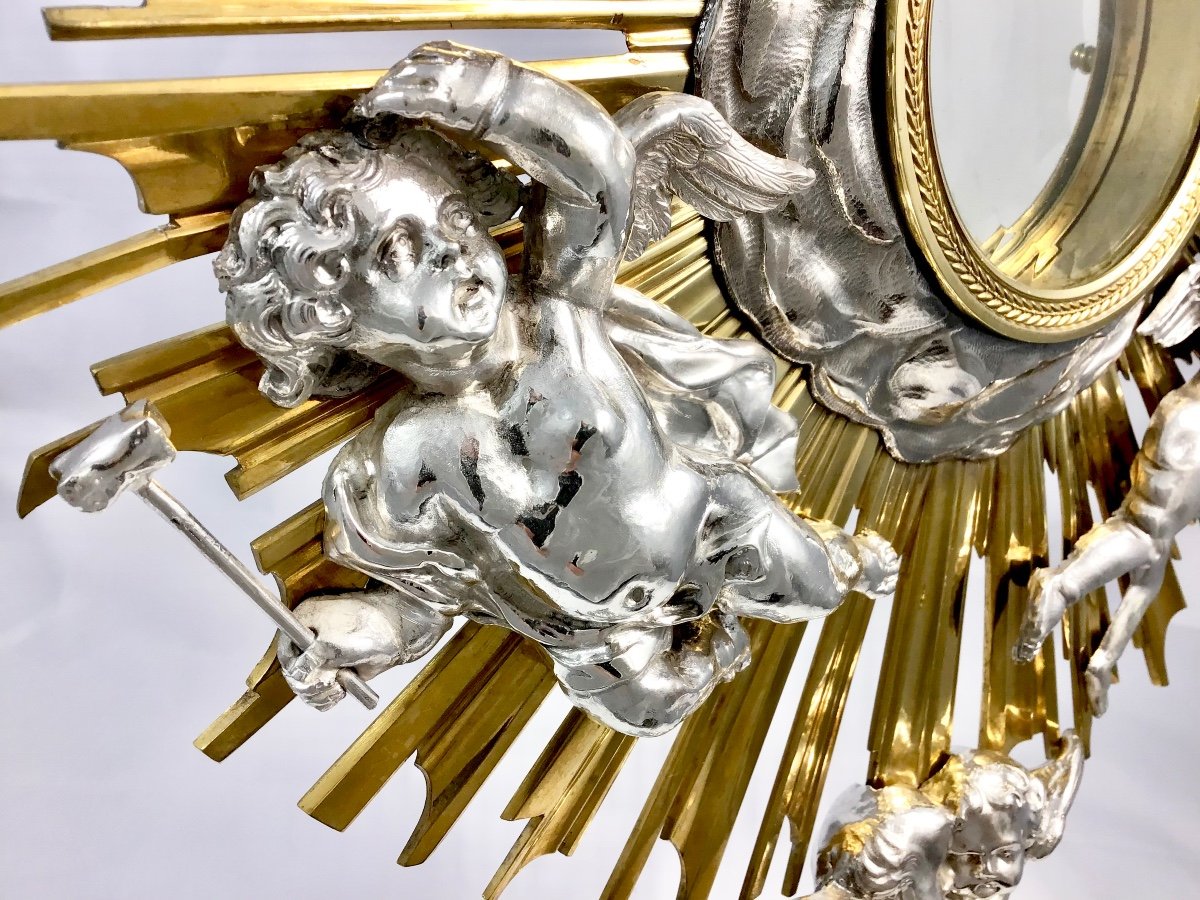
The central medallion, the rays and the knot just below the rays are clearly from the 1820-1830 period.
The crown, the sumptuous base and the four cherubs presenting the instruments of the passion could indeed date from the beginning of the eighteenth century.
The cartridges in the foot and the three cartridges of the knot are all decorated with instruments of the passion of Christ: ladder, nails, believe, the thirty denarii, three dice, a spear, etc. Four angels in the round seem to fly around the central medallion, presenting three nails, crown of thorns, whip and hammer.
More than usual, the accent of the decorations is placed on the passion of Jesus, not on the Trinity or the bread and wine as is often the case.
The quality of the silversmith's work is exceptional. This monster weighs a very impressive 2700 grams and measures no less than 69 cm high.
The foot of the monstrance has the typical shape of the feet of Bruges ciboriums and monstrances from the beginning of the eighteenth century.
It is therefore more than likely that this piece is the work of a Bruges goldsmith.
The central medallion, the rays and the knot just below the rays are clearly from the 1820-1830 period.
The crown, the sumptuous base and the four cherubs presenting the instruments of the passion could indeed date from the beginning of the eighteenth century.
The cartridges in the foot and the three cartridges of the knot are all decorated with instruments of the passion of Christ: ladder, nails, believe, the thirty denarii, three dice, a spear, etc. Four angels in the round seem to fly around the central medallion, presenting three nails, crown of thorns, whip and hammer.
More than usual, the accent of the decorations is placed on the passion of Jesus, not on the Trinity or the bread and wine as is often the case.
The quality of the silversmith's work is exceptional. This monster weighs a very impressive 2700 grams and measures no less than 69 cm high.
7 250 €
Period: 19th century
Style: Renaissance, Louis 13th
Condition: Excellent condition
Material: Sterling silver
Width: 33 cm
Height: 69 cm
Reference (ID): 1362027
Availability: In stock
Print