THIS OBJECT WAS SOLD
Germanic Cavalery Rapier, 17th Century

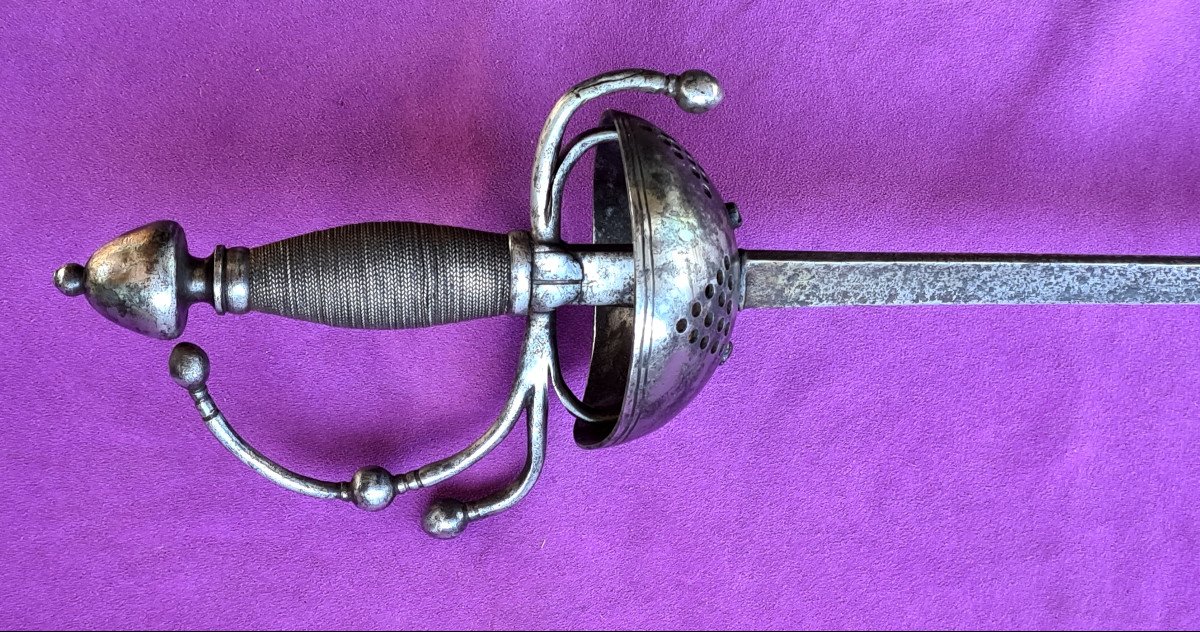




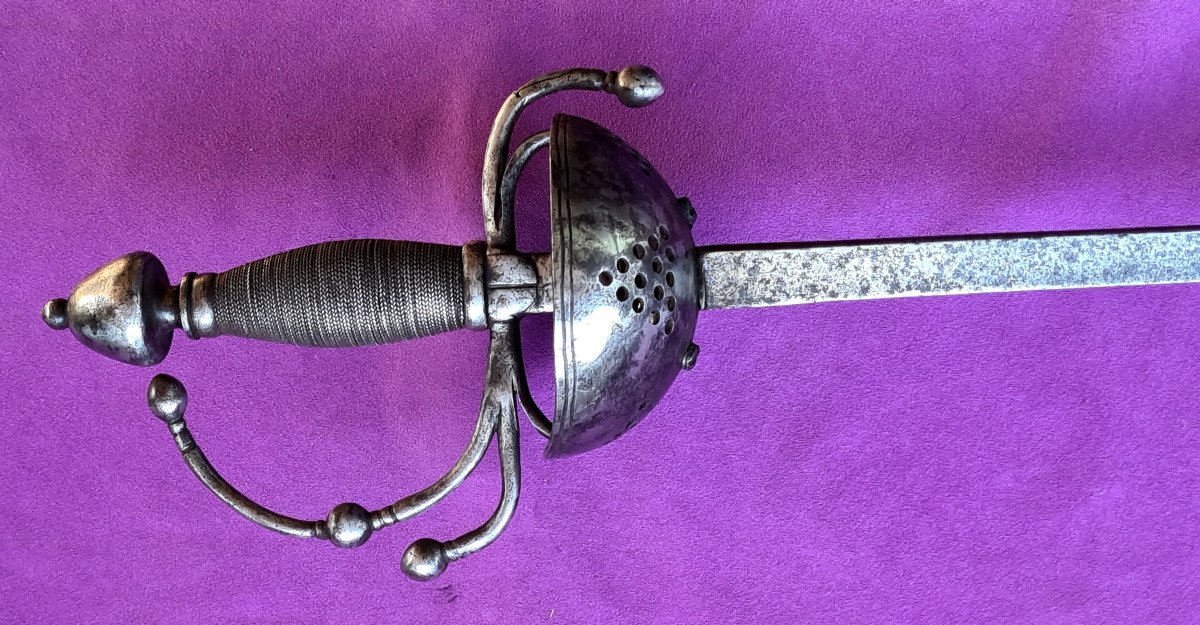

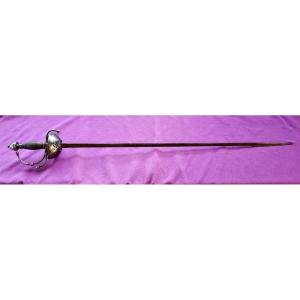


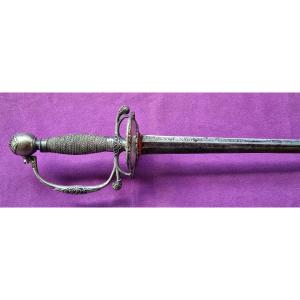
It is a rapier of a very unusual model, very probably Germanic.
First of all, the cup of the guard does not correspond to the models known in Spain, nor to the Italian models.
On the other hand, the nuckle guard branch with a central bulge is entirely in the tradition of the Germanic guards of the period.
And on the other hand the single-edged blade with false edge on the last 13 centimeters is typical of the production of Solingen in the 1600s (see a 1580 rapier that I sold on this same site), so we can attribute without great risk of error a Germanic origin to this weapon
BLADE: It is a single-edged blade, which begins immediately after the bowl, the ricasso part being inside the cup. Counter edge on the last 13 cm near the tip. This blade is very thick, and the back is two-sided (like on a Japanese sword) This thickness allows the blade to retain good solidity during thrusting blows.
Blade length: from the bowl 88.5 cm, from the quillons 94 cm. Width near the hilt = 1.8 cm, thickness near the hilt = 0.8 cm Balance point 7cm from the edge of the cup
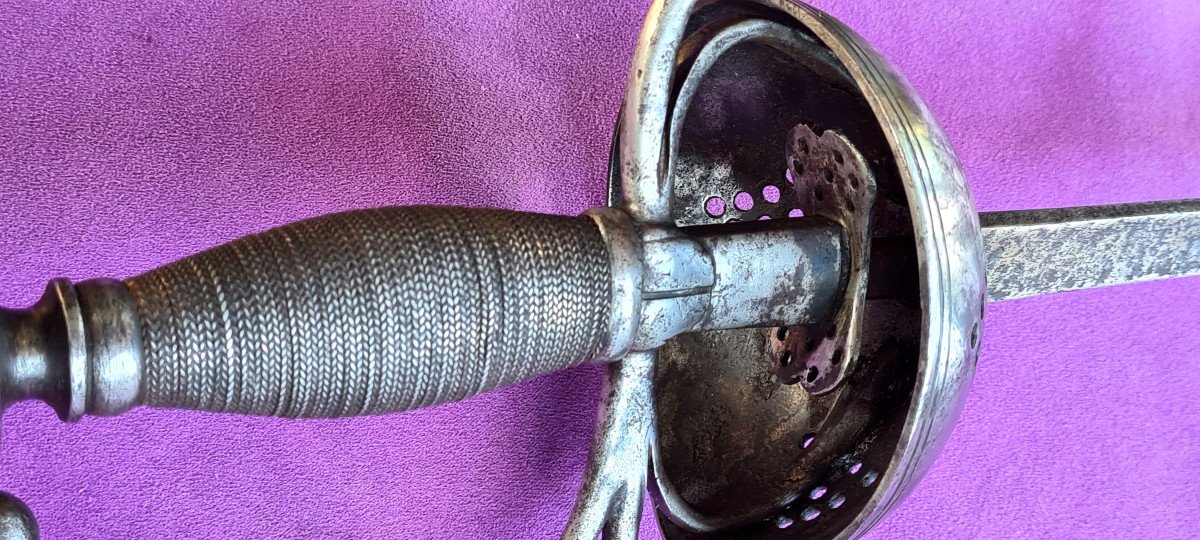
HILT : this is a so-called “Taza” hilt. The bowl is small in size so as not to get in the way when carrying, as is common on cavalry weapons. It is pierced with multiple holes called "point breakers", arranged in triangles.
Two screws ensure the fixing of the bowl to the "donkey steps" (finger rings) .
Presence inside the bowl of a part which corresponds to what the Spaniards call a “guarda polvo”. It is a small interior decoration plate, in pierced iron, in the outer third of the ricasso. I have never encountered this mounting on any other rapier.
The guard itself is with inverted quillons, strongly curved over the mount to avoid snagging on clothing when the weapon has to be quickly taken out of the scabbard. Very slight crack, incomplete at the level of the upper quillon: the quillon is not broken. I mention this for the sake of detail.
The guard branch ends near the pommel.
POMMEL: It is made of iron, conical, surmounted by a small ball.
GRIP: it is made of wood covered with double iron filigree of thin thickness, mounted in rafters.
The ferrules are made of metal rings.
It is therefore a very unusual model of rapier, very probably Germanic. Presumably, it must be a horseman's weapon. Its originality must make it find a place in a collection of swords of this period.
Ref: F23-08
First of all, the cup of the guard does not correspond to the models known in Spain, nor to the Italian models.
On the other hand, the nuckle guard branch with a central bulge is entirely in the tradition of the Germanic guards of the period.
And on the other hand the single-edged blade with false edge on the last 13 centimeters is typical of the production of Solingen in the 1600s (see a 1580 rapier that I sold on this same site), so we can attribute without great risk of error a Germanic origin to this weapon
BLADE: It is a single-edged blade, which begins immediately after the bowl, the ricasso part being inside the cup. Counter edge on the last 13 cm near the tip. This blade is very thick, and the back is two-sided (like on a Japanese sword) This thickness allows the blade to retain good solidity during thrusting blows.
Blade length: from the bowl 88.5 cm, from the quillons 94 cm. Width near the hilt = 1.8 cm, thickness near the hilt = 0.8 cm Balance point 7cm from the edge of the cup
HILT : this is a so-called “Taza” hilt. The bowl is small in size so as not to get in the way when carrying, as is common on cavalry weapons. It is pierced with multiple holes called "point breakers", arranged in triangles.
Two screws ensure the fixing of the bowl to the "donkey steps" (finger rings) .
Presence inside the bowl of a part which corresponds to what the Spaniards call a “guarda polvo”. It is a small interior decoration plate, in pierced iron, in the outer third of the ricasso. I have never encountered this mounting on any other rapier.
The guard itself is with inverted quillons, strongly curved over the mount to avoid snagging on clothing when the weapon has to be quickly taken out of the scabbard. Very slight crack, incomplete at the level of the upper quillon: the quillon is not broken. I mention this for the sake of detail.
The guard branch ends near the pommel.
POMMEL: It is made of iron, conical, surmounted by a small ball.
GRIP: it is made of wood covered with double iron filigree of thin thickness, mounted in rafters.
The ferrules are made of metal rings.
It is therefore a very unusual model of rapier, very probably Germanic. Presumably, it must be a horseman's weapon. Its originality must make it find a place in a collection of swords of this period.
Ref: F23-08
Explore similar pieces and discover your ideal find:
Edged Weapons