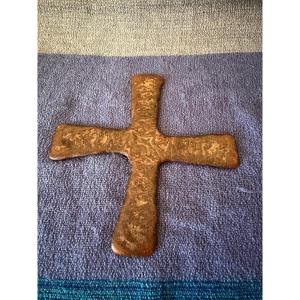
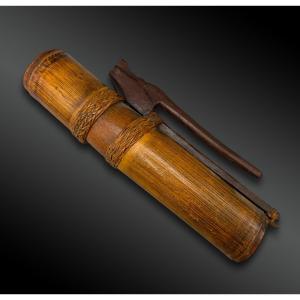
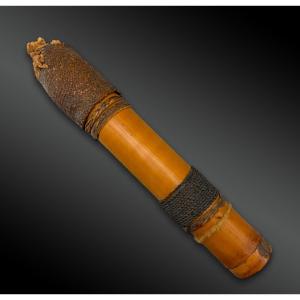
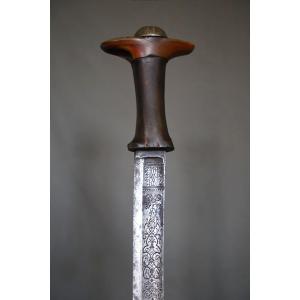
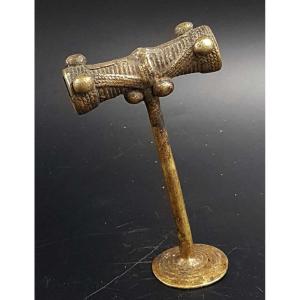
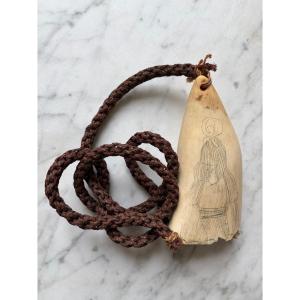
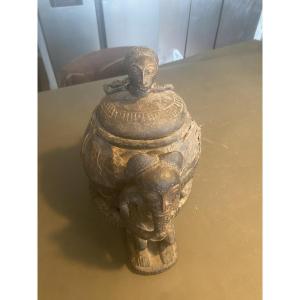
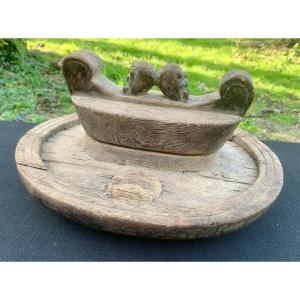
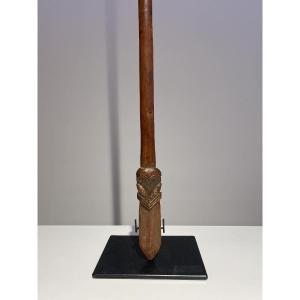
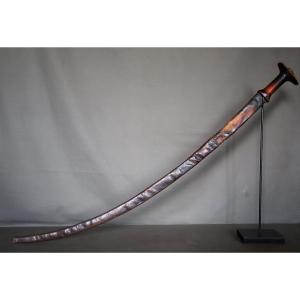
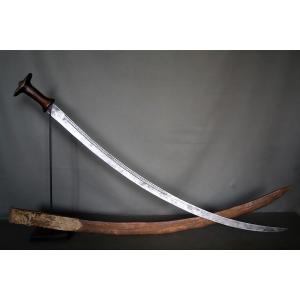
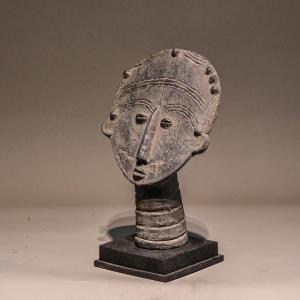
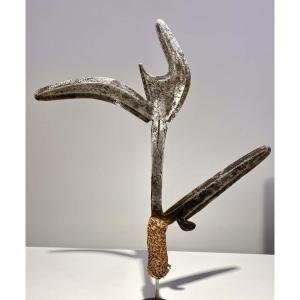
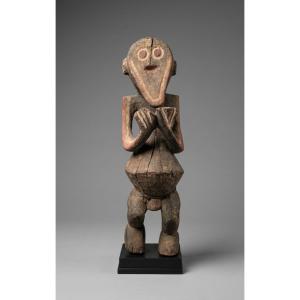
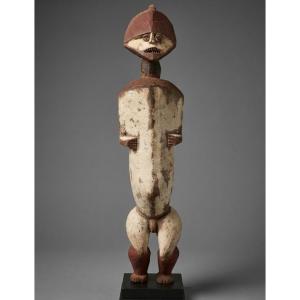
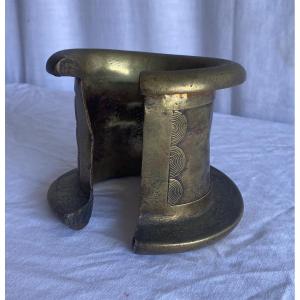
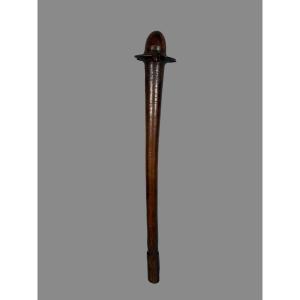
Dogon ritual necklace from Mali.This ritual necklace is made of bronze elements obtained through lost-wax casting and a green Hombori stone mounted as a pendant. Attributed to the sphere of the Hogon[...]
Male portrait, oil on canvas,The intensity of the gaze and the warm light shaping the face make this portrait a fascinating example of late 19th-century portraiture. Size: 21.5 x 29 cmsmall restoratio[...]
Tutsi Shield - Rwanda - African Art - Late 19th - Early 20th Century People: Tutsi Country of origin: Rwanda Height: 32 cm Perfect condition Shield used by Tutsi warriors in the traditional 'intore' d[...]
Large,
hand-thrown, glazed earthenware bowl
Hand-thrown on a wheel, with twin lug handles. These are practical for lifting when full; typical
in traditional cookware. The glaze inside shows heavy [...]
A wrought iron divination bracelet, forming a twisted spiral ring, terminated by a stylized bovine head. The long, tapering horns extend the dynamic of the circle, while the hammered head, reduced to [...]
A standing wrought-iron figure, its extremely slender silhouette resting on large, flat, palm-shaped feet, whose disproportionate size accentuates the overall verticality. Slender legs extend a narrow[...]
Bracelet ending in two ovoid protrusions, engraved with linear almond and dotted geometric patterns. Brass, patinated by time and use. Fulani, Niger, Mali, 19th century. Dimensions: 10 × 9 cm. Provena[...]
A bracelet in the form of an open ribbon, featuring a central head adorned with linear scarification, flanked by two naturally sculpted mice in relief. The piece is distinguished by its precise carved[...]
Indonesia, North Sumatra, Batak Toba peopleThis ancient book of magic and divination serves as a reference guide for Datus (priests, sorcerers, doctors, diviners, astrologers) and their disciples. It [...]
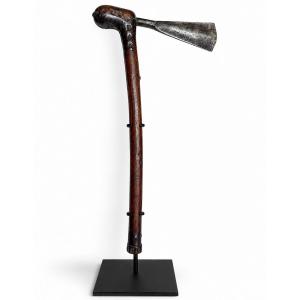
Hardwood, wrought iron, patina from use. Late 19th – early 20th century. This elegant ceremonial axe (prestige axe) comes from the artistic tradition of the Luba people of southeastern Congo. It is di[...]
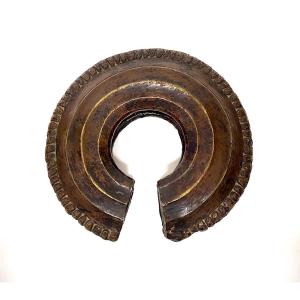
Important bronze money bracelet, also known as a slave bracelet. Incised motifs typical of the Akan Baoulé ethnic group, late 19th, early 20th century. Patina and signs of wear, dents, cracks, and los[...]
Pendant depicting a standing bird-man figure, poised on slender, elegant legs. One hand rests on the lower back while the other accompanies the beak in a symbolic gesture. The face, with its sculpted,[...]
A divination ring featuring a humanized buffalo head with a strongly projecting muzzle, triangular and cubist in form, lending the piece a powerful graphic presence. The widely spread horns and the ce[...]
A very old pendant depicting a hornbill standing on its two legs, its tail fanned out. The wings, rendered in stylized volumes, are adorned with spiral motifs forming an abstract face integrated into [...]
TSUBA Naga Maru GataJapanEdo period (1603–1868)Iron, gold, silverH: 6.3 cm; W: 6.4 cm; Thickness: 3 mm H. Nakago Hitsu Ana: 3.1 cmOpenwork tsuba, chiselled with a man in a kimono with a copper face, s[...]
A seated wrought-iron figure with a slender body and deliberately simplified forms. Long, forward-leaning legs end in flat, slightly raised feet. The narrow torso rises to an elongated head, almost ge[...]
Pair of marble garden planters, extremely rare neoclassical model, attributed to Rome, Italy, 19th century. Large in size, please allow ample space and a second person to move these planters as they a[...]
Pet bed, polychrome wood, circa 1900, from India. RADJASTAND: With its simple and elegant design, it will delight your beloved pet. Shipping subject to conditions; quote upon request; documents will f[...]
FISHING HOOKMalaita Island, Solomon IslandsLate 19th–early 20th centuryTortoiseshell and natural fibersH: 7 cm; W: 1 cmThe shank and barb are carved from tortoiseshell and assembled using a cord made [...]
FISHING HOOKSolomon IslandsLate 19th–early 20th centuryMother-of-pearl, tortoiseshell, and natural fibersH: 0.34 in; W: 0.59 in(restored)The shaft, shaped like a stylized fish, is made of mother-of-pe[...]
Wood, ritual patina. Non-professional base. Provenance: Gérald MINKOFF & Muriel OLESEN, Switzerland (photo of the object in the collection). Literature: Voodoo, Cartier Foundation for Contemporary Art[...]
Beautiful monoxyle bowl carved from a single block of solid walnut, originating from the Ardèche region.
An antique piece of traditional rural craftsmanship, carved with a gouge, displaying a rich pa[...]
Exceptional Kota Ndasa wooden shrine, partially eroded and covered with copper and brass sheets, 52cm high plus base. This is the archetype of the Mbulu-Ngulu variant made by the Ndasa people living i[...]
Ashanti bronze gold dust box with twin crocodile motif – Ghana, late 19th / early 20th century
Beautiful Ashanti (Asante) gold dust box (forowa or abamoo), cast in solid bronze using the lost-wax tec[...]
WEAVING LOOM PULLEY BRACKET ANIMATED WITH AN ANTHROPOMORPHIC FIGUREGouro culture, Ivory CoastLate 19th–early 20th centuryWood and pigmentsH: 25; W: 9.5 cmPulley featuring a large bust with a particula[...]
This pipe bowl demonstrates the sculptors' mastery. The figure of the body conforms to the shape of the bowl. The face, scarified with motifs, extends a hairstyle typical of the Mangbetu, highlighting[...]
WEAVING LOOM PULLEY BRACKET featuring a FEMALE FIGUREMossi culture, Burkina FasoLate 19th–early 20th centuryWoodH: 16; W: 9 cmThe upper part of the stirrup features a conical chest—a stylistic charact[...]
WEAVING LOOM PULLEY BRACKET with a BIFRONS FACEGouro culture, Ivory CoastLate 19th–early 20th centuryWood with crusty patinaH: 18; W: 5 cmThis pulley has a bifrons face, both anthropomorphic and zoomo[...]
WEAVING LOOM PULLEY BRACKET with a HOOKBILL HEADSenufo culture, Ivory CoastLate 19th–early 20th centuryWoodH: 17; W: 8 cmSingle-piece wooden pulley, carved with a stylized bird's head reminiscent of a[...]
WEAVING LOOM PULLEY BRACKET featuring a FEMALE FIGURE Gouro culture, Ivory CoastLate 19th–early 20th centuryWood with crusty patinaH: 22.5; W: 7 cmSculpted with an oval face and pointed chin, this fig[...]
WEAVING LOOM PULLEY BRACKET with ANTHROPOZOOMORPHIC FACEGouro culture, Ivory CoastLate 19th–early 20th centuryWood with shiny patinaH: 6.5 in; W: 2.4 inAlso known as kono, this pulley is animated by a[...]
WEAVING LOOM PULLEY BRACKET with ANTHROPOMORPHIC FACEMossi culture, Burkina FasoLate 19th–early 20th centuryWood and ironH: 18.5; W: 6 cmBracket featuring a stylized anthropomorphic face with a long n[...]
WEAVING LOOM PULLEY BRACKET with HOOKED HEADSenufo culture, Ivory CoastLate 19th–early 20th centuryWoodH: 18; W: 9 cmSingle-piece wooden pulley, carved with a stylized bird's head reminiscent of a hor[...]
WEAVING LOOM PULLEY BRACKET with ANTHROPOMORPHIC FACEGouro culture, Ivory CoastLate 19th–early 20th centuryWoodH: 16.5; W: 6 cm(slight damage from age)The stylized face that adorns the upper part of t[...]
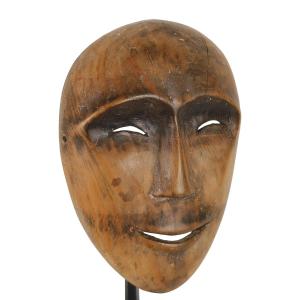
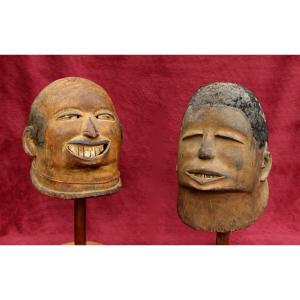
Wood, bone 23 cm. Provenance: Adama Jawara, Monrovia, April 1984. Dr. Frederick Lamp, New Haven. AHDRCao-0141872-001. This mask, of remarkable ancient beauty, is distinguished by its prominent mouth a[...]
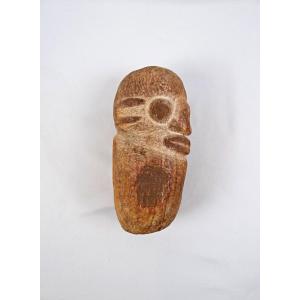
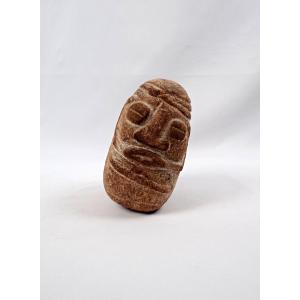
CIVILIZATIONSDOCEANIC PRIMITIVE ART Rare funerary stele SUNDUK in fossil limestone (coral fossil?) Indonesia, SULU Archipelago, Southern Philippines BAJAU Culture The upright body ends on its sides wi[...]
CIVILIZATIONS / ETHNIC JEWELRY Morocco 19th century Superb Berber ethnic necklace, composed of 7 silver medallions alternating with multicolored blown glass tubes (in the style of Venetian Mille Fiori[...]
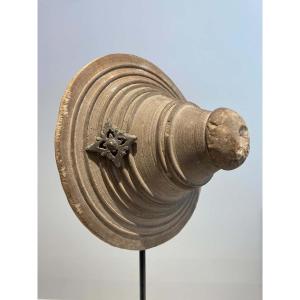
POLYNESIA 19th-century phallic pestle for pounding breadfruit, pestle with a large circular base, tapering to a cylindrical handle surmounted by a phallic head, hard basalt stone carved and polished w[...]
African pendant from the 'Hungaan/Hungana' tribe of the Congo - Africa - late 19th century. Sold with a CITES certificate for free trade in Europe.included base! Ex. William Brill collection, New York[...]
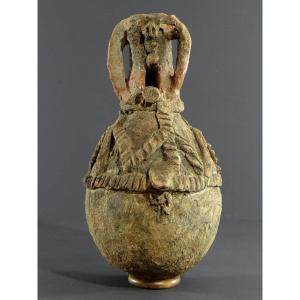
Nkisi Mbumba Fetish – Vili-Kongo, Democratic Republic of Congo – late 19th – early 20th century. Rare Nkisi Mbumba fetish, also known as a “medicine ball,” from the religious tradition of the Vili-Kon[...]
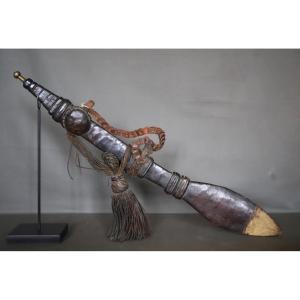
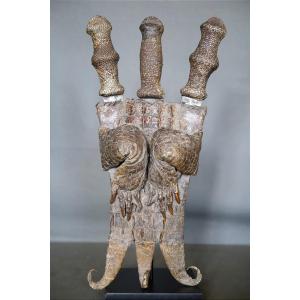
This bronze Tlingit dagger was used as a ritual and symbolic emblem of clan affiliation. It is distinguished by the presence of a totemic animal as its pommel: a bear, which, for the Tlingit, evokes s[...]
This large powder flask is carved from dark wood patinated by use. It illustrates the care and creativity of Kuba artists. Its rounded body is covered with engraved geometric patterns characteristic o[...]
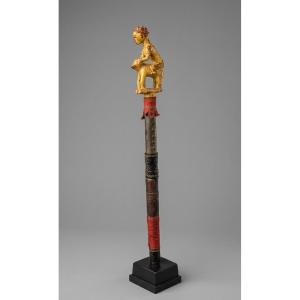
Ritual scepter "Oshe Shango" used during ceremonies related to the god of thunder. It consists of a handle topped with a zoomorphic Janus head. The mouth is common to both heads. It is open and accomm[...]
Traditional Melanesian Fishing Spear Head – Bismarck Archipelago (Papua New Guinea) – Late 19th / Early 20th Century
A rare multi-pronged fishing spear head (leister) from the Bismarck Archipelago, m[...]
Antique Kanak bracelet, from a village chief, made of shell cône (Conus leopardus) and braided fruit bat hair (large bat).* New Caledonia, late 19th, early 20th *Length of the braids: 4 braids of 2 me[...]
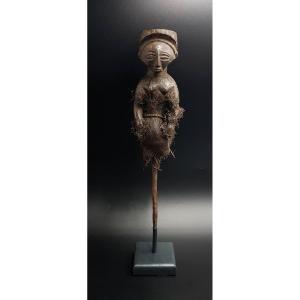
SONGYE, Democratic Republic of CongoFetish depicting a character with bent knees, hands with fan-shaped fingers placed on the stomach, face with a vigorous expressionWood, cord, copper, wrought iron a[...]
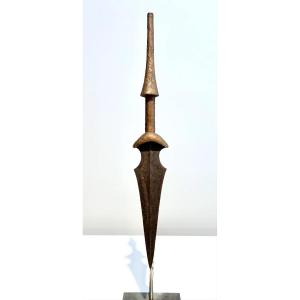
Wrought iron rod with a rhomboidal lanceolate point enriched with a sort of perimeter "eyelashes". Used as currency at the time.Height: 49 cm Found in the book: (An Ethnographic Study of Traditional M[...]
Kitab Ethiopian amuletVery beautiful piece in leather and parchmentWork late 19th early 20thOromo people, EthiopiaFree and insured shipping in mainland France
Guampa (tereré container) in horn and silver. Plata Arana hallmark, tested with a touchstone Paraguay, late 19th – early 20th centuryPolished natural horn mounted with two silver rings finely chiseled[...]
Proantic uses a cookie to analyze traffic and improve its service by using Google Analytics. Data sent to Google Analytics (frequency of visits to the site and pages visited) are anonymous. No other cookie tracks your activity, your personal data is not collected. Thank you for helping us to have better understanding how Proantic is used.