





Lille, 1790, Solid Silver, François Baudoux, Pair Of Candlesticks
Pair of Solid Silver Candlesticks – François Baudoux-Delefosse – Lille, 1790
An elegant pair of solid silver candlesticks made in Lille in 1790 by the silversmith François Baudoux, known as Baudoux-Delefosse.
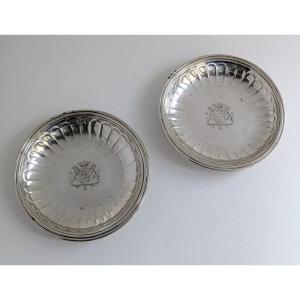
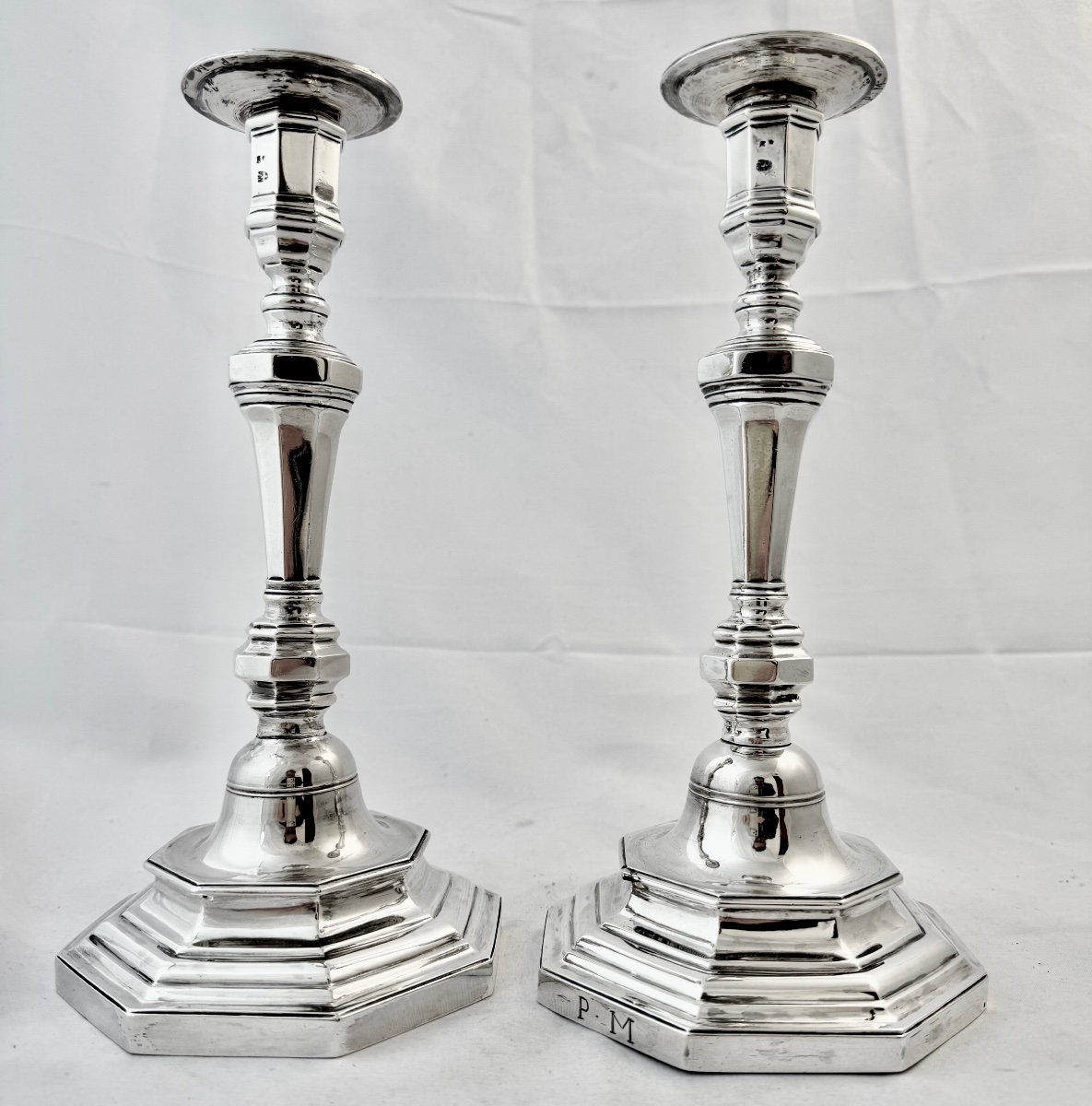
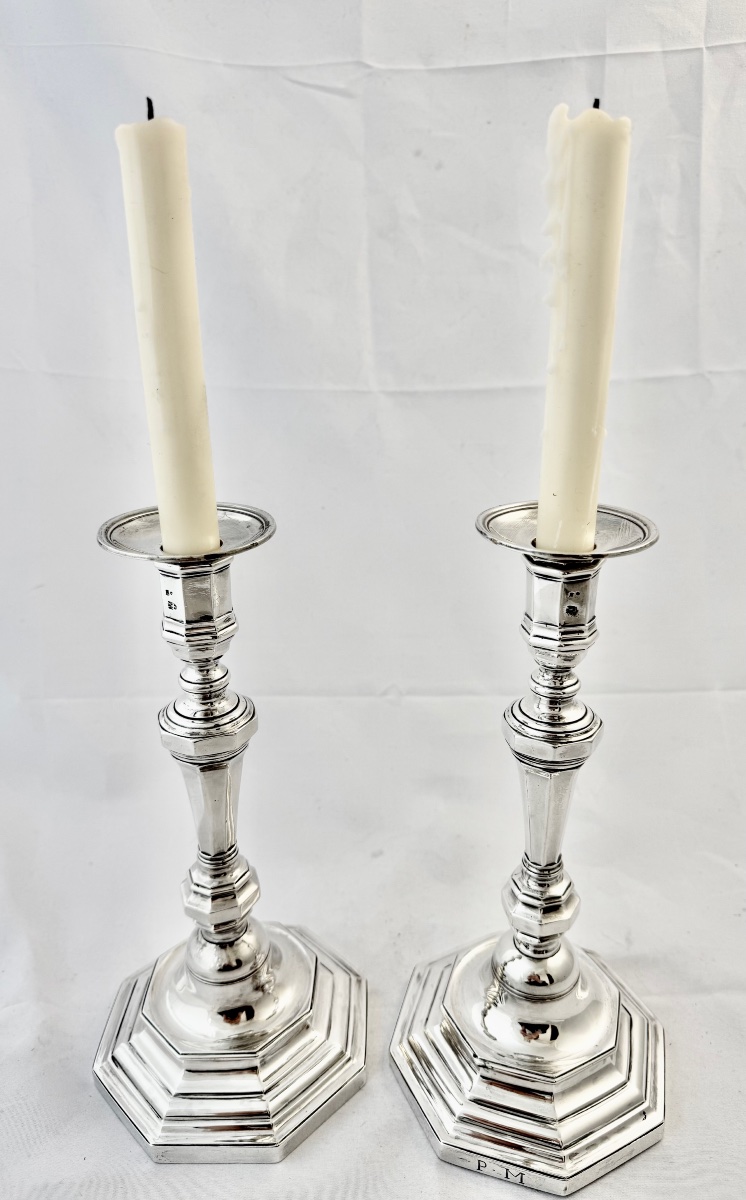
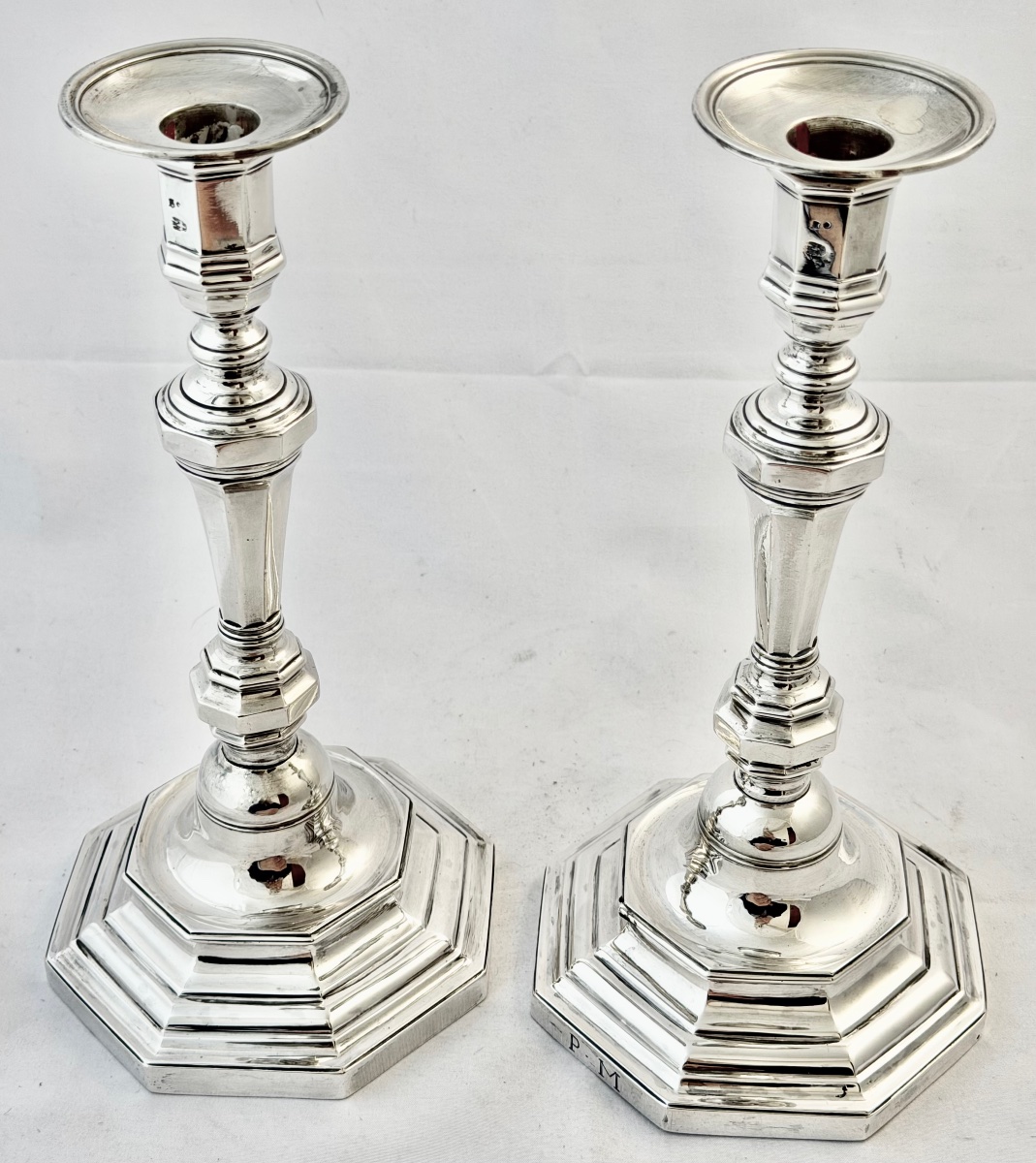
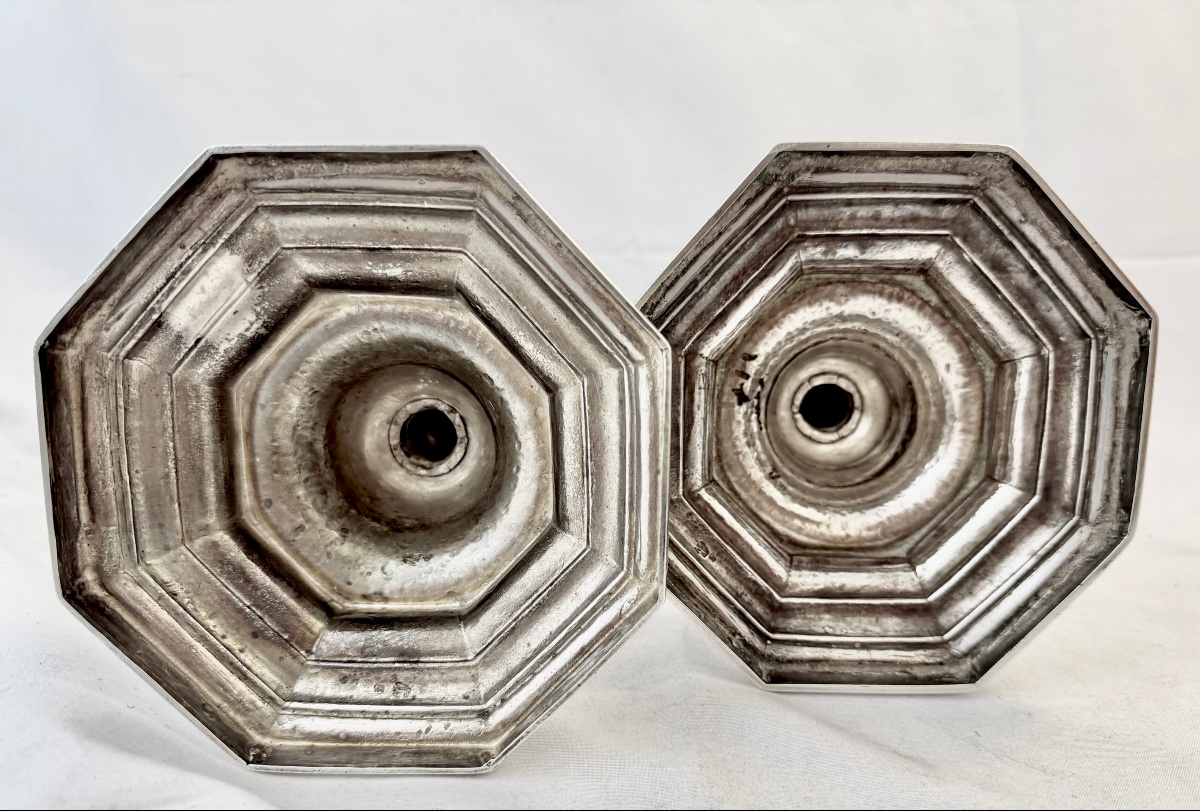
The candlesticks stand on broad octagonal bases composed of several ogee-moulded steps, surmounted by a bell-shaped section. The eight-sided design is echoed throughout the knops, stems and candle sockets, lending the pair remarkable architectural unity. The sockets retain their two detachable circular drip pans, each bordered by a double moulding.
The pair is distinguished by the purity of its lines, the balance of its proportions and the harmonious alternation of flat surfaces and rounded mouldings. The absence of applied ornament particularly emphasises the quality of the silversmith’s workmanship and the subtle interplay of light across the polished silver.
It is particularly interesting to encounter in 1790 a candlestick design that was already widespread around 1710–1720, towards the end of the reign of Louis XIV and during the Régence period. The design was therefore some seventy to eighty years old when these candlesticks were made, at a time when Neoclassical taste had dominated Parisian silver production for several decades. It is conceivable that they were specially commissioned to match an earlier pair, thereby enabling their owner to assemble a set of four identical candlesticks.
Another particularly noteworthy feature is the survival of both original detachable drip pans. These removable elements, frequently lost or replaced over the centuries, bear the same hallmarks as the candlesticks themselves, confirming that they belong to the original ensemble.
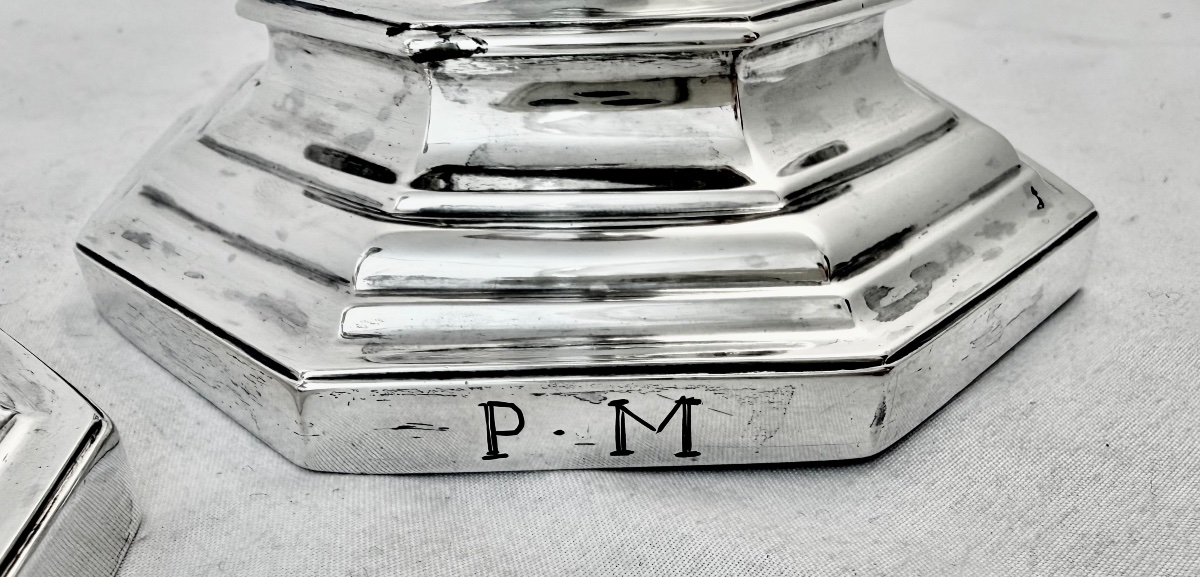
The ownership initials P · M, engraved in Roman capitals on the rims of the bases and on the drip pans, further confirm the integrity of the set.
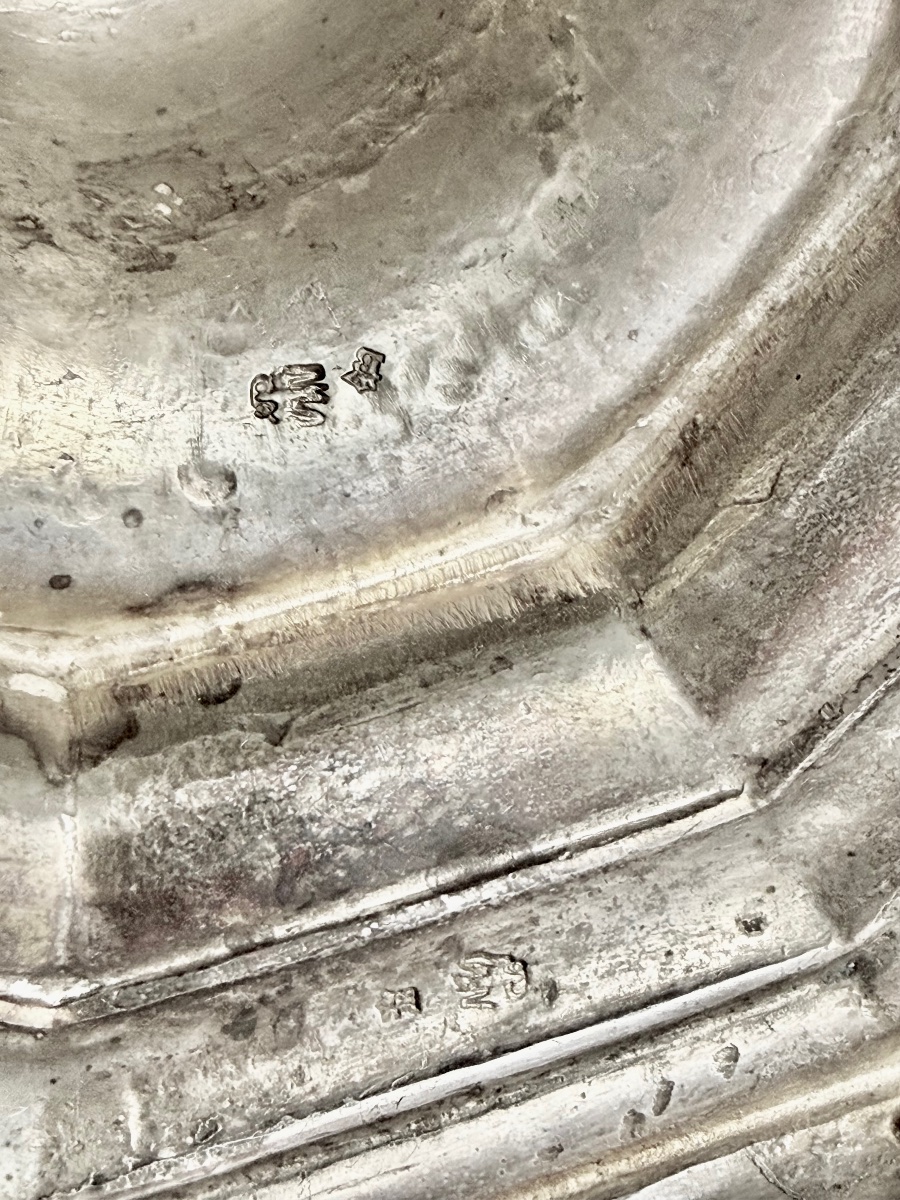
The candlesticks are remarkably well hallmarked. Both the maker’s mark of François Baudoux and the Lille assay mark for 1790, depicting a swallow flanked by the numerals 9 and 0, appear on the various components.
François Baudoux, known as Baudoux-Delefosse
Born in Lille on 19 May 1760, François Baudoux was the son of the silversmith François-Joseph Baudoux and his second wife, Marie-Antoinette Dartois. He was also the half-brother of the silversmith Alexandre Legrand.
An exceptionally precocious artist, he exhibited a study depicting the head of Saint Augustine in 1774, at the age of fourteen. He was admitted as a master silversmith in 1776, aged only sixteen.
Alongside his work as a silversmith, he pursued extensive artistic training and regularly exhibited at the Salons of the Lille Academy of Arts. His works included mythological, historical and religious subjects. In 1781, he exhibited, among other works, two chased copper portraits depicting Henri IV and Louis XV.
Between 1781 and 1784, he spent time in Paris, perfecting his skills under Jean-Guillaume Moitte, sculptor to the King, who worked for the celebrated silversmith Robert-Joseph Auguste.
Upon his return to Lille in 1785, he exhibited several sculptures and examples of chased metalwork. He also taught drawing at the Lille Academy.
On 24 October 1786, he married Reine Delefosse in Valenciennes, who brought a dowry of 6,000 florins to the marriage. That same year, he was unanimously admitted to the Academy of Arts with a work depicting the Presentation of Christ in the Temple, acquired by his relative, the Countess of Montozon, for the tabernacle of the church of Lallaing. This work was signed Baudoux-Delefosse.
In 1788, following his father’s death, he took over the family workshop in the rue des Cabochus in Lille. Between 1788 and 1791, he was listed among the city’s first-class silversmiths.
The French Revolution brought his career as a silversmith to an end. Following the abolition of the guilds, he ceased trading in 1792. His shop was sold on 5 January of that year for the considerable sum of 12,041 livres and 4 deniers.
Made in 1790, this pair of candlesticks thus belongs to the final years of his activity under the traditional guild system of French silversmithing.
Hallmarks
- Maker’s mark of François Baudoux, known as Baudoux-Delefosse: his mark bearing the letter B.
- Lille assay mark for 1790, depicting a swallow flanked by the numerals 9 and 0.
- Hallmarks struck underneath the bases, beneath the detachable drip pans and on the candle sockets.
- Later French crab control mark.
Dimensions and weight
France, Lille, 1790. Solid silver. Height: 25.5 cm. Diameter of the bases: 13 cm. Total weight: 965 g.
Period: 18th century
Style: Louis 14th, Regency
Condition: Excellent condition
Material: Sterling silver
Diameter: pied 13 cm
Height: 25,5 cm
Reference (ID): 1863991
Availability: In stock