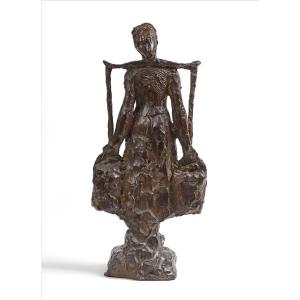
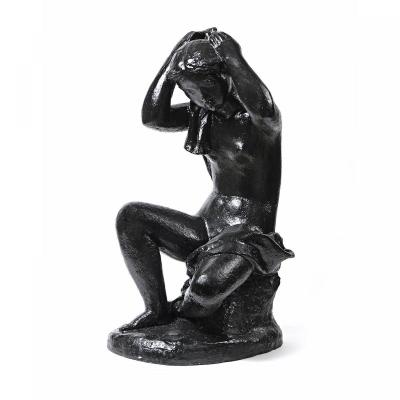
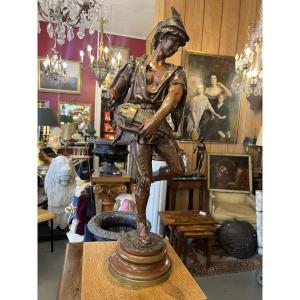
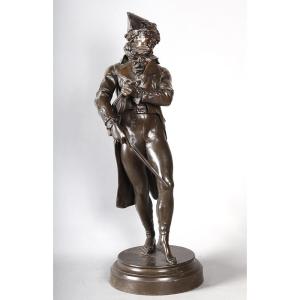
Paul Serste (1910–2000) — "young Woman Kneeling"
Bronze cast with a nuanced brown patina
Sand-cast, likely produced by the Compagnie des Bronzes in Brussels
Signed on the left side of the base “P. Sersté”
Circa 1950
Dimensions: Height: 59 cm
Width: 17 cm – Depth: 23 cm
An elegant depiction of a young woman kneeling, in a pose marked by modesty and serenity.
Here, Paul Sersté reveals his full sensitivity in his treatment of the female form. The silhouette, both slender and harmonious, is distinguished by the delicacy of its modeling, the softness of its lines, and the expressiveness of the tilted face.
The treatment of the material alternates between polished surfaces and freer textures, particularly visible in the hair and the rendering of the terrace. The brown patina with golden-brown highlights subtly emphasizes the volumes and lends the piece a beautiful sense of depth.
This sculpture reflects Paul Sersté’s interest in the human figure and depictions of African figures.
Biography:
Paul SERSTE (1910–2000)
Belgian School
Paul Sersté was a Belgian sculptor born in Anderlecht on September 17, 1910. Coming from a family that valued creativity and manual labor, he showed an aptitude for drawing and sculpture from an early age. His father, an inventor, and his grandparents, timber merchants in Dilbeek, lived in an environment that seems to have fostered his appreciation for forms and materials.
Encouraged in his artistic aspirations, he attended classes at the Royal Academy of Fine Arts in Brussels for a year before turning to a professional career that did not prevent him from continuing his creative work. After spending his days working in a bicycle shop, he devoted his evenings to sculpture, creating small figurines and animals out of terracotta at home, which he sold in various shops.
These works quickly gained some success. As his business grew, he moved with his wife, Andrée Renée Paule Vanderlinden—whom he married in 1941—into a more spacious studio on Place Sainctelette in Molenbeek-Saint-Jean. There, he installed a kiln specifically for firing his works.
Gradually, the studio grew into a full-fledged family business. His wife helped with glazing and finishing, while his brother handled sales and his sister-in-law took care of the bookkeeping. The increase in production led to the hiring of three assistants. The pieces were then produced in small batches, typically twenty pieces each.
The work of Paul Sersté is characterized primarily by figurative sculpture devoted to the representation of the human form. He created female nudes, young women with youthful figures, and male figures with well-defined musculature. Beginning in the 1950s, his repertoire expanded to include African-inspired figures, reflecting the broadening of his subject matter and his interest in depicting different types of people.
Terracotta is the primary material of his work. His sculptures are frequently covered with white glazes—applied either over the entire piece or in touches—as well as pastel tones that give them a distinctive decorative quality. Some compositions are also cast in bronze, notably by the Compagnie des Bronzes in Brussels. Among them are The Crouching Archer and The Javelin Thrower.
Paul Sersté exhibited his works at several venues, notably at the Pierre-Paul Hamesse Foundation, at the Carrefour des Arts in 1989, and at the La Gerbe Gallery in Anderlecht.
In 1985, he ceased his work as a sculptor and closed his studio. He then turned to watercolor painting, working primarily from photographs.
He passed away on August 21, 2000, in Molenbeek-Saint-Jean, leaving behind a primarily figurative body of work characterized by glazed terracotta pieces and a particularly unique artisanal and family-oriented approach.
Period: 20th century
Style: Other Style
Condition: Perfect condition
Material: Bronze
Width: 17 cm
Height: 59 cm
Depth: 23 cm
Reference (ID): 1859082
Availability: In stock