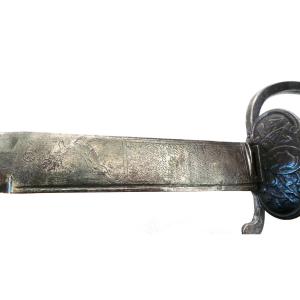
British Cavalry Sword, Known As A “backsword,” Kingdom Of Great Britain, Circa 1750
BRITISH CAVALRY SWORD, known as a “BACKSWORD,” Kingdom of Great Britain, reigns of George II and George III, circa 1750–1760. 34603
Heavy blackened iron mountings. Scottish-style “basket hilt” with multiple prongs and a pear-shaped pommel. Wooden tang sheathed in leather, bound with iron, and adorned with simple brass filigree. Straight blade with a back, fuller, and blood grooves, 99.5 cm long, without any markings.
Kingdom of Great Britain.
Reigns of George II and George III, circa 1750 to 1760.
Good condition; the tang shows signs of wear and has some missing leather. This broadsword has never been cleaned. No scabbard.
PROVENANCE:
Former PM collection.
HISTORY:
Around 1550–1600, English swords began to feature increasingly protective guards, designed particularly for combat on horseback. Guards with prongs, rings, and, gradually, basket hilts appeared.
A particularly early example is an English sword dated to 1560–1570, which already features an old-style basket hilt, a blade with primarily a single cutting edge, and strong hand protection.
This development thus predates the reign of James I.
By the end of the 16th century, the backsword had gradually become a weapon suited for military combat, particularly for mounted soldiers.
The fundamental difference lies in the narrower blade of the rapier.
Under James I, English hilts became more elaborate.
John F. Hayward’s research on English swords from 1600–1650 shows that in the second quarter of the 17th century, a new form of backsword guard appeared, which gradually became the characteristic guard type for cavalrymen during the English Civil Wars.
After the Restoration of the monarchy in 1660, heavy swords with basket-hilt guards remained widely used.
PROVENANCE:
Former PM Collection.
2 200 €
Period: 18th century
Style: Louis 15th - Transition
Condition: Good condition
Reference (ID): 1856920
Availability: In stock
Print