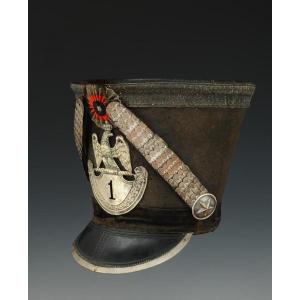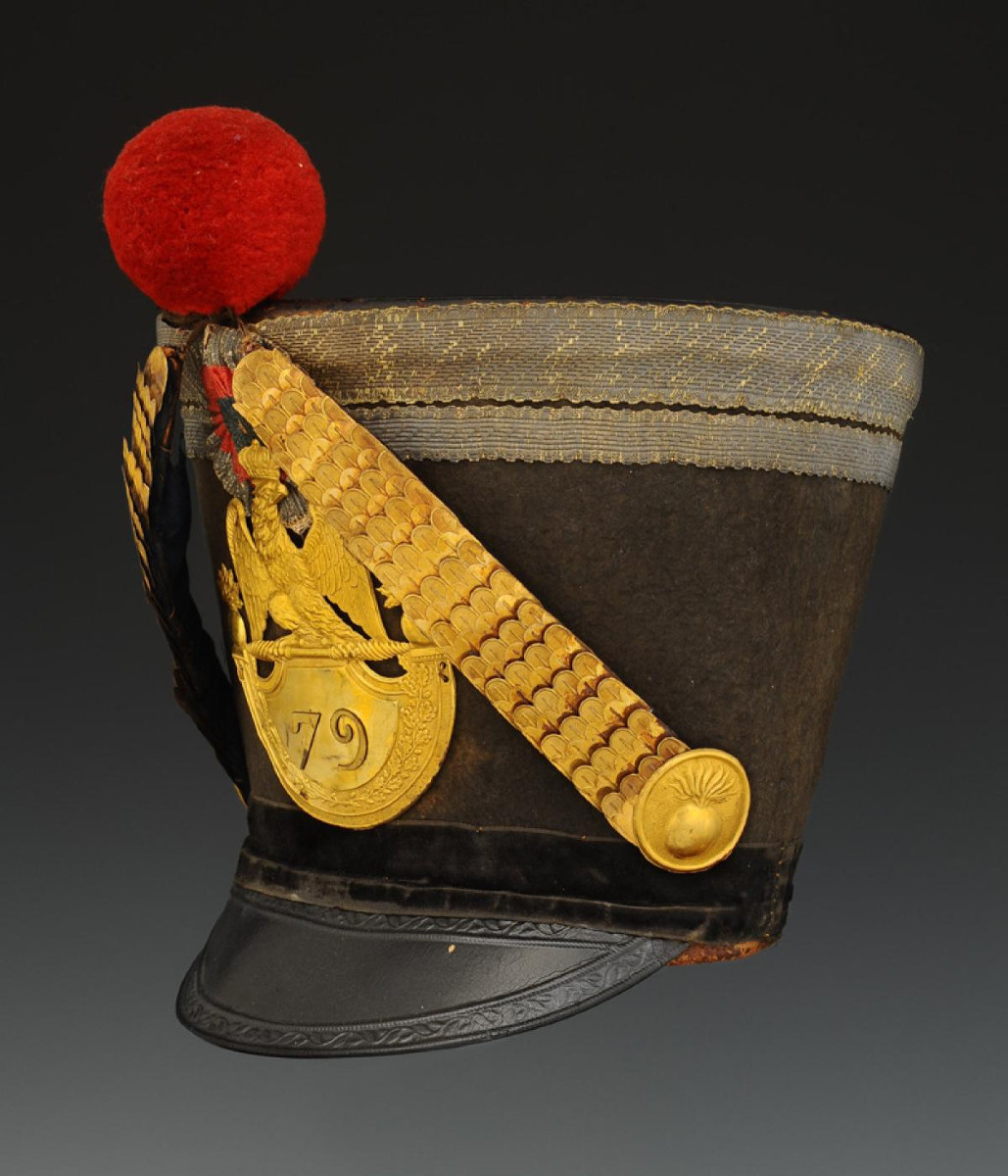
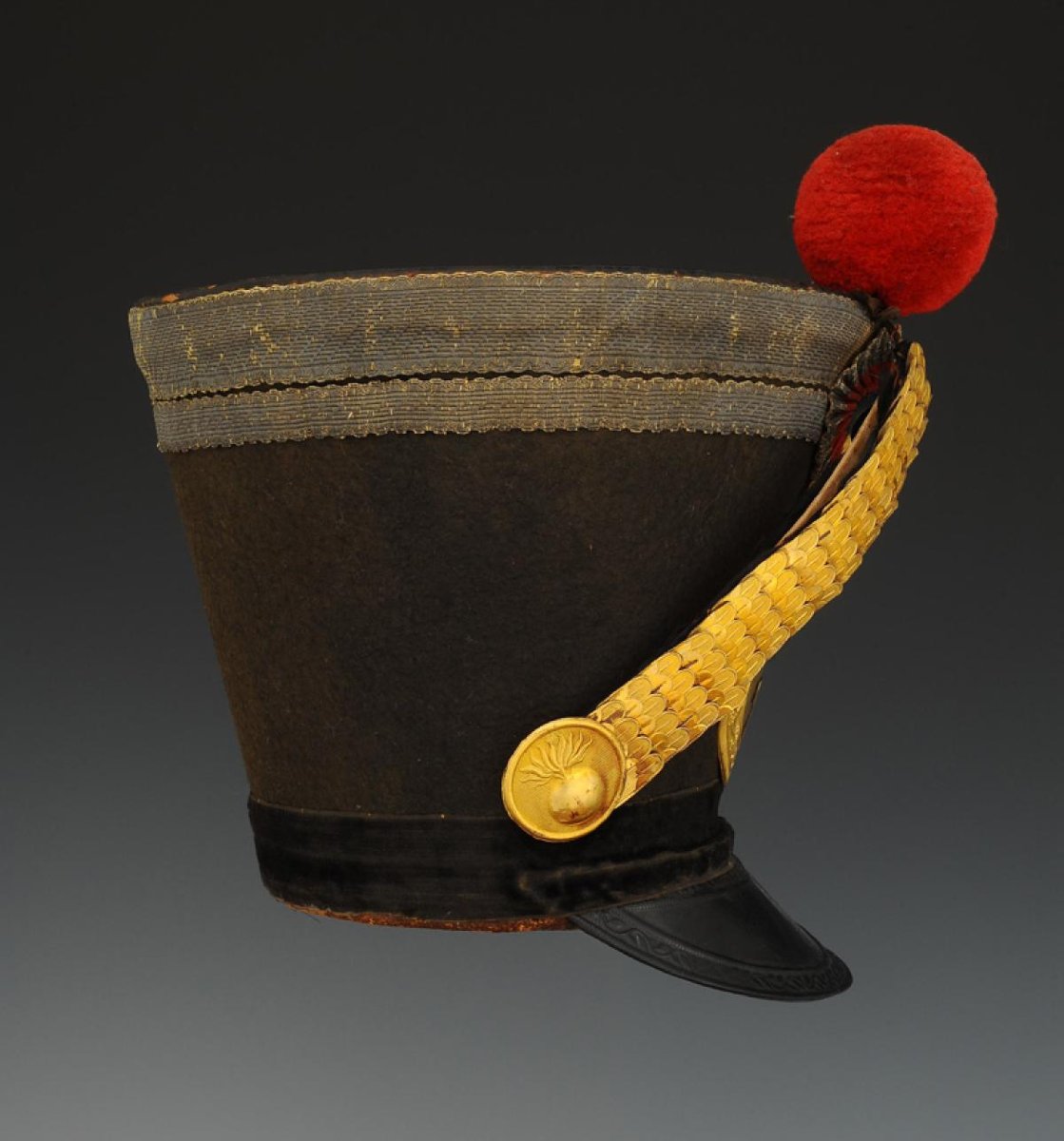
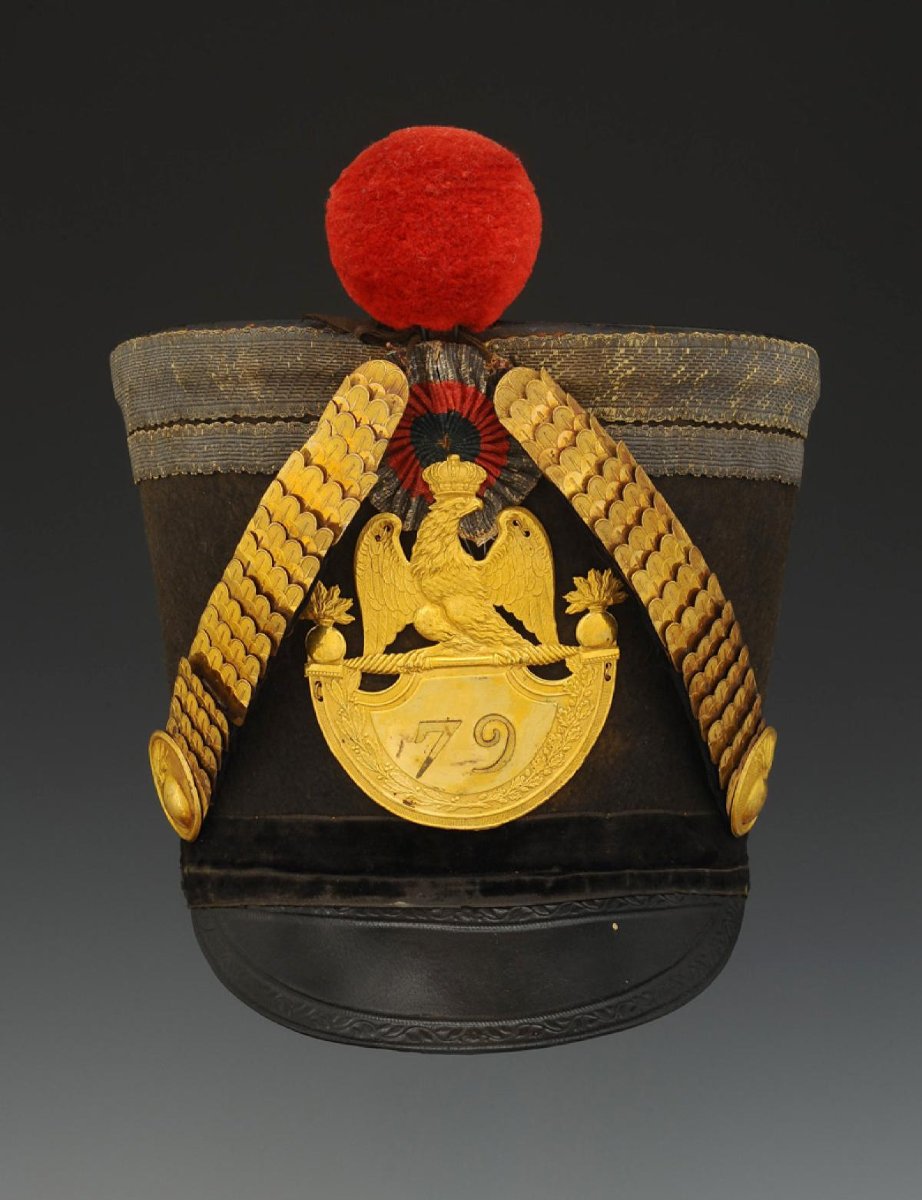
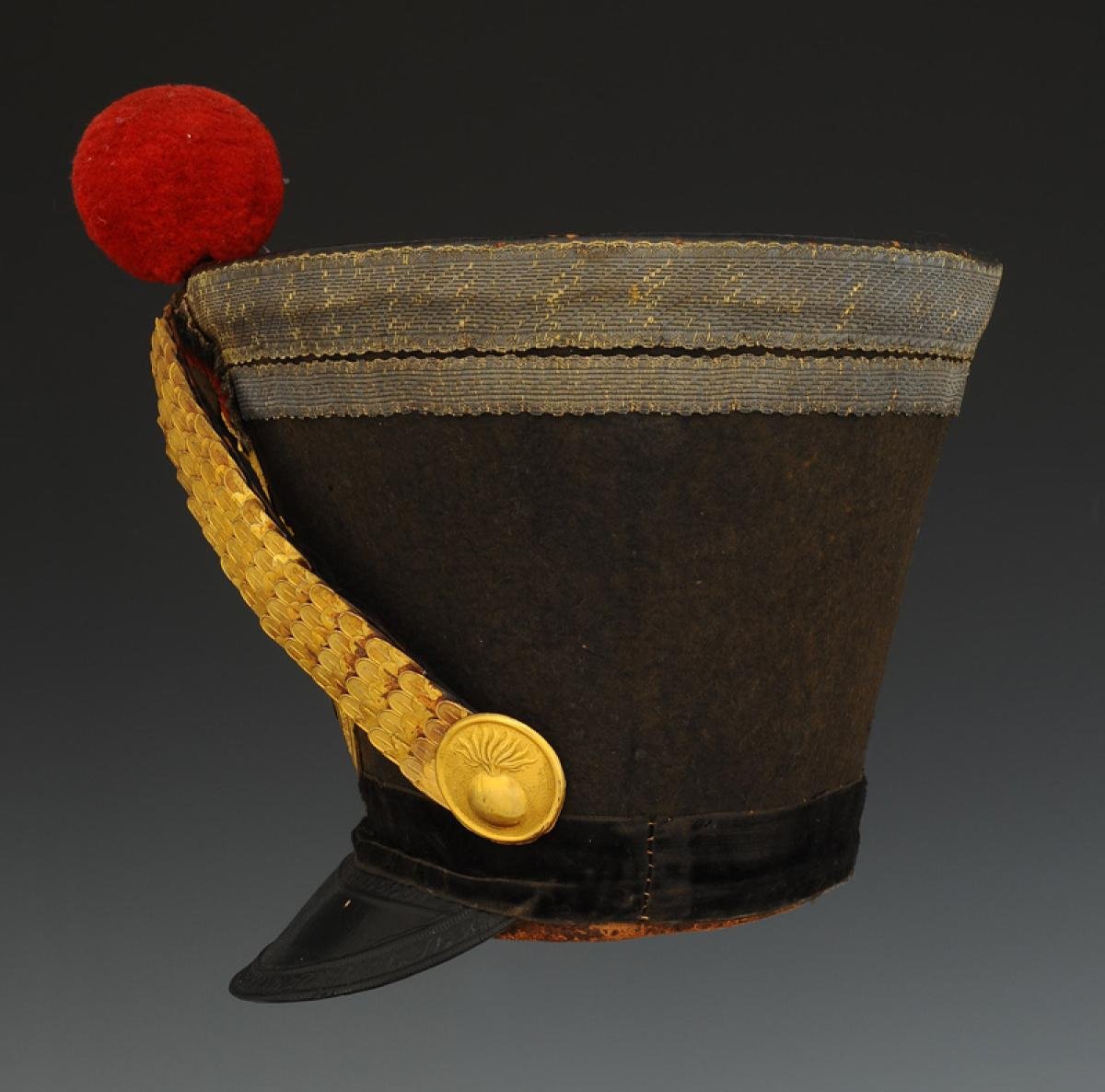
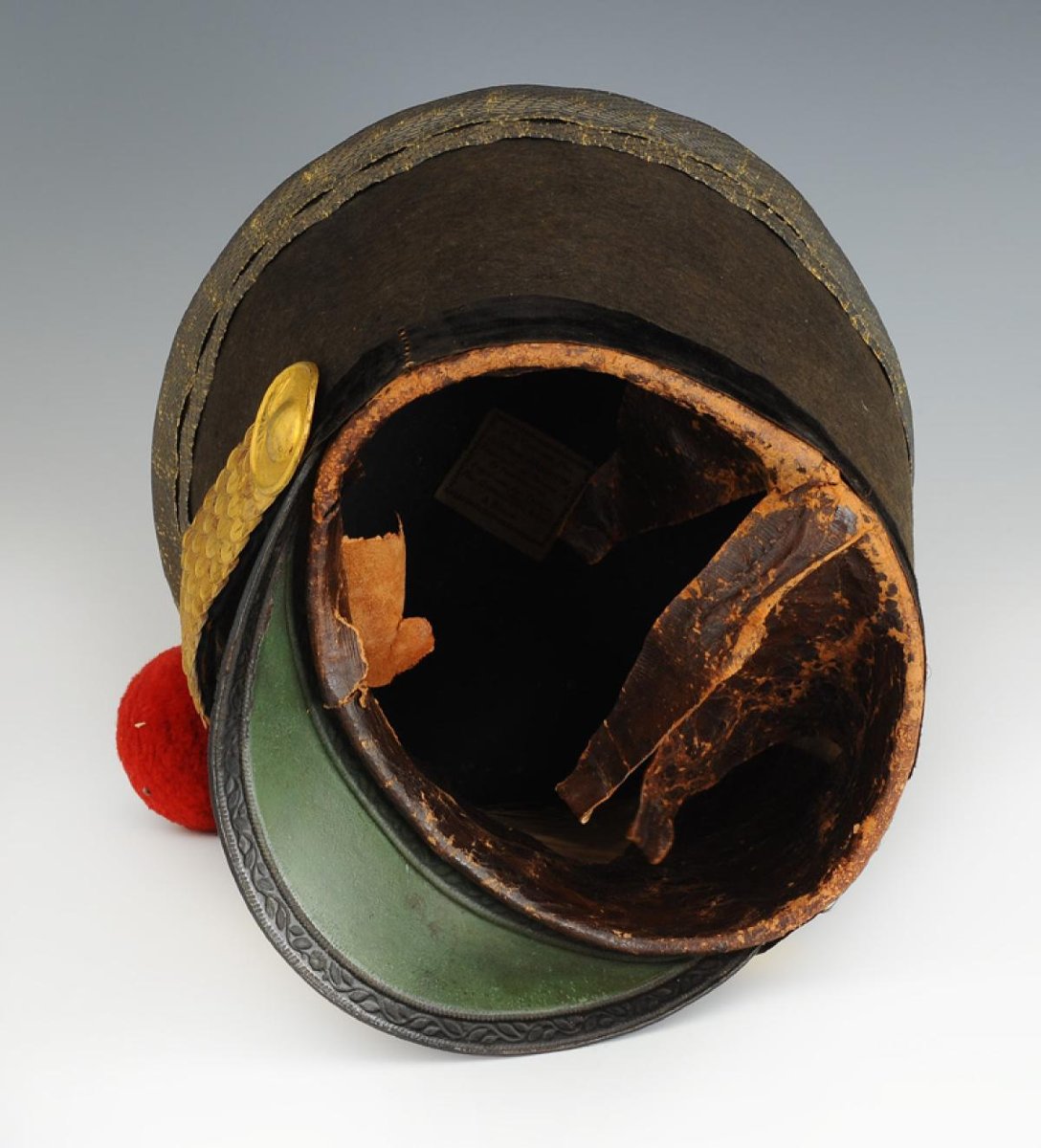


Shako Of Colonel Louis Gay, Grenadier Of The 79th Infantry Regiment, First Empire 1809-1814
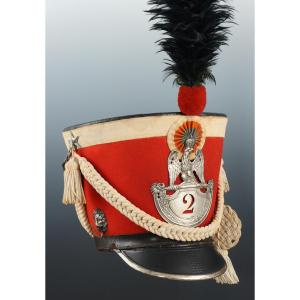
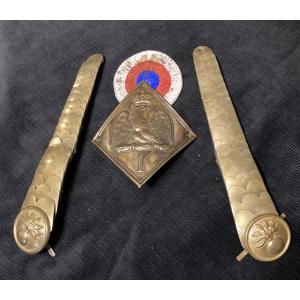
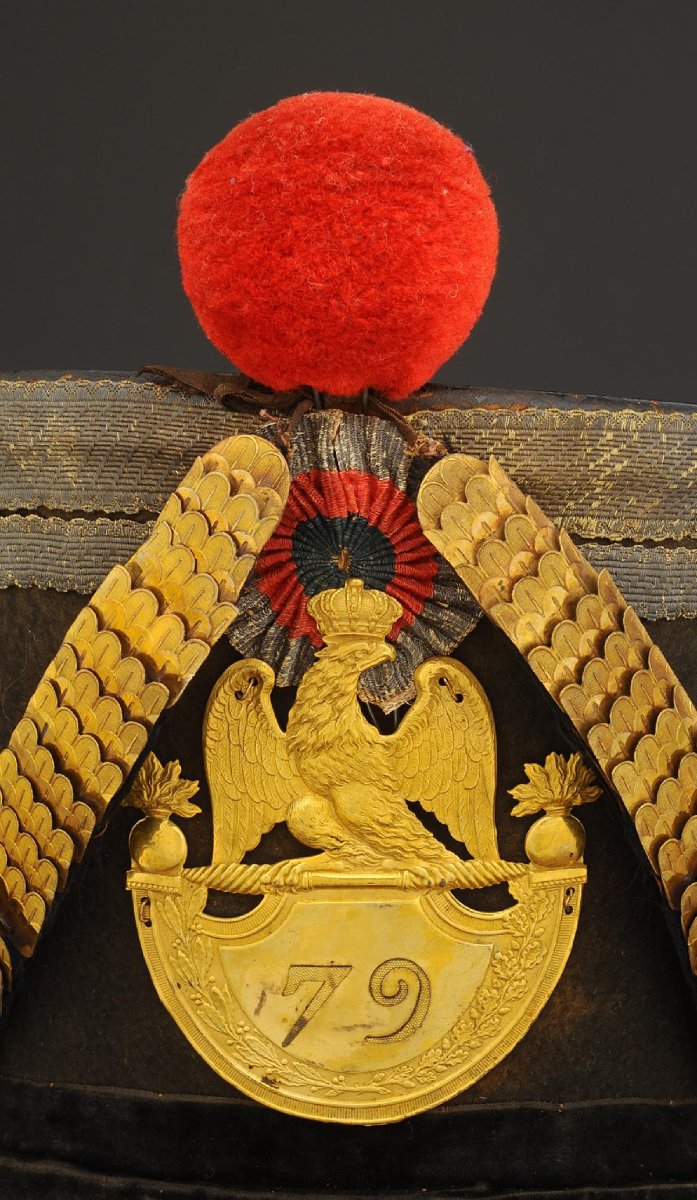
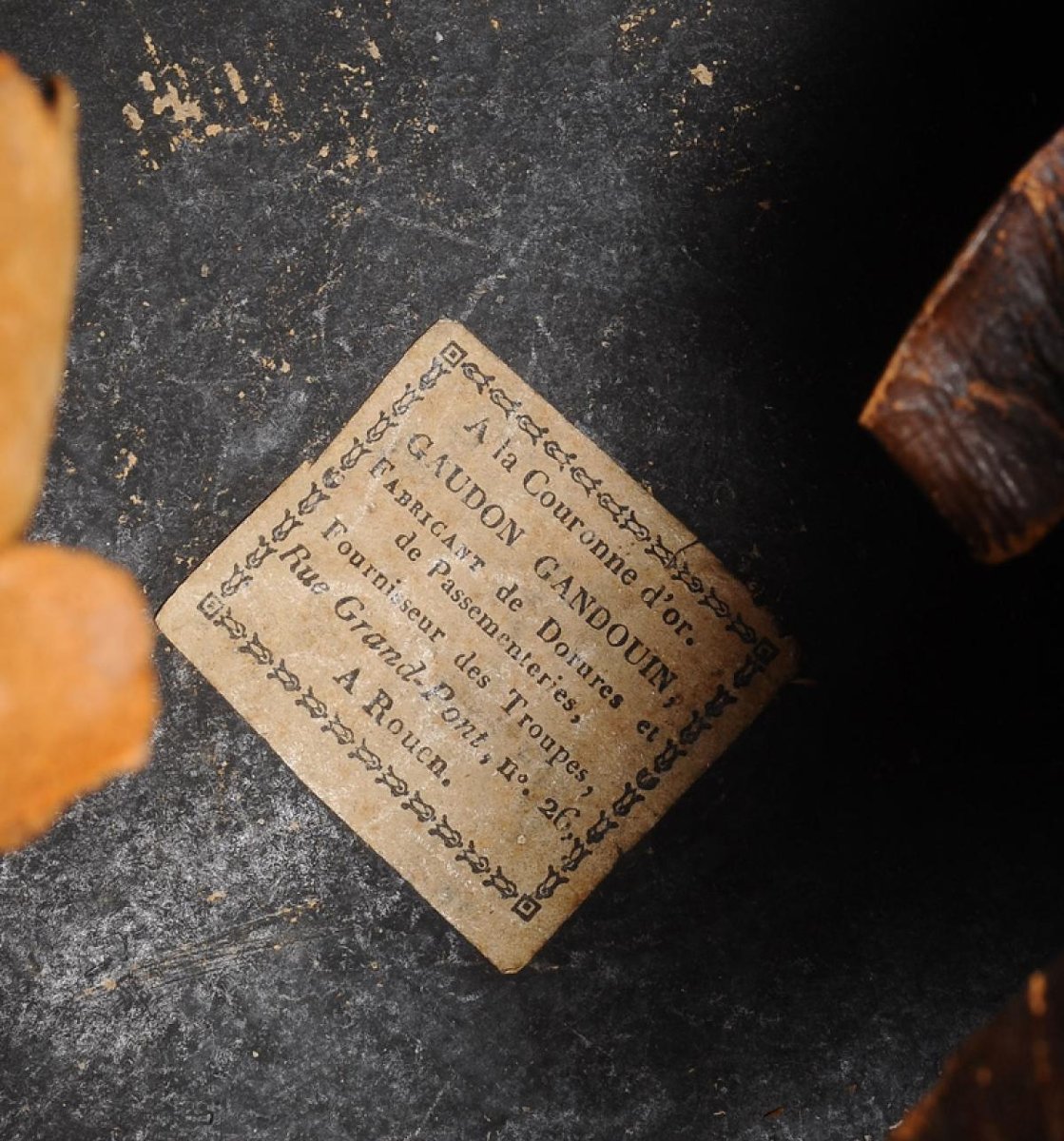
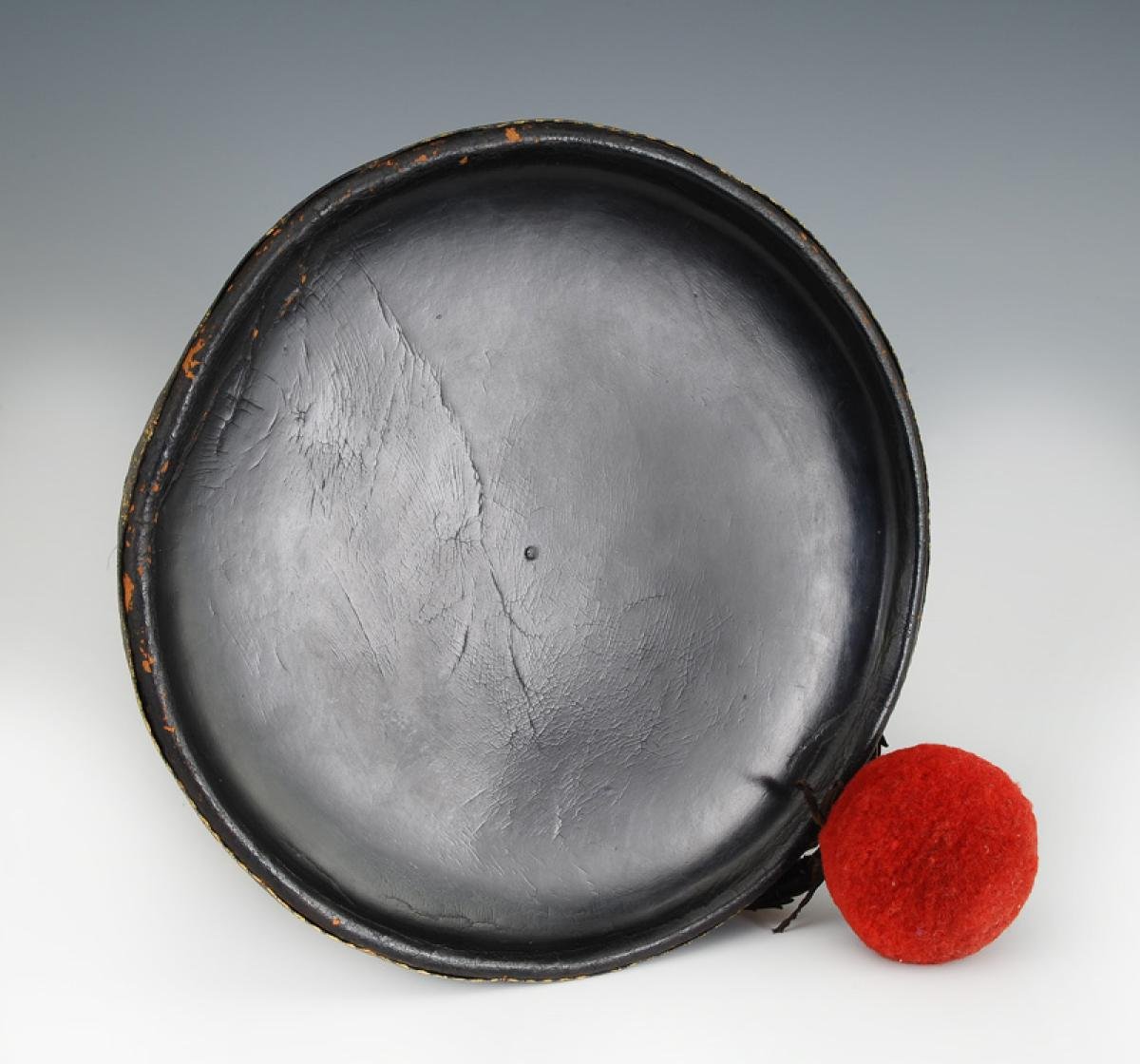
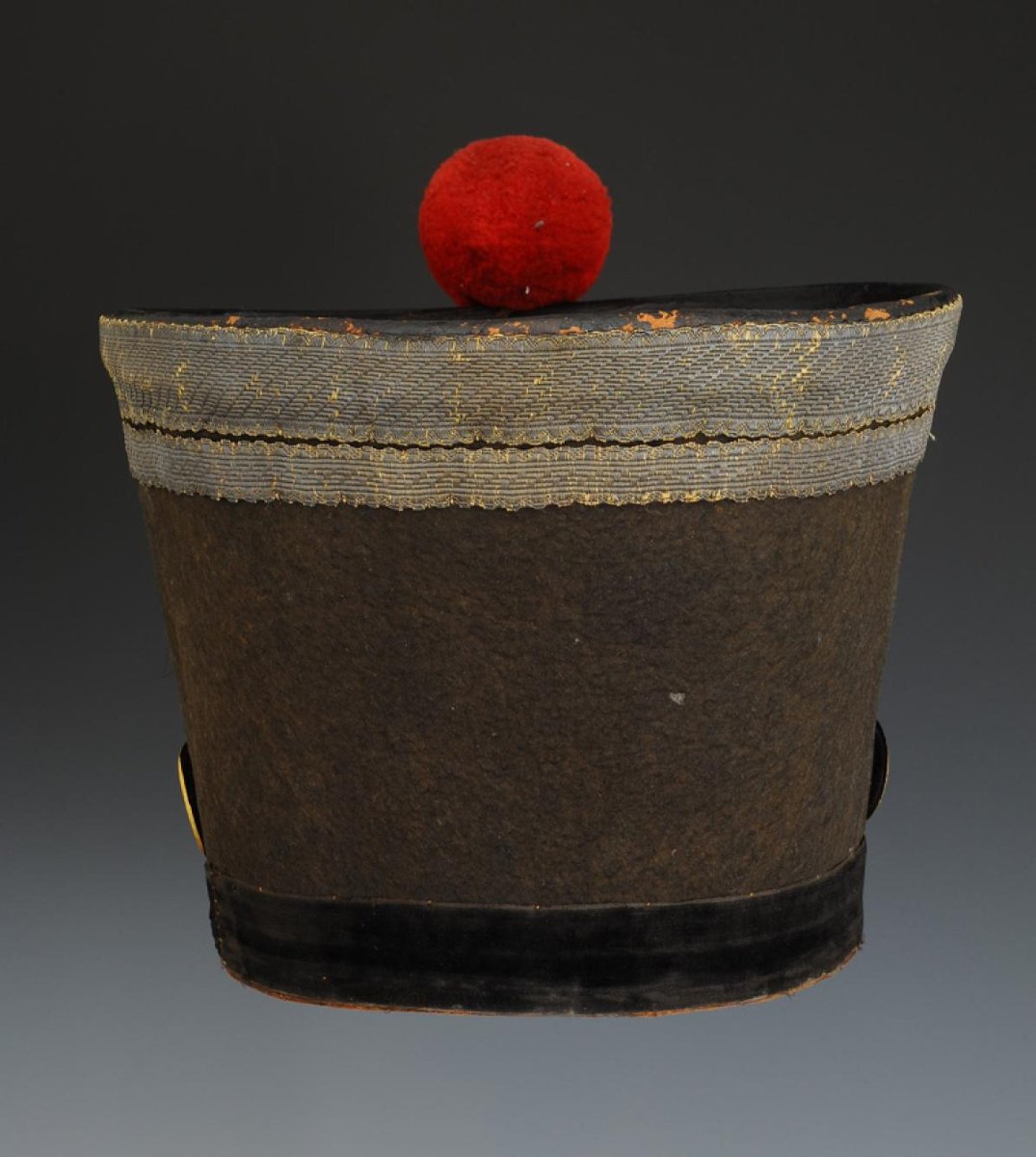
Shako of Colonel Louis Gay, Grenadier of the 79th Infantry Regiment, First Empire (1809-1814). 30550. Body made of black felt, 21 cm high. Crown made of very strong waxed cowhide leather, 26 cm in diameter, folded down over the felt to a height of 2 cm and covered with two braids corresponding to the rank of colonel: a first braid of gilt silver, 1.8 cm wide, surmounted by a second, 3 cm wide. A 2.7 cm wide black velvet band is sewn at the bottom of the felt. A rounded visor of strong varnished cowhide leather, sewn to the front of the shako, is printed with a laurel wreath around its edges and measures 7 cm wide. A plate (or escutcheon) affixed to the front, made of gilt-stamped brass with the raised areas burnished with agate, depicts a crowned imperial eagle holding in its talons Jupiter's thunderbolt, resting on a shield-shaped base. The center of the base is adorned with the number "79" stapled to the plate (the numbers are in gilt brass with a checkered background). The base is bordered by an oak branch and a laurel branch; the lateral ends of the shield are decorated with flaming bombs. The plate measures 13.3 cm high and 12 cm wide. A cockade of silver braid and scarlet and dark blue silk is placed above the plate and sewn to the shako body. It measures 6.5 cm in diameter and is silver on the outside, then scarlet and blue in the center. The chin straps consist of two chin straps, each held to the helmet body by a rosette. The chin straps are made of soft leather covered in black velvet and adorned with 15 gilt brass scales, each cut with four scalloped edges, plus a sixteenth scale rounded at its tip. They are finished with a silk ribbon. The scales are attached to the leather with flat metal clasps. The first scale is 3.4 cm wide, the last 2 cm wide. The length of each chin strap, including the rosette, is 22.5 cm. The rosettes, also known as "large buttons," are round, made of gilt brass stamped with a flaming bomb in the center on a sandblasted background, and bordered with a raised molding. They measure 54 cm in diameter. The scarlet pompom is spherical, 6.5 cm in diameter. The interior is lined with black patent calfskin cut into seven scalloped edges. The helmet body is lined with ivory paper. Interior of the skullcap with a square label printed in black: "A la Couronne d'or. / Gaudon Gandoin, / Manufacturer of Gilding and Trimmings, / Supplier to the Troops, / 26 Rue Grand-Pont, / Rouen." France. First Empire (1809-1814). Very good condition, interior lining with damage and losses. PROVENANCE: — "Collections of Decorations and Antique Weapons," Hôtel Drouot, Maître Vincent, June 23, 1960, expert Robert Jean Charles. — René Van Den Neste Collection, Hôtel Drouot, Maître de Maigret, November 18, 2009, lot 334. BIOGRAPHY: Louis Gay (1772-1838). Captain in the 1st Battalion of Mont-Blanc, incorporated on 26 Germinal, Year II (April 17, 1794) into the 5th Provisional Demi-Brigade, which later became the 18th Line Infantry Regiment. He served in the campaigns of 1793 to Year III (1795-1796) with the Army of the Eastern Pyrenees, in the campaigns of Years IV, V, and VI in Italy and Switzerland, and from Year VII to Year IX (1795-1796) in Egypt and Syria, where he was shot in the right leg. He was promoted to Battalion Commander on 11 Prairial, Year IX (June 11, 1794). Appointed Major in the 35th Line Infantry Regiment on 11 Brumaire, Year XII (November 11, 1804), he was then made a member of the Legion of Honor on 4 Germinal (April 14, 1805). He served in Holland during Years XII, XIII, and XIV (1805-1806), and in Italy from 1806 to 1809. Louis Gay was made Colonel on March 31, 1809, and Knight of the Empire with an endowment on August 15. He took command of the 79th Line Infantry Regiment on September 24, 1809. He served in the Army of Spain from 1811 to 1814. He was made an Officer of the Legion of Honor in 1813. He was promoted to Brigadier General and Baron of the Empire in 1814. Louis XVIII made him a Knight of Saint Louis on August 20 of the same year and placed him on inactive duty. Employed in the organization of the National Guard of the 7th Military Division in 1815, he transferred to the Army of the Alps before being placed back on inactive duty. He retired in 1825. HISTORICAL BACKGROUND: Created during the Revolution from the Boulonnais Regiment, the 79th Line Infantry Regiment joined the Army of Italy (1797) and occupied the island of Corfu (1798-1799). On 18 Brumaire 1799, the 79th Regiment participated in Bonaparte's coup d'état by entering the Council Chamber of the Five Hundred. It served in the Army of the West from 1800 to 1802, then in Saint-Domingue (1802-1803), again in the Army of Italy (1805) and Naples, in the Army of Dalmatia (1806-1809), and in Spain (1810-1814). In 1813, the 4th Battalion of the 79th Regiment participated in the German campaign. It was disbanded in 1815.
19 500 €
Period: 19th century
Style: Consulat, Empire
Condition: Perfect condition
Reference (ID): 1692112
Availability: In stock
Print