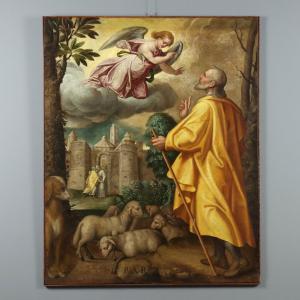
Lorenzo Brazzi, Known As "il Rustico," And Tiberio Billò, St. Jerome In Prayer
Lorenzo Brazzi, known as “il Rustico” (Siena, 1521 – 1572) and Tiberio Billò (Siena, c. 1540 – after 1597)
Saint Jerome in Prayer
Oil on panel, 97 x 77 cm – with frame, 118 x 98 cm
Critical essay by Prof. Marco Ciampolini
Saint Jerome in Prayer is an oil on panel depicting the hermit in an intense moment of prayer. The saint, kneeling and turned three-quarters of the way, spreads his arms before the entrance to a dark cave and raises his gaze toward a Crucifix that stands out on the left against a cloudy sky, above a landscape of distant mountains. The elderly figure, with dry skin and a white beard, seems almost to be questioning the image of Christ, while his right hand clutches the stone with which the ascetic strikes his chest as a sign of atonement. The bright red of the cloak and the rosy drapery on his legs, in stark contrast to the darkness of the rock, gives the scene a chromatic vibrancy that is its most memorable feature. This subject enjoyed great popularity in Siena during the sixteenth century, as evidenced by two paintings very similar to this one. The first, in the Chigi Saracini collection, was cautiously attributed by Mario Salmi and later identified by Fabio Bisogni as the work of Bartolomeo Neroni, known as “il Riccio”; the second, closely related to the first, was sold at auction in 2011 as a work from the Sienese school and is now in a private collection in Colle di Val d’Elsa. Michele Maccherini, in his study of the Chigi Saracini panel, placed it within the circle of painters who, after the fall of the Republic of Siena in 1555, reestablished the local school by drawing inspiration from the masters of the early sixteenth century: Sodoma, Domenico Beccafumi, and Riccio himself. Both panels are in fact by Tiberio Billò, whose name brings us to the heart of the matter. Tiberio Billò, born in Siena around 1540 and documented until 1597, was—along with Lorenzo Brazzi, known as “il Rustico,” and Arcangelo Salimbeni—one of the leading figures who kept the Sienese tradition alive, updating it according to the models of Vasari and the Zuccari brothers. At least as early as 1566, he formed a partnership with il Rustico, and this collaboration produced the *Cataletto* in the Diocesan Museum of Pienza, the “Christ in Pietà” from the Monte dei Paschi collection, and the frescoes—now lost—painted for Scipione Chigi in a chapel at his villa in Vico Alto, on the outskirts of the city. After Rustico’s death, Billò worked with Salimbeni, and together they decorated the hall of Palazzo Chigi Saracini and the adjacent rooms in 1574, populating the ceilings with graceful figures in the style of Beccafumi. The collaboration between Rustico and Billò also produced this Saint Jerome, in which Beccafumi’s painterly and chromatic vitality combines with the classicism of Sodoma and Riccio, and is enriched by more modern rhythms derived from Vasari. The most telling comparison is with the Christ in Piety at Monte dei Paschi, commissioned in 1569 by the institution’s magistrate: the fresco shares the same stylistic characteristics with the panel painting—and even the difficulty in rendering the foreshortened bust. It is also worth noting the saint’s head next to that of John the Baptist in The Baptism of Christ, painted on one of the panels of the Cataletto di Pienza, where the physical resemblances confirm that they are by the same hand.
Period: 16th century
Style: Other Style
Condition: Good condition
Material: Oil painting on wood
Width: 77
Height: 97
Reference (ID): 1855200
Availability: In stock