


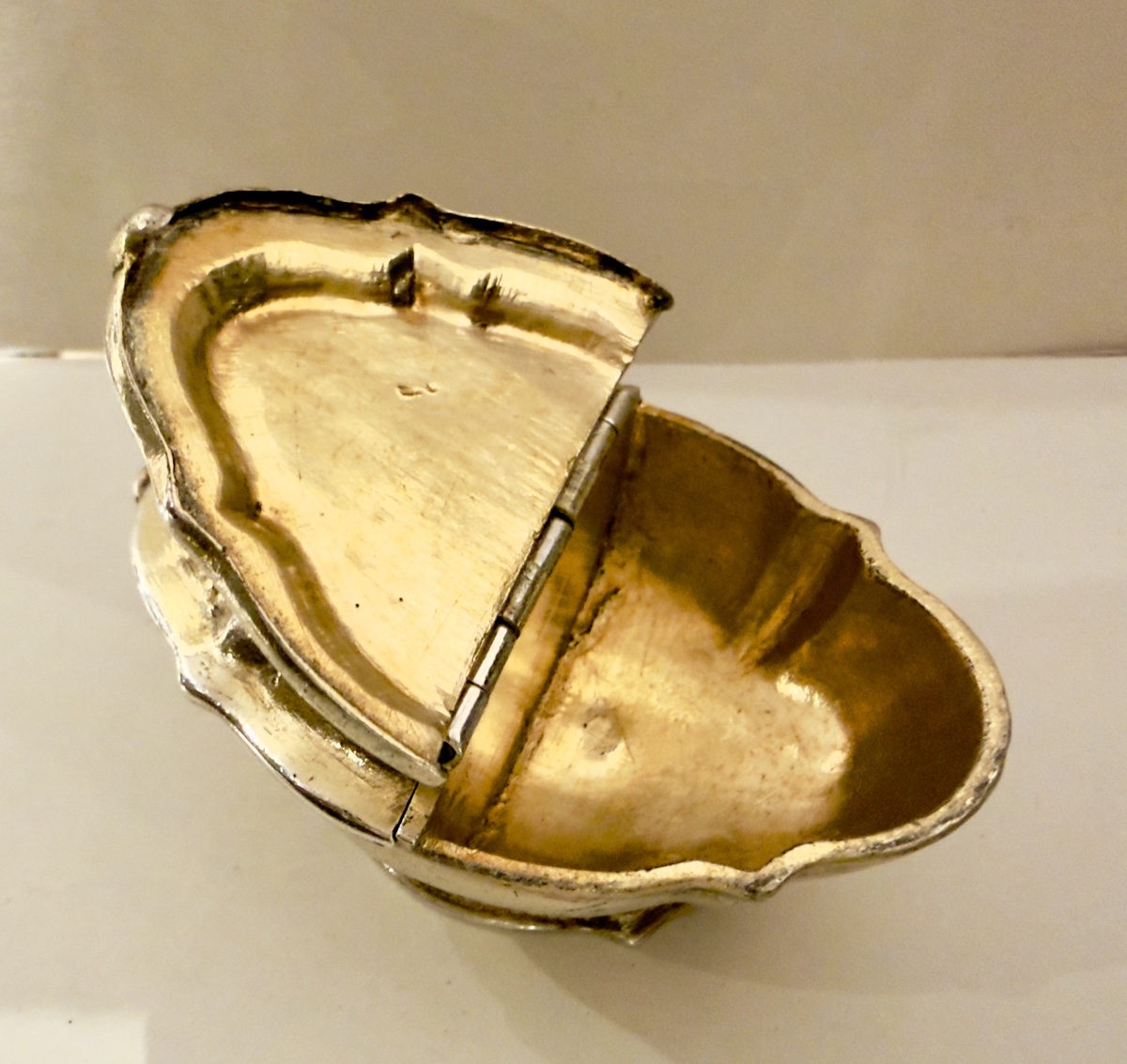


Augsburg, 1724–1728, Solid Silver And Vermeil Spice Box, Johann Gelb
Rare Double Spice Box in Silver-Gilt – Augsburg, 1724–1728 – Johann Gelb
Rare double spice box in solid silver-gilt (vermeil), made in Augsburg between 1724 and 1728 by the silversmith Johann Gelb, who became a master around 1723 and died in 1759.
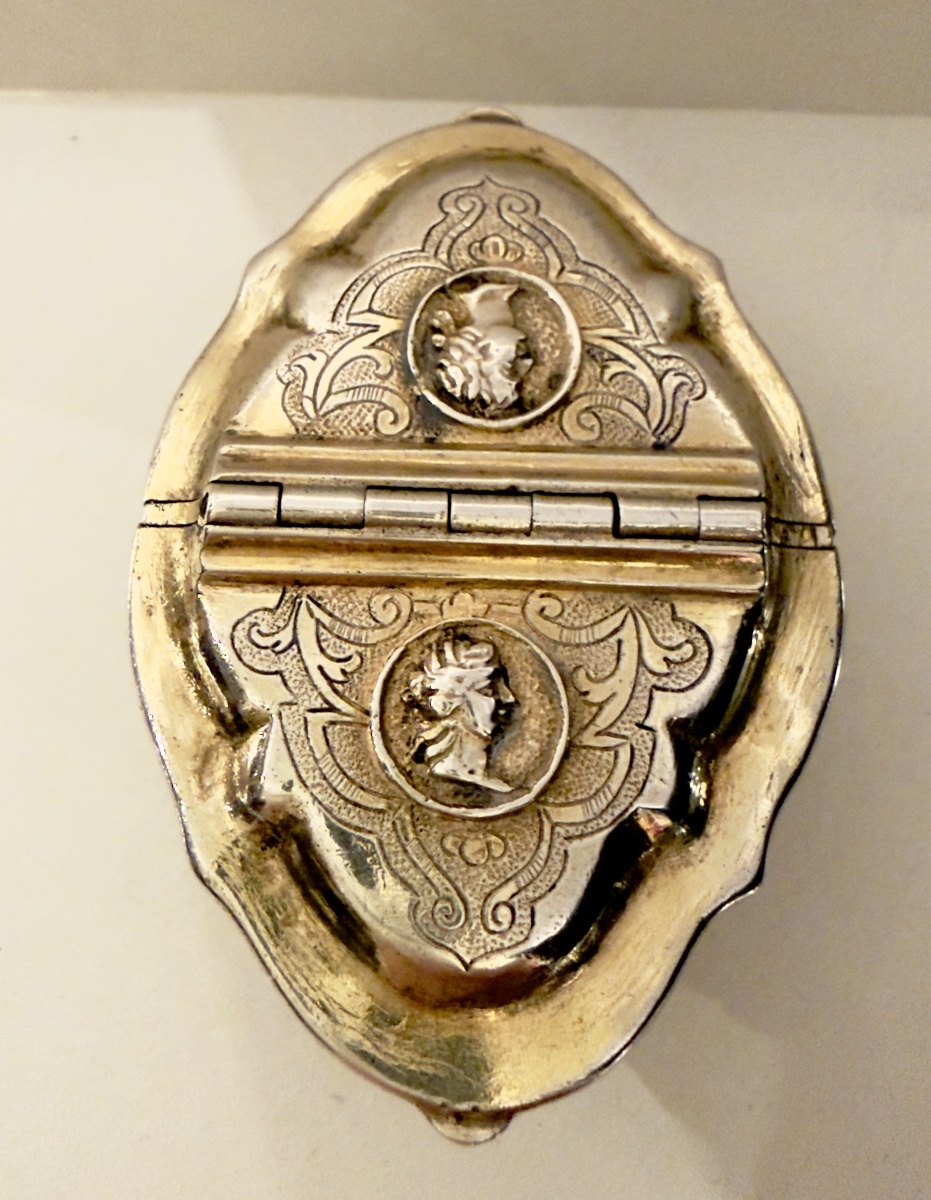
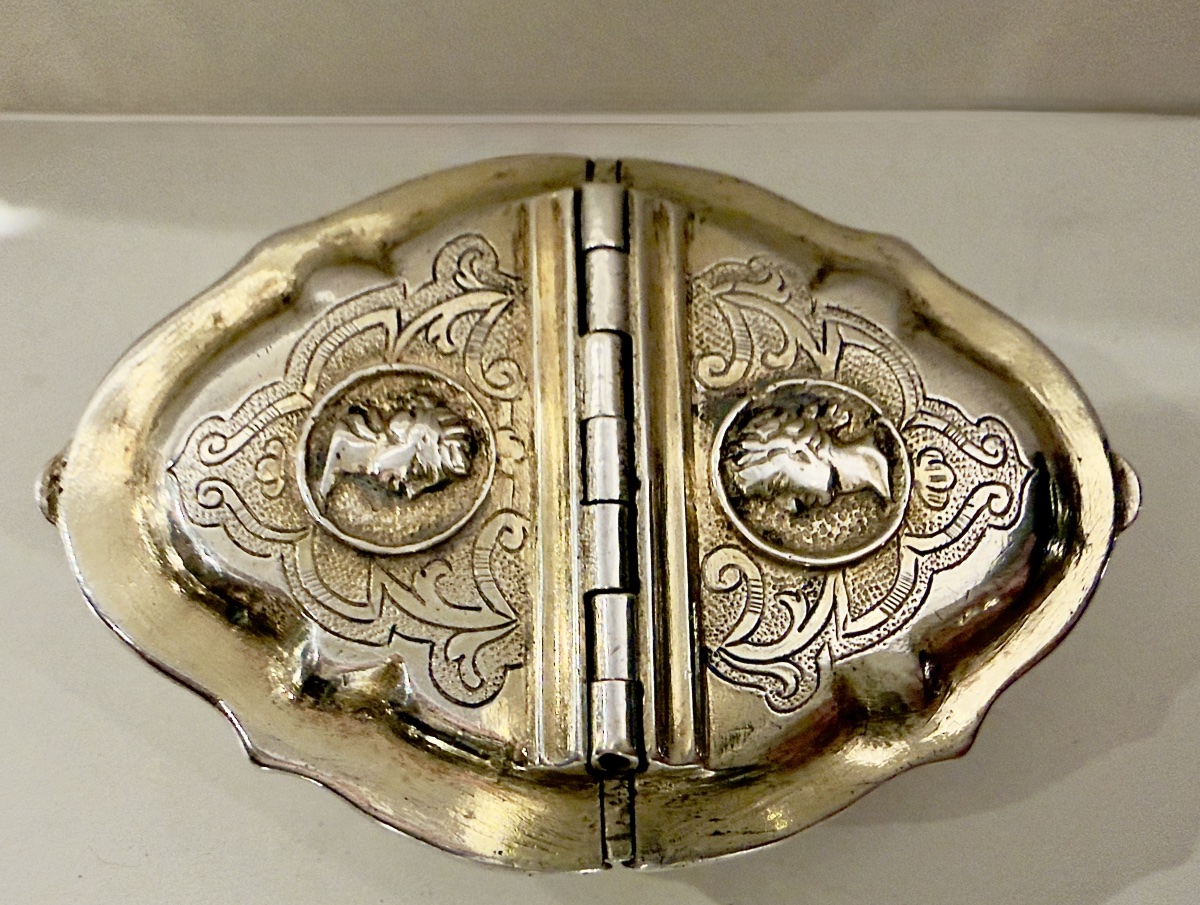
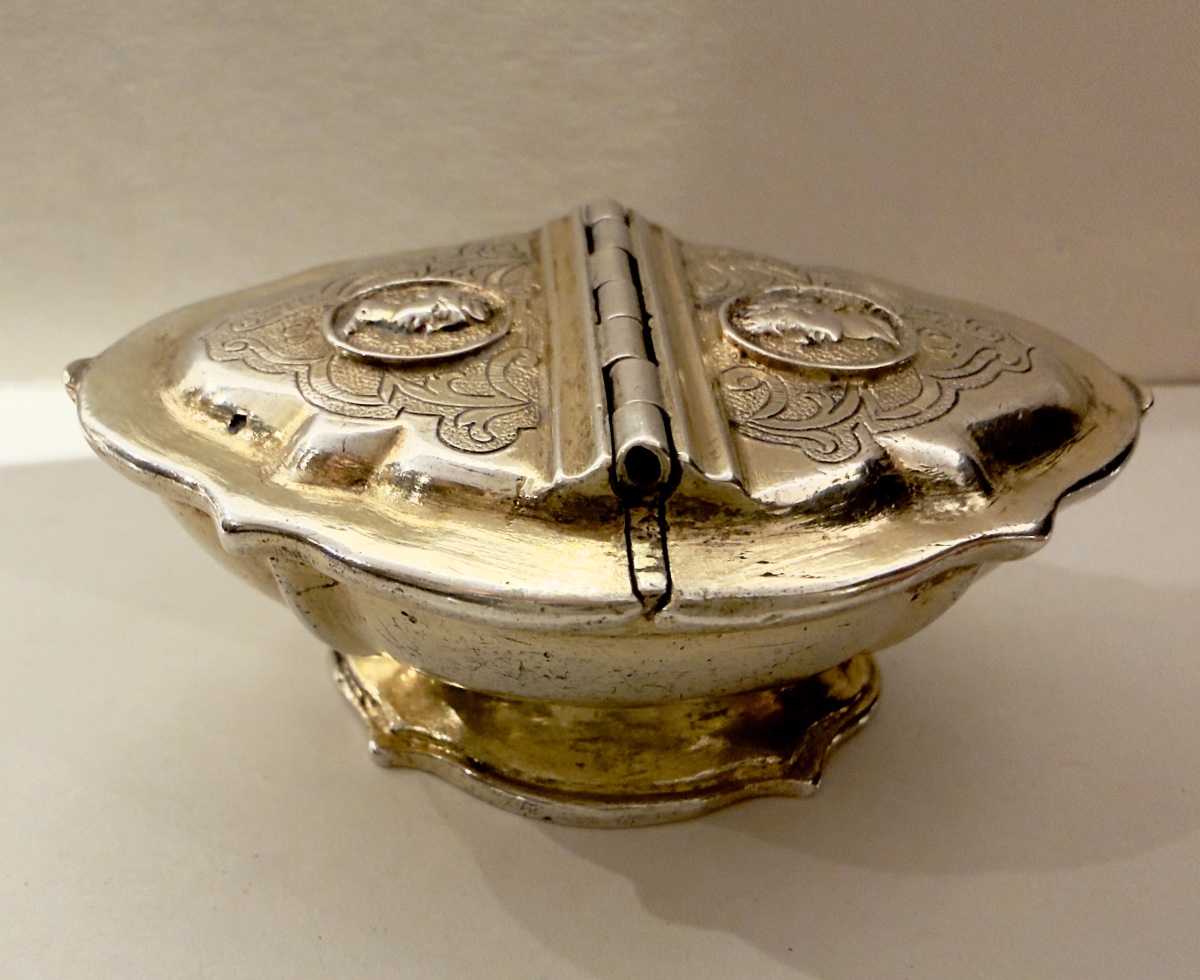
Of oval form and resting on a shaped and moulded central foot, this box is divided into two separate compartments, each closed by a domed hinged lid. Both lids are attached to a common central hinge, the particularly careful construction of which demonstrates the technical skill of the silversmith.
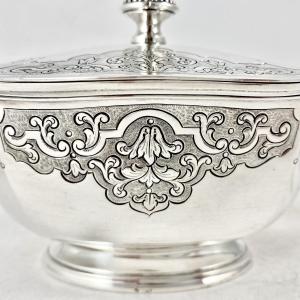
The lids are decorated with exceptionally fine engravings of scrolling foliage, volutes and symmetrical ornaments against delicately stippled backgrounds. This decoration is reminiscent of the engraving found on French silverware of the Régence period, in the early 18th century. At the centre of each lid is a circular medallion in relief depicting a female bust in profile, in the classical manner.
The fineness and precision of the engraving, combined with the two portraits in relief, give this box a particularly remarkable decorative quality.
The box was originally entirely gilded, both inside and out. Much of this original gilding has survived, although it shows some wear in places, particularly on the surfaces most exposed to handling. The interiors of both compartments retain a fine layer of gilding.
Despite its very small dimensions, the box is remarkably heavy for its size, reflecting its solid construction and the substantial thickness of the silver.
The clearly legible hallmarks include the Augsburg town mark corresponding to the period 1724–1728, together with the maker’s mark of Johann Gelb, recorded under number 2154 in Helmut Seling’s reference work. A silver assay scrape, known in German as a Tremolierstich, is also visible on the underside. This mark was made by the assay authorities when removing a small quantity of metal to verify the silver content.
Dimensions: length 6 cm; width 4 cm; height 2.5 cm.
Origins and Use of Spice Boxes
These spice boxes, known in German as Gewürzdosen, were refined accessories of aristocratic and wealthy bourgeois dining tables during the 17th and 18th centuries.
Double spice boxes, with two separate compartments closed by individual hinged lids, were generally intended to hold salt and pepper, allowing diners to season their food individually at the table.
Contemporary sources, however, also document the use of other spices, including cinnamon, cloves and nutmeg. Pierre Richelet’s Dictionnaire françois, published in 1680, mentions pepper boxes divided into several compartments for different spices.
The study devoted to spice containers in the Reallexikon zur Deutschen Kunstgeschichte, under the title “Gewürzgefäß”, confirms the existence of these double boxes and their use in European dining customs. It refers in particular to Martin van Meytens’ painting depicting the wedding banquet of Archduke Joseph of Austria and Isabella of Parma in 1760, in which two-compartment boxes intended for salt and pepper can be seen beside the place settings.
Such boxes could also form part of precious personal travelling dining sets, known in German as Mundzeug or Reisemundzeug. These sets contained various utensils intended for dining, such as cutlery, egg cups, drinking vessels and spice boxes, carefully arranged in a fitted case to accompany their owners during their travels.
The most luxurious of these sets were frequently made of gilded silver, sometimes entirely silver-gilt, as was the present box. Besides its prestigious appearance, the gilding of the interior served a practical purpose by protecting the silver from the corrosive effects of salt.
The Silversmith Johann Gelb
Johann Gelb belonged to a family of silversmiths working in Augsburg, one of Europe’s leading centres for the production of luxury silverware during the Baroque period.
The son of the silversmith Johann Caspar Gelb I, he became a master around 1723, married in 1724 and died in 1759.
Helmut Seling records among his works engraved and gilded cutlery with Meissen porcelain handles, as well as a partially gilded travelling cutlery set, both dated 1729–1733.
The present spice box thus belongs to the tradition of precious personal objects associated with refined dining customs and the pleasures of the table in the early 18th century.
Bibliographical References
- Helmut Seling, Die Kunst der Augsburger Goldschmiede 1529–1868, master silversmith no. 2154, Johann Gelb, p. 533; Augsburg town marks for the period 1724–1728.
- Reallexikon zur Deutschen Kunstgeschichte, article “Gewürzgefäß”, concerning the history, forms and uses of spice containers.
- Pierre Richelet, Dictionnaire françois, Geneva, 1680, entries concerning pepper pots and pepper boxes.
- The Metropolitan Museum of Art, New York, catalogue entries for the spice boxes by Noël-Charles Langlois (1718–1719) and Nicolas Mahon (1723–1724), illustrating the different compartments and their intended uses.
Period: 18th century
Style: Louis 14th, Regency
Condition: Excellent condition
Material: Sterling silver
Length: 6 cm
Width: 4 cm
Height: 2,5 cm
Reference (ID): 1851768
Availability: In stock