

Marquis De Sade - Signed Autograph Letter - Charenton Asylum - 1806
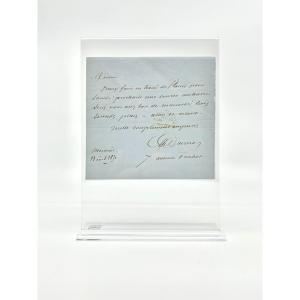
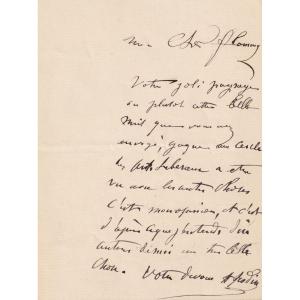
A beautiful letter from the Marquis de Sade, written from his asylum in Charenton, cursing his children, “those barbaric individuals.”
Children who cling to “ancient prejudices whose consequences have, throughout history, brought both misfortune and misery upon the fatherland.”
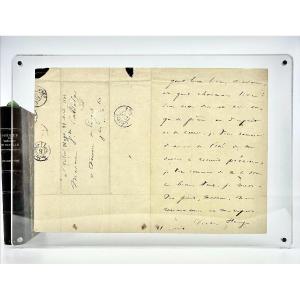
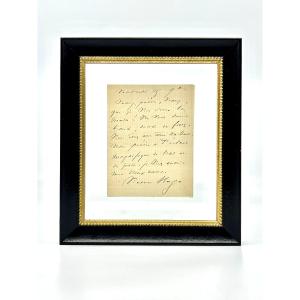
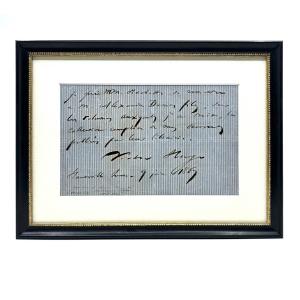
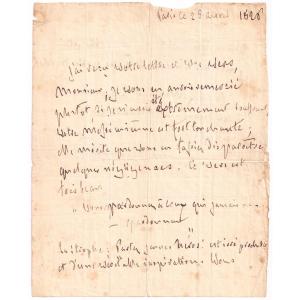
Autograph, signed letter from the Marquis de Sade (D. A. F. de Sade, Donatien-Alphonse-François de Sade, 1740–1814) to his attorney, Monsieur Paris (Jean-Simon Paris de Lamaury, 1759–1827).
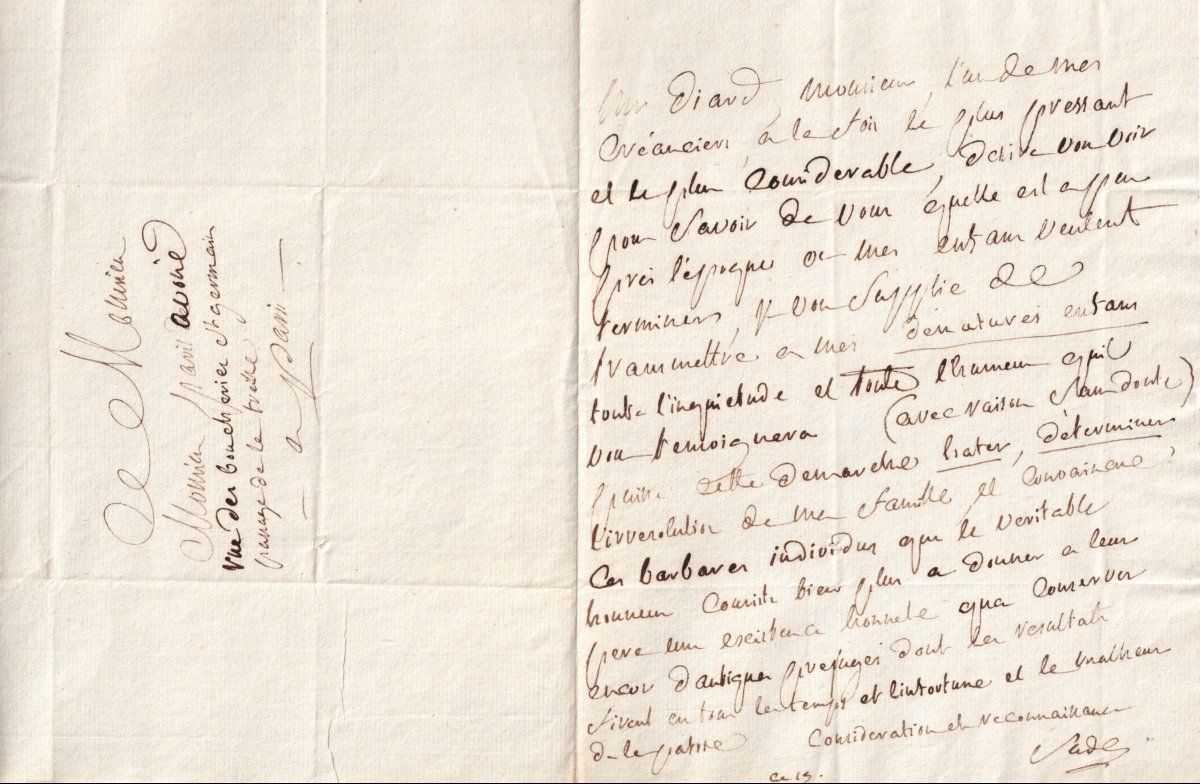
“The 15th” [1806 – Charenton Asylum]. One full page on a double sheet with handwritten address. Discreet pinholes, marks, and a small wear hole in the margin. Size: 19.5 × 31 cm when unfolded. Single sheet: 15.5 × 19.5 cm. (Plexiglass display frame included upon request.)
A very beautiful letter from the “Divine Marquis” cursing his children, “those barbaric individuals” who, refusing to help their father in distress, cling to “ancient prejudices whose consequences have, throughout history, brought both misfortune and misery upon the fatherland.” ”
Imprisoned in Charenton since April 1803 by order of Napoleon, Sade no longer has free access to his income. His children, who had control of the estate, dragged their feet on paying off the debts so as not to deplete their capital, leaving their father relatively destitute and under threat from bailiffs.
Sade regularly accused his children of being enslaved by traditional aristocratic and religious morality—dogmas he believed were responsible for France’s divisions and ruin—and portrayed himself as a victim of this intolerance. He also denounced their rejection of him as the result of blind conformism that destroyed both family ties and the fatherland. His youngest son, Armand de Sade—a devout Catholic, royalist, and man concerned with moral respectability—was ashamed of his father and refused to see him.
More generally, his three children reproached him for causing their mother suffering, squandering the family fortune, and bringing dishonor to their name through his behavior, his lawsuits, and his scandalous writings.
“Mr. Diard*, sir, one of my creditors—both the most insistent and the most substantial—wishes to see you to find out from you approximately when my children intend to finalize matters; I beg you to convey to my children, the beneficiaries, all the concern and displeasure he expresses to you (no doubt with good reason).
May this step hasten, resolve my family’s indecision and convince these barbaric individuals that true honor lies far more in providing their father with an honest livelihood than in clinging to antiquated prejudices whose consequences have, throughout history, brought both misfortune and misery upon the fatherland.
With respect and gratitude.
Sade
[in small print] On the 15th
[handwritten address]
Mr. Paris, attorney
Rue des Boucheries-Saint-Germain
Passage de la Treille
in Paris"
*Claude Diard, merchant. Sade acknowledged owing him 7,672 francs (a substantial sum equivalent to approximately 35,000 contemporary euros; notarized deed dated 21 Ventôse, Year XII / March 12, 1804). Since he was not being paid by the children, Diard threatened to challenge the gift in court and hounded the marquis even during his confinement in Charenton. Sade constantly referred his creditors to his attorney, Paris de Lamaury, so that he might force the children to settle (“terminer”).
Sade donated his property (notably the estates of Mazan and Saumane) to his two sons, Louis-Marie and Donatien-Claude-Armand, in exchange for an annual annuity and the assumption of his debts. Although the initial steps to transfer his assets began in late 1799 to save the lands from confiscation, the execution of the donation agreements and the settlement of debts by the “donees” dragged on throughout the entire First Empire.
Period: 19th century
Style: Consulat, Empire
Condition: Good condition
Length: 31 cm
Height: 19,5 cm
Reference (ID): 1851098
Availability: In stock