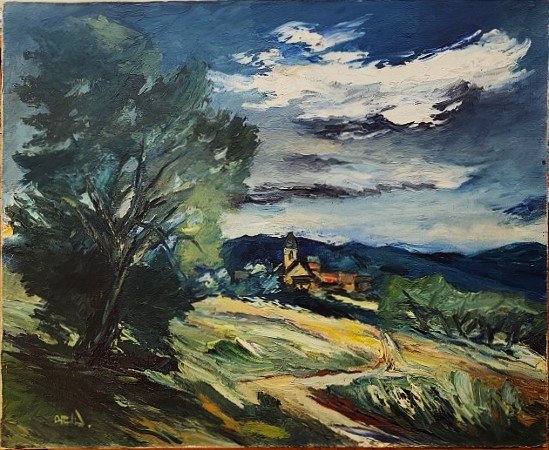
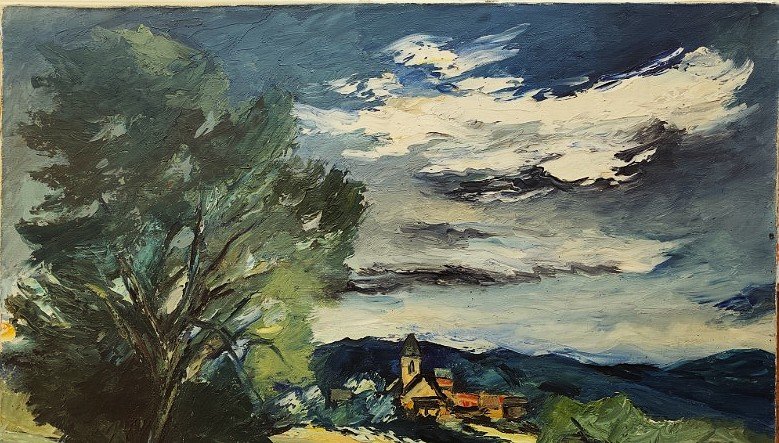






Anders Osterlind (1887–1960) Limetz, 1949. Yvelines, Giverny. Crozant School, Expressionist
Artist: Anders Osterlind (1887-1960)
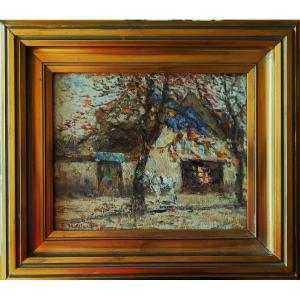
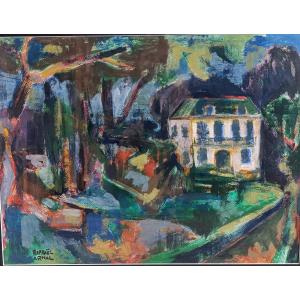
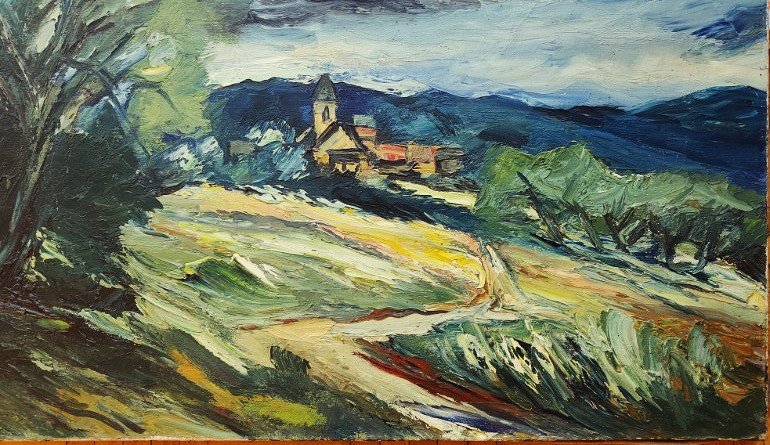
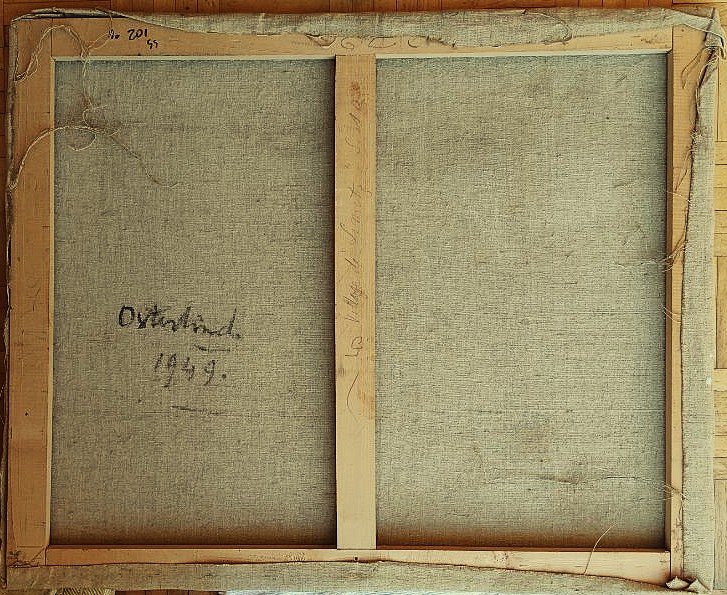
A beautiful new oil on canvas by Anders Osterlind, this time from 1949, depicting the village of Limetz near Giverny in Yvelines, signed lower left and labeled with location and date on the back.
Dimensions of the canvas alone, unframed: 60x73 cm.
The canvas is in perfect original condition and comes in an antique gilded frame (I’ll post a photo with the frame on Thursday).
Authenticity guaranteed.
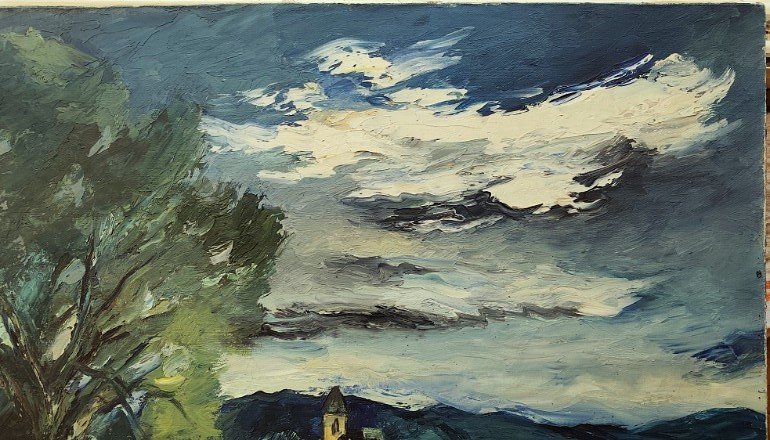
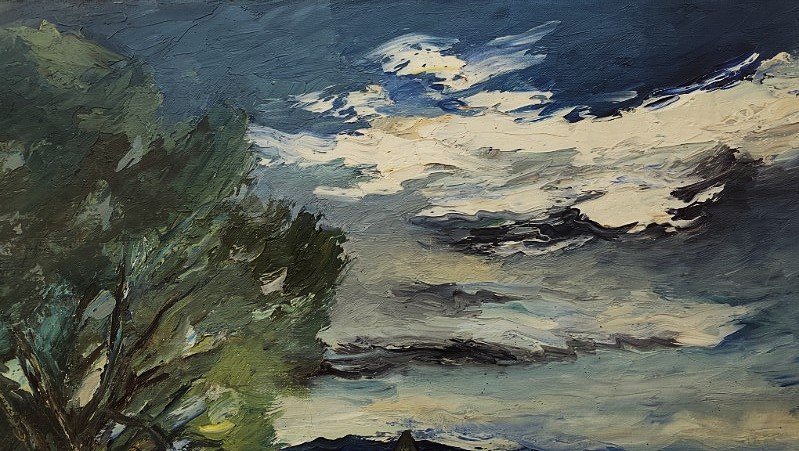
This is therefore a new work by Anders Osterlind, dated 1949—a period of artistic maturity for the artist, surely his most expressionist phase, his brushwork is highly powerful, featuring broad, flat areas of color that are extremely rich in texture; as for his palette, it has become colorful once again—petroleum blues, greens, and grays are still very much present, but he has reintroduced chrome yellows, oranges, reds, browns, etc... A work of exceptional quality by one of the finest painters of the Crozant school. The village of Limetz, viewed from a distance, bears a striking resemblance to the village of Gargilesse; Osterlind painted both of these villages extensively.
I need not introduce Anders Osterlind, whom all my loyal clients know and have come to know well, as he is one of my favorite painters and a near-permanent fixture on the walls of my gallery, alongside Léon Detroy and Charles Bichet.
He was one of the leading figures of the famous Crozant School, one of its last great painters, and also close to the painters of Bréhat and the Paris School, alongside his friends Modigliani, Soutine, Kikoïne, and Kickert.
The son of Allan Osterlind, a great Swedish painter and friend of Maufra, Anders was born in Lépaud in the Creuse department—the region closest to his heart—which explains his connection to the Crozant School. At first, he followed in his father’s footsteps and drew inspiration from him, but he soon broke free from his father’s influence through his close association with Modigliani, Soutine, and Kikoïne in Paris. Yet he would say that his lifelong master was Cézanne. And indeed, in his paintings from 1915 to 1925, one can see that the master from Aix exerted a strong influence. The other region dear to Anders’s heart was Brittany, especially Bréhat and its surroundings, where his father had lived for many years.
Anders’s body of work can be divided into five major periods. The first, lasting until around 1915–1916, was largely Impressionist and closely aligned with his father’s style; this was followed by a radical shift, the 1916–1925 period, which was very Cézanne-esque and already very powerful; then 1925–1932, when he began to find his true style—increasingly Expressionist, with a predominance of gray, hence the so-called “gray period”; followed by 1932–1943, the so-called “green period,” which is quite similar to the “gray period” except for the dominant colors, and finally 1943–1960. The death of his son Nanic (also a painter) in 1943 at which point his painting took on a harsher quality, in the spirit of Soutine, with compositions that were at times highly deconstructed, featuring a very powerful brushstroke rich in texture; color reappeared, and even more so toward the end of his life, when his painting softened with views of Provence or Tunisia in the 1950s.
He set up his easel in many regions—Touraine, central France, the Alps, the Pyrenees, Provence, Cantal, Charente, Orne, and even Tunisia toward the end of his life; but Brittany and the Creuse were the regions he painted most frequently, and today he is considered one of the finest painters of the Crozant school, thanks in particular to his sumptuous views of Gargilesse.
He exhibited his work in numerous art fairs and galleries, both in France and abroad.
A major exhibition took place at the Musée de la Vallée de la Creuse in Eguzon in 2023; it was accompanied by a very interesting catalog published by Les Ardents Editeurs, which I highly recommend—you’ll find several works there very similar to the one I’m offering you.
1 950 €
Period: 20th century
Style: Modern Art
Condition: Perfect condition
Material: Oil painting
Length: 73
Height: 60
Reference (ID): 1849672
Availability: In stock
Print