
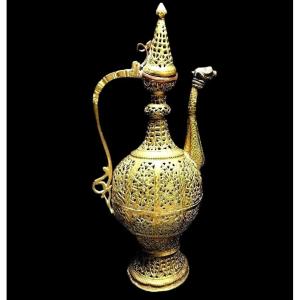


Kashmiri Ewer, Openwork Brass And Bronze, Height 47 Cm, 19th Century, Islamic Art
Artist: Cachemiris
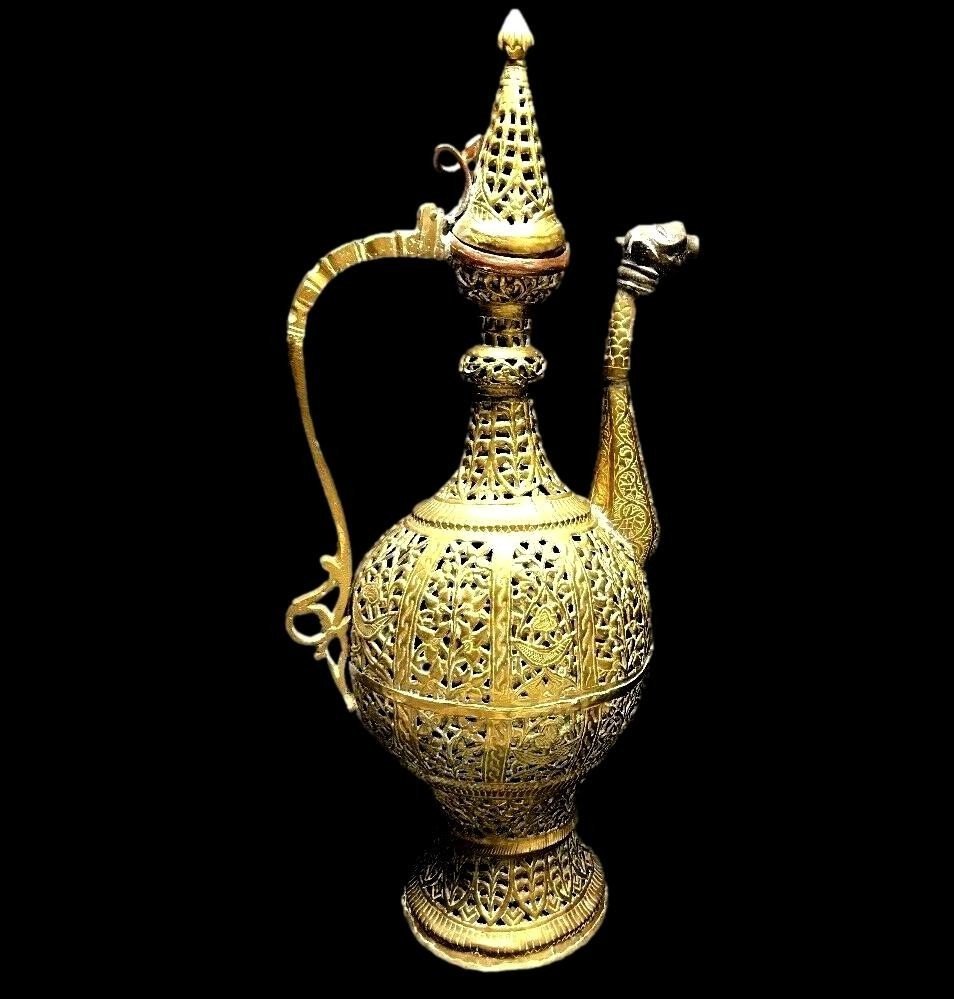
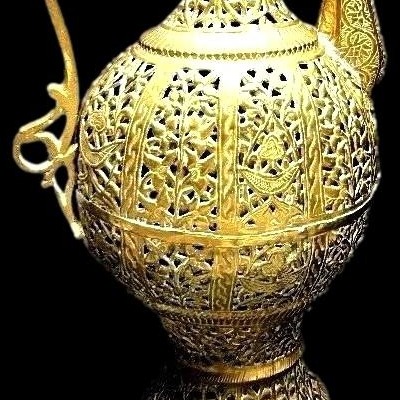
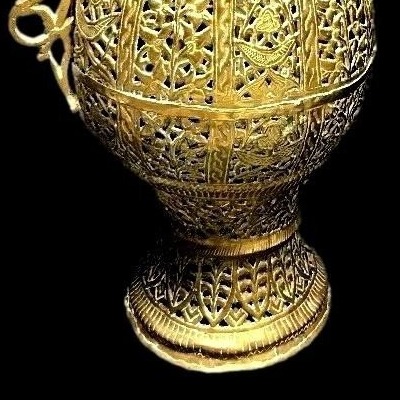
Kashmiri ewer with an oblong, pear-shaped body resting on a pedestal.
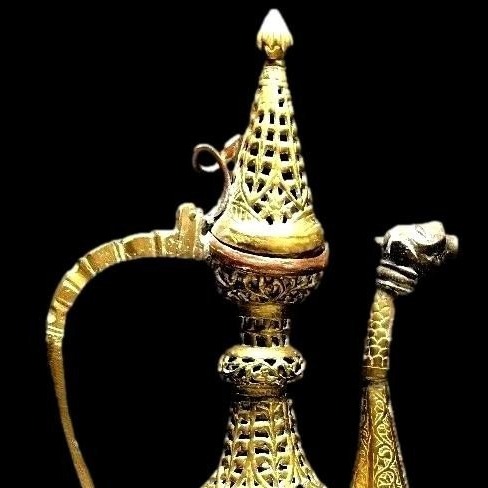
It features an S-shaped handle made of cast brass and a fluted spout topped with a bronze feline head—either a cat or a tiger.
It is topped by a dome with a faceted fretel.
At the top of the handle, a small red copper snake rises toward the fretel.
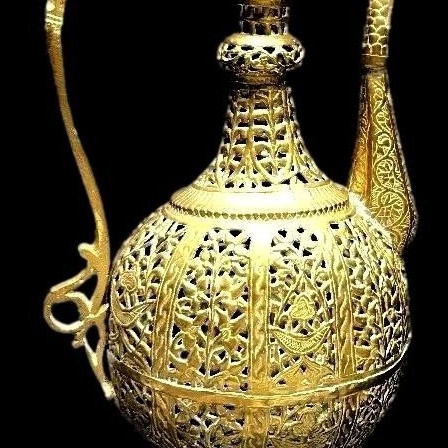
The entire object is made of openwork bronze decorated with plants, trees of life, interlacing patterns, and friezes.
# A boat motif appears repeatedly on the ewer:
It symbolizes the transport of souls in the rite of passage to the afterlife.
The Hindu lunar boat carries souls to their new incarnation.
It is associated with the lunar cycles and the goddesses of the Moon, who hold the power of life and rebirth, through which immortality is bestowed upon the individual.
Beneath this decoration—which resembles a suit of chain mail, skillfully cut and curved throughout the entire piece—lies a copper vessel designed to hold water for ablutions.
This ewer was and is primarily used for ablutions—washing the face and hands—during religious ceremonies.
One-of-a-kind collector’s item
Provenance:
Kashmir, India, 19th century.
## Purchased from a collection in the U.S.
# The term "oblong, pear-shaped body" (or often written oblong and pear-shaped body) is a technical term primarily used in archaeology, art history, and ceramology to describe the morphology (shape) of an ancient vase, amphora, jug, or container.
Here is a breakdown of this term:
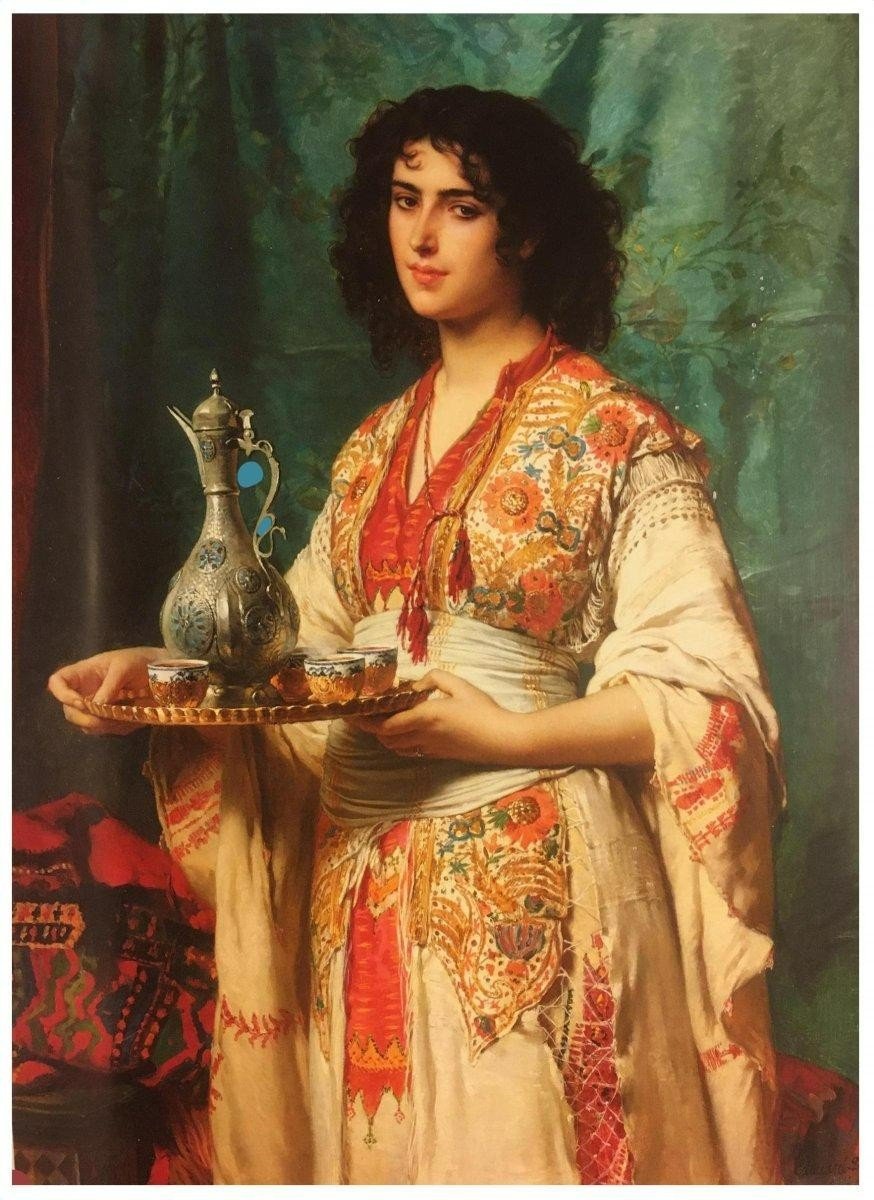
"At the feast of the initiates, standing ready to serve, beauties from all sides hold the ewer in their hands;
the lovers wash their hands with all their soul;
while the beauties pour the water, the ewer in hand"
Reading and translation by A.S. Melikian-Chirvani, 1973, p. 119.
From the 19th century and in good condition.
Ewers are iconic and rank among the most beautiful objects of ancient Eastern art;
they are all unique because they were all custom-made.
Dimensions: Height: 47 cm - Width: 22 cm - Base diameter: 12 cm - Weight: 1,521 grams
We feature other antique ewers from various sources on Proantic.
FREE SHIPPING TO FRANCE via Colissimo (€0) / EUR 25 / WORLD 50
For more information, you can reach me at 06 13 36 09 30 or at winsteinprovence@gmail
www.winsteinprovence.com
It features an S-shaped handle made of cast brass and a fluted spout topped with a bronze feline head—either a cat or a tiger.
It is topped by a dome with a faceted fretel.
At the top of the handle, a small red copper snake rises toward the fretel.
The entire object is made of openwork bronze decorated with plants, trees of life, interlacing patterns, and friezes.
# A boat motif appears repeatedly on the ewer:
It symbolizes the transport of souls in the rite of passage to the afterlife.
The Hindu lunar boat carries souls to their new incarnation.
It is associated with the lunar cycles and the goddesses of the Moon, who hold the power of life and rebirth, through which immortality is bestowed upon the individual.
Beneath this decoration—which resembles a suit of chain mail, skillfully cut and curved throughout the entire piece—lies a copper vessel designed to hold water for ablutions.
This ewer was and is primarily used for ablutions—washing the face and hands—during religious ceremonies.
One-of-a-kind collector’s item
Provenance:
Kashmir, India, 19th century.
## Purchased from a collection in the U.S.
# The term "oblong, pear-shaped body" (or often written oblong and pear-shaped body) is a technical term primarily used in archaeology, art history, and ceramology to describe the morphology (shape) of an ancient vase, amphora, jug, or container.
Here is a breakdown of this term:
- Body: This is the widest, most bulging, and most rounded part of a vase or container (the “body” of the object).
- Oblong: This means that the body is longer than it is wide, extending upward. It has an elongated, oval, or elliptical shape.
- Piriform: Derived from the Latin pirum (pear). This means that the body is shaped like a pear, that is, it is wider at the base (or toward the top, depending on the orientation) and tapers gradually
"At the feast of the initiates, standing ready to serve, beauties from all sides hold the ewer in their hands;
the lovers wash their hands with all their soul;
while the beauties pour the water, the ewer in hand"
Reading and translation by A.S. Melikian-Chirvani, 1973, p. 119.
From the 19th century and in good condition.
Ewers are iconic and rank among the most beautiful objects of ancient Eastern art;
they are all unique because they were all custom-made.
Dimensions: Height: 47 cm - Width: 22 cm - Base diameter: 12 cm - Weight: 1,521 grams
We feature other antique ewers from various sources on Proantic.
FREE SHIPPING TO FRANCE via Colissimo (€0) / EUR 25 / WORLD 50
For more information, you can reach me at 06 13 36 09 30 or at winsteinprovence@gmail
www.winsteinprovence.com
1 260 €
Period: 19th century
Style: Orientalism
Condition: Excellent condition
Material: Brass
Width: 22 cm - 9"
Height: 47 cm - 18
Reference (ID): 1847408
Availability: In stock
Print