





Orthodox Triptych Depicting The Crowned Virgin And The Infant Christ — Tempera On Wood, 18th Century
Artist: école Post-byzantine, Attribution Probable Aux Balkans
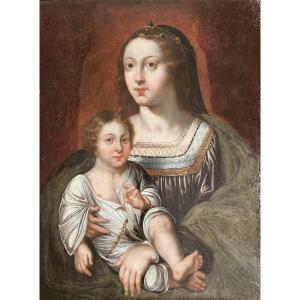
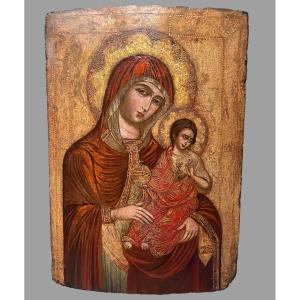
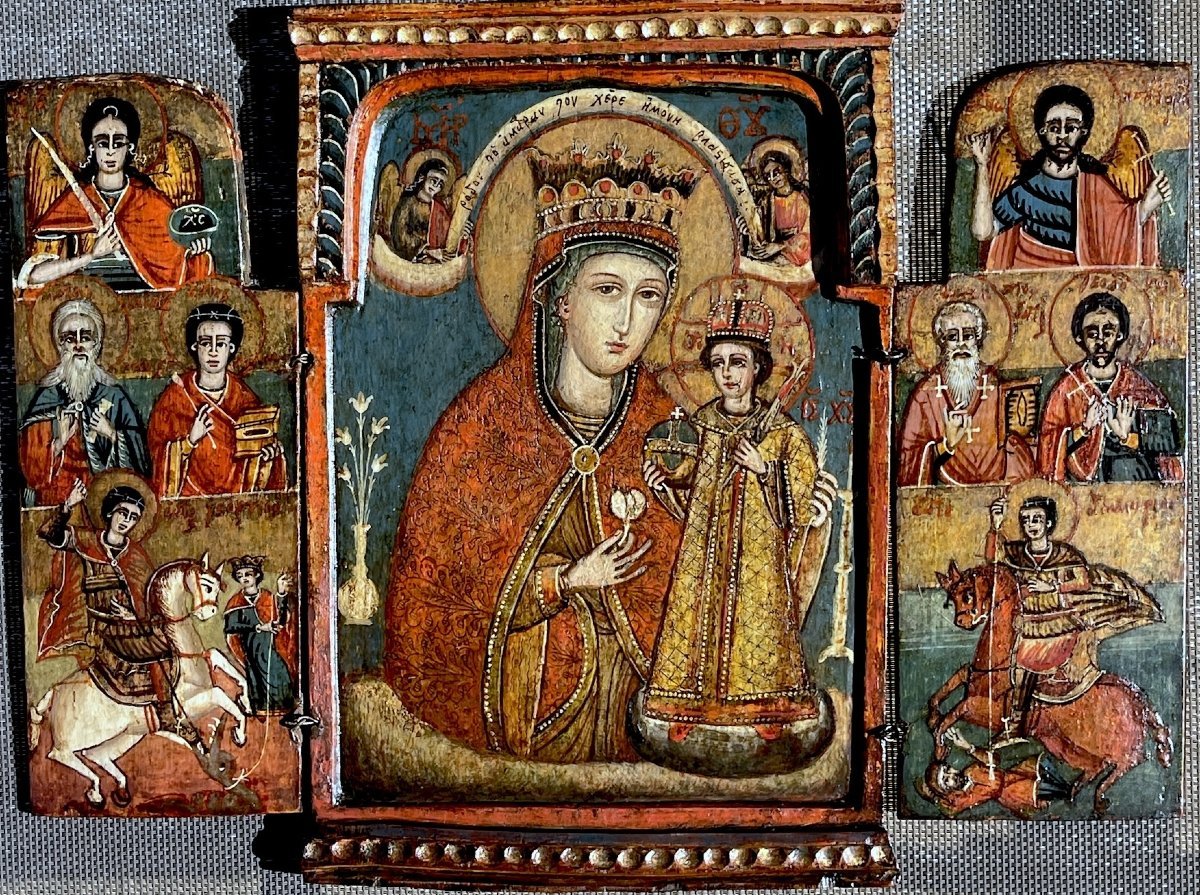
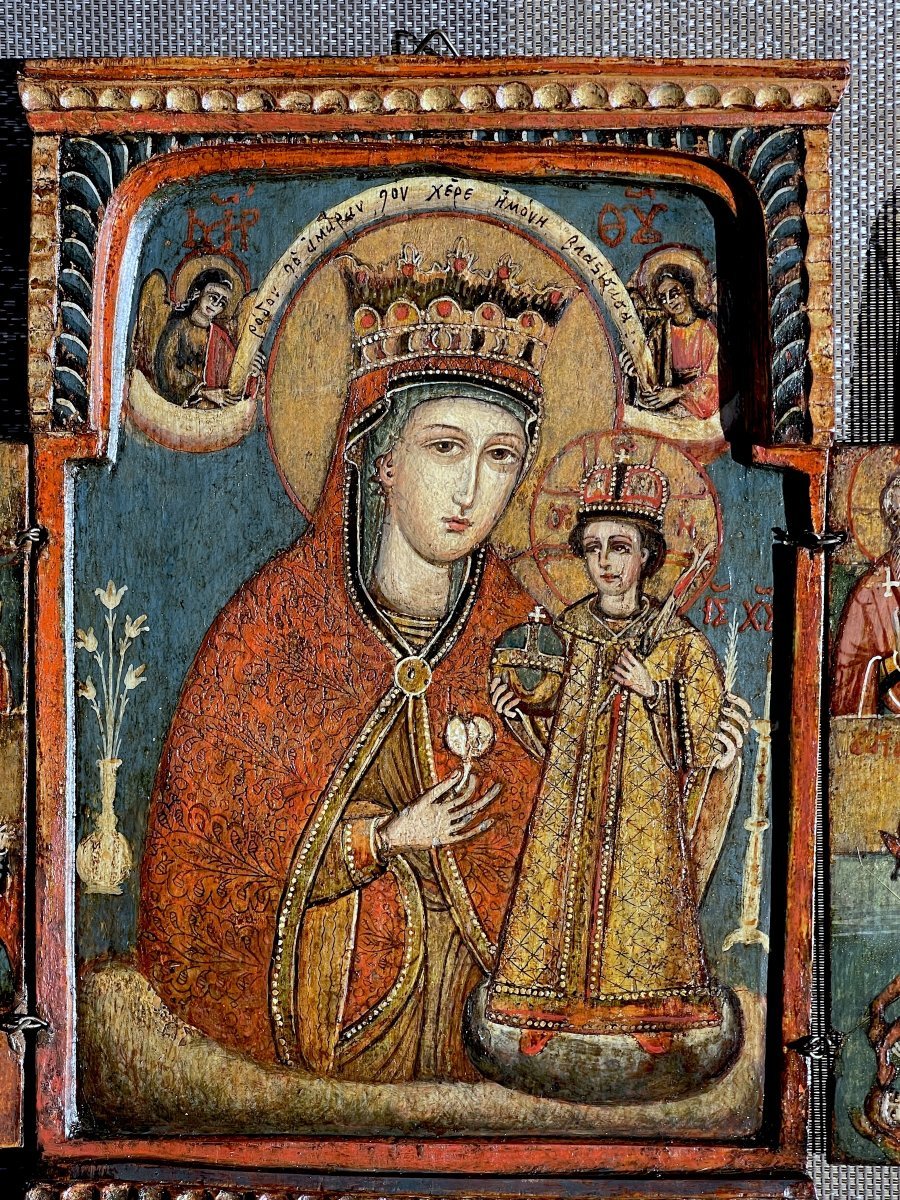
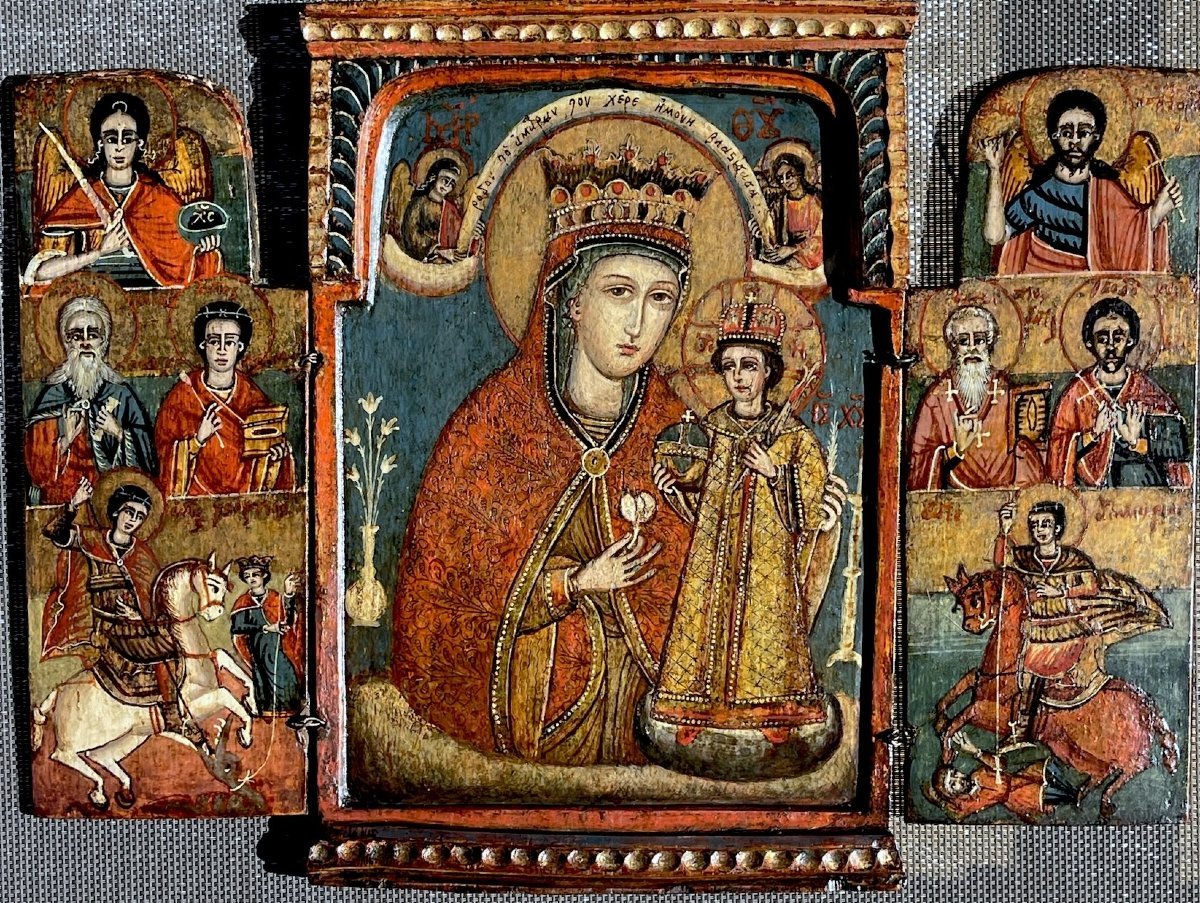
A remarkable Orthodox devotional triptych painted on wooden panels, featuring a composition centered on the crowned Virgin Mary holding the also-crowned Christ Child, within a rich iconographic program dedicated to the protective figures of the Eastern Christian tradition.
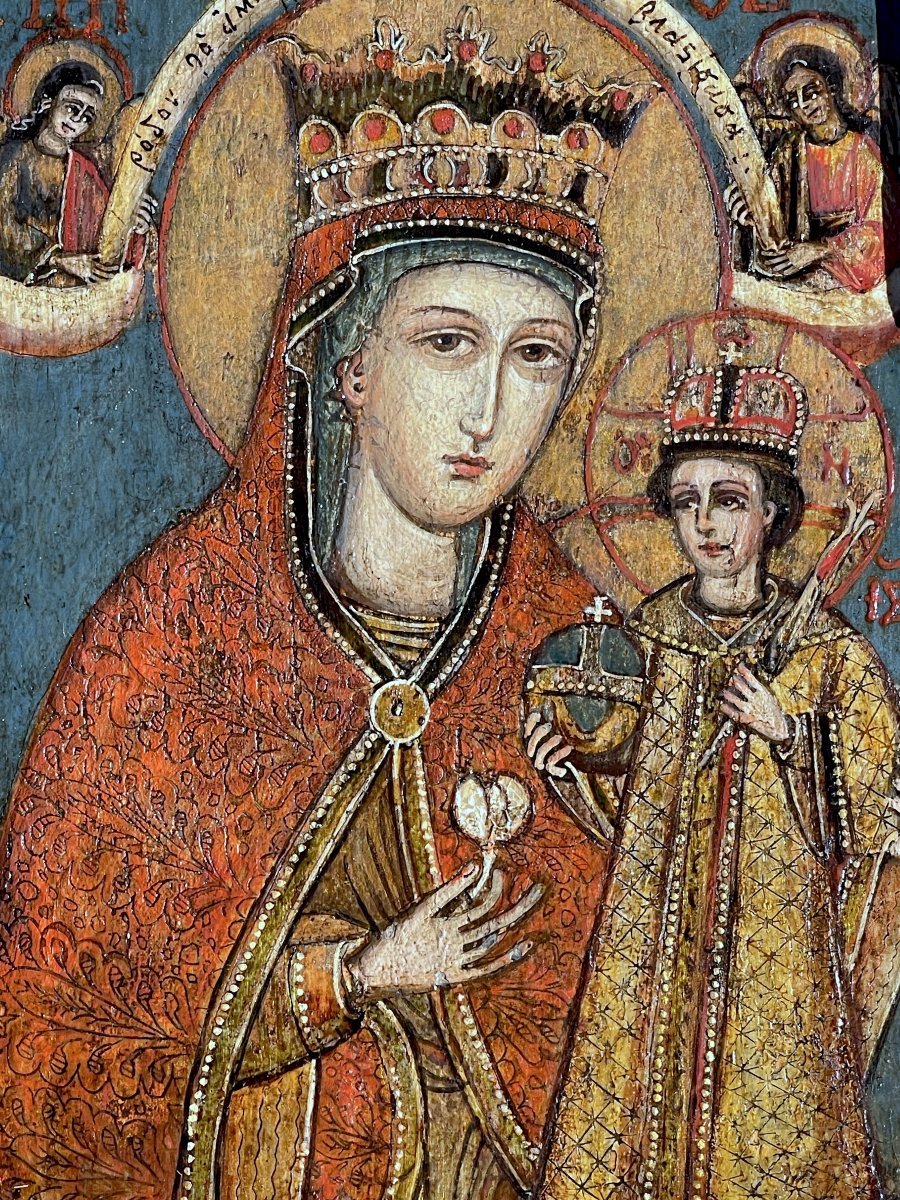
The central panel, monumental in size compared to the side panels, depicts the Theotokos, the Mother of God, recognizable by the Greek inscriptions MR ΘΥ that frame her halo. Dressed in a red mantle adorned with decorative motifs, she wears an imposing crown and stands out against a vast golden halo, while the Christ Child, adorned in a finely ornamented golden-yellow garment, is shown standing at her side.
Two angels are positioned in the upper part of the composition, on either side of the monumental halo. The deep blue background, the gold highlights, and the polychrome architectural frame underscore the solemnity of this representation.
The ensemble is distinguished by the richness of its palette, combining reds, blues, greens, and ochres, as well as by the abundance of decorative motifs that enliven the garments, halos, and borders.
An iconography of protection and intercession
The triptych unfolds across its three panels a collection of sacred figures that contribute to its devotional purpose.
The central panel: The Virgin Queen and the Christ Child
The Virgin occupies a dominant position. Her crown, her monumental halo, and her richly decorated mantle underscore her royal dignity and her central place in Orthodox devotion.
The Christ Child, also crowned, appears dressed in a robe with golden geometric patterns. His presence alongside Mary affirms the mystery of the Incarnation and the divine dimension of the Theotokos' motherhood.
The composition retains the fundamental principles of Eastern iconographic art: frontality, hierarchy of figures, prominence of halos, and the preeminence of symbolism over naturalistic representation.
The side panels: saints, angels, and protective figures
Both panels feature several superimposed registers, combining holy figures and scenes of saints on horseback.
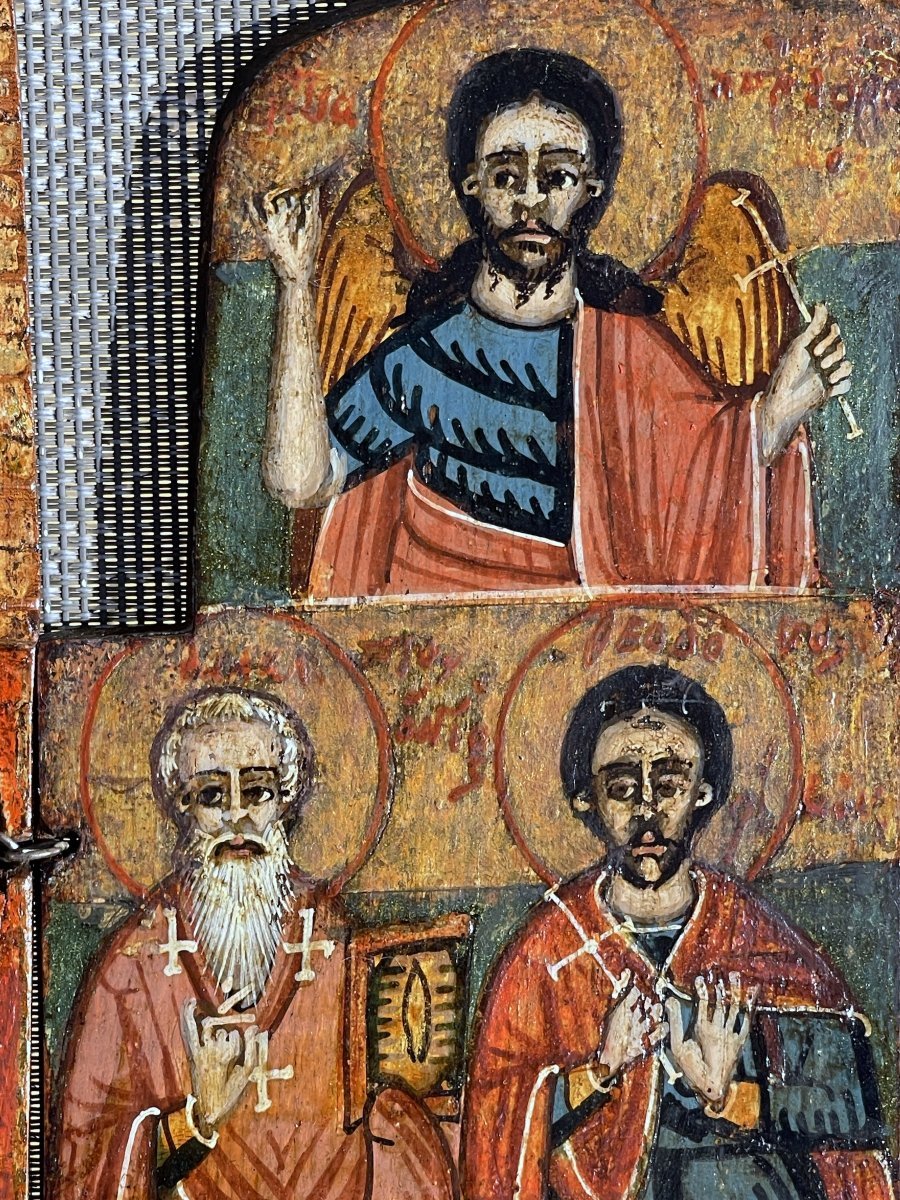
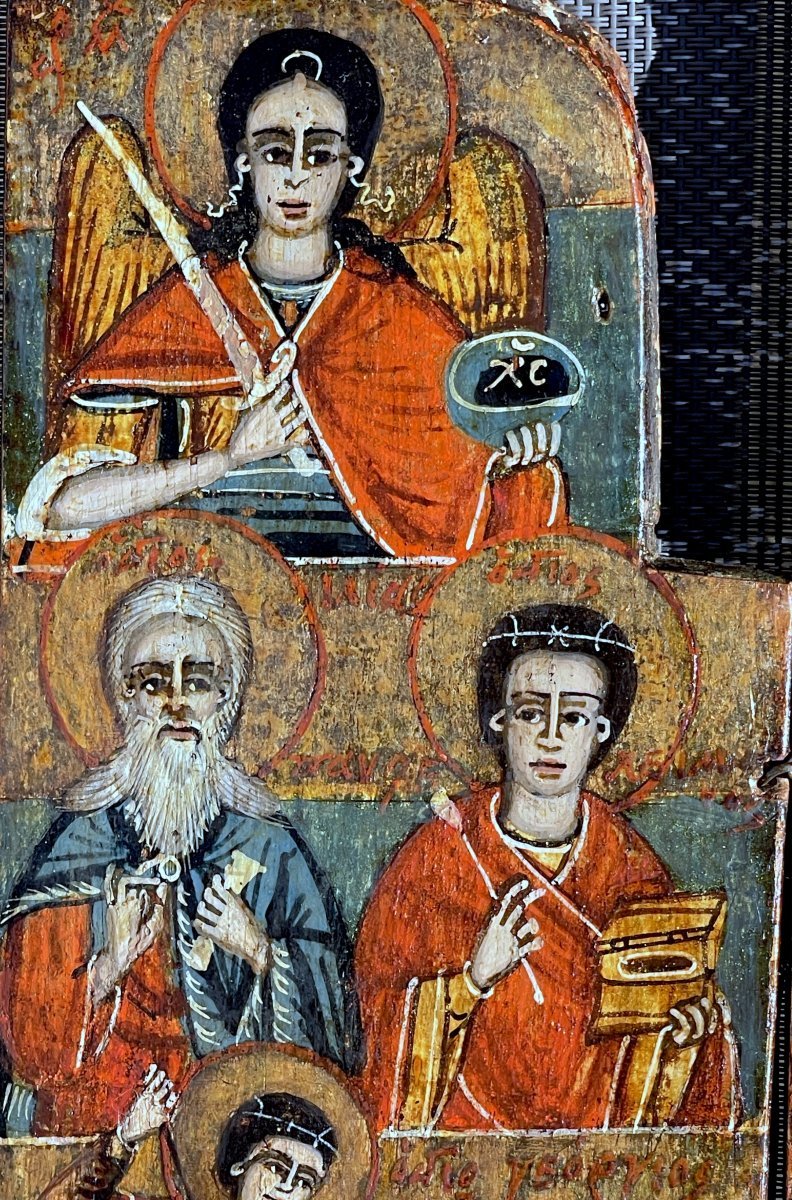
On the left panel, the upper section shows a winged figure holding a sword and a spherical object, whose identification as an archangel remains to be confirmed. The middle register includes a saint with a long white beard and a figure dressed in red. In the lower section, a rider on a white horse appears above an inverted figure.
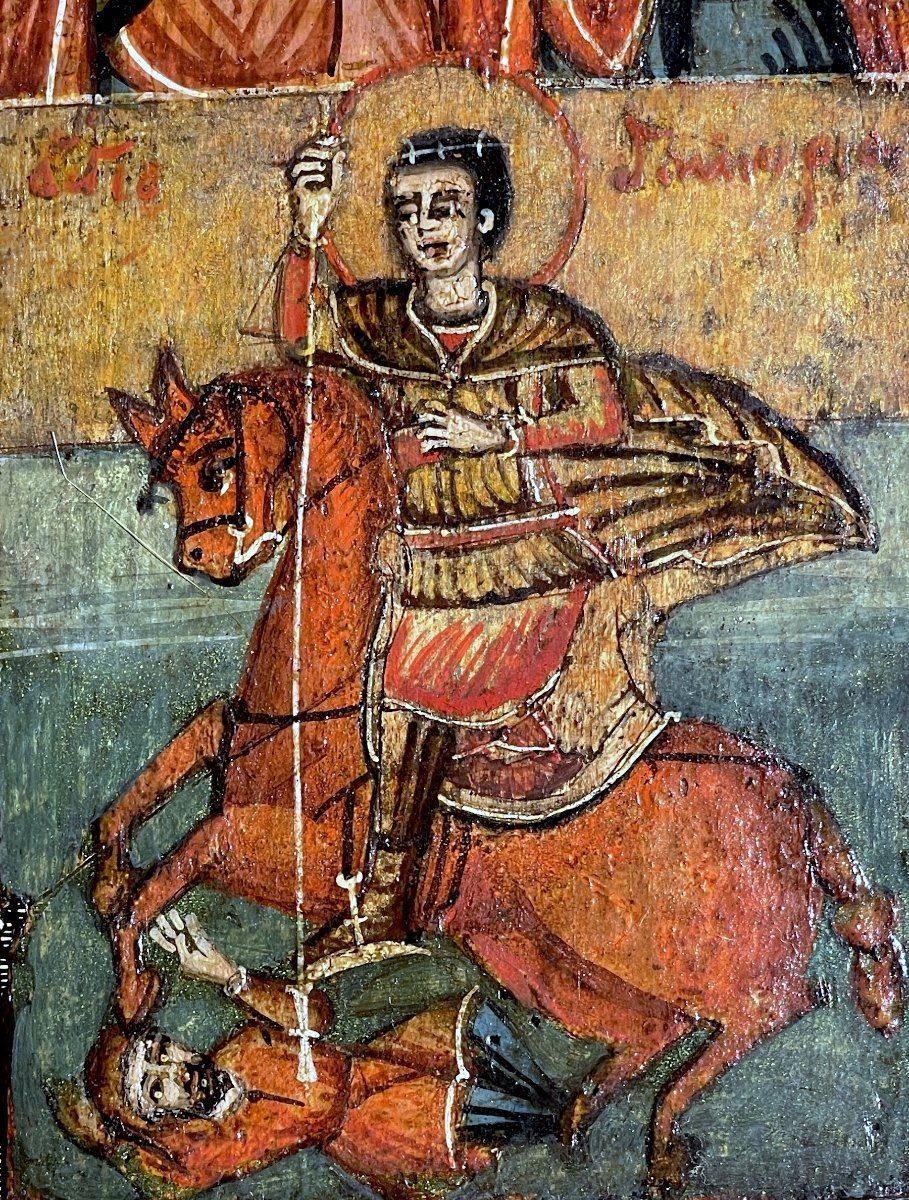
The right panel also features a winged figure in its upper section, followed by two ecclesiastical or saintly figures in the middle register. The lower section is occupied by a rider on a red horse, towering over a fallen adversary.
These equestrian scenes evoke the tradition of patron saints, a tradition particularly prevalent in Balkan Orthodox art. Precisely identifying each figure would require a more thorough examination of their attributes and inscriptions.
A pictorial language inherited from Byzantium
The composition testifies to the enduring influence of Byzantine models in the religious painting of Orthodox communities.
The figures are arranged according to a spiritual hierarchy rather than the rules of Western perspective. Halos play a central role, while the garments are enlivened by repetitive patterns and luminous highlights.
The palette relies on strong contrasts: the deep red of the Marian mantle, the blue of the central background, the yellows and golds of the garments, and the ochres of the flesh tones and the backgrounds of the side panels.
The beaded decoration of the upper and lower borders, combined with the red frames and geometric motifs, lends the whole an architectural presentation and the character of a small, portable shrine.
Attribution and Dating
Proposed attribution: Post-Byzantine school, probably within the Orthodox Balkan region.
Proposed dating: 18th century, possibly in its last quarter, subject to further material and stylistic examination.
The tripartite organization, the iconographic vocabulary, and the use of Greek inscriptions are consistent with an Eastern devotional tradition. However, these features alone are insufficient to determine a workshop, a specific region, or a definitive date.
A more precise attribution to Macedonia, Epirus, or another Balkan region would require documented comparisons with works of known provenance.
Condition
The artwork presents an old painted surface, characterized by contrasting polychromy, craquelure, and visible signs of wear. These elements contribute to its historical appearance and attest to its material history.
The structural condition, the stability of the panels, the functionality of the hinges, and the extent of any restorations remain to be determined after direct examination.
Technical Specifications
Subject: Crowned Virgin and Child with Angels, Saints, and Equestrian Scenes
Period: 18th century, proposed date
School: Post-Byzantine, likely Balkan
Technique: Tempera on wood panel, traditional technique, subject to material examination
Inscriptions: Greek, including MR ΘΥ, abbreviation for "Mother of God"
Dimensions:
Height: 31 cm
Width (open): 40 cm
Provenance: Européan collection
Reference: Arte Collection
This triptych offers an interesting example of the Orthodox iconographic tradition, in which sacred images accompany private prayer and family devotion. Its portable format, rich composition, and the prominence given to protective figures make it a representative work of the enduring influence of Byzantine art in Eastern European religious art.
Keywords
#Orthodox Triptych #Ancient Icon #Theotokos #Crowned Virgin #Christ Child #PostByzantine Art #Balkan Art #TemperaOn Wood #Sacred Art #Orthodox Icon #Horseman Saints #Religious Painting #18th Century #Religious Heritage #Collector #Proantic #ArteCollection
2 900 €
Period: 18th century
Style: Renaissance, Louis 13th
Condition: Good condition
Material: Other
Width: 40 cm
Height: 31 cm
Reference (ID): 1846623
Availability: In stock
Print