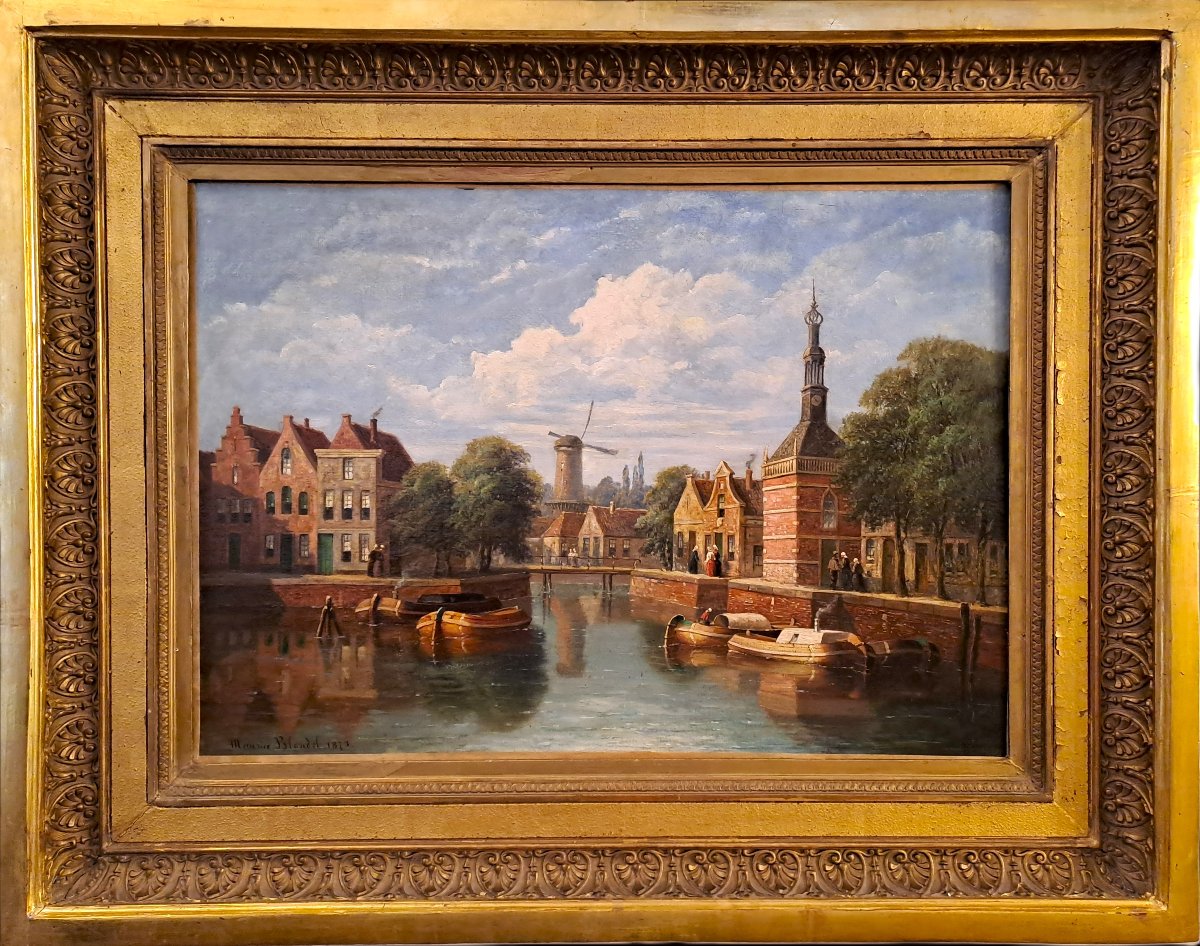



Marcel Blondel (19th Century), Oil On Canvas, The Verdronkenoord Canal In Alkmaar (netherlands), 1873
Artist: Maurice Blondel (actif Dans La Seconde Moitié Du Xixème Siècle)
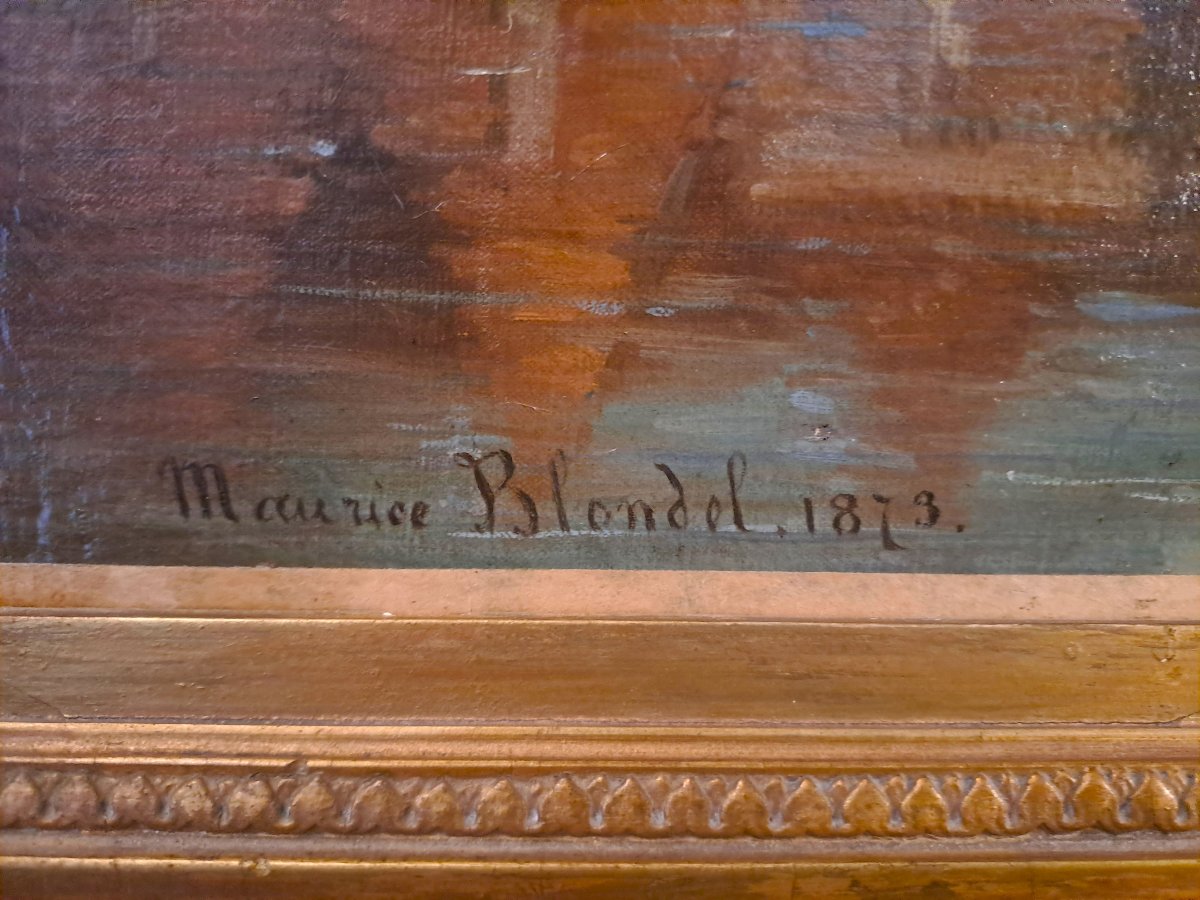
Oil on canvas, signed and dated ‘Maurice Blondel 1873’ in the bottom left-hand corner.
Analysis of the work:
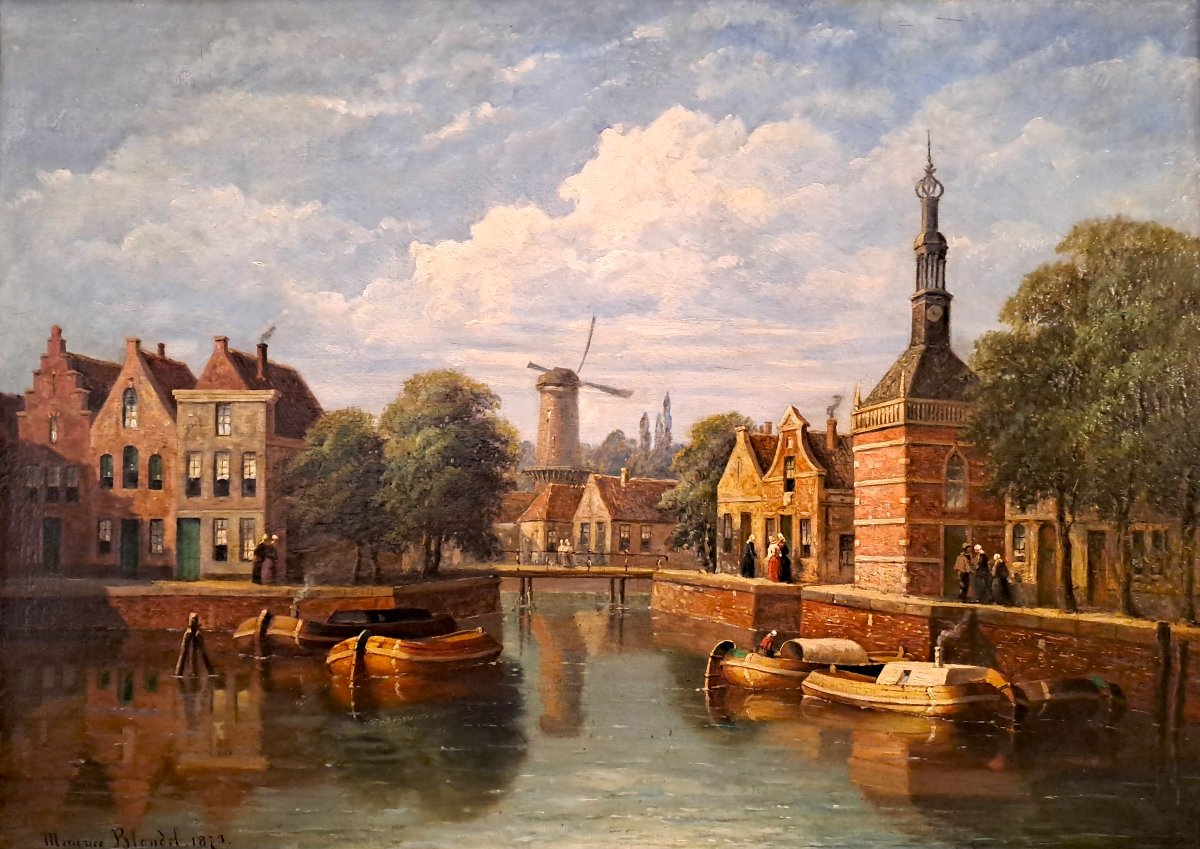
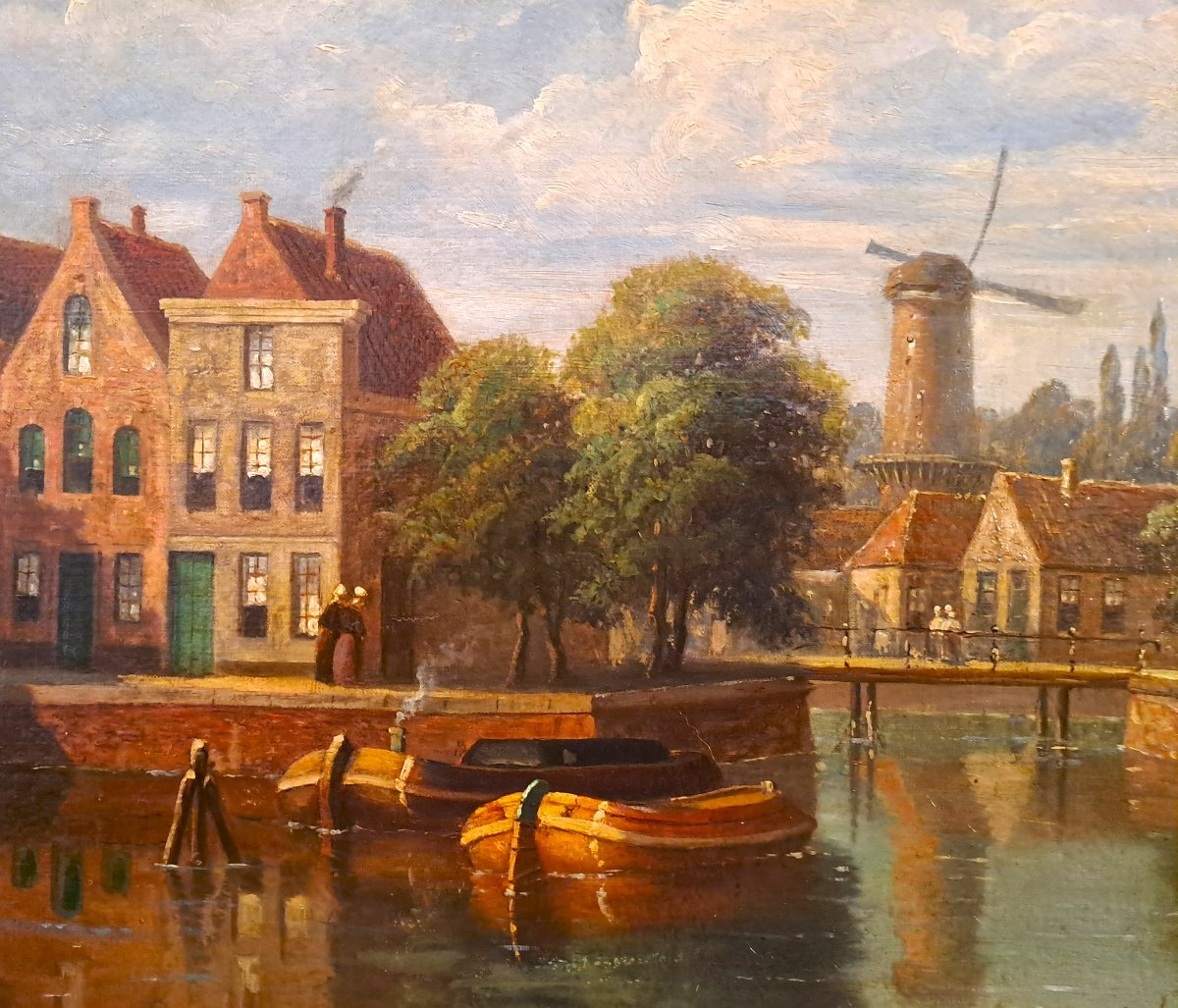
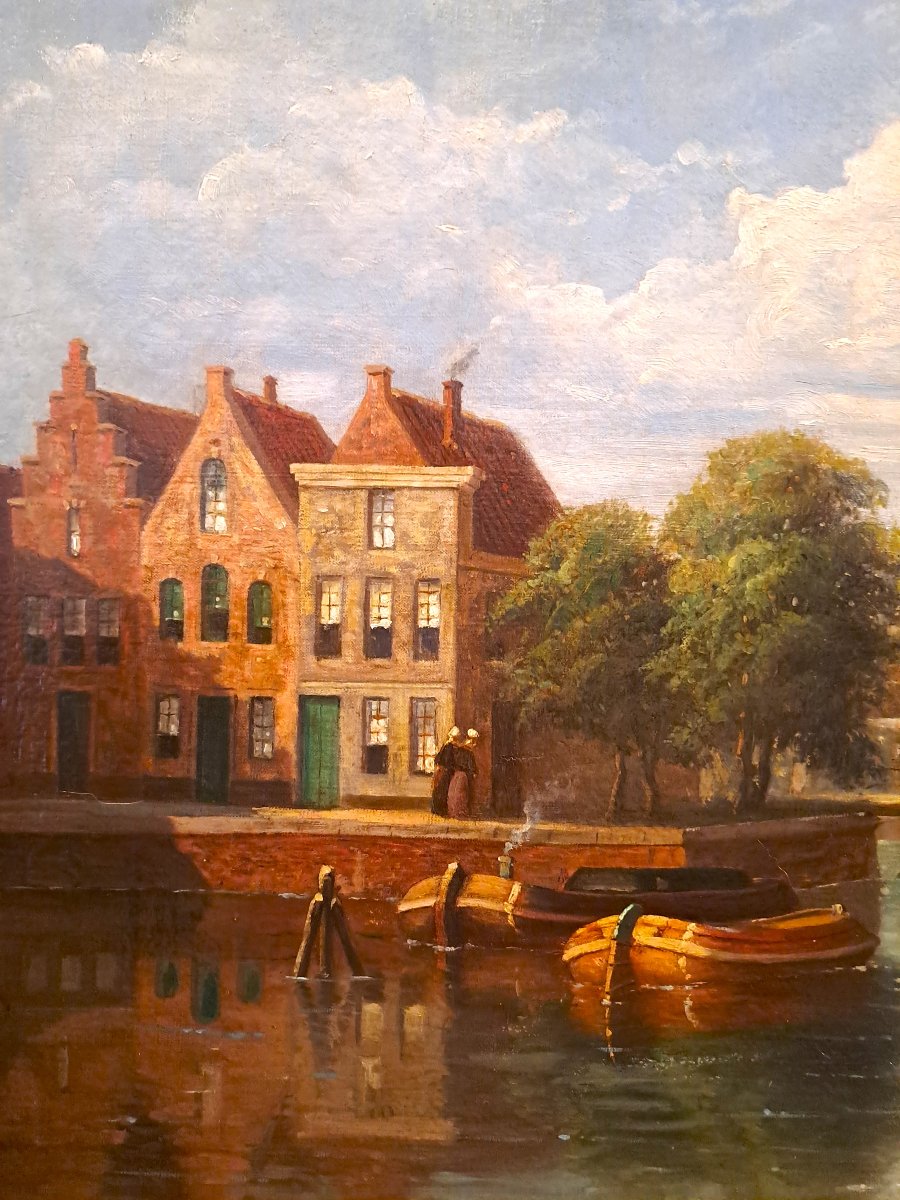
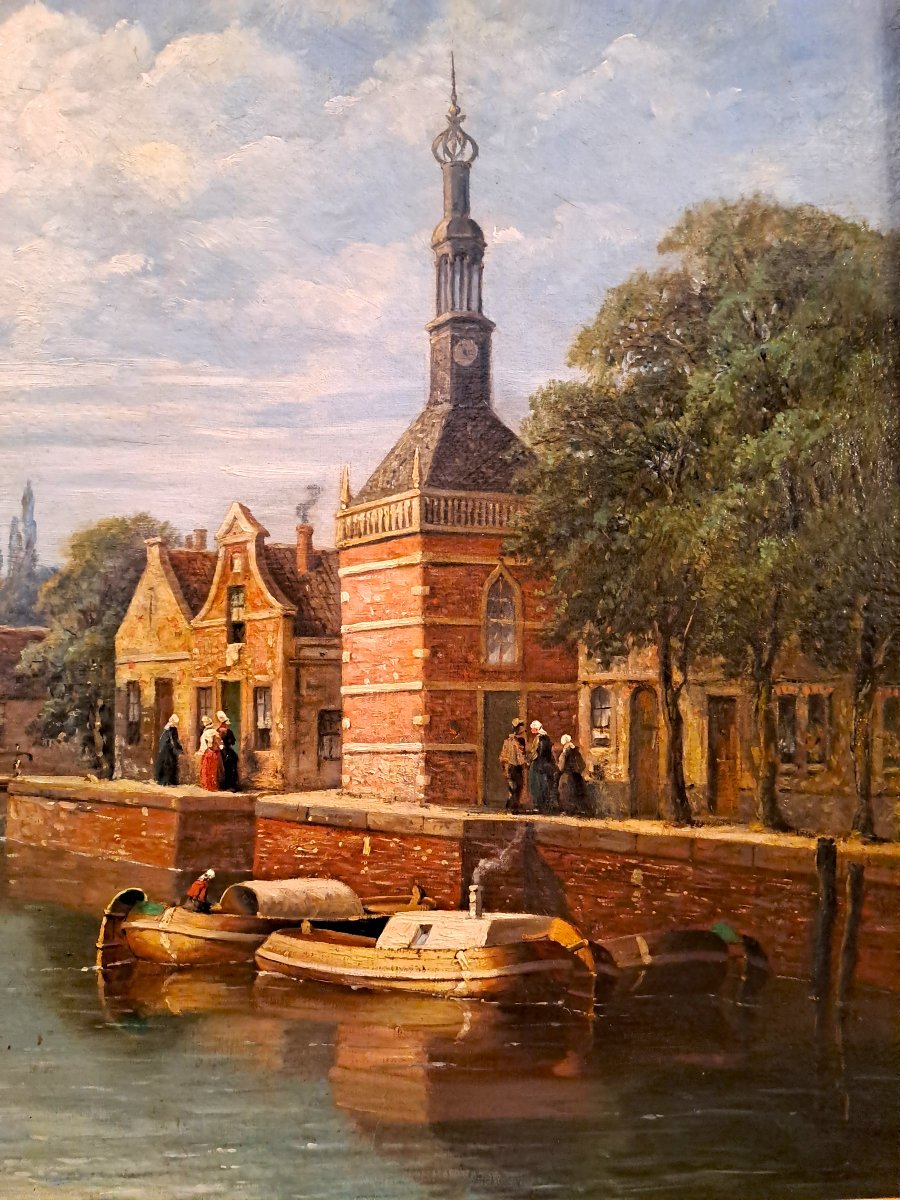
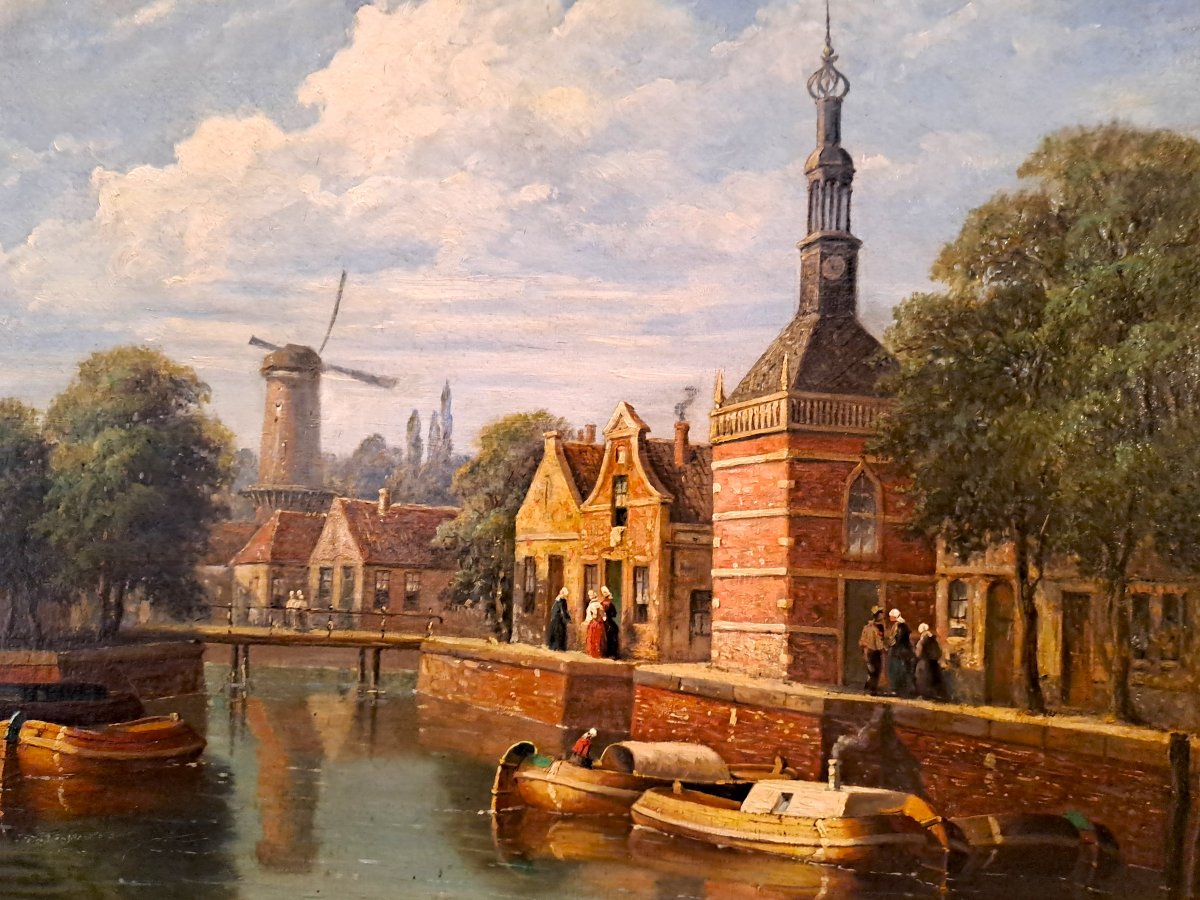
The work offers a very accurate depiction of the town of Alkmaar (North Holland) during the last third of the 19th century, with this scene painted from the Verdronkenoord canal. On the right stands the Excise Tower (Accijnstoren). This square brick building, erected in 1622, served as an excise office for collecting duties on goods imported by ship. Its distinctive structure, wooden balustrade and elegant lantern with an openwork spire are immediately recognisable. The painting captures the monument in its original location, before it was moved back four metres in 1924 to widen the Bierkade and allow for easier traffic flow.
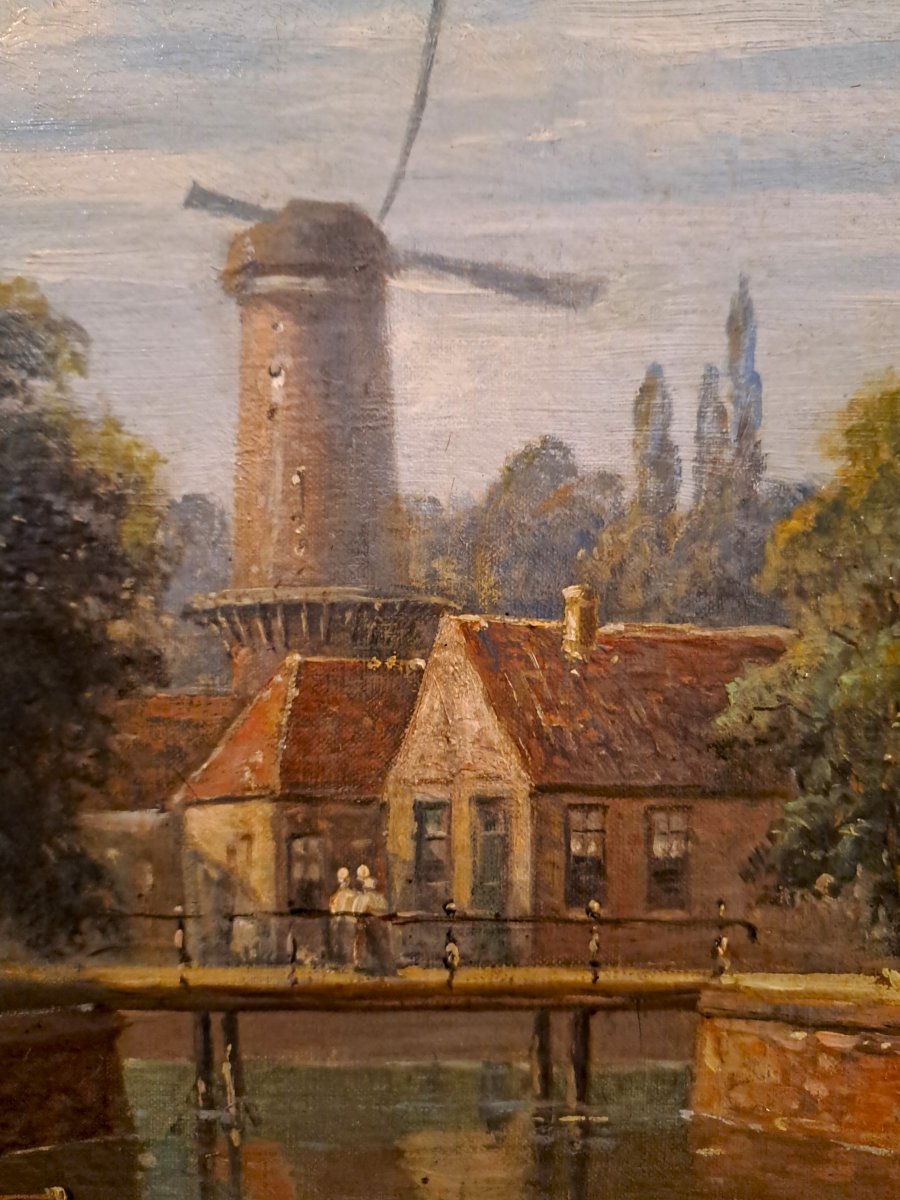
In the background stands the Piet Mill, or Molen van Groot. This large, round stone mill, of the ‘stellingmolen’ type, was built in 1769 on the city’s former western ramparts. This type of windmill, with a scaffold structure, is generally found in built-up areas and must be tall enough to catch sufficient wind within the urban environment. The sails and tail therefore do not reach the ground, and in order to operate the mill, there must be scaffolding running round it at mid-height. It is from this scaffolding that the mill is secured and the sails are attached to the blades. This mill still dominates the Alkmaar landscape today and remains one of the city’s major landmarks.
The painter employed a rigorous perspective composition dictated by the canal and the alignment, on either side of it, of the brick façades of the houses with stepped gables (Trapgevel) or neck gables (Halsgevel), guiding the eye towards the distant silhouette of the windmill and thus creating a subtle transition between the urban centre and the town’s historic outskirts. The sky and water occupy more than half the surface of the canvas, a characteristic inherited from the 17th-century masters. Blondel uses subtle shades of grey, off-white and washed-out blues to paint this North Sea sky, laden with clouds that filter the light and render it soft, almost milky. The Verdronkenoord canal, meanwhile, is rendered in a gradient of watery green with greyish highlights, in which the houses and barges are reflected in a harmony of brick, sienna, ochre and brown tones, creating a chromatic link between the upper and lower parts of the painting.
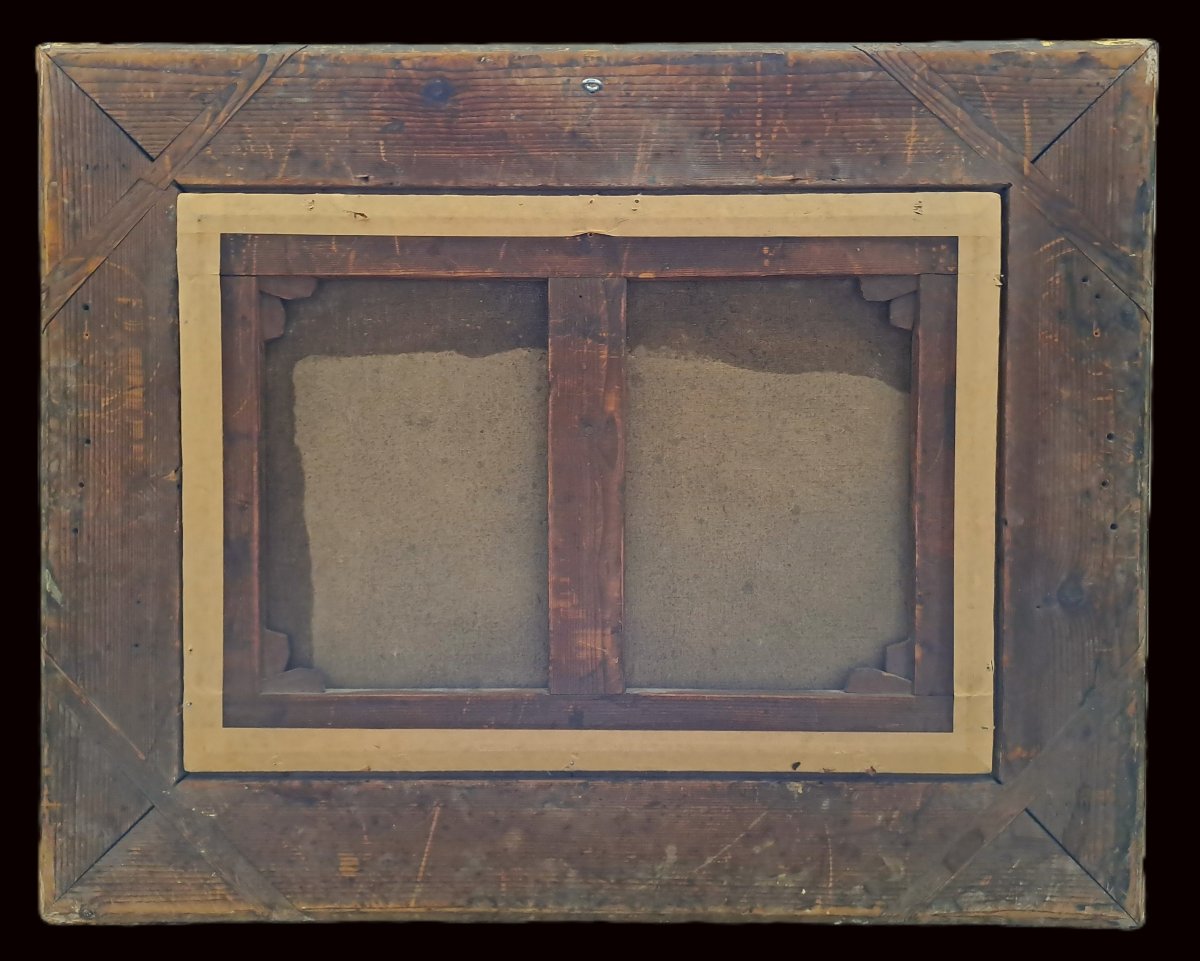
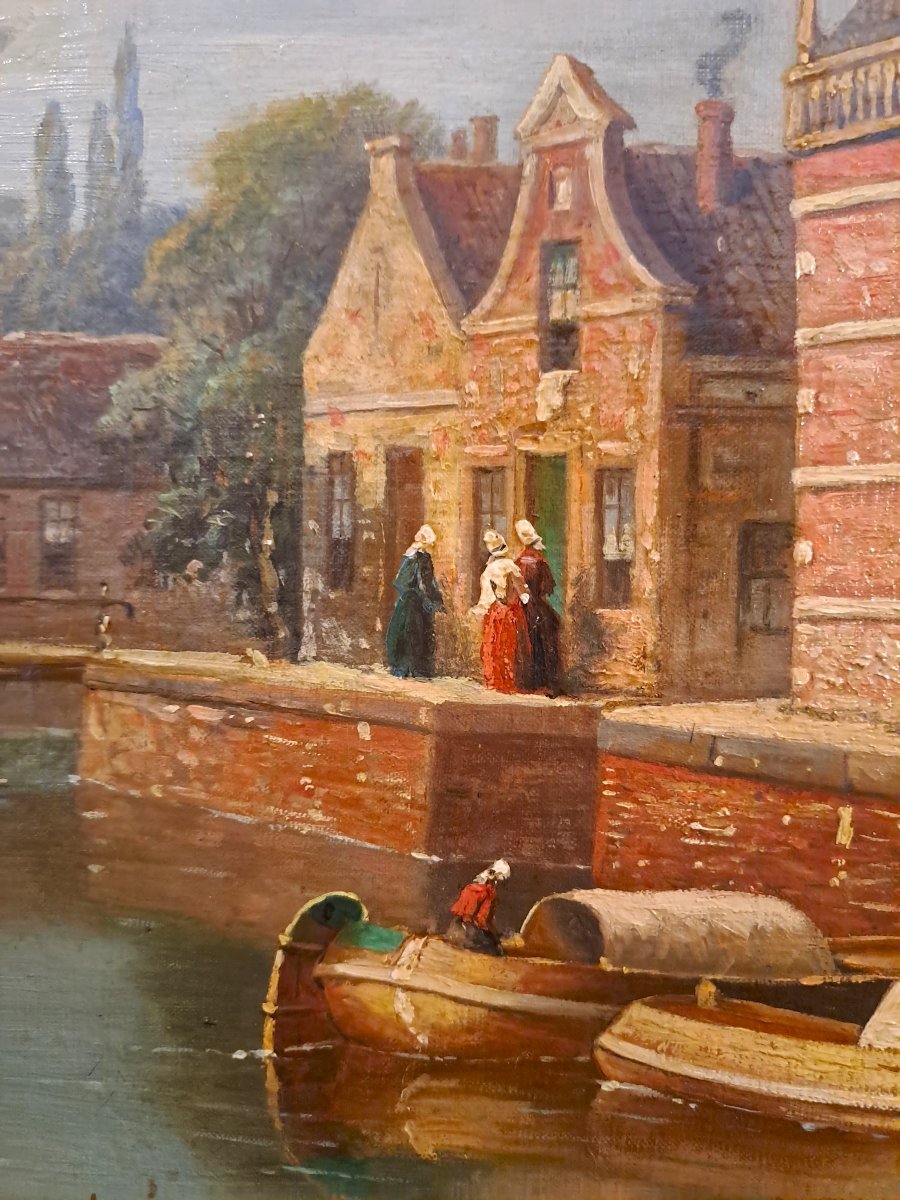
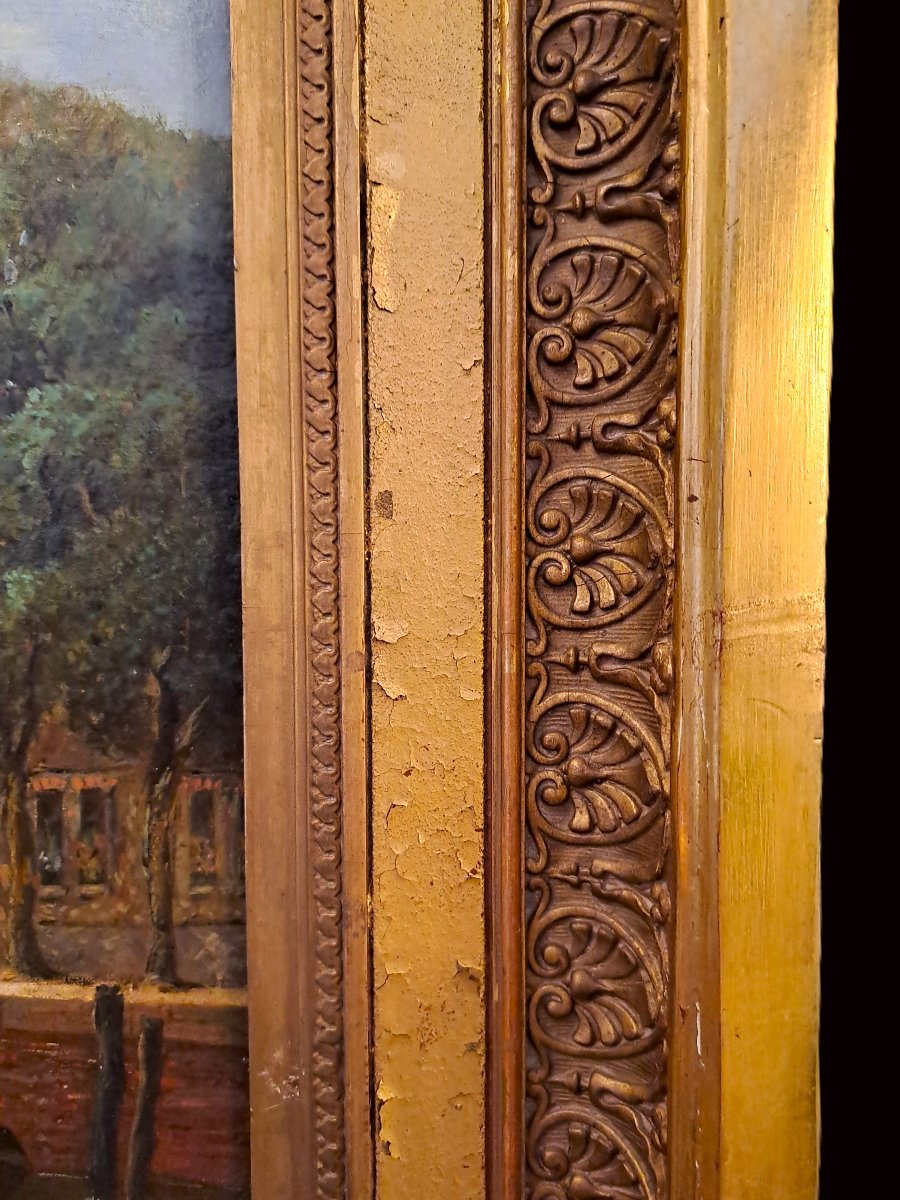
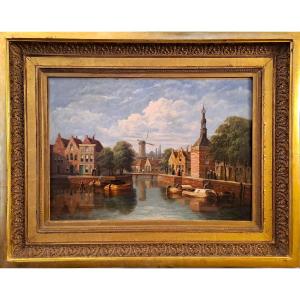
The small flecks of white on the women’s headdresses echo the cloudy sky, whilst the tiny touches of vermilion red, judiciously scattered across their clothing, bring the composition to life. These flecks of pure colour serve to guide the viewer’s eye towards areas of human activity. The painting is beautifully set off by an antique wooden frame with gilded stucco and a palmette design, though it does show some signs of wear visible in the photographs.
A social and economic chronicle of the late 19th century:
The painting illustrates the importance of Alkmaar’s river-based economic activity in the 19th century. At that time, the canals were not places for strolling, but genuine trade routes. In the foreground, traditional flat-bottomed cargo barges (of the ‘Pram’ or ‘Snik’ type) are moored to the Ducs-d’Albe. These barges carried timber, peat (the main fuel for heating at the time), grain and barrels of beer. In fact, the quay where the barges are moored on the right is historically known as the Bierkade (the beer quay). All the vessels are positioned directly opposite the Excise Tower, a reminder that no goods could be unloaded or sold in the town without the boatmen first declaring their cargo and paying the compulsory excise duty to the tower’s administration.
In 1873, Alkmaar was a hub for regional trade, renowned for its famous cheese market. Boats were therefore also used to transport cheese wheels from the surrounding farms to the town centre, and then to export them to major ports such as Amsterdam. The human figures painted by Maurice Blondel are not merely decorative elements. In the tradition of Dutch landscape painting, these figures are known as ‘animating figures’ (or staffage). They serve to bring the scene to life, establish the scale of the buildings and anchor the scene in a specific social reality. Whilst the barges are stationary, these figures introduce a dynamic sense of movement that runs horizontally across the painting. The small size of these silhouettes emphasises the verticality and imposing stature of the Flemish gabled houses, accentuating the picturesque and well-preserved character of Alkmaar’s historic centre.
The painting depicts social life centred on the banks of the canal, probably in the late afternoon, with an abundance of female figures who have made the quayside their own. Indeed, at this time of day, dockers, cheese carriers (kaasdragers) and farm labourers are still busy inside the warehouses, in the holds of ships or on the farms in the surrounding polders. As for Alkmaar’s sailors, canal boatmen and fishermen, they are often away for several days on the Zuiderzee or the major transport canals. The only man visible is standing at the foot of the Excise Tower; he is probably the excise clerk who has been left on duty to keep watch over the moored boats. The women are all wearing the traditional white headdress made of linen or lace, a symbol of respectability and piety in nineteenth-century Holland.
About the artist:
Although the precise details of his personal history are not recorded in any major archives, Maurice Blondel’s works enable us to piece together his artistic profile. In his day, there was a great deal of enthusiasm in France, Belgium and England for the rediscovery of vedutism and the 17th-century Dutch Golden Age. In 1873, Europe was in the midst of the Industrial Revolution, but the art world was characterised by a nostalgia for traditional landscapes. For a painter such as Maurice Blondel, travelling to Holland at that time was therefore a quest for a picturesque and unspoilt world. The railway, then rapidly expanding in the Netherlands (Alkmaar station opened in 1865), greatly facilitated access to these northern water towns for a large number of travellers, including artists.
Maurice Blondel thus follows in the tradition of those 19th-century travelling painters who devoted their work primarily to depicting the landscapes of northern Europe, in the direct lineage of the late Flemish and Dutch landscape school, characterised by a solid academic technique, though his work was distributed commercially on a largely regional basis – which explains why he is given little mention in major national biographies – and was aimed at a bourgeois clientele with a taste for seascapes and scenes of tranquil canals. Combining architectural precision with the romantic poetry of genre scenes, Maurice Blondel presents here a rare work that goes beyond the mere fantasy landscape to establish itself as a veritable visual archive of Alkmaar in 1873.
900 €
Period: 19th century
Style: Louis Philippe, Charles 10th
Condition: Good condition
Material: Oil painting
Width: toile : 57,5 cm / cadre : 78 cm
Height: toile : 41 cm / cadre 61,5 cm
Reference (ID): 1845809
Availability: In stock
Print