

Henry Auguste, Paris 1787–1788, Solid Silver, Plate From The Louis XVI Period
Solid Silver Plate by Henry Auguste, Goldsmith to the King — Paris, 1787–1788
Louis XVI period
Diameter: 25.5 cm — Weight: 710 g
Price: €2,300
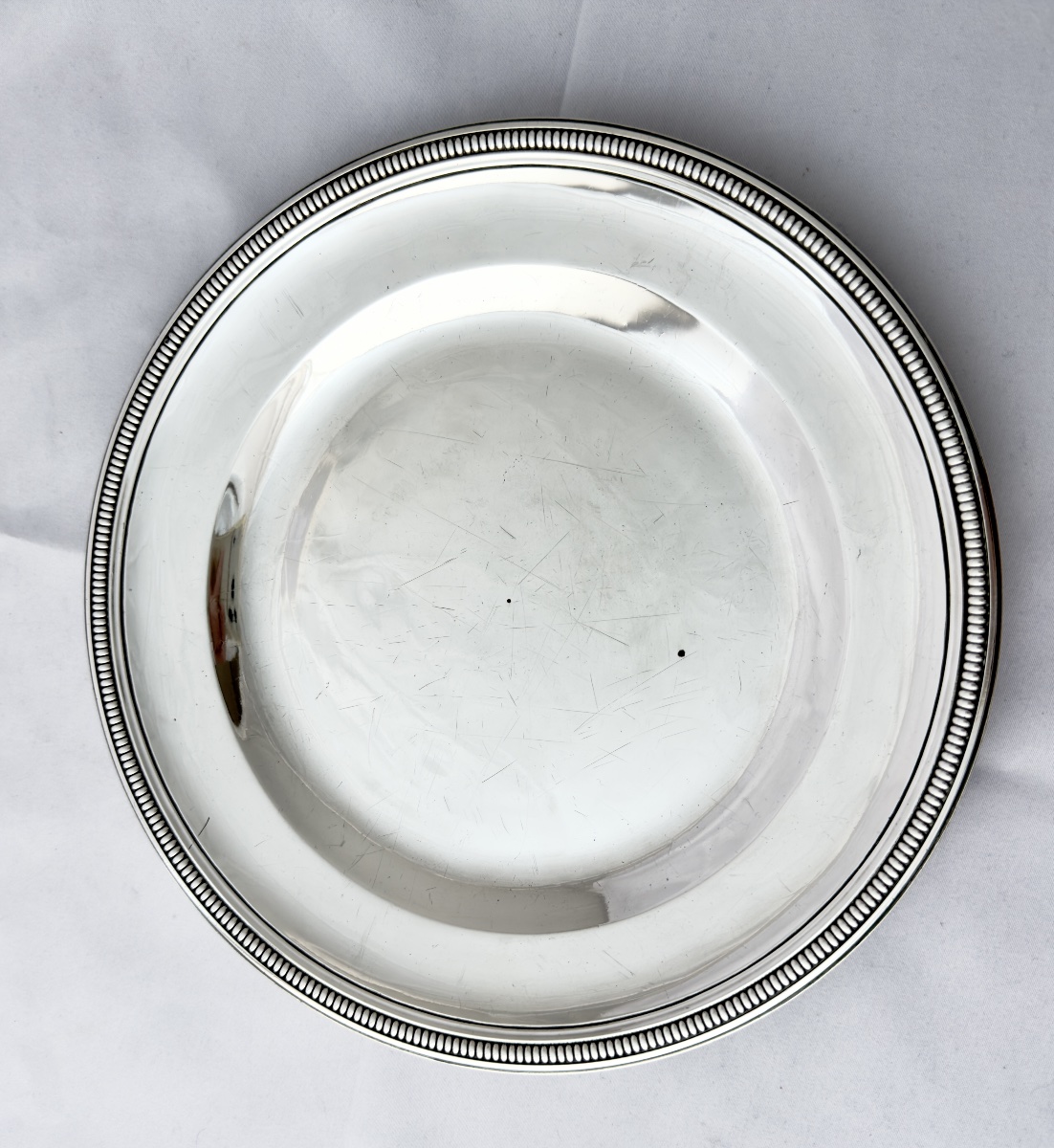
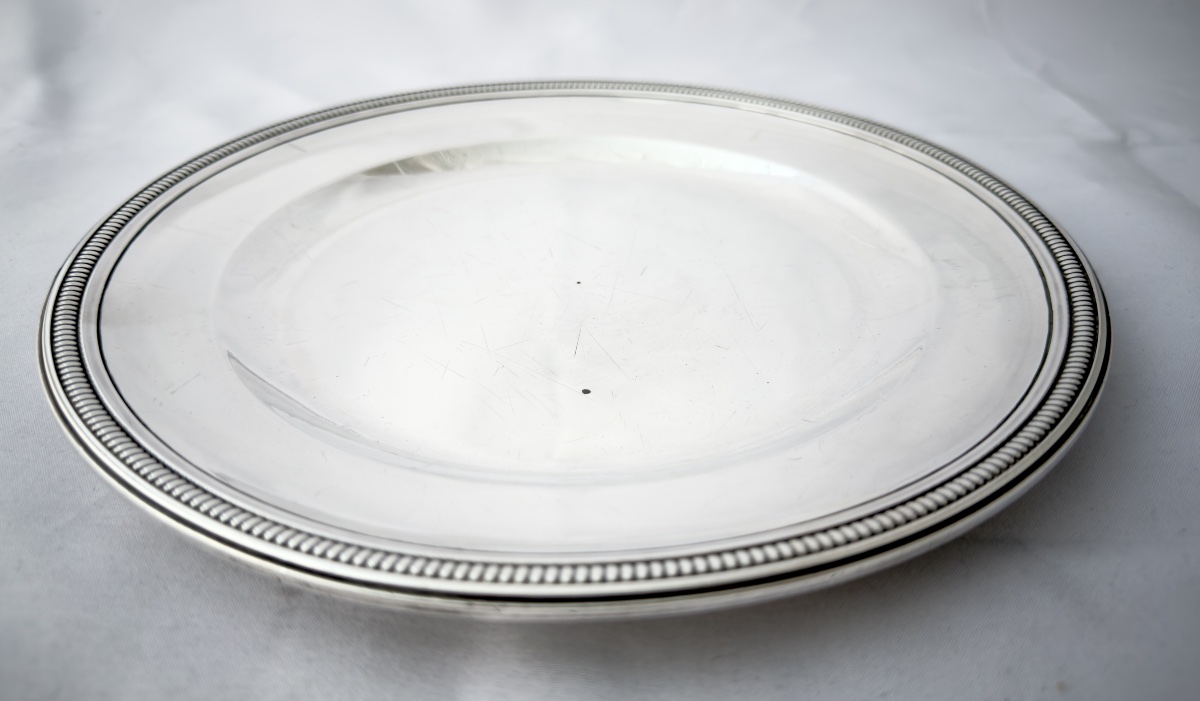
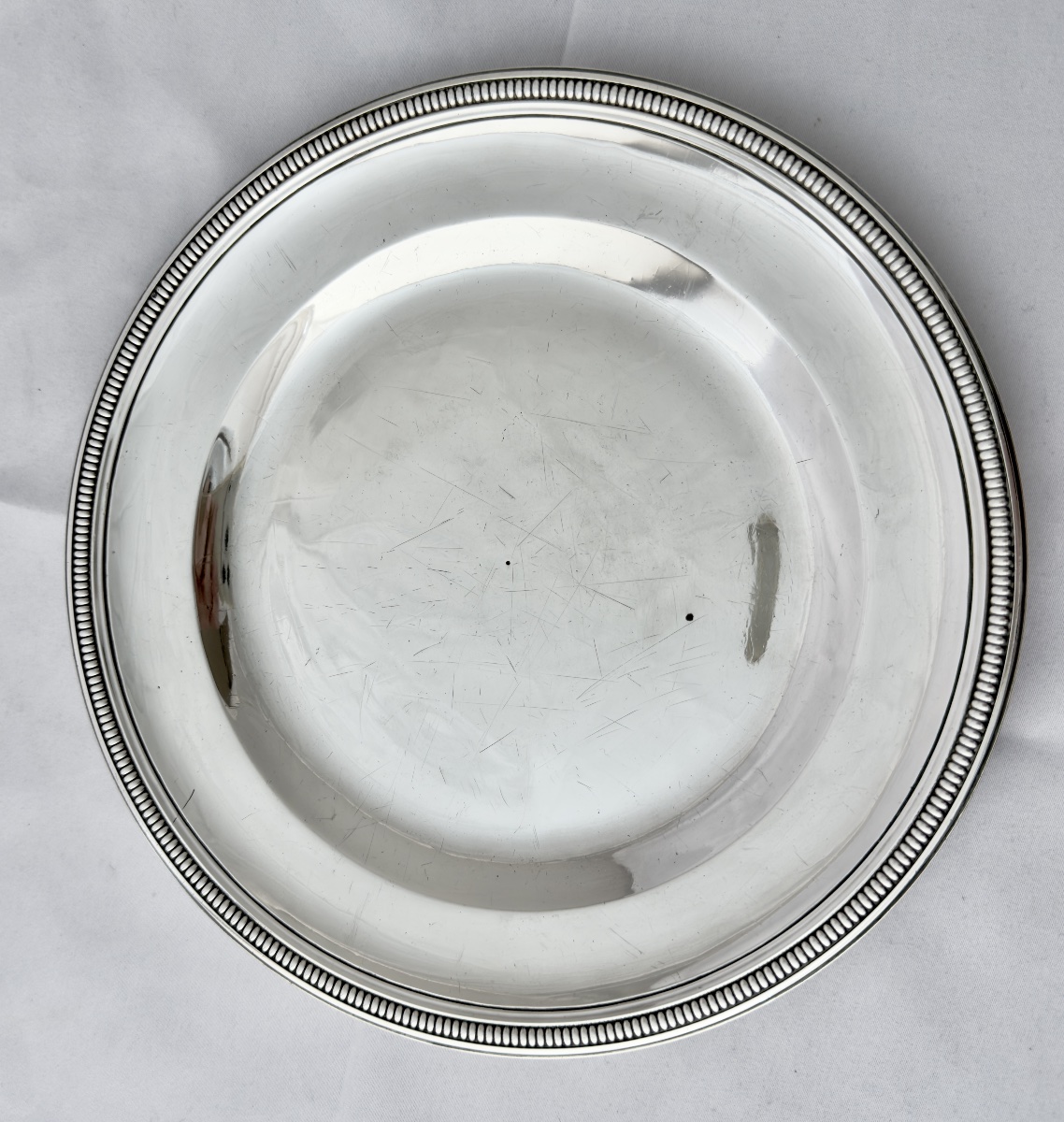
Circular solid silver plate made in Paris by Henry Auguste, goldsmith to King Louis XVI, during the final years of the Ancien Régime.
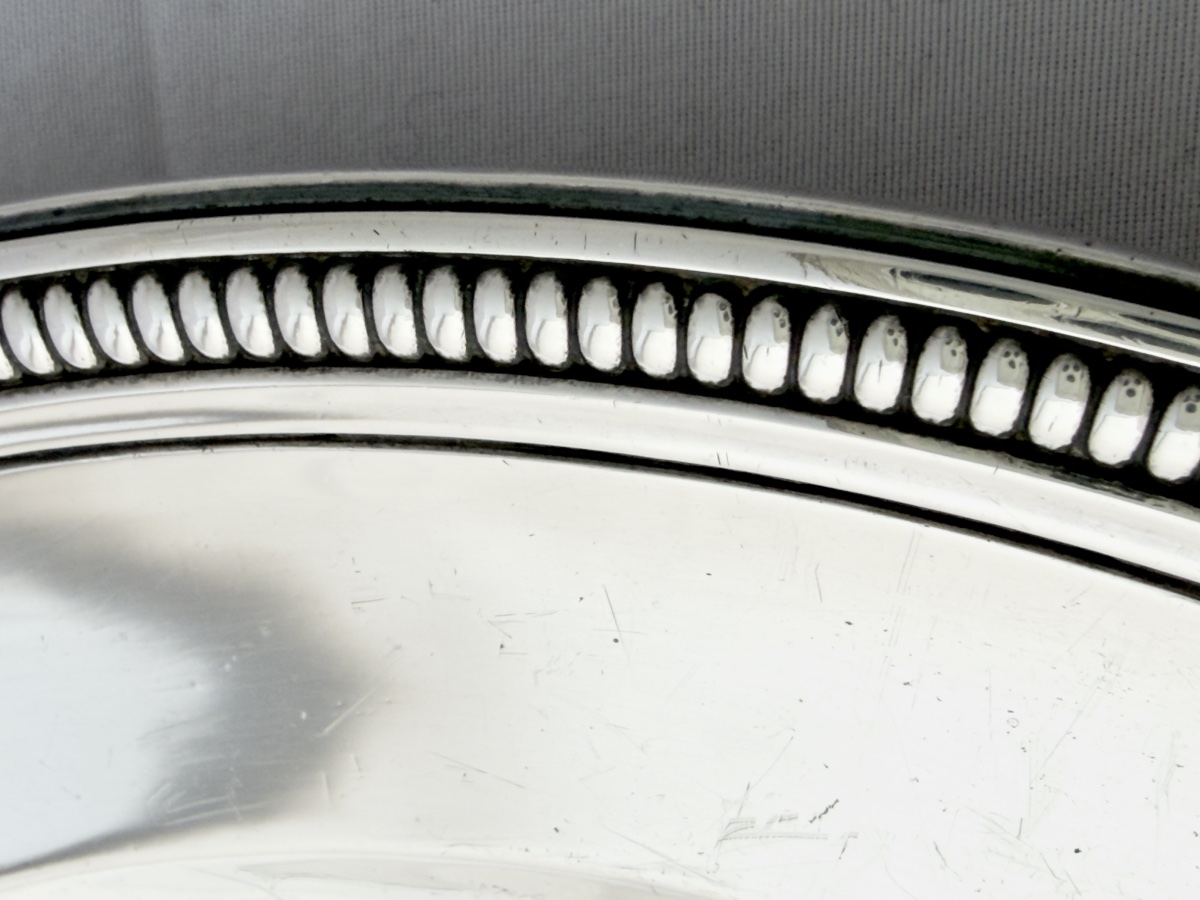
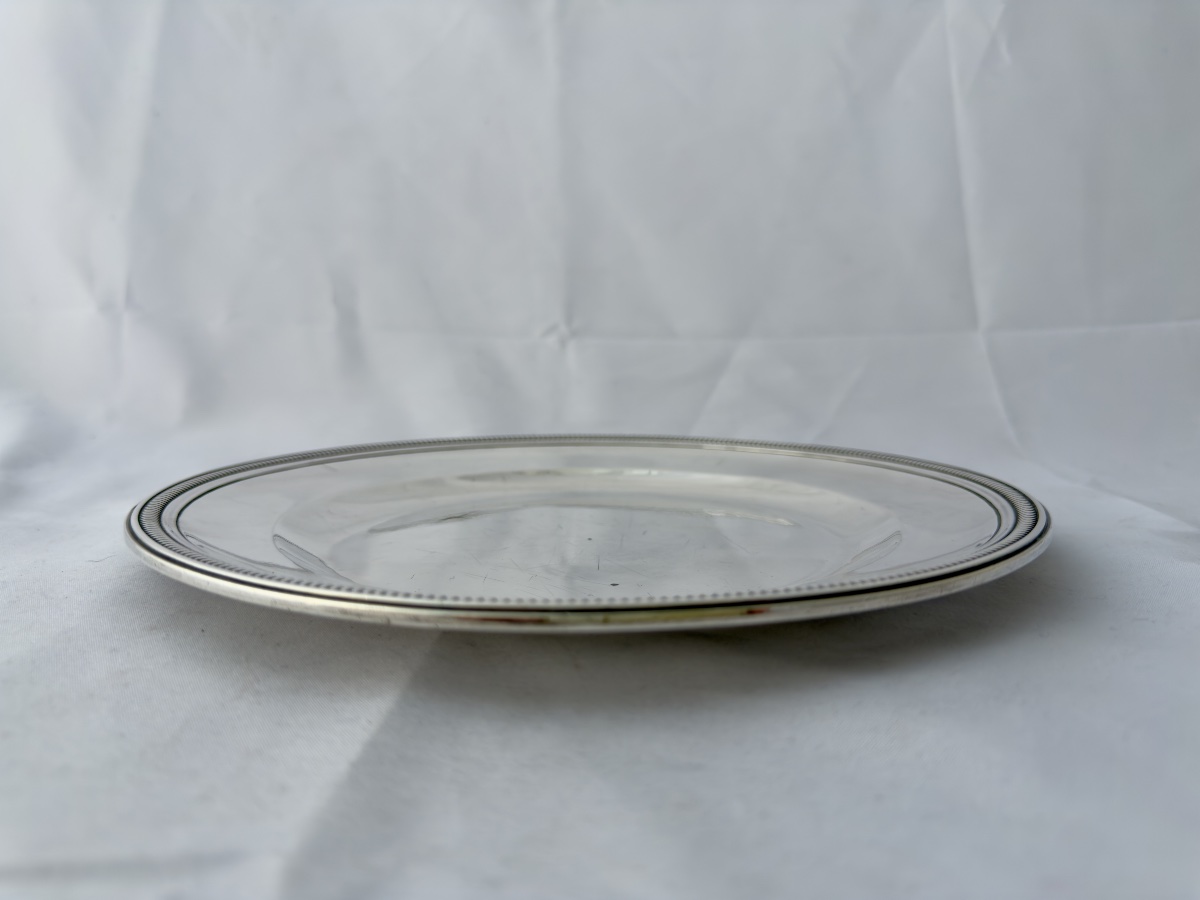
The plain, shallow centre extends into a broad, gently sloping rim. A border of regular gadroons, framed by smooth mouldings and concentric fillets, defines the circumference. Its balanced proportions and restrained decoration exemplify the elegance of Louis XVI table silver. The raised decoration of the border contrasts with the polished surfaces of the centre and rim.
Weighing 710 grams and measuring 25.5 cm in diameter, this plate is distinguished by its particularly substantial construction. It bears old scratches and signs of use, notably in the centre.
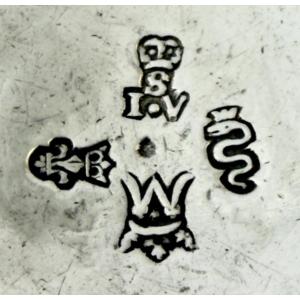
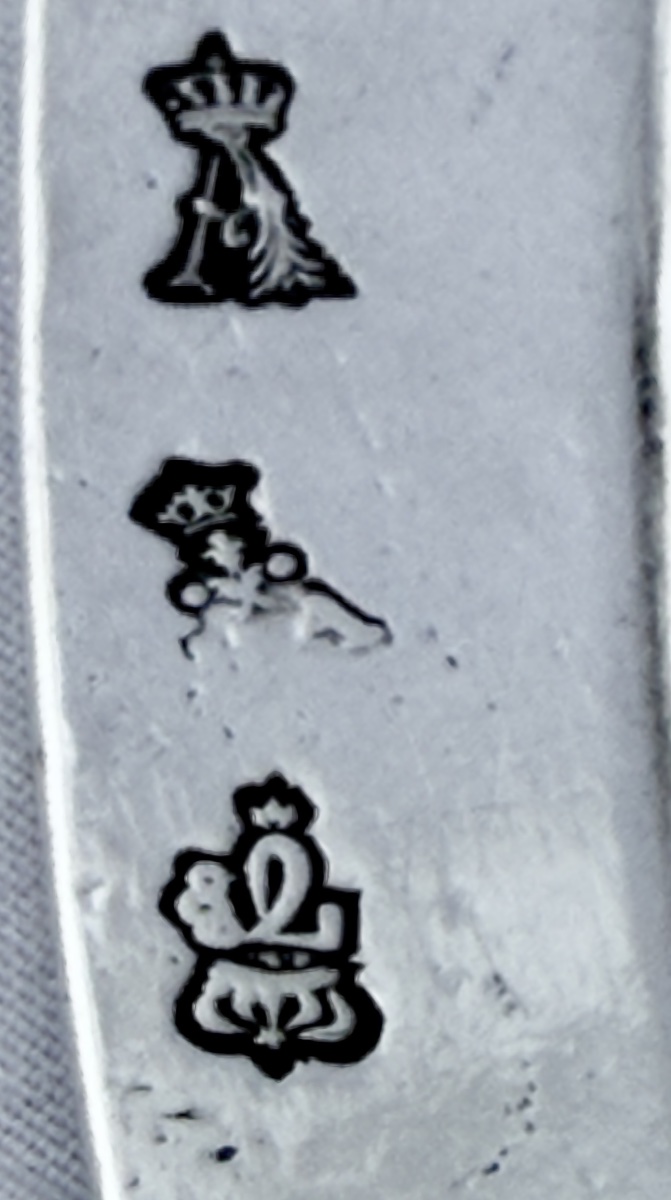
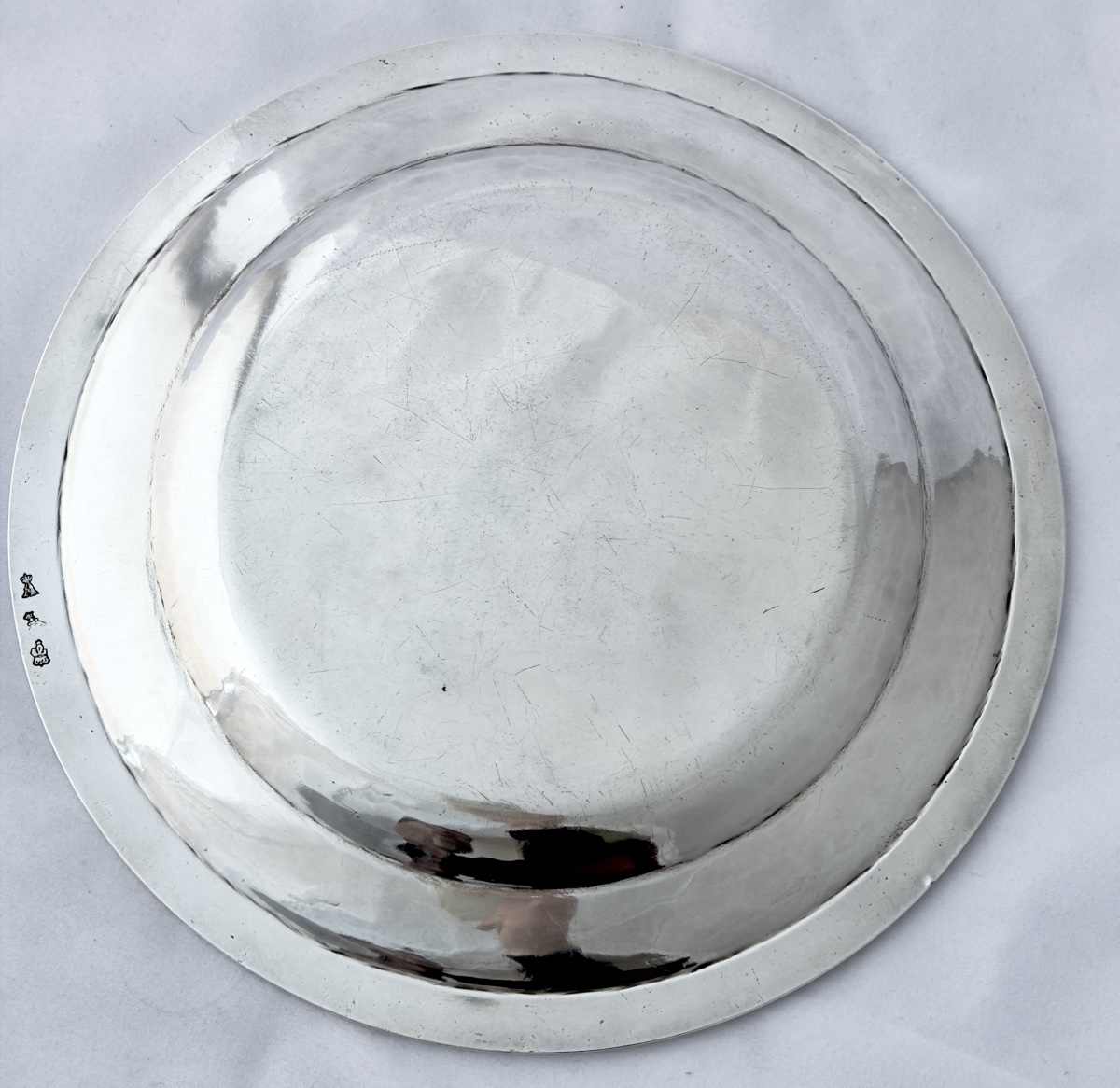
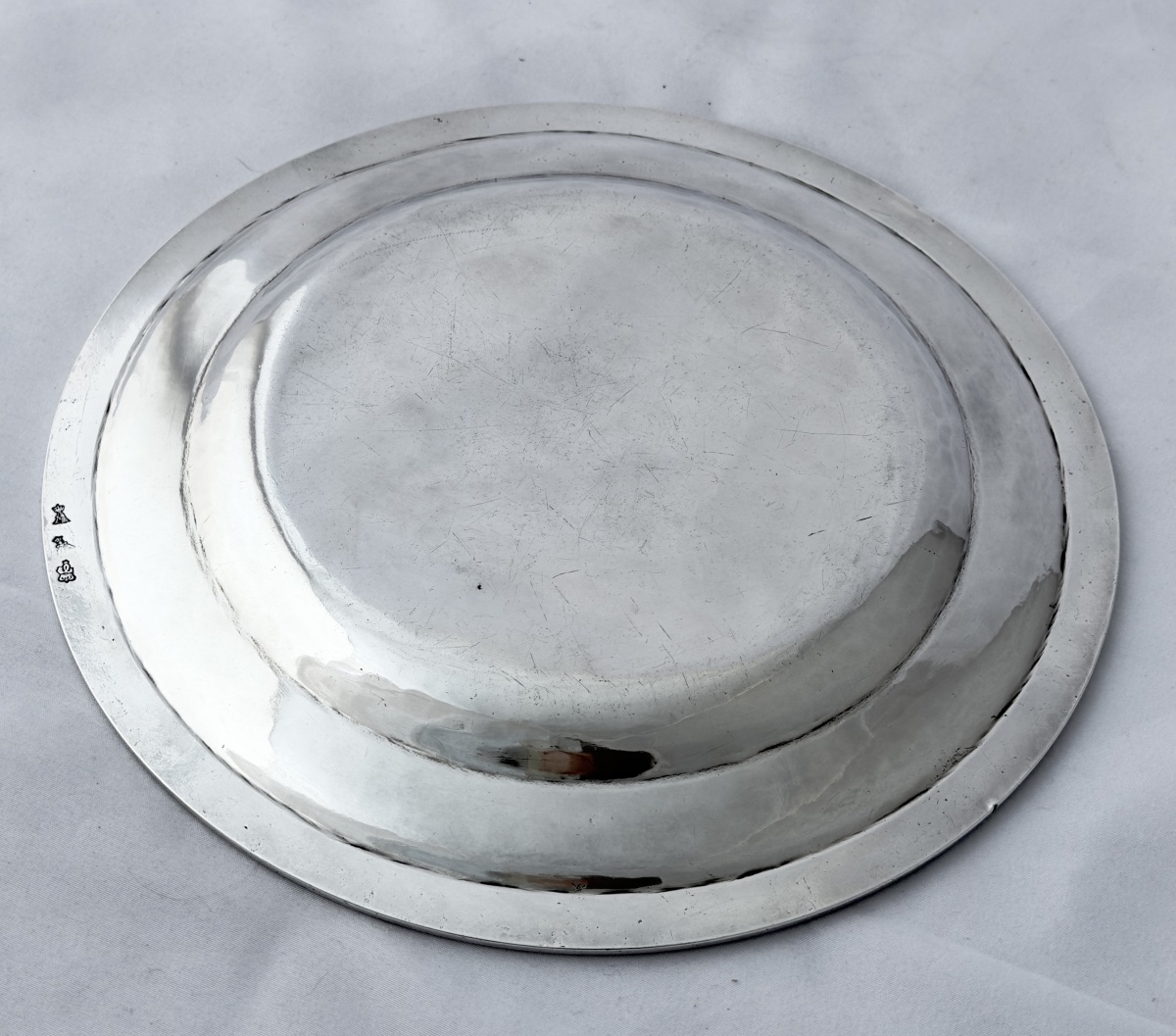
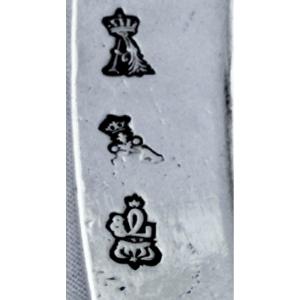
The plate bears four hallmarks:
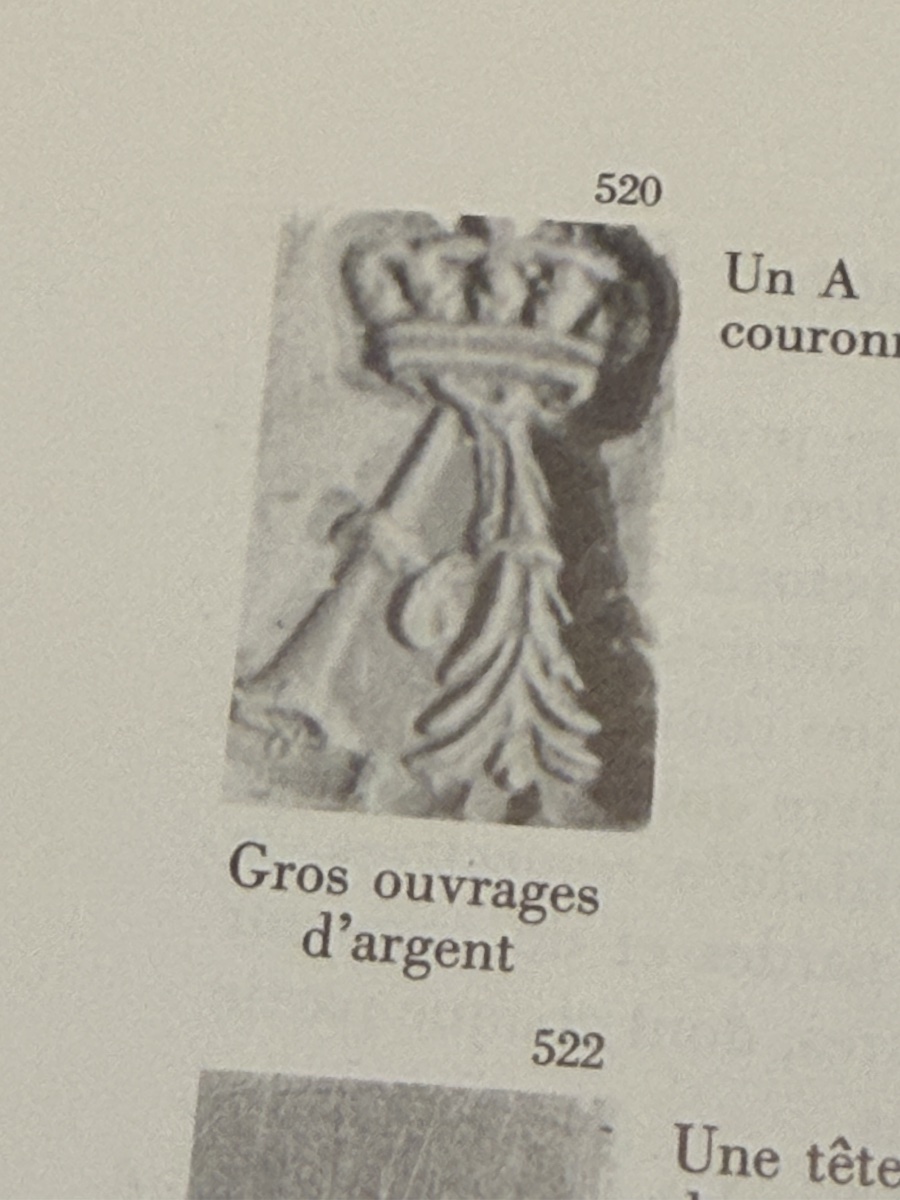
- The Paris charge mark for large silver articles: a crowned A incorporating a palm branch and a trumpet, used during the period 1782–1789.
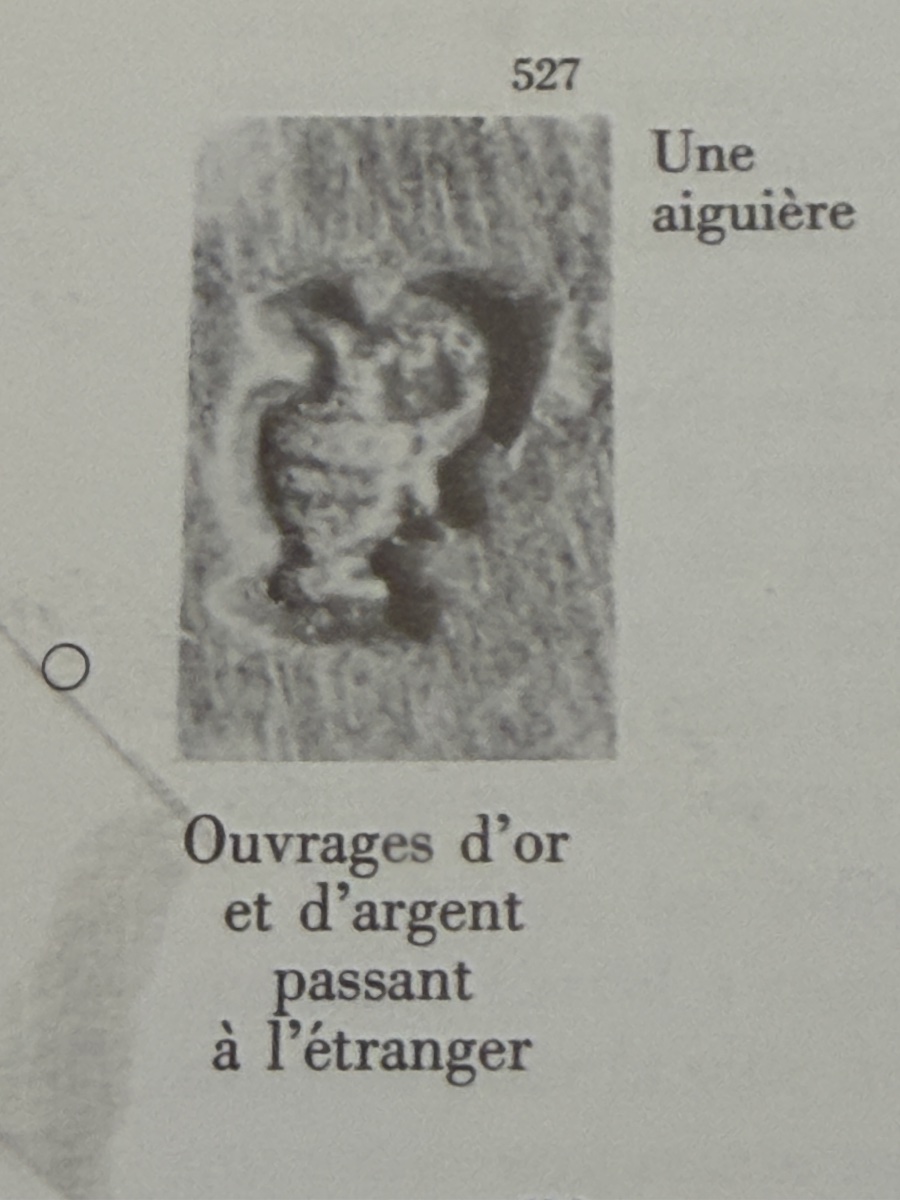
- The export discharge mark, in the form of a ewer, applied to gold and silver articles leaving France.
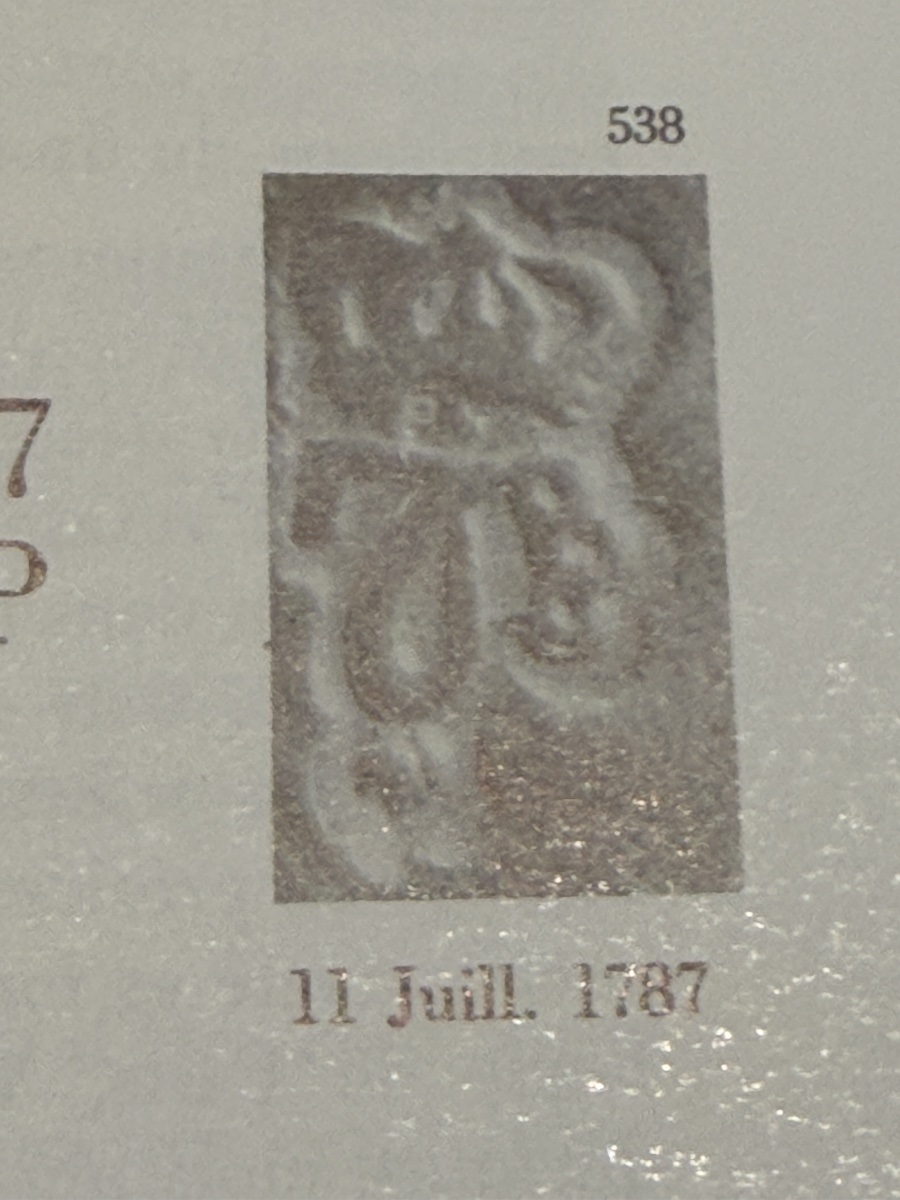
- The mark of the Paris goldsmiths’ guild: a crowned P accompanied by the numerals 87, introduced on 11 July 1787 and used until 12 November 1788. This dates the plate to 1787–1788.
- Henry Auguste’s maker’s mark: the initials H A, two palm branches crossed in saltire, a crowned fleur-de-lis and the two prescribed pellets. This mark was registered on 20 April 1785, a few days after his admission as a master goldsmith.¹ ²
The ewer-shaped mark records inspection for export, reflecting the international clientele of the leading Parisian workshops.
Henry Auguste (1759–1816) belonged to one of the most important families of French goldsmiths of the eighteenth century. His father, Robert-Joseph Auguste (1723–1805), had already served as goldsmith to Louis XV and subsequently to Louis XVI. A supplier to several European courts, he fulfilled commissions for Catherine II of Russia, George III of Great Britain, Christian VII of Denmark, and the courts of Portugal and Sweden. Henry therefore grew up in a workshop at the forefront of European silvermaking. (arts-graphiques.louvre.fr)
Trained by his father, he took over the family business around 1784–1785. Admitted as a master goldsmith in Paris on 13 April 1785, he became goldsmith to the King himself and signed the accounts for his deliveries to the Crown “Auguste fils”. Working from premises on the Place du Carrousel, he supplied table silver and other articles for the sovereign and the royal family.
The scale of these commissions emerges from the royal Garde-Meuble accounts studied by Henry Nocq. For deliveries recorded between 1784 and 1786, Nocq reports that the old silver handed over to Auguste in payment represented approximately 1,900 kilograms of metal. This included royal table silver dating from the reign of Louis XV and the Regency, consigned to the melting pot to provide material for new work. This episode reveals both the magnitude of the commissions entrusted to the workshop and the practice of renewing royal services as tastes changed.²
Henry Auguste’s marriage on 7 September 1782 to Madeleine-Julie Coustou, a member of the celebrated family of sculptors, further connected him with Parisian artistic circles. Their children included two sons, Charles-Louis and Jules-Robert, the latter becoming a sculptor and subsequently a painter. Madeleine-Julie died in 1795. Nevertheless, François Gérard depicted her alongside her husband and their children in the family portrait exhibited at the Salon of 1798, giving this intimate scene a commemorative dimension. (turquin.fr)
Auguste’s collaboration with the sculptor Jean-Guillaume Moitte, who supplied drawings and models to the workshop, contributed to the renewal of French silver design. Their creations developed a vocabulary inspired by antiquity, combining purity of form with richly sculptural ornament. Among the admirers of their work was William Beckford, one of the leading European collectors of his day. (metmuseum.org)
Under the Consulate and subsequently the Empire, Henry Auguste once again received prestigious commissions. Awarded a gold medal at the Exhibition of the Products of French Industry in 1802, he was commissioned in 1804 to create the Grand Vermeil service, presented by the City of Paris to Napoleon I on the occasion of his coronation. This monumental ensemble, which included the Emperor’s and Empress’s nefs, was completed in two months by 150 workmen and formally presented to the sovereigns on 16 December 1804. Surviving pieces are now preserved at the Château de Fontainebleau. (christies.com, collection.mobilier-national.fr)
This imperial triumph was, however, brief. Facing substantial financial difficulties, Auguste filed for bankruptcy in 1806. In 1809, his attempt to leave for England with his stock and possessions led to proceedings for fraudulent bankruptcy. He spent his final years in the Caribbean and died in Port-au-Prince in 1816. (christies.com)
Several auction appearances demonstrate the standing of his work. The celebrated Beckford-Béhague gold ewer, made in 1790 and now preserved at the Metropolitan Museum of Art in New York, was offered at Christie’s in Paris on 4 November 2015, with an estimate of €1,200,000–€1,800,000. Although unsold on that occasion, it remains one of the most remarkable surviving examples of his work in gold. (alaintruong.com, metmuseum.org)
A set of six silver candlesticks dated 1787, from the Perenchio collection, achieved US$106,250 at Christie’s in New York in October 2020. More recently, a silver tureen dated 1789 reached a published price of €43,750 at Senequier-Crozet in Grenoble on 25 November 2025. These pieces illustrate the diversity of a body of work sought after for its maker, craftsmanship and importance in the history of the decorative arts. (christies.com, senequiercrozet.fr)
Works made by Henry Auguste during the Ancien Régime are now particularly rare on the market. Their survival must be considered against the history of successive meltings of silver: the renewal of services under the monarchy, financial pressures, and subsequently the upheavals of the Revolution. As early as September 1789, the dispatch of the King’s and Queen’s silver to the Mint was announced to the National Assembly. A considerable proportion of this production has consequently disappeared. (persee.fr)
The present plate preserves a tangible example of the work of a leading Parisian workshop serving Louis XVI, at a time when Henry Auguste had recently succeeded his father and already occupied an eminent position among the capital’s goldsmiths.
¹ Michèle Bimbenet-Privat and Gabriel de Fontaines, La datation de l’orfèvrerie parisienne sous l’Ancien Régime : poinçons de jurande et poinçons de la Marque, 1507–1792, Paris, Paris-Musées, 1995, nos. 520, 527 and 538.
² Henry Nocq, Le Poinçon de Paris, vol. I, Paris, H. Floury, 1926, entry “Auguste (Henry)”, pp. 33–35.
Period: 18th century
Style: Louis 16th, Directory
Condition: Excellent condition
Material: Sterling silver
Diameter: 25,5 cm
Reference (ID): 1843477
Availability: In stock