



Pierre Chiboust, Pair Of Candlesticks Signed With Winged Victory Figures, Empire Period.
Artist: Pierre Chiboust (1779-1824)
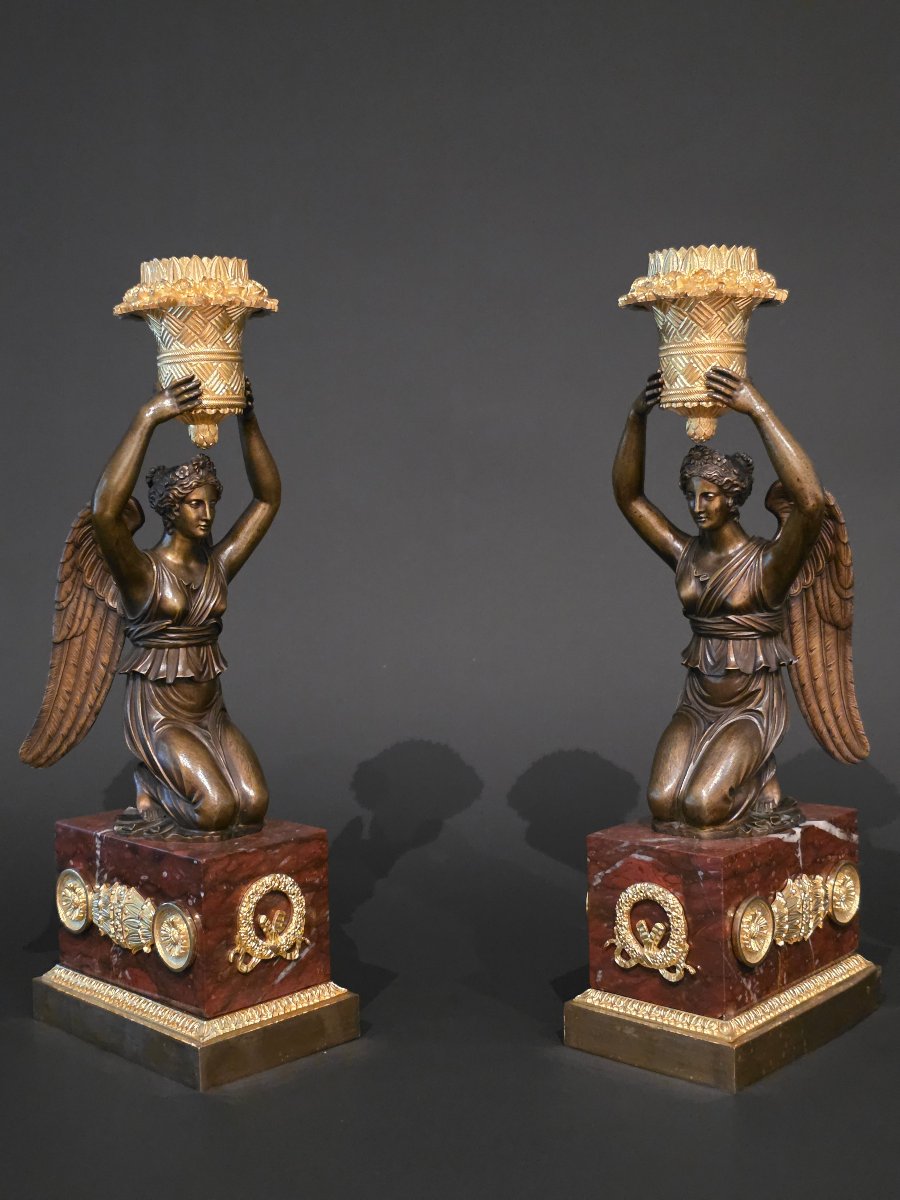
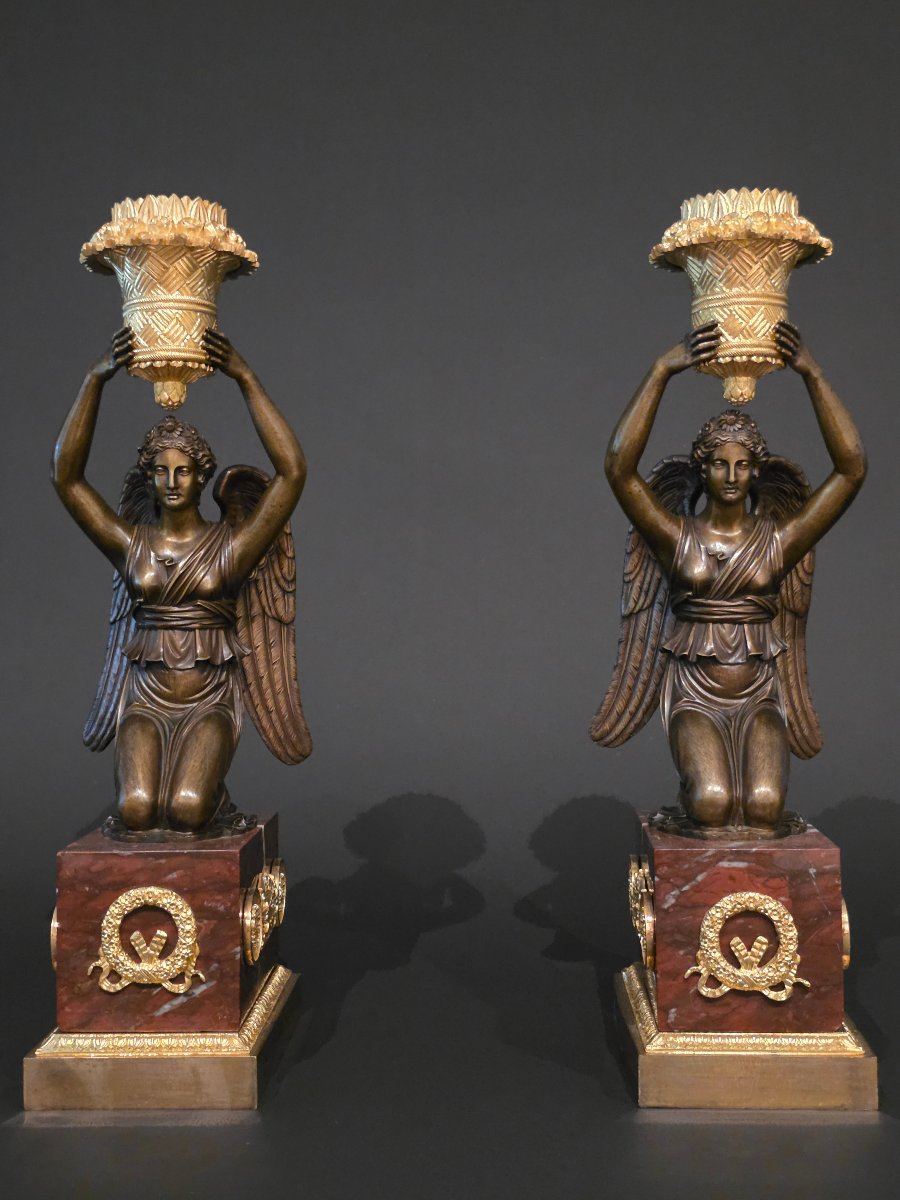
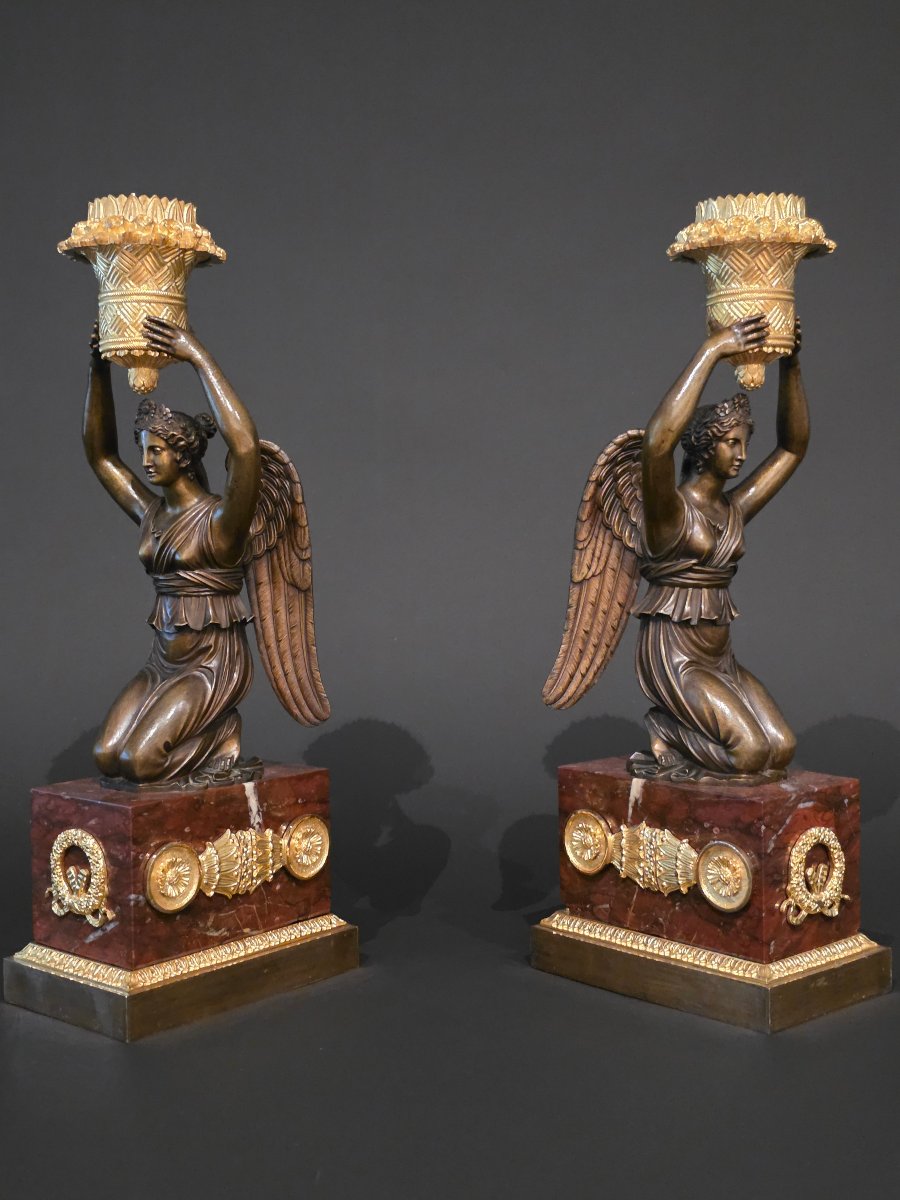
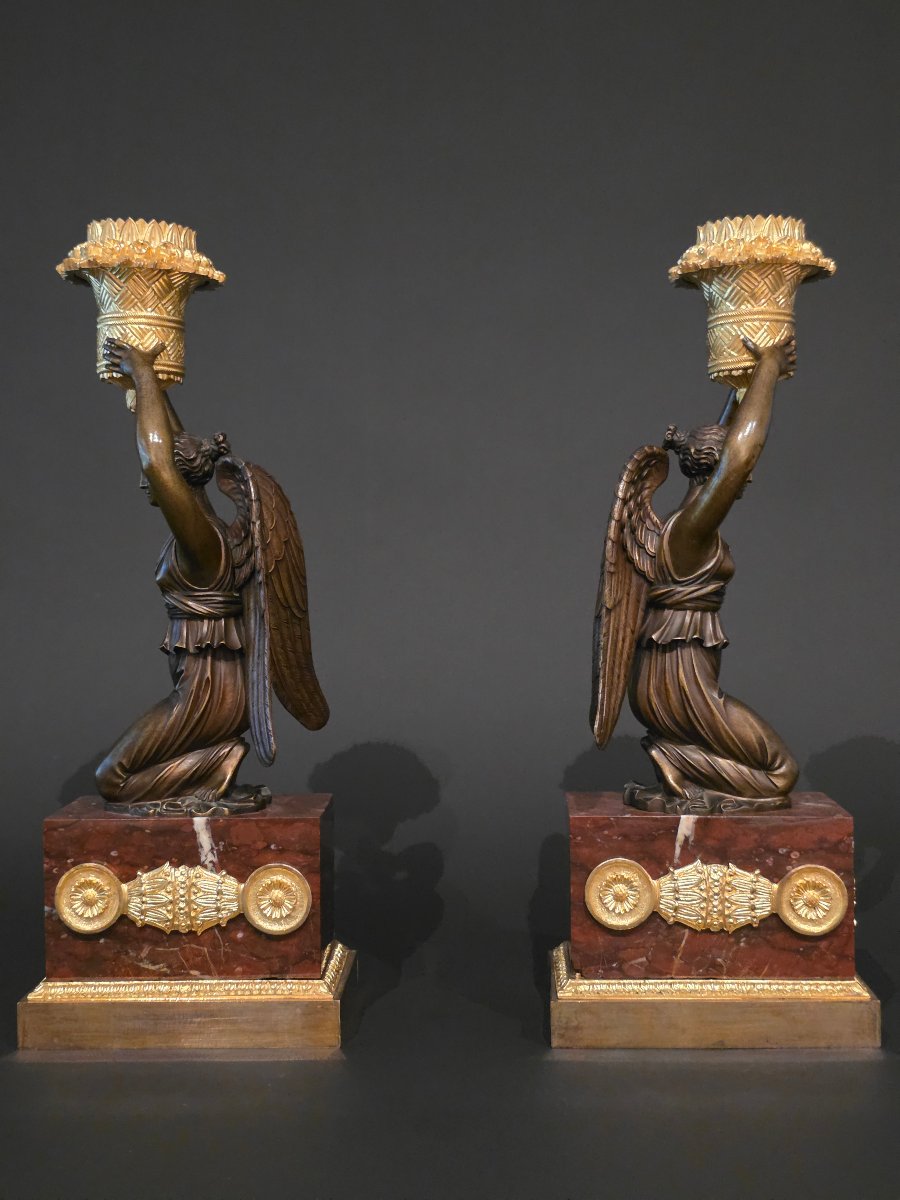
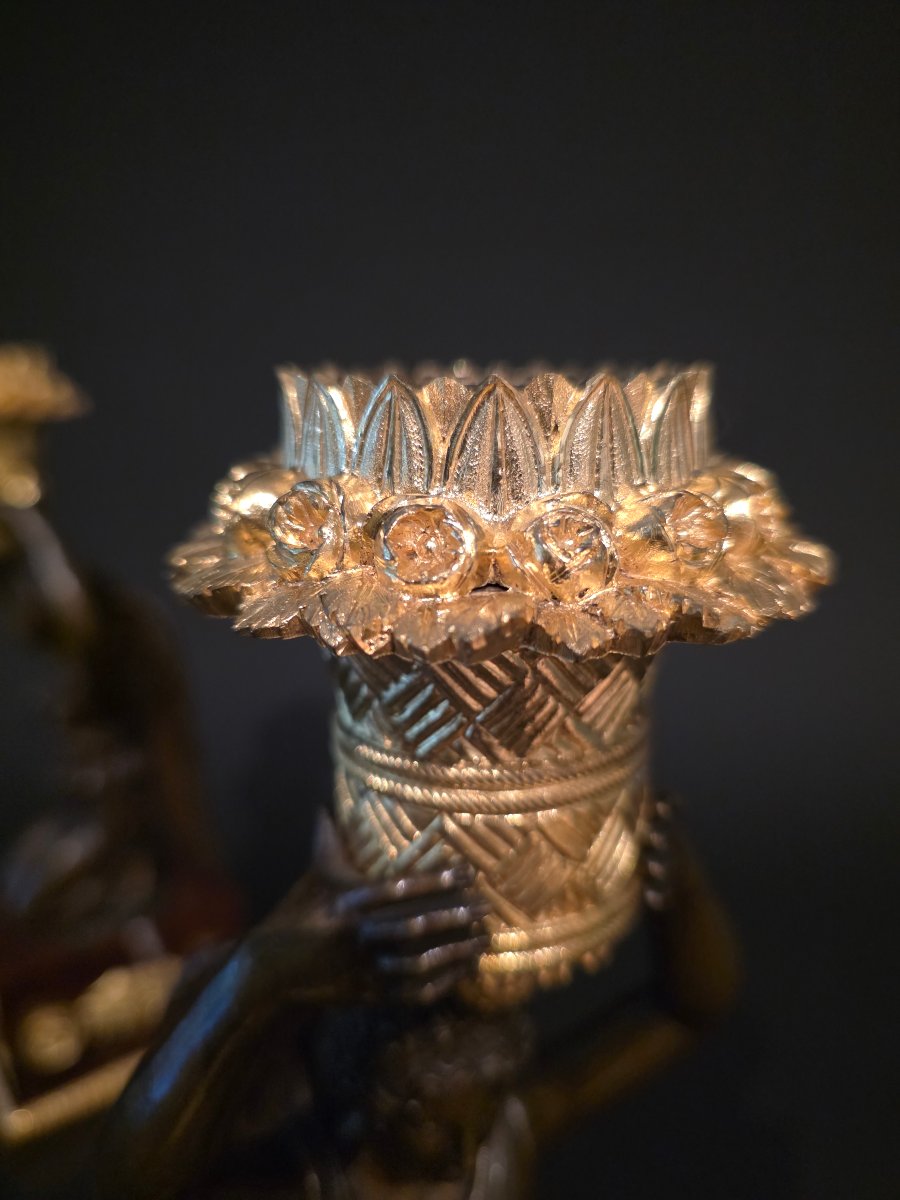
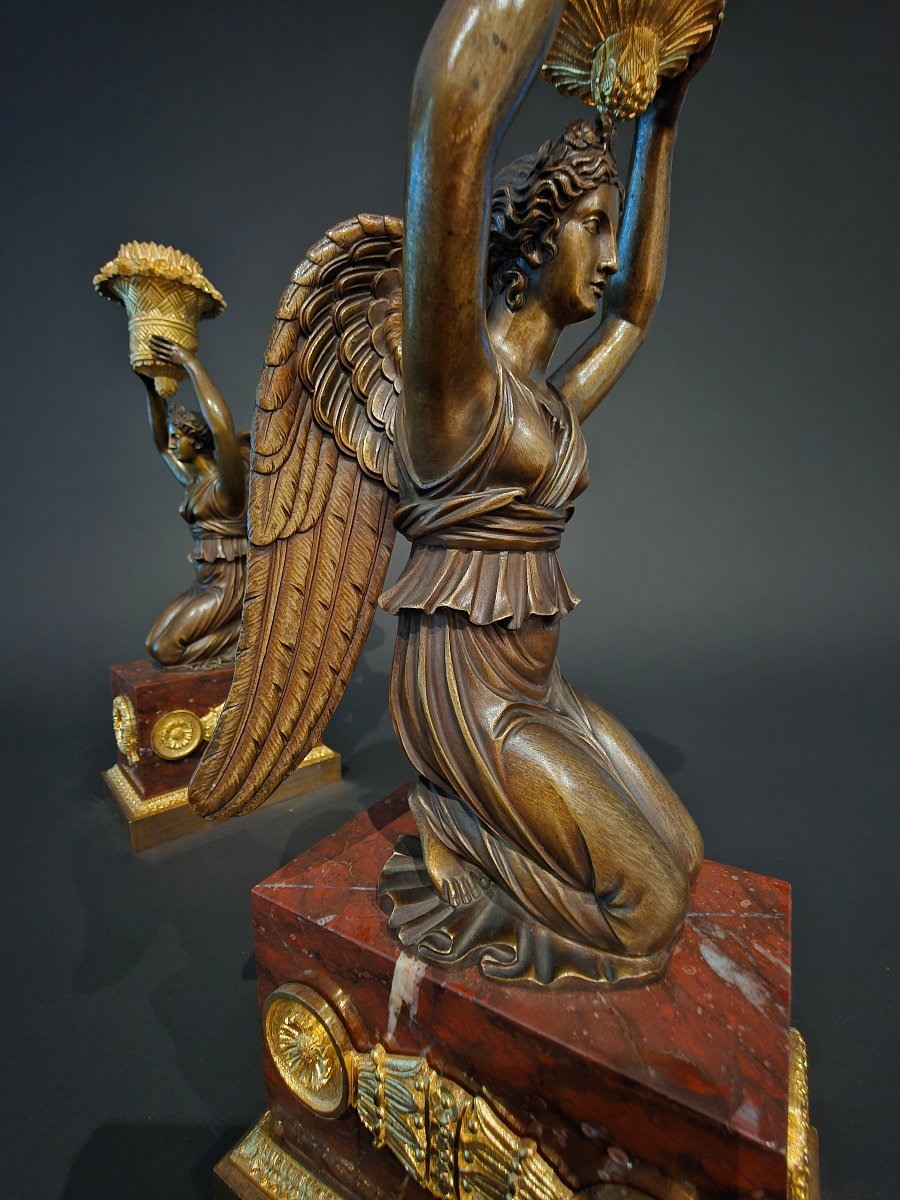
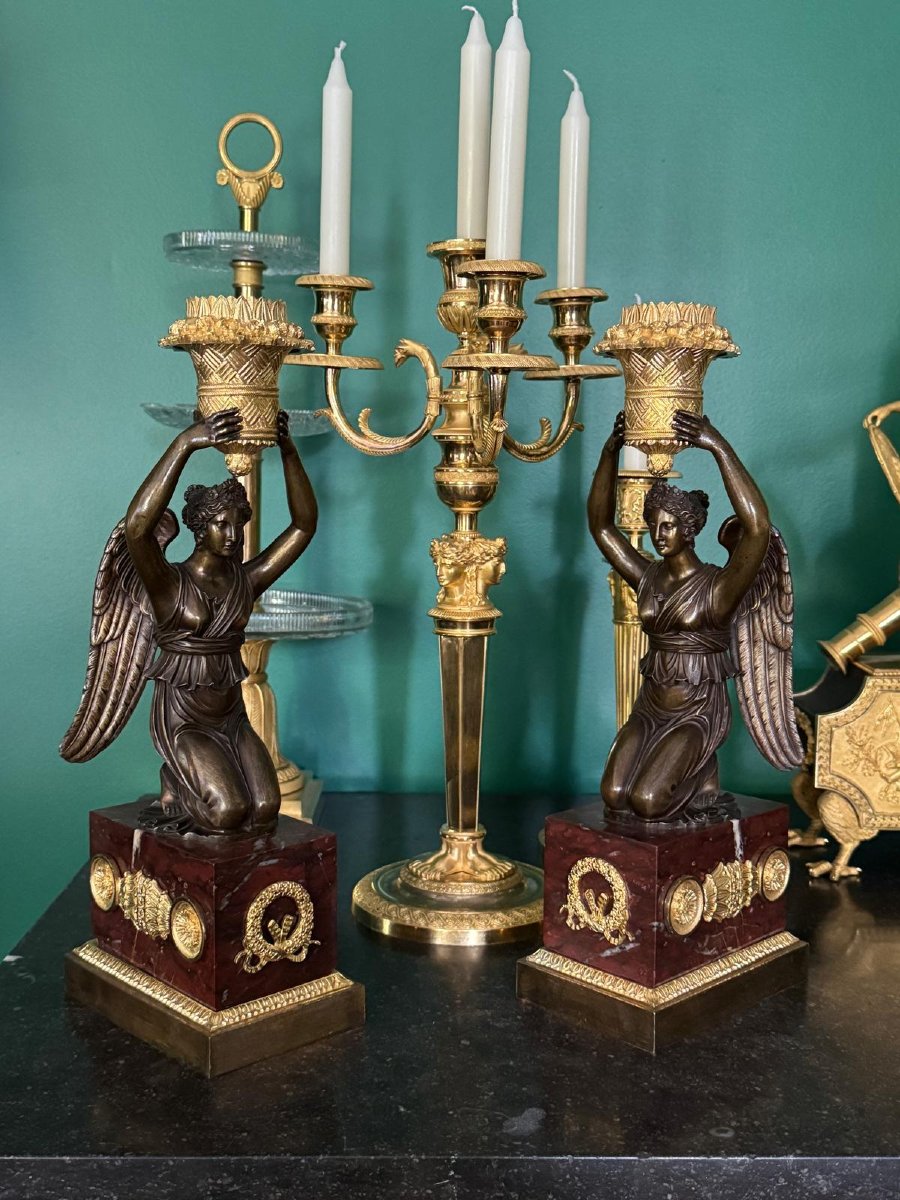
A rare pair of candlesticks by Pierre Chiboust, shaped like kneeling winged Victories, holding the binet aloft with their hands raised toward the sky. The binet is modeled after a woven wicker basket containing a bouquet of assorted flowers.
This pose symbolizes the kanephores of ancient Greece (from the Greek kanêphoros: “basket-bearer”); noble young women selected to lead sacred processions. They carried heavy baskets on their heads containing offerings, flowers, fruits, and ritual knives intended for sacrifices.
Here, the bronze Victories, with a brown patina, are dressed in a chiton and wear the krobylos. The wicker baskets, meanwhile, are crafted from chiseled and gilded bronze. All display great finesse and high-quality chiseling.
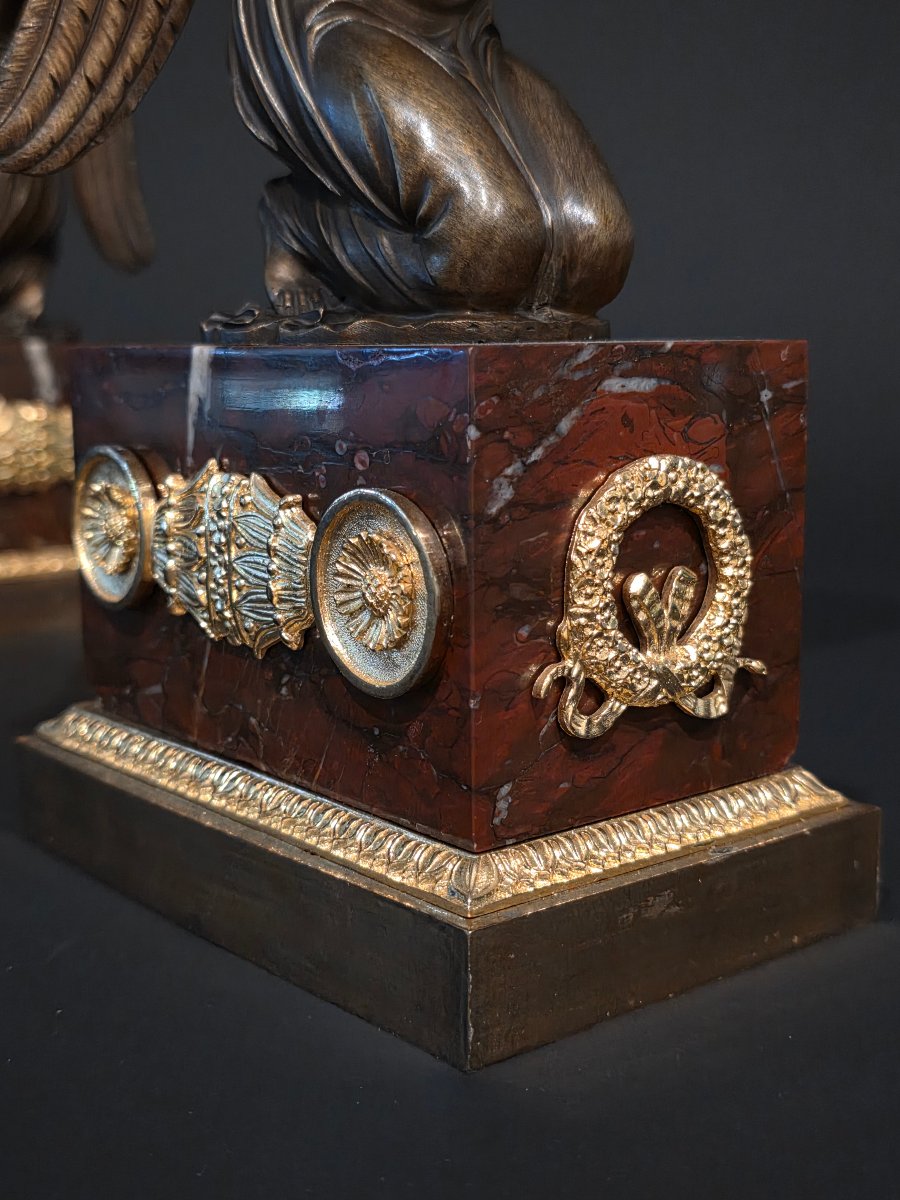
The ensemble rests on a rectangular base of cherry-red marble featuring applied, chiseled, and gilded bronze decorations such as:
A wreath of flowers with a ribbon tied in a flowing knot, two cartouches each containing a sunflower, two bouquets of water leaves enclosed in stylized leaf calyxes (reminiscent of the base of an ancient vase), and a frieze of small flowers.
A gilded bronze counter-plinth, accented by a frieze of heart-shaped motifs, frames the red marble base.
During the Empire, artisans imbued furniture and everyday objects with symbolism based on their decorative elements. These motifs, inspired by ancient Greece and Rome, could represent virtue, fidelity, family values, abundance, courage, and so on.
Here, on this pair of candelabra, the cephora and the basket symbolize, respectively, triumph, peace, and abundance.
An identical piece sold at Sotheby’s on June 29, 2023, lot 654.
In good condition.
Signed “CHI” on several bronze pieces, for Pierre Chiboust (1779–1824)
Empire period.
Dimensions:
Height: 38 cm
Base: 14.5 x 9.5 cm
Pierre Chiboust
(Sometimes spelled Chibout)
A leading French bronze artist of the Empire period, born in 1779 and died in 1824.
Active in Paris in the early 19th century, his major productive period spanned from 1806 to 1824.
His work is distinguished by the high quality of his chasing and gilding, typical of the decorative arts under Napoleon I.
In 1806, Pierre Chiboust went into partnership with the famous foundryman and chaser Claude François Rabiat.
Upon Rabiat’s death in 1815, Chiboust took full control of his Parisian workshop.
He is primarily known for his lighting fixtures and fine decorative objects. The art market still holds remarkable pieces by him, including a pair of palmette-decorated wall sconces, signed incense burners, Medici vases, and prestigious Empire-era candelabras and torches—some of which were inspired by the designs of the famous architects, Percier and Fontaine.
We handle delivery for you both within France and internationally. Shipping terms depend on your location. Contact us to find out the cost and arrange your delivery.
We ensure that special care is taken to provide packaging and protection tailored to your purchases.
Since only a portion of our furniture and art objects is visible on Proantic, we invite you to follow our Instagram account, where you can see all our new arrivals displayed in real-life settings: @monantiquaire
All of our Furniture and Art Objects
On our Website:
MON ANTIQUAIRE
We look forward to your visit,
Géraldine Buisson & Manuel Keepfer
5 800 €
Period: 19th century
Style: Consulat, Empire
Condition: Excellent condition
Material: Bronze
Height: 38 cm
Reference (ID): 1840127
Availability: In stock
Print