



Pierre De Lestrade (1901–1977) Meyssac, Corrèze
Artist: Pierre De Lestrade
Pierre de Lestrade de Conti
(Périgueux 1901 – Turenne 1977)
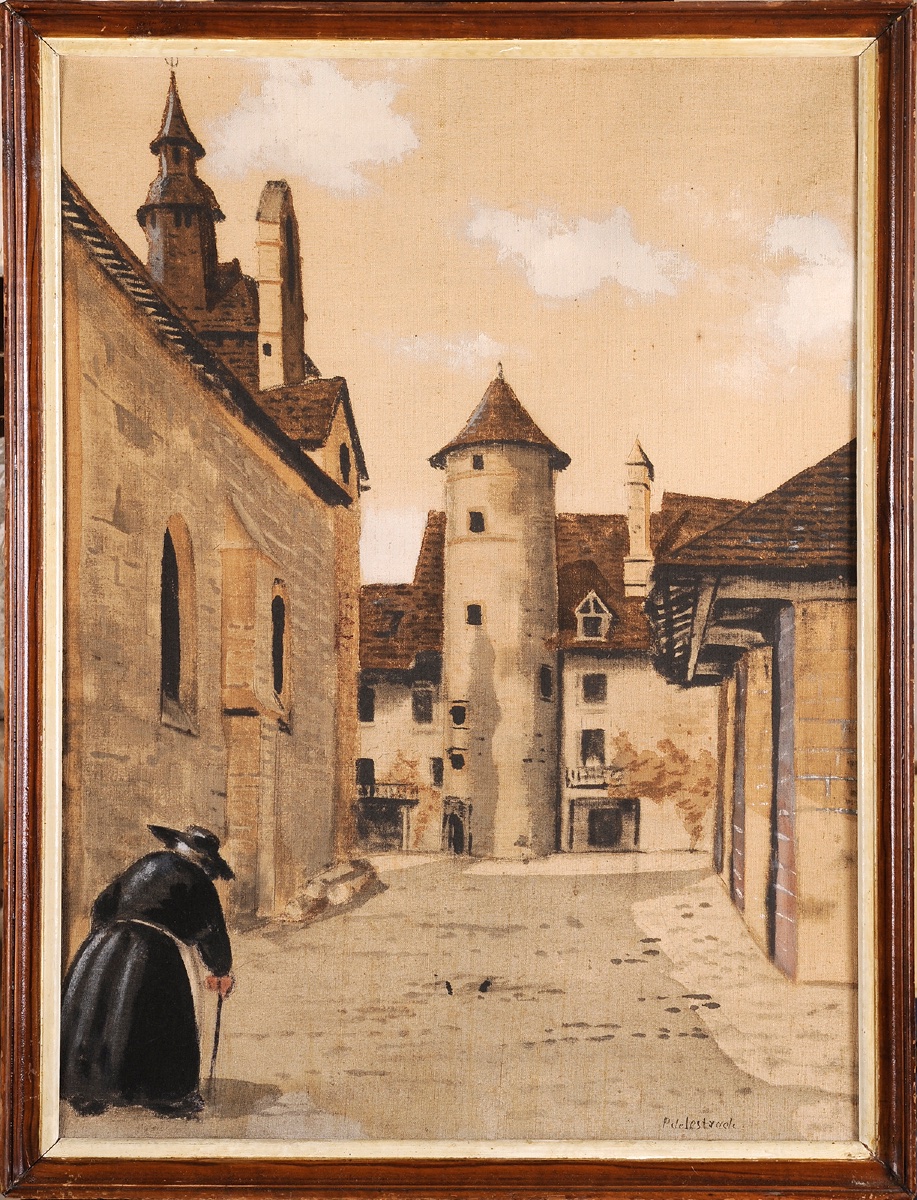
Meyssac, Corrèze
Oil on canvas
H. 75 cm; W. 53 cm
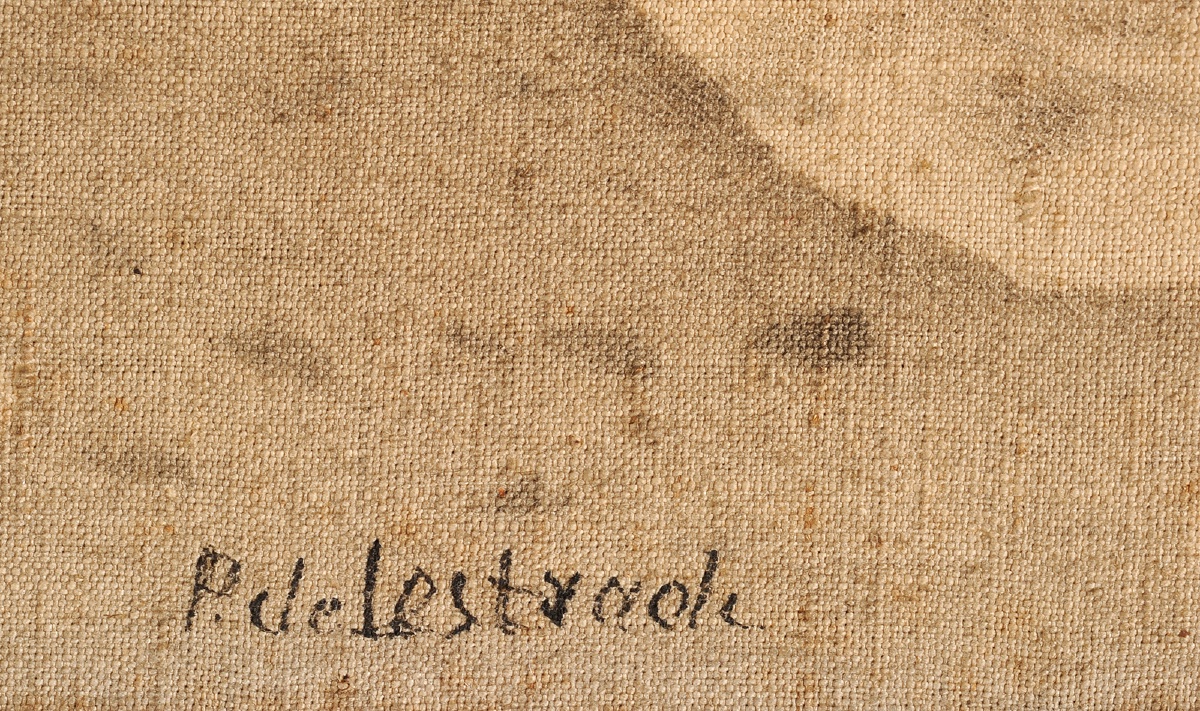
Signed lower right
Born in 1901, Pierre de Lestrade grew up in a family of nine children. His family settled on Rue Romaine, in the Hôtel de Lestrade de Conti, a remarkable residence that preserves vestiges of the Gallo-Roman citadel, listed as a historical monument. The property is believed to have belonged to Count Wlgrin de Taillefer, his great-grandfather, a passionate archaeologist and draftsman, whose work may have sparked young Pierre's artistic curiosity. He studied at the Saint-Joseph institution, located on Rue Georges-Pompidou in Périgueux.
As early as 1923, at just 22 years old, Pierre de Lestrade published his first album of caricatures, dedicated to prominent figures from the Périgord region. In 1929, he also created a Christmas album. The 1930s marked the golden age of press caricature: he stayed in Paris several times, for periods ranging from a few days to several years. There, he worked as an illustrator for newspapers such as Le Matin and Le Petit Journal, and lent his talent to the courtroom reports written by the legal columnist Géo London.
His work bears the mark of Sem (1863-1934), a famous caricaturist and illustrator from the Périgord. This artistic lineage is particularly evident in the preface to Charges périgourdines, which testifies to his attachment to the local tradition of caricature.
Mobilized in 1939 into a rifle regiment, Pierre de Lestrade found himself in Végennes, Corrèze, in 1940, where he was taken in by Raymond Billard, a wealthy Jewish industrialist who had fled to the unoccupied zone and who would later become mayor of the town.
In 1942, he published *Tout Brive*, an album of caricatures created to benefit prisoners of war. A few years later, he undertook several major works in Végennes: in 1948, a vast oil painting on canvas, over five meters wide, entitled *La Fête des moissons* (The Harvest Festival), as well as the series *Les Quatre Saisons* (The Four Seasons). In 1950, he created twenty pen-and-ink portraits of the town's inhabitants. These works, recognized for their artistic and historical significance, are listed as historical monuments.
Over the years, the artist traveled throughout the lower Corrèze region, staying in castles and hotels where he readily exchanged his drawings and paintings for room and board. His work can be traced to the restaurant Le Vin Paillé in Queyssac-les-Vignes, to Les Charmilles in Beaulieu-sur-Dordogne, and even to the Château de Coutinard in Turenne.
Everywhere he went, he sketched local figures, including Gabriel Gleize, mayor of Queyssac and political opponent of Raymond Billard. His sharp eye, though keen, never truly turned cruel: humor and keen observation always prevailed over wounding satire.
In 1954, Pierre de Lestrade arrived at the Hôtel des Voyageurs in Meyssac for what was supposed to be a two-week stay. He ended up staying until his death in 1977, twenty-three years during which he tirelessly pursued his work as a caricaturist.
His pen targeted both local personalities and prominent figures in national politics. Auriol, De Gaulle, Pompidou, and Giscard d’Estaing are among his subjects, often depicted alongside their ministers. His caricatures capture attitudes, personalities, and power dynamics with remarkable acuity.
Those who knew him remember his sharp wit, his humor, and his almost instinctive ability to understand his subjects. He himself mischievously summed up this intuition: “I’m like the priest or the notary; I see my client coming.”
Even in his signature, the artist cultivated irregularity and whimsy: Lestrade, DeLestrade, P. de L., or sometimes no signature at all. He also used several pseudonyms, including Le Chapelain (The Chapelain), a nod to his character as a celibate monk, and Lhipo or Lipo, self-deprecating nicknames inspired by his physical appearance.
A free spirit, tireless observer, and witty chronicler of his time, Pierre de Lestrade immortalized, through drawing and painting, the faces, characters, and anecdotes of the political and social life of his era. His work stands today as a precious testament to 20th-century Périgord and Corrèze society, while also revealing a draftsman whose personality was as original as his style.
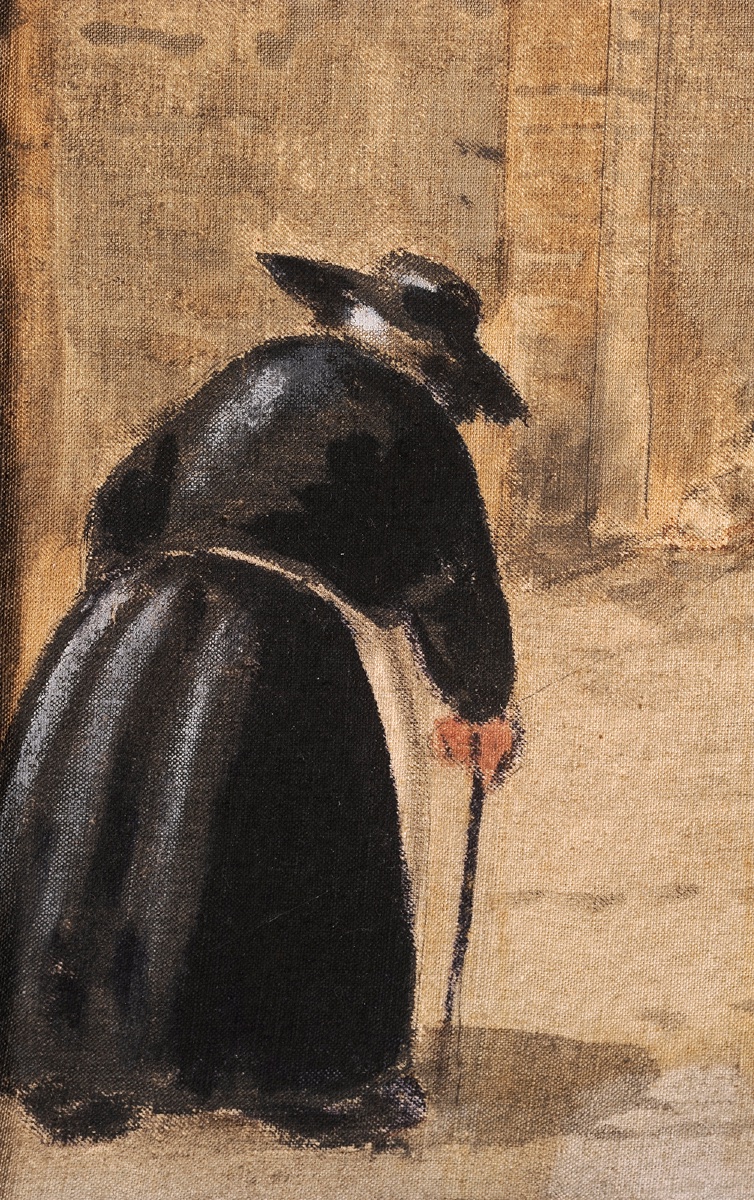
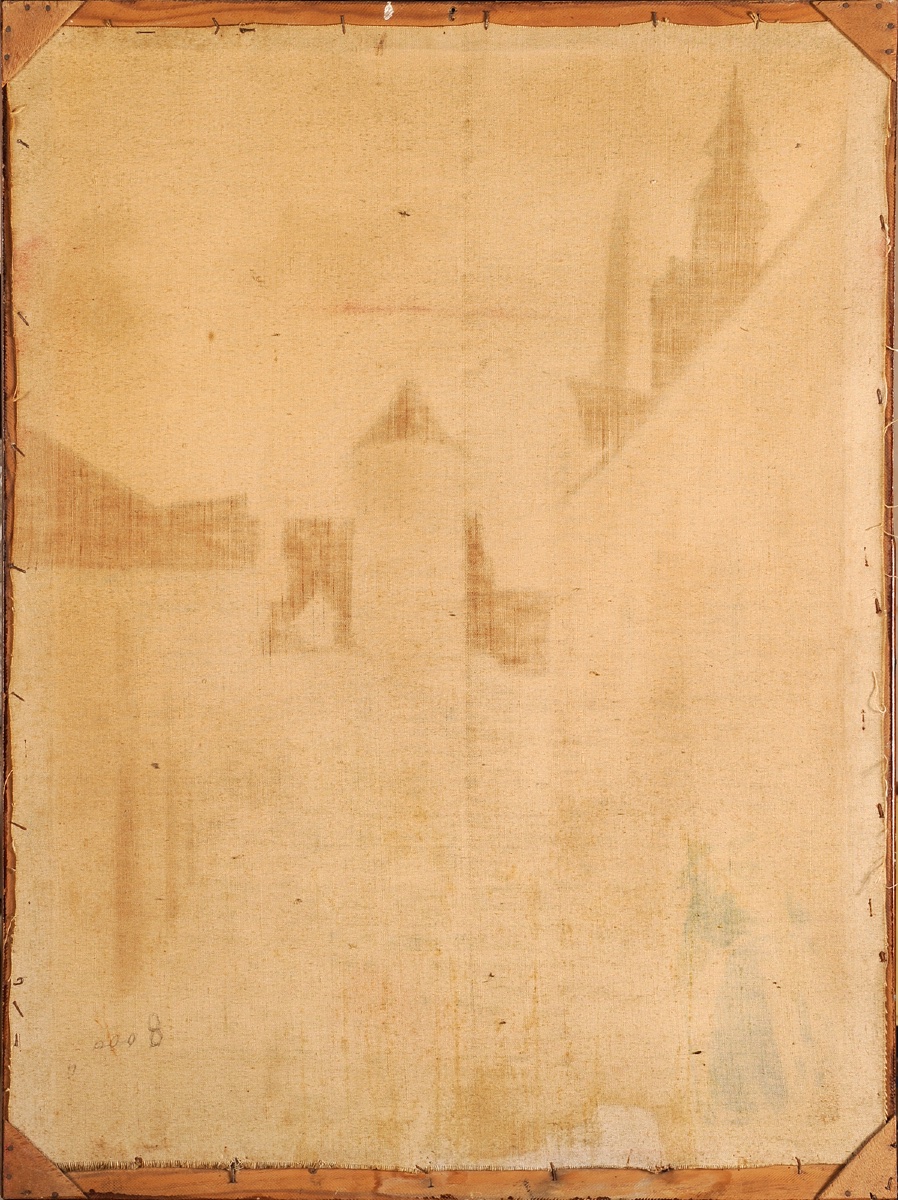
As was his custom, Lestrade created this work with whatever materials were at hand. A very light canvas, nailed to the back of a frame made of simple painted strips, and this same canvas, painted economically. The predominant beige hue is simply that of the canvas used as a reserve. Lestrade adds just a few touches of black, white, and ochre to create the main forms and the values that define the shadows and highlights.
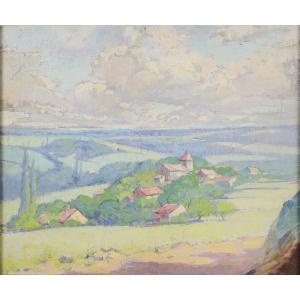
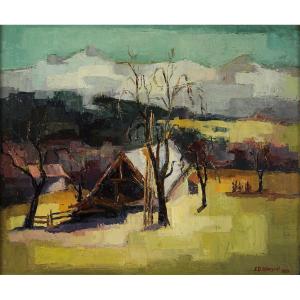
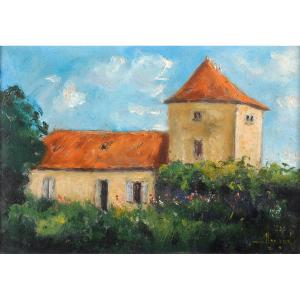
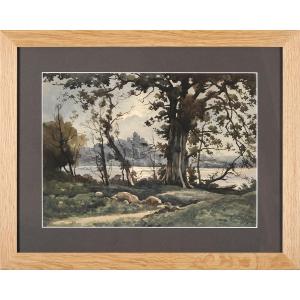
This view of the market hall and the house with the tower in Meyssac was a daily sight from the mid-1950s until the end of his life. Views of this village are therefore commonly found in Corrèze families.
680 €
Period: 20th century
Style: Modern Art
Condition: Perfect condition
Material: Oil painting
Length: 75 cm hors cadre
Width: 53 cm hors cadre
Reference (ID): 1839795
Availability: In stock
Print