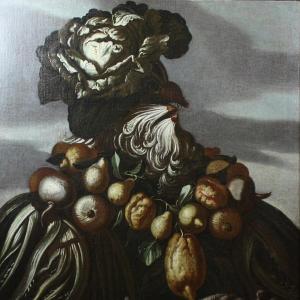

Allegory Of Winter By Francesco Zucchi “inspired By Arcimboldo” 8th Century
Artist: Francesco Zucchi
ALLEGORY OF WINTER
Francesco Zucchi
“Inspired by Arcimboldo”
Francesco Zucchi (Venice, 1692 – Rome, 1764) 18th century Medium Oil on canvas Dimensions 97 x 73 cm; with period frame: 118 x 92 cm
Description of the Work
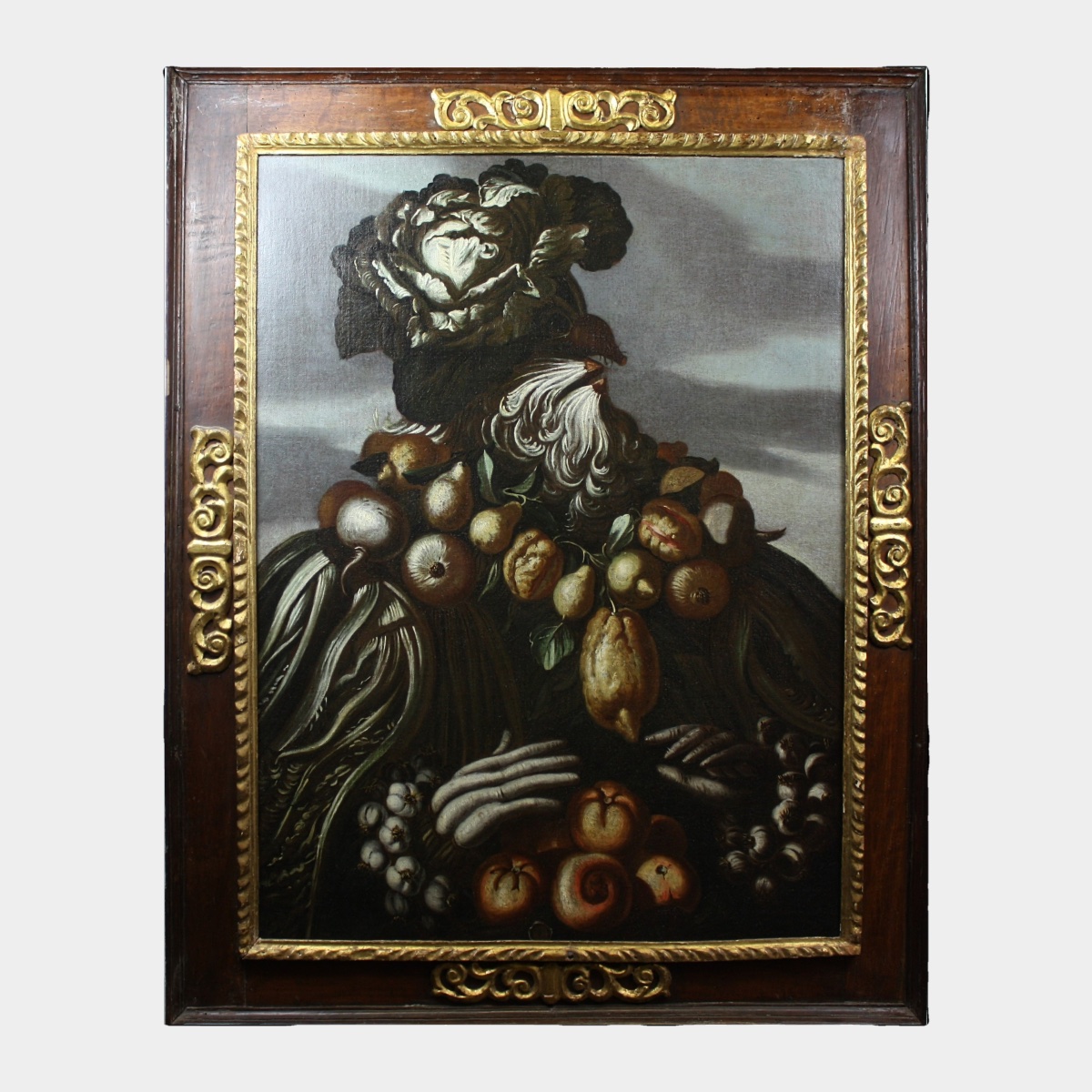
This work is part of a refined and fascinating artistic tradition characterized by illusionism and allegory, offering an 18th-century reinterpretation of the famous genre of “composite heads” made renowned by Giuseppe Arcimboldo in the second half of the 16th century.
The painting depicts an anthropomorphic personification of Winter, in which the human figure is entirely composed of natural elements associated with the earth, cold, and preservation:
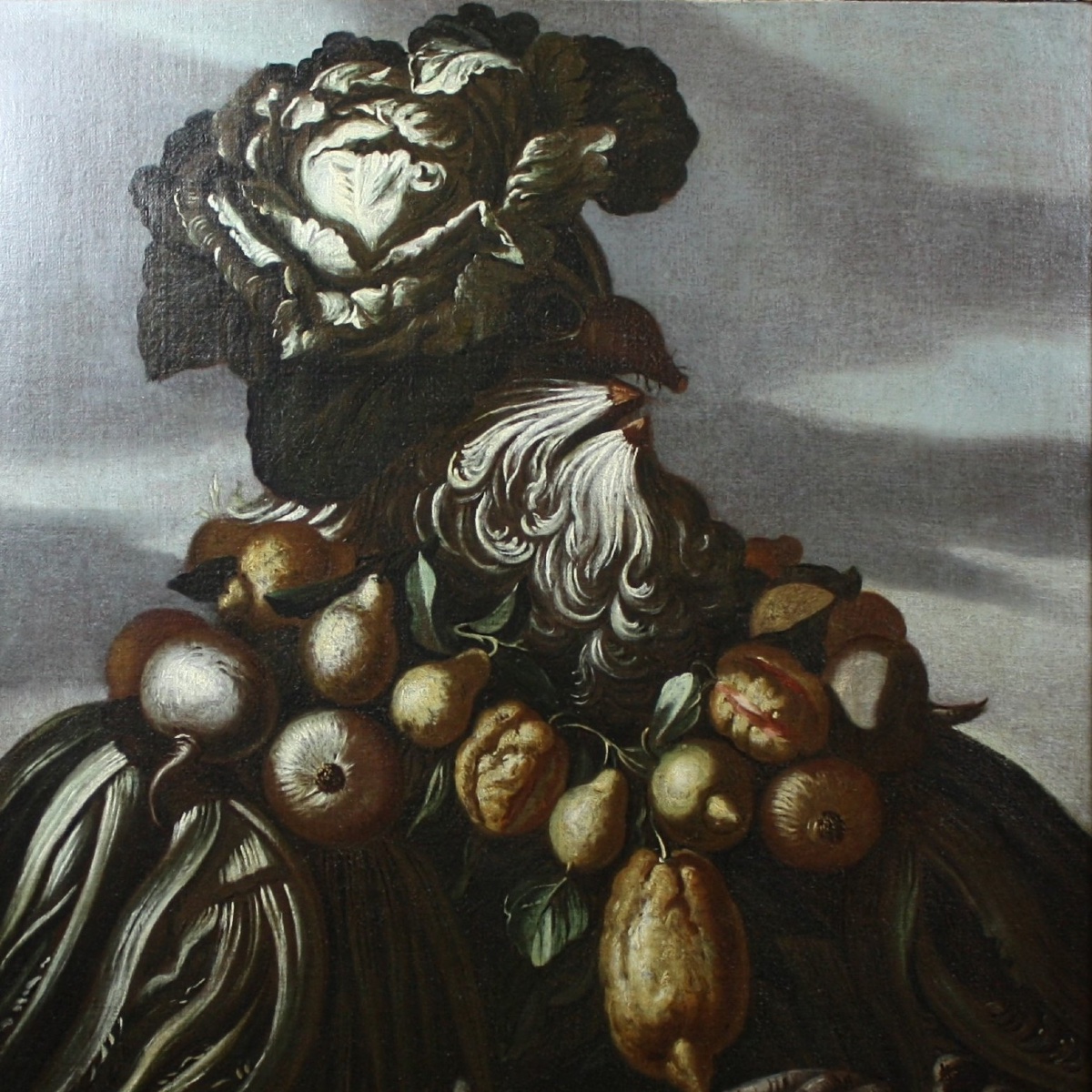
The headdress: It is formed from a large savoy cabbage, likely the quintessential winter vegetable.
The face and beard: The face has a dark, wrinkled appearance, evoked by tree bark and roots, while the thick, white beard is composed of shiny strands reminiscent of leek or onion roots, or upside-down tufts of celeriac.
The garland: A rich garland of winter fruits with a long shelf life adorns the chest, featuring lemons, pears, quinces, onions, and turnips.
The Torso and Hands: The left shoulder features large, ribbed leaves (like Swiss chard or cardoons), while the lower part displays garlic heads and split pomegranates—a classic symbol of fertility that withstands the frost. The hands are delicately shaped by mushrooms or elongated tubers.
In terms of execution, the work stands out for its exceptional painterly quality: the sheen of the lemons’ skin, the textural consistency and sharp veins of the savoy cabbage, and the refined chiaroscuro of the garlic demonstrate the hand of a master fully in control of rendering nature from life. The gray, cloudy, and flat background is typical of 18th-century genre paintings, specifically designed to highlight the warm tones and rich colors of the fruit.
The work is complemented and enhanced by its contemporary dark wood frame (118 x 92 cm), featuring elegant embossed gilt metal corner and center pieces—an element that confirms its authenticity and historical-artistic value.
Artist Profile: Francesco Zucchi
The attribution of the work to Francesco Zucchi (Venice, 1692 – Rome, 1764) places the painting squarely in the mid-18th century, offering a cultured and inventive revival of visual models from the past.
A versatile artist known primarily as an engraver and set designer—active between his native Venice and Rome—Zucchi belonged to a renowned family of artists specializing in perspective drawings, theatrical set designs, and graphic adaptations. In this painting, the artist demonstrates a keen decorative sensibility and exceptional compositional talent, reinterpreting the taste for “bizarre” elements and antiquarian whimsy that was very much in vogue in 18th-century cabinets of curiosities and the palaces of the nobility.
Francesco Zucchi
“Inspired by Arcimboldo”
Francesco Zucchi (Venice, 1692 – Rome, 1764) 18th century Medium Oil on canvas Dimensions 97 x 73 cm; with period frame: 118 x 92 cm
Description of the Work
This work is part of a refined and fascinating artistic tradition characterized by illusionism and allegory, offering an 18th-century reinterpretation of the famous genre of “composite heads” made renowned by Giuseppe Arcimboldo in the second half of the 16th century.
The painting depicts an anthropomorphic personification of Winter, in which the human figure is entirely composed of natural elements associated with the earth, cold, and preservation:
The headdress: It is formed from a large savoy cabbage, likely the quintessential winter vegetable.
The face and beard: The face has a dark, wrinkled appearance, evoked by tree bark and roots, while the thick, white beard is composed of shiny strands reminiscent of leek or onion roots, or upside-down tufts of celeriac.
The garland: A rich garland of winter fruits with a long shelf life adorns the chest, featuring lemons, pears, quinces, onions, and turnips.
The Torso and Hands: The left shoulder features large, ribbed leaves (like Swiss chard or cardoons), while the lower part displays garlic heads and split pomegranates—a classic symbol of fertility that withstands the frost. The hands are delicately shaped by mushrooms or elongated tubers.
In terms of execution, the work stands out for its exceptional painterly quality: the sheen of the lemons’ skin, the textural consistency and sharp veins of the savoy cabbage, and the refined chiaroscuro of the garlic demonstrate the hand of a master fully in control of rendering nature from life. The gray, cloudy, and flat background is typical of 18th-century genre paintings, specifically designed to highlight the warm tones and rich colors of the fruit.
The work is complemented and enhanced by its contemporary dark wood frame (118 x 92 cm), featuring elegant embossed gilt metal corner and center pieces—an element that confirms its authenticity and historical-artistic value.
Artist Profile: Francesco Zucchi
The attribution of the work to Francesco Zucchi (Venice, 1692 – Rome, 1764) places the painting squarely in the mid-18th century, offering a cultured and inventive revival of visual models from the past.
A versatile artist known primarily as an engraver and set designer—active between his native Venice and Rome—Zucchi belonged to a renowned family of artists specializing in perspective drawings, theatrical set designs, and graphic adaptations. In this painting, the artist demonstrates a keen decorative sensibility and exceptional compositional talent, reinterpreting the taste for “bizarre” elements and antiquarian whimsy that was very much in vogue in 18th-century cabinets of curiosities and the palaces of the nobility.
15 000 €
Period: 18th century
Style: Other Style
Condition: En l'etat
Reference (ID): 1830523
Availability: In stock
Print