




Saint Catherine Of Siena. Oil On Copper.
Subject: Saint Catherine of Siena.
Artist (attributed): Orsola Maddalena Caccia (Moncalvo, 1596–1676).
Date: 17th century.
Technique: Oil on copper.
Dimensions: 15.5 x 12 cm.
Condition: The work has some chipping along the edges, as shown in image 0, and slight loss of paint, visible in the details (images 1 and 2). The painted surface shows a patina consistent with the period and slight yellowing, likely due to oxidized varnish.
2. Description of the Painting and Iconography
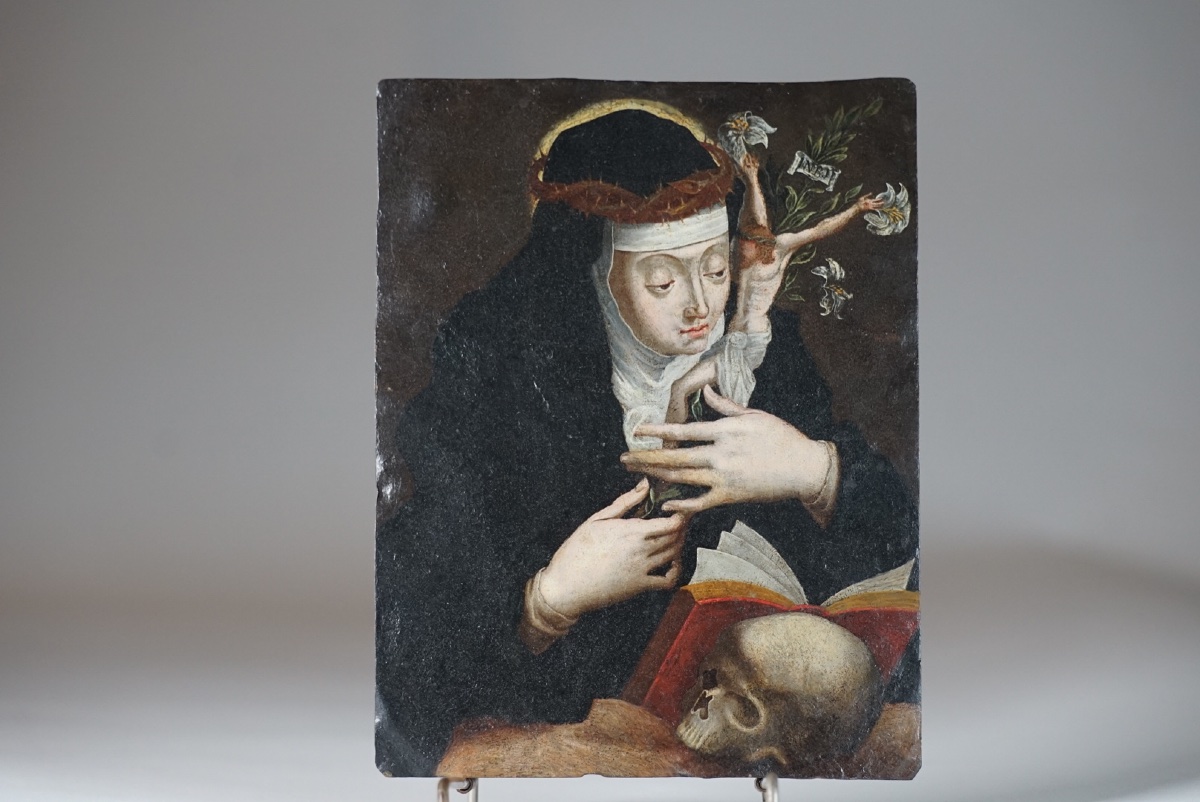
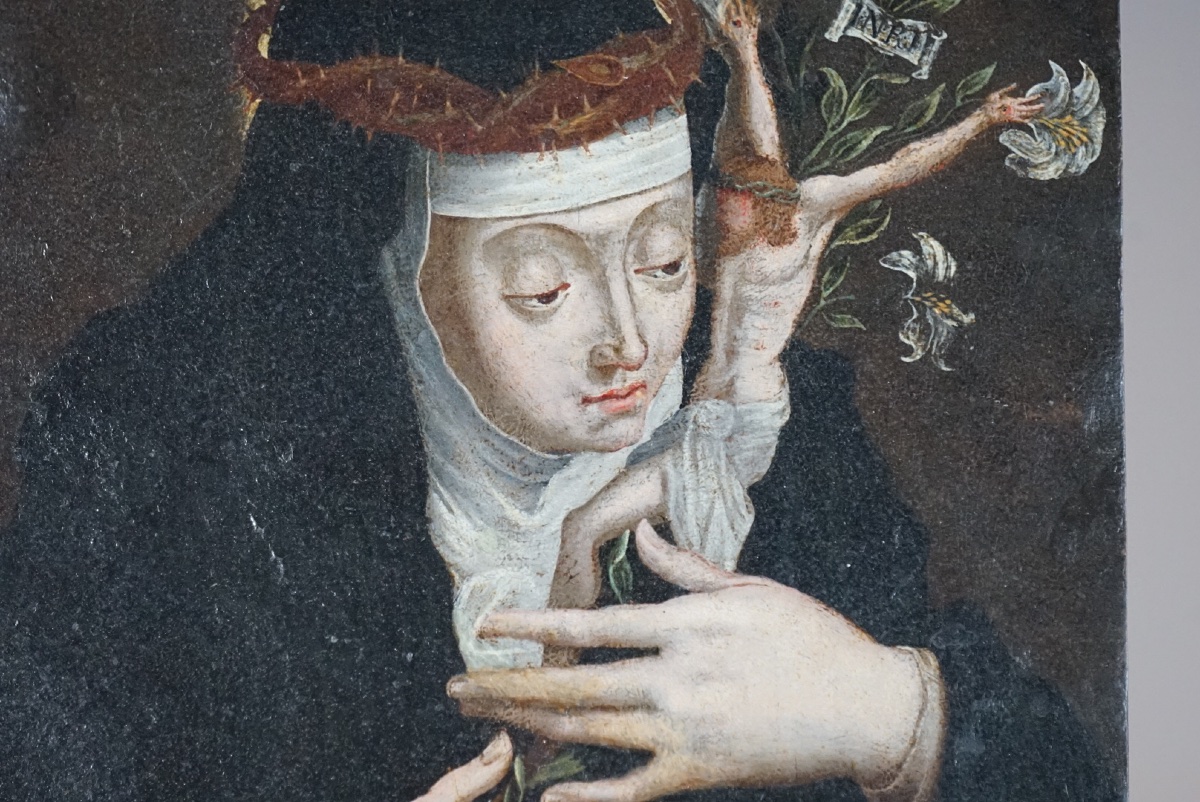
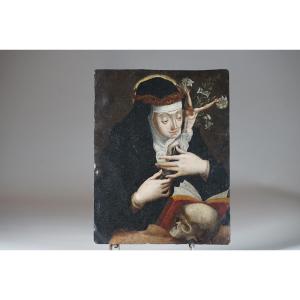
The painting depicts Saint Catherine of Siena in a half-length portrait, absorbed in prayer and contemplation. The iconographic attributes are essential for her unambiguous identification:
The Dominican Habit: The saint wears the habit of the Dominican Order, consisting of a tunic and a white veil, the latter covered by a black cloak.
The Crown of Thorns: A key attribute for Saint Catherine. It refers to the episode in which Christ offered her the choice between a crown of gold and one of thorns. Catherine chose the crown of thorns as a sign of her participation in Christ’s Passion.
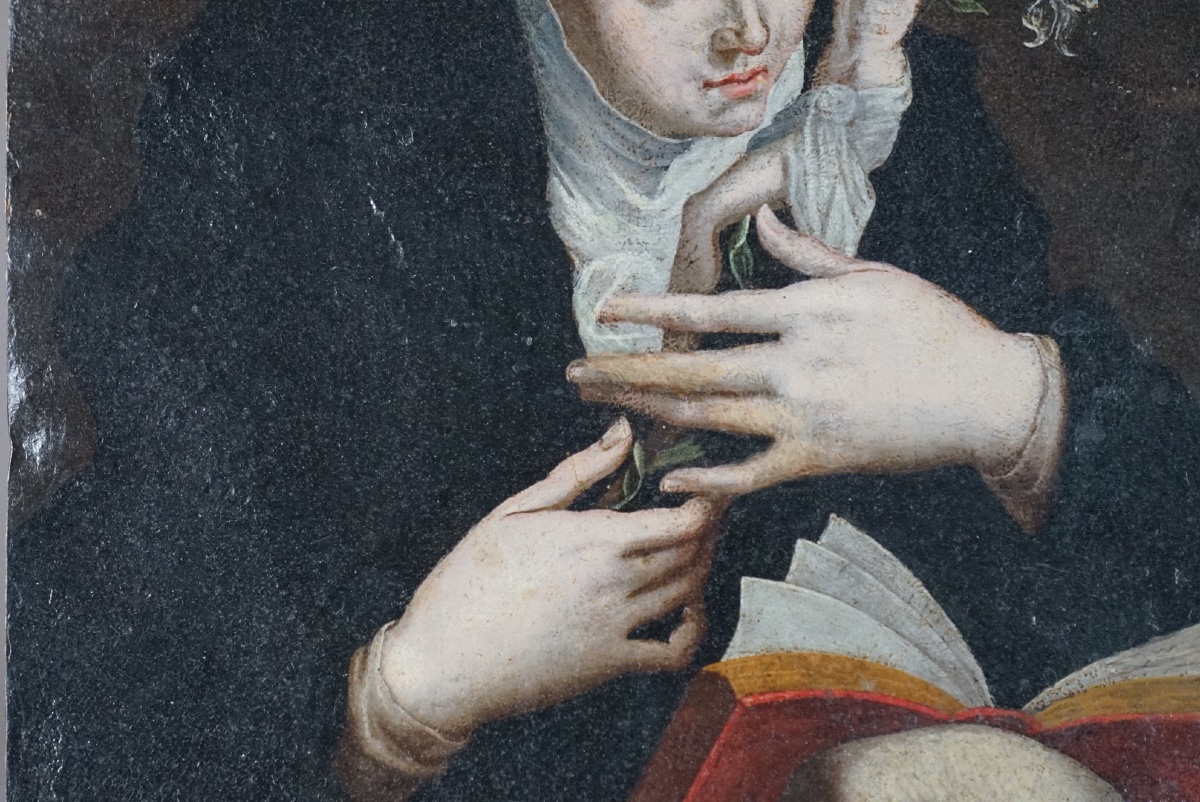
The Crucifix with Lilies: In images 0 and 2, the saint is depicted gazing intently at a crucifix. On the cross, Jesus is portrayed with his head crowned with thorns, while three lilies bloom from either side of him. These flowers are symbols of purity, virginity, and, in this context, of Christ’s suffering and the saint’s faith. The crucifix itself seems almost to grow out of the lilies, creating a powerful symbolic image.
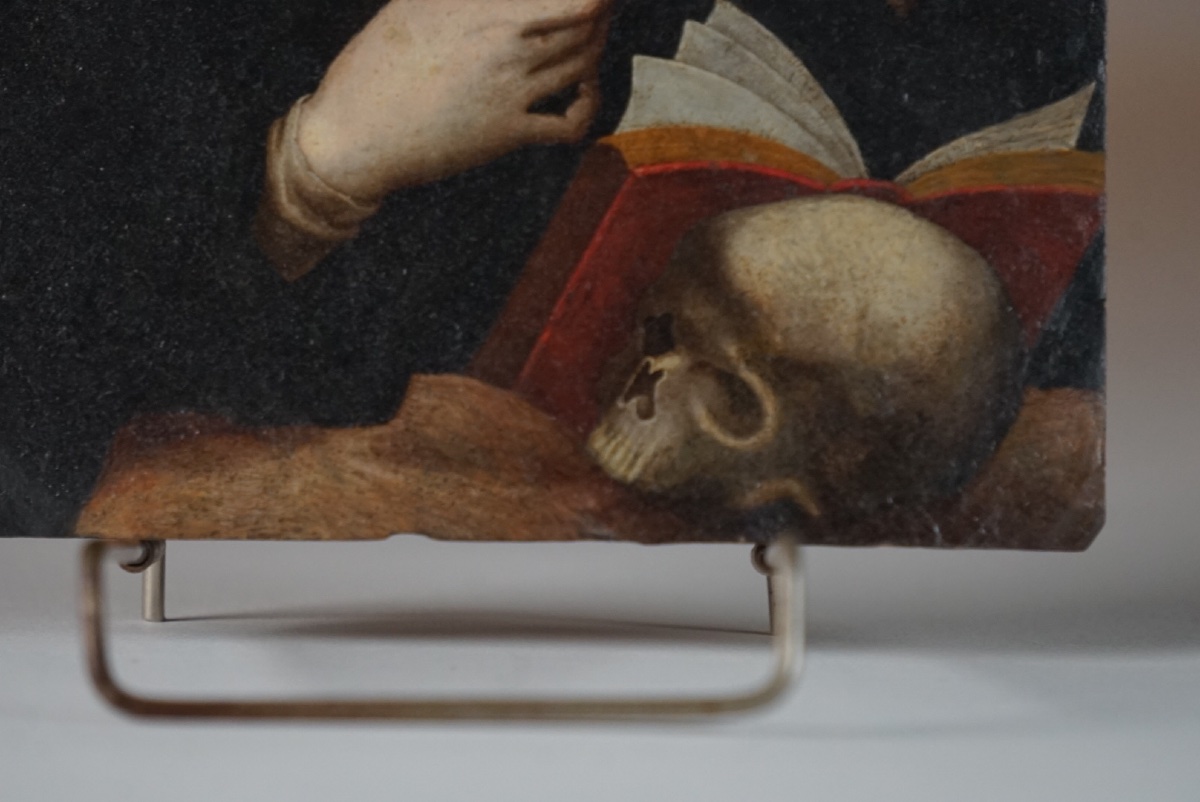
The Skull and the Book: At the saint’s feet, resting on a table or piece of furniture (clearly visible in images 4 and 5), are a skull and an open book with red and yellow pages. The skull is a memento mori, a symbol of meditation on the transience of earthly life and on death. The book represents divine wisdom, theology, and the Dominican Rule, to which the saint adheres.
The Hands: The saint’s hands (images 1 and 3) are delicate and carefully painted. One hand clutches the crucifix and the lilies, while the other rests on her abdomen in a gesture of profound devotion and introspection.
3. Stylistic Analysis and Comparisons
The attribution to Orsola Maddalena Caccia is based on her artistic output, particularly works with religious and mystical subjects. The painting exhibits stylistic characteristics consistent with her work:
Composition: The composition is simple and measured, featuring a central figure and a calm, contemplative atmosphere.
Rendering of Details: The details are rendered with accuracy and precision, such as the folds of the robe and the shape of the flowers and the skull.
The Color Palette: The color palette is dominated by dark tones, with accents of white, red, and yellow.This creates a sober and mystical atmosphere.
Comparisons: The painting can be compared to other works by Orsola Maddalena Caccia, such as her depictions of saints and biblical scenes. Her works are often characterized by a strong sense of religiosity and a focus on the inner dimension of faith.
4. Interpretation of the Painting
The painting depicts Saint Catherine of Siena as a model of faith and mysticism. The use of the crown of thorns and the crucifix with lilies underscores her deep devotion and her participation in the Passion of Christ. The skull and the book represent the transience of earthly life and the quest for divine wisdom. The painting invites the viewer to meditation and prayer, offering a model of Christian life based on faith and love for God.
Artist (attributed): Orsola Maddalena Caccia (Moncalvo, 1596–1676).
Date: 17th century.
Technique: Oil on copper.
Dimensions: 15.5 x 12 cm.
Condition: The work has some chipping along the edges, as shown in image 0, and slight loss of paint, visible in the details (images 1 and 2). The painted surface shows a patina consistent with the period and slight yellowing, likely due to oxidized varnish.
2. Description of the Painting and Iconography
The painting depicts Saint Catherine of Siena in a half-length portrait, absorbed in prayer and contemplation. The iconographic attributes are essential for her unambiguous identification:
The Dominican Habit: The saint wears the habit of the Dominican Order, consisting of a tunic and a white veil, the latter covered by a black cloak.
The Crown of Thorns: A key attribute for Saint Catherine. It refers to the episode in which Christ offered her the choice between a crown of gold and one of thorns. Catherine chose the crown of thorns as a sign of her participation in Christ’s Passion.
The Crucifix with Lilies: In images 0 and 2, the saint is depicted gazing intently at a crucifix. On the cross, Jesus is portrayed with his head crowned with thorns, while three lilies bloom from either side of him. These flowers are symbols of purity, virginity, and, in this context, of Christ’s suffering and the saint’s faith. The crucifix itself seems almost to grow out of the lilies, creating a powerful symbolic image.
The Skull and the Book: At the saint’s feet, resting on a table or piece of furniture (clearly visible in images 4 and 5), are a skull and an open book with red and yellow pages. The skull is a memento mori, a symbol of meditation on the transience of earthly life and on death. The book represents divine wisdom, theology, and the Dominican Rule, to which the saint adheres.
The Hands: The saint’s hands (images 1 and 3) are delicate and carefully painted. One hand clutches the crucifix and the lilies, while the other rests on her abdomen in a gesture of profound devotion and introspection.
3. Stylistic Analysis and Comparisons
The attribution to Orsola Maddalena Caccia is based on her artistic output, particularly works with religious and mystical subjects. The painting exhibits stylistic characteristics consistent with her work:
Composition: The composition is simple and measured, featuring a central figure and a calm, contemplative atmosphere.
Rendering of Details: The details are rendered with accuracy and precision, such as the folds of the robe and the shape of the flowers and the skull.
The Color Palette: The color palette is dominated by dark tones, with accents of white, red, and yellow.This creates a sober and mystical atmosphere.
Comparisons: The painting can be compared to other works by Orsola Maddalena Caccia, such as her depictions of saints and biblical scenes. Her works are often characterized by a strong sense of religiosity and a focus on the inner dimension of faith.
4. Interpretation of the Painting
The painting depicts Saint Catherine of Siena as a model of faith and mysticism. The use of the crown of thorns and the crucifix with lilies underscores her deep devotion and her participation in the Passion of Christ. The skull and the book represent the transience of earthly life and the quest for divine wisdom. The painting invites the viewer to meditation and prayer, offering a model of Christian life based on faith and love for God.
3 800 €
Period: 17th century
Style: Other Style
Condition: En l'etat
Reference (ID): 1830681
Availability: In stock
Print