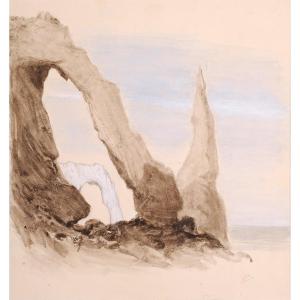


Eugène Le Poittevin (1806–1870) Etretat: The Porte D’aval And The Aiguille
Artist: Eugène Le Poittevin
Eugène-Modeste LE POITTEVIN
(Paris, 1806 – Paris, 1870)
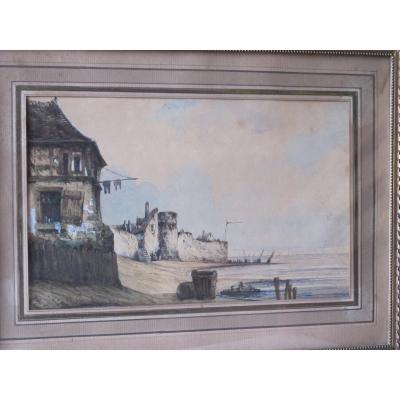
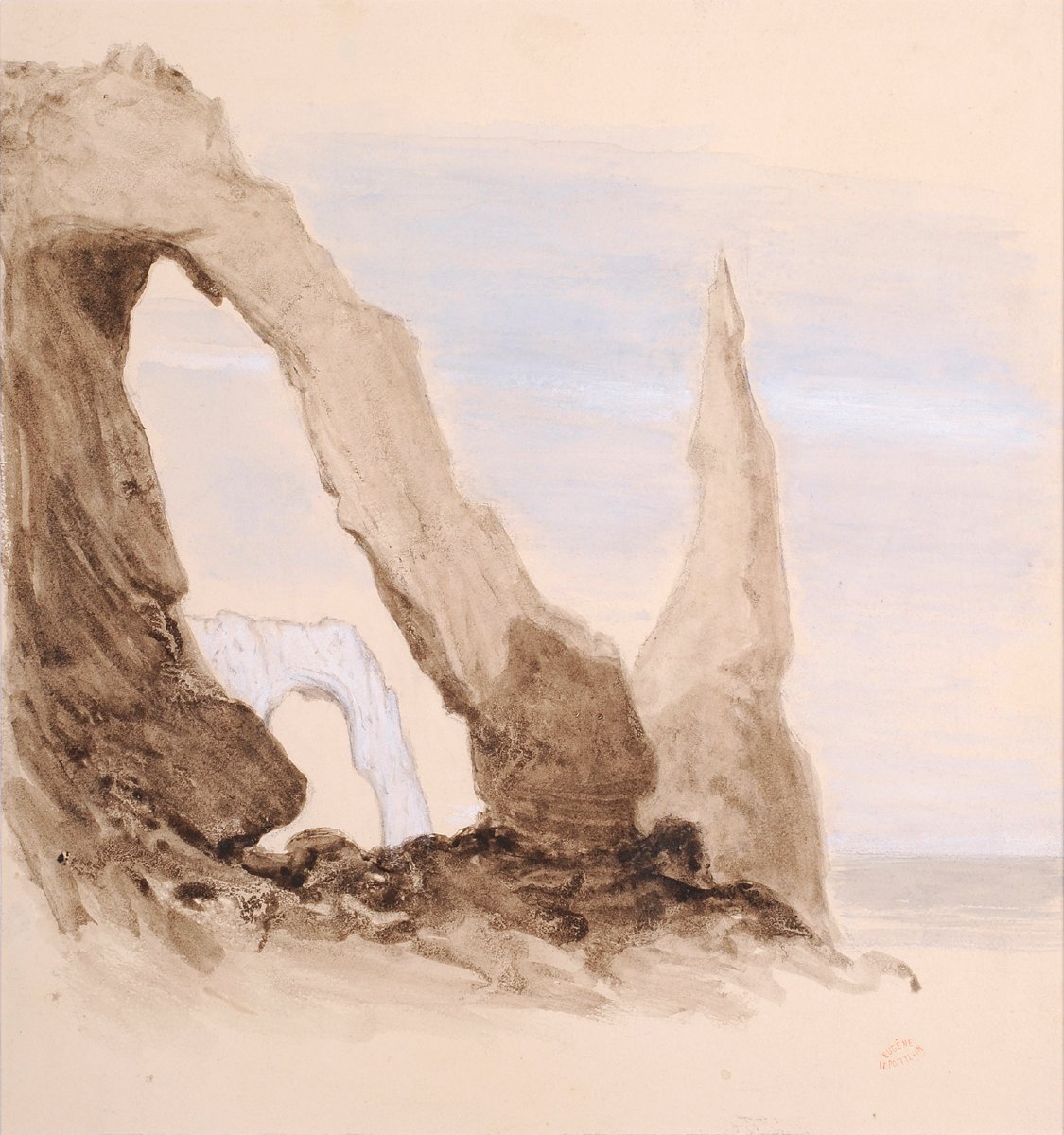
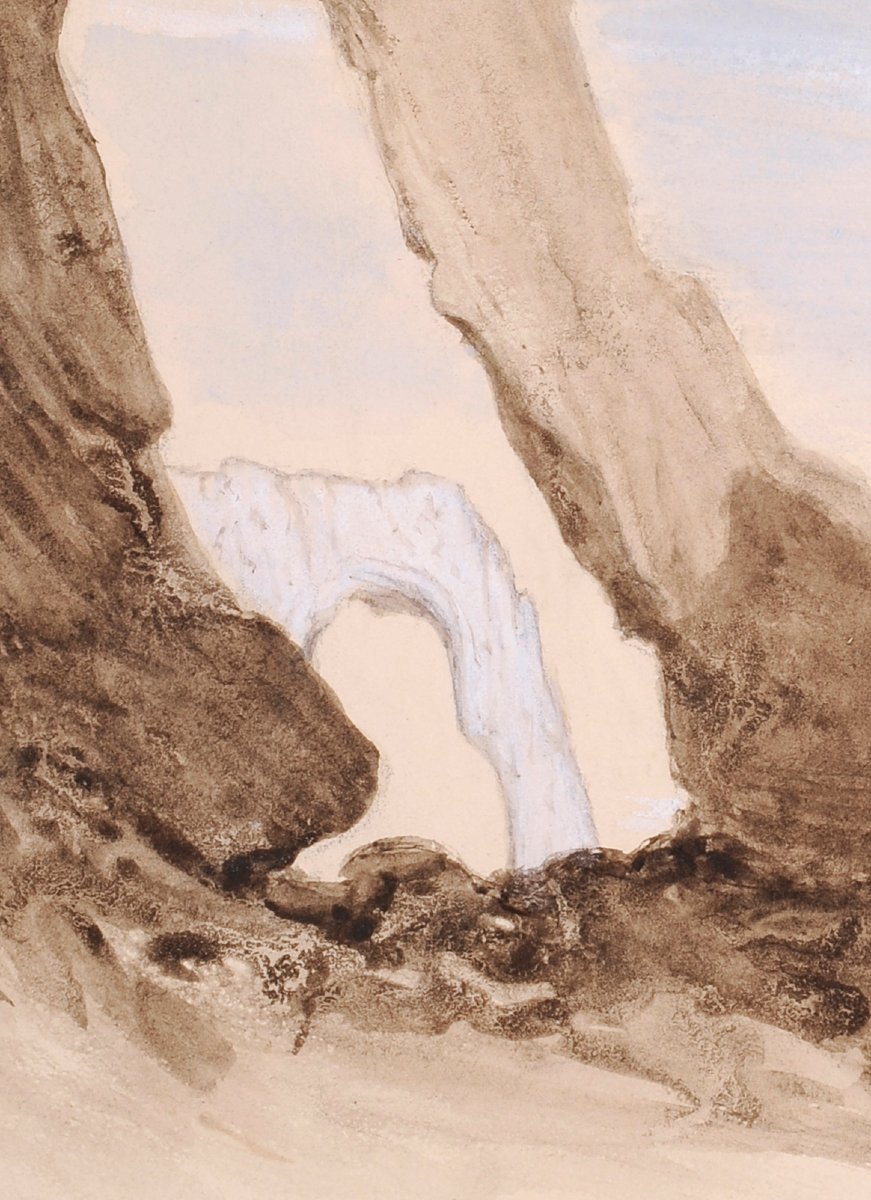
Etretat, the Porte d’Aval and the Aiguille
Watercolor and gouache over pencil lines
H. 23.5 cm; W. 22 cm
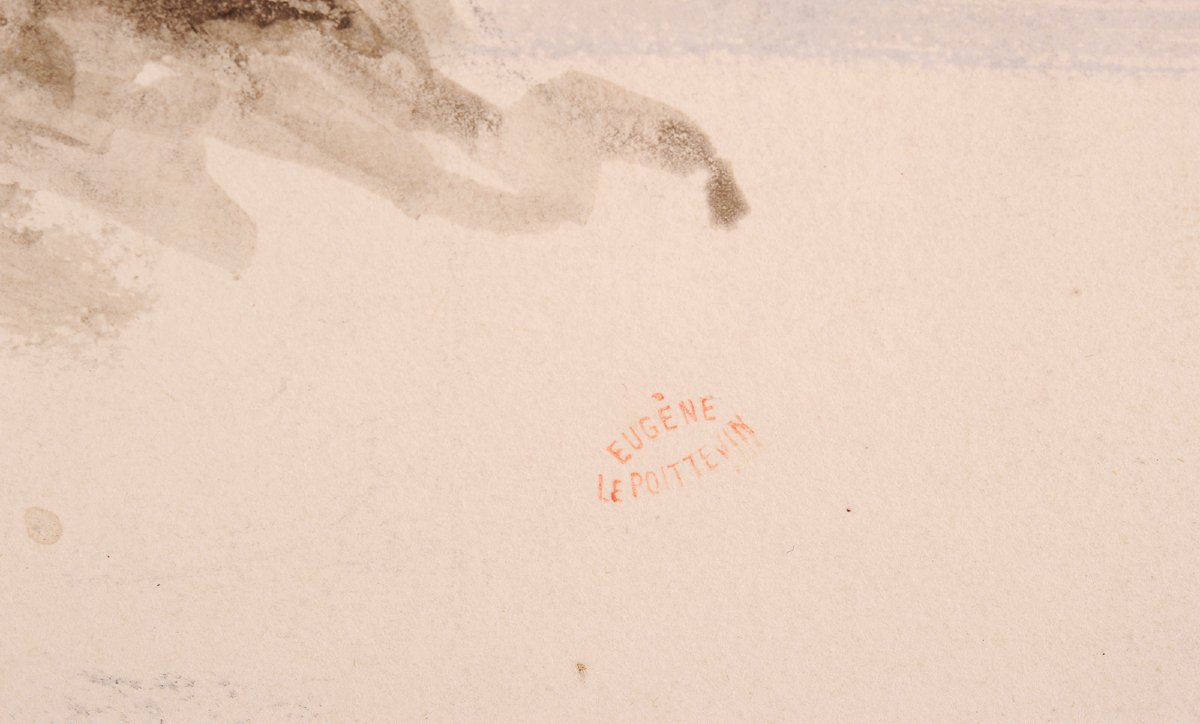
Studio sale stamp in the lower right corner
Provenance: sale of the artist’s studio (April 9–12, 1872, Drouot, Room 8,
auctioneer Escribe, experts Francis Petit and Charles Mannheim),
likely part of Lot 207 (Seascapes, beaches, rocks, and cliffs,
approximately 106 sheets) in the catalog
Le Poittevin (whose real name was Poidevin) spent his childhood in Versailles, where
his father held the position of “Assistant Curator of the Crown’s Furniture.”
His artistic talents enabled him to join Louis Hersent’s studio around
1823, then that of Xavier Leprince (following the latter’s death in late 1826,
Le Poittevin settled there and even completed his
master’s final unfinished works); he was notably supported by Alexandre du Sommerard, a major
collector and future founder of the Cluny Museum, who purchased several
paintings from him. Le Poittevin narrowly missed winning the Prix de Rome for historical landscape in
1829, but this did not prevent him from exhibiting at the Salon as early as 1831, and he continued to do so
without interruption until his death.
Appointed official painter to the navy in 1849, following in the footsteps of Louis-Ambroise
Garneray, Louis-Philippe Crépin, and Théodore Gudin, he was highly regarded in his
time and received several official awards at the Salons: a first-class medal
in 1836, second-class medals in 1831 and 1848, and a third-class medal in 1855.
His Paris studio was located at 5 Cité Trévise, in what is now the 9th
arrondissement.
Although he worked as an illustrator and caricaturist (see his lithographic collections
of *Diableries* and his erotic and even pornographic drawings),
the bulk of Le Poittevin’s work consists of scenes depicting the return from fishing and
seascapes along the Normandy coast, particularly in the Cauchois region.
He thus maintained a strong connection with Etretat; much like Charles Mozin (who was also a student of Leprince) with Trouville, he was among the first artists to establish this village as a fashionable seaside resort; it was his friend Eugène Isabey
who had introduced him to the place, and he quickly purchased a house there, La
Chauferette, where he hosted Gustave Courbet in 1869, among others.
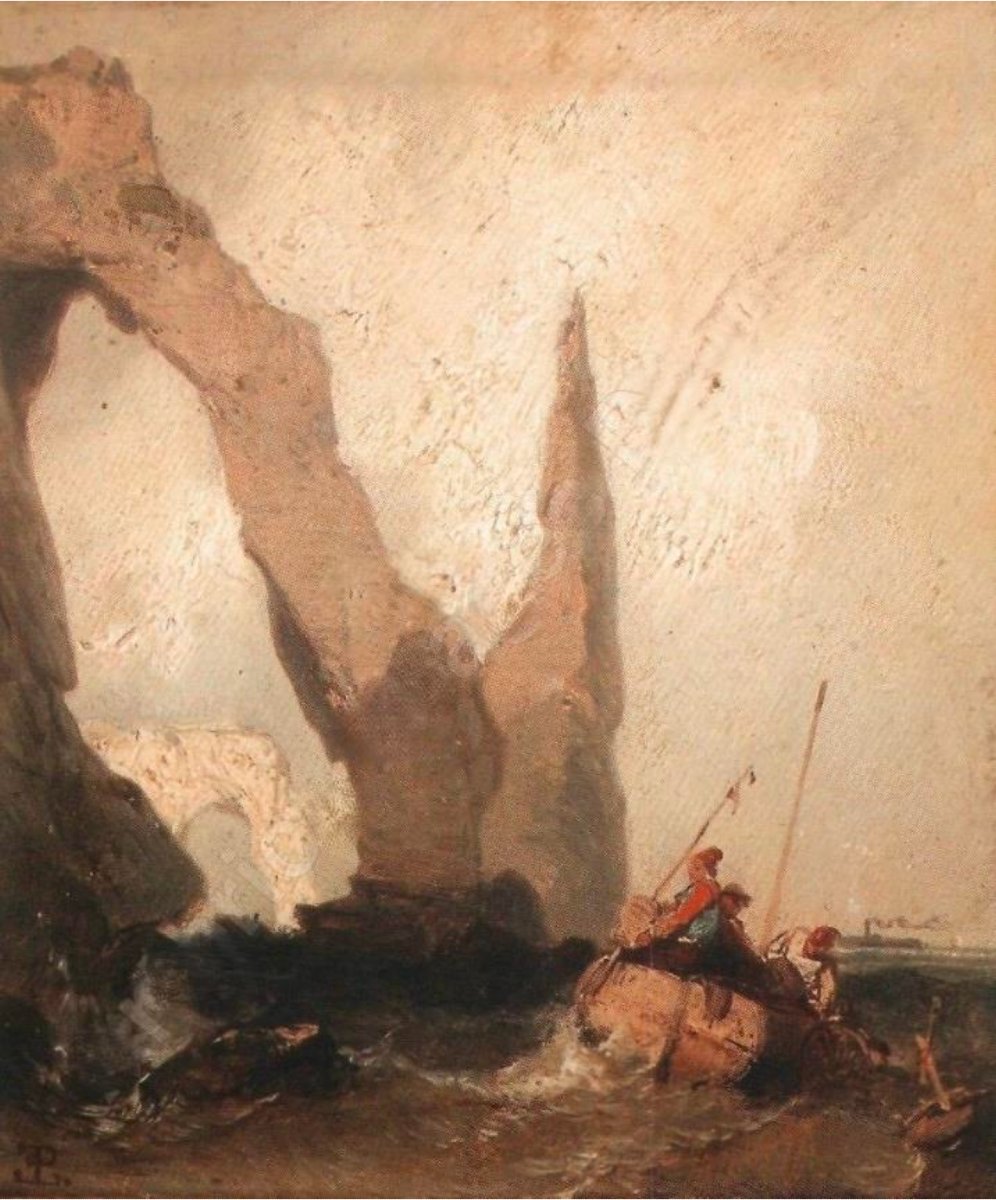
Our drawing, which is very atmospheric, is a study for a small painting (24 x 20 cm)
that went up for public auction about fifteen years ago—perhaps itself
a preparatory study for a more ambitious composition.
(Paris, 1806 – Paris, 1870)
Etretat, the Porte d’Aval and the Aiguille
Watercolor and gouache over pencil lines
H. 23.5 cm; W. 22 cm
Studio sale stamp in the lower right corner
Provenance: sale of the artist’s studio (April 9–12, 1872, Drouot, Room 8,
auctioneer Escribe, experts Francis Petit and Charles Mannheim),
likely part of Lot 207 (Seascapes, beaches, rocks, and cliffs,
approximately 106 sheets) in the catalog
Le Poittevin (whose real name was Poidevin) spent his childhood in Versailles, where
his father held the position of “Assistant Curator of the Crown’s Furniture.”
His artistic talents enabled him to join Louis Hersent’s studio around
1823, then that of Xavier Leprince (following the latter’s death in late 1826,
Le Poittevin settled there and even completed his
master’s final unfinished works); he was notably supported by Alexandre du Sommerard, a major
collector and future founder of the Cluny Museum, who purchased several
paintings from him. Le Poittevin narrowly missed winning the Prix de Rome for historical landscape in
1829, but this did not prevent him from exhibiting at the Salon as early as 1831, and he continued to do so
without interruption until his death.
Appointed official painter to the navy in 1849, following in the footsteps of Louis-Ambroise
Garneray, Louis-Philippe Crépin, and Théodore Gudin, he was highly regarded in his
time and received several official awards at the Salons: a first-class medal
in 1836, second-class medals in 1831 and 1848, and a third-class medal in 1855.
His Paris studio was located at 5 Cité Trévise, in what is now the 9th
arrondissement.
Although he worked as an illustrator and caricaturist (see his lithographic collections
of *Diableries* and his erotic and even pornographic drawings),
the bulk of Le Poittevin’s work consists of scenes depicting the return from fishing and
seascapes along the Normandy coast, particularly in the Cauchois region.
He thus maintained a strong connection with Etretat; much like Charles Mozin (who was also a student of Leprince) with Trouville, he was among the first artists to establish this village as a fashionable seaside resort; it was his friend Eugène Isabey
who had introduced him to the place, and he quickly purchased a house there, La
Chauferette, where he hosted Gustave Courbet in 1869, among others.
Our drawing, which is very atmospheric, is a study for a small painting (24 x 20 cm)
that went up for public auction about fifteen years ago—perhaps itself
a preparatory study for a more ambitious composition.
3 200 €
Period: 19th century
Style: Louis Philippe, Charles 10th
Condition: Perfect condition
Material: Water color
Length: 23,5 cm hors cadre
Width: 22 cm hors cadre
Reference (ID): 1829241
Availability: In stock
Print