

Eugène Le Poittevin (1806-1870) Sunset By The Sea
Artist: Eugène Le Poittevin
Eugène Modeste LE POITTEVIN
(Paris, 1806 - Paris, 1870)
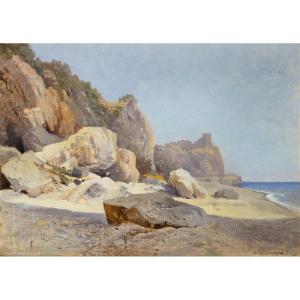
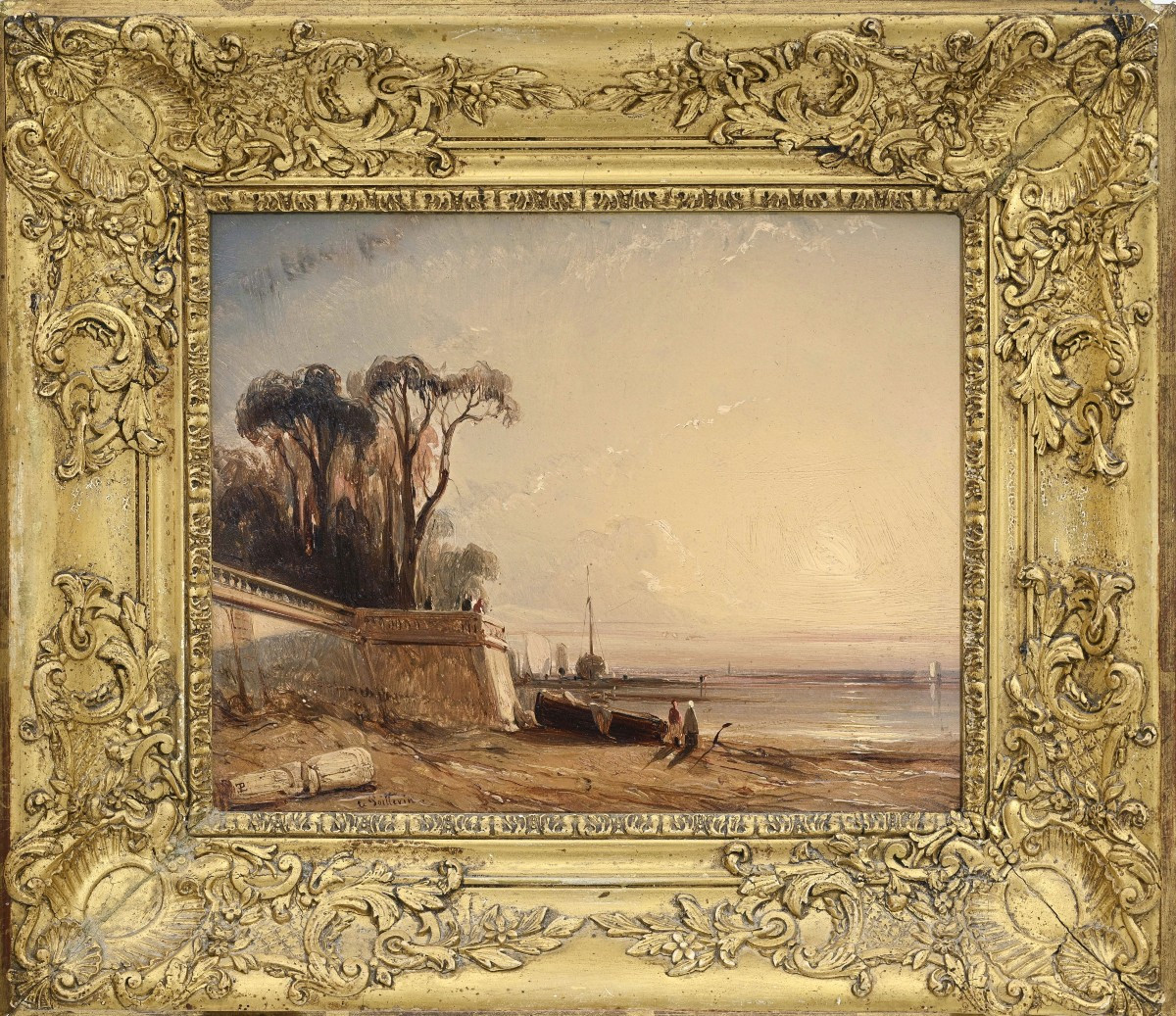
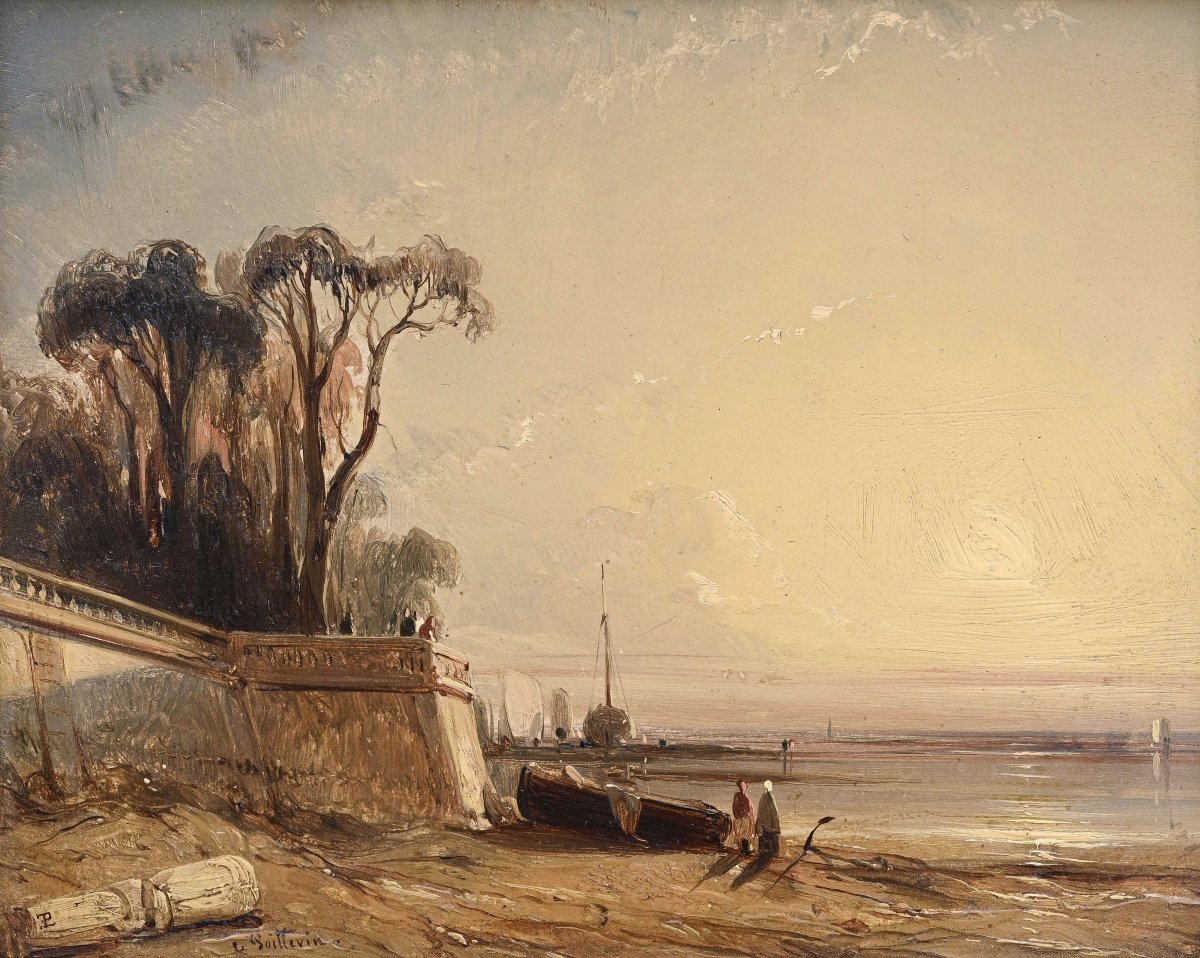
Sunset by the Sea
Oil on panel
H. 15 cm; W. 19 cm
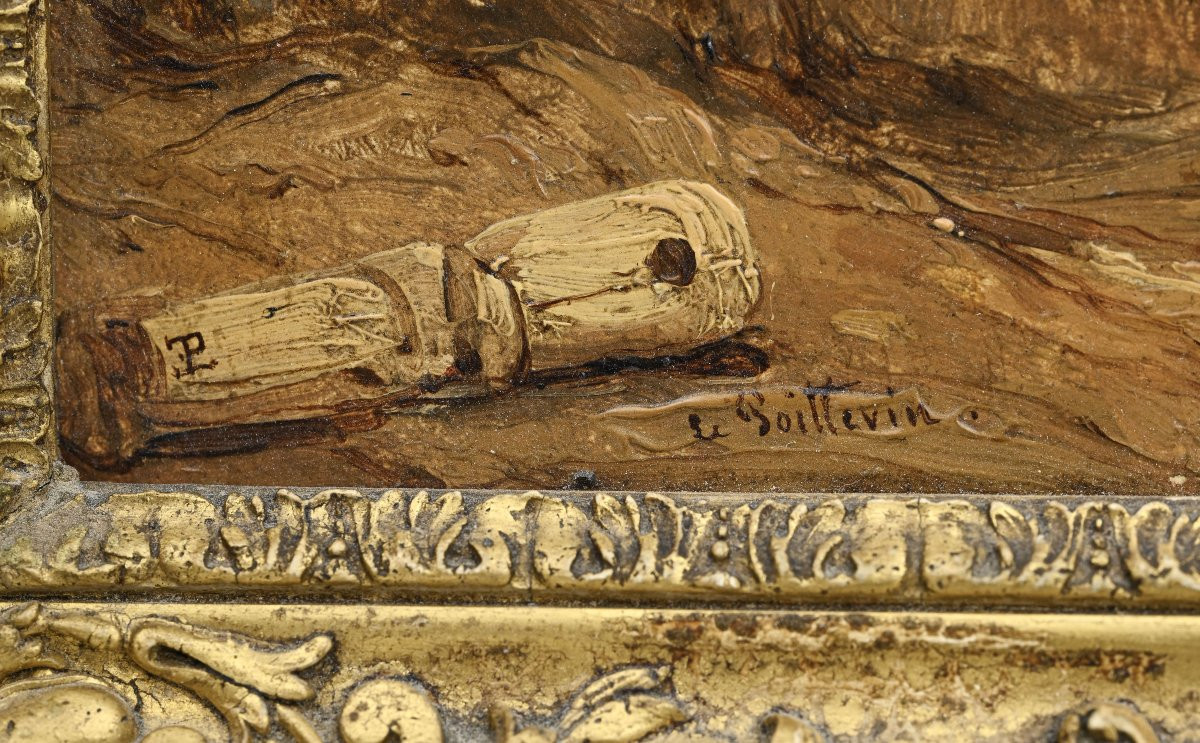
Signed and monogrammed lower left
Probably circa 1845
Le Poittevin (whose real name was Poidevin) spent his childhood in Versailles, where his father held the position of "Sub-Conservator of the Crown Furniture." His artistic talents allowed him to join the studio of Louis Hersent around 1823, then that of Xavier Leprince (following the latter's death at the end of 1826, Le Poittevin moved in and even finished his master's last unfinished works). He was notably supported by Alexandre du Sommerard, a great collector and future founder of the Cluny Museum, who bought several of his paintings. Le Poittevin narrowly missed winning the Prix de Rome for historical landscape painting in 1829, but this did not prevent him from exhibiting at the Salon from 1831 onwards, and continuing to do so until his death.
His style, romantic in the 1820s and 1830s (with works similar to those of Eugène Isabey or Auguste Biard, with whom he was friends and sometimes collaborated), gradually became more realistic thereafter.
Although he was active as an illustrator and caricaturist (see his lithographic collections of "Diableries" and his erotic, even pornographic, drawings), the majority of his work depicts scenes of fishing boats returning from their voyages and seascapes along the Normandy coast, particularly in the Pays de Caux region. Here, the soft, golden light, along with the balustrade bordering a park with tall trees, lends an Italianate, even Orientalist, character to this seemingly imaginary landscape, even though one might discern chalk cliffs in the background.
The style of the signature allows us to date the work to the 1840s.
(Paris, 1806 - Paris, 1870)
Sunset by the Sea
Oil on panel
H. 15 cm; W. 19 cm
Signed and monogrammed lower left
Probably circa 1845
Le Poittevin (whose real name was Poidevin) spent his childhood in Versailles, where his father held the position of "Sub-Conservator of the Crown Furniture." His artistic talents allowed him to join the studio of Louis Hersent around 1823, then that of Xavier Leprince (following the latter's death at the end of 1826, Le Poittevin moved in and even finished his master's last unfinished works). He was notably supported by Alexandre du Sommerard, a great collector and future founder of the Cluny Museum, who bought several of his paintings. Le Poittevin narrowly missed winning the Prix de Rome for historical landscape painting in 1829, but this did not prevent him from exhibiting at the Salon from 1831 onwards, and continuing to do so until his death.
His style, romantic in the 1820s and 1830s (with works similar to those of Eugène Isabey or Auguste Biard, with whom he was friends and sometimes collaborated), gradually became more realistic thereafter.
Although he was active as an illustrator and caricaturist (see his lithographic collections of "Diableries" and his erotic, even pornographic, drawings), the majority of his work depicts scenes of fishing boats returning from their voyages and seascapes along the Normandy coast, particularly in the Pays de Caux region. Here, the soft, golden light, along with the balustrade bordering a park with tall trees, lends an Italianate, even Orientalist, character to this seemingly imaginary landscape, even though one might discern chalk cliffs in the background.
The style of the signature allows us to date the work to the 1840s.
3 800 €
Period: 19th century
Style: Louis Philippe, Charles 10th
Condition: Perfect condition
Material: Oil painting on wood
Length: 15 cm hors cadre
Width: 19 cm hors cadre
Reference (ID): 1758291
Availability: In stock
Print