



Sloping Desk Converted Into A Prayer Stool, Stamped "p. Daneau," Dating From The Late Louis XIV To Early Regency Period,
Artist: Pierre Daneau
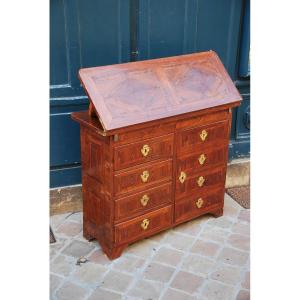
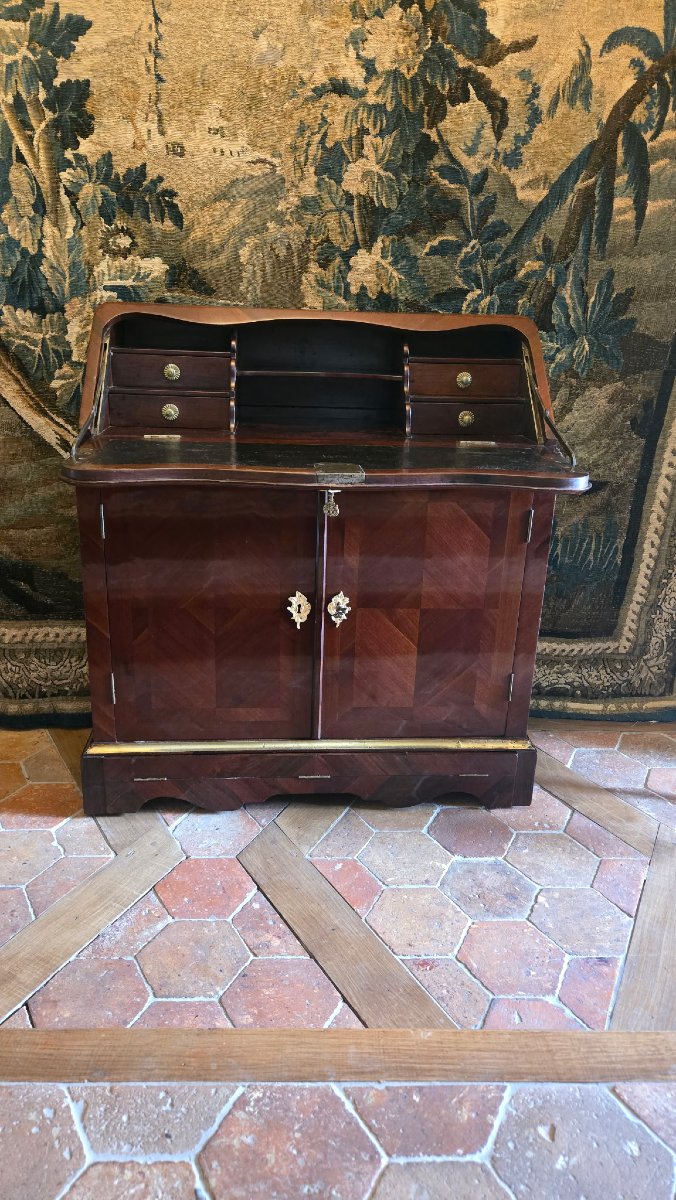
A dual-purpose piece of furniture serving as both a slanted desk and a prayer stool, constructed on a frame made entirely of softwood and veneered with amaranth.
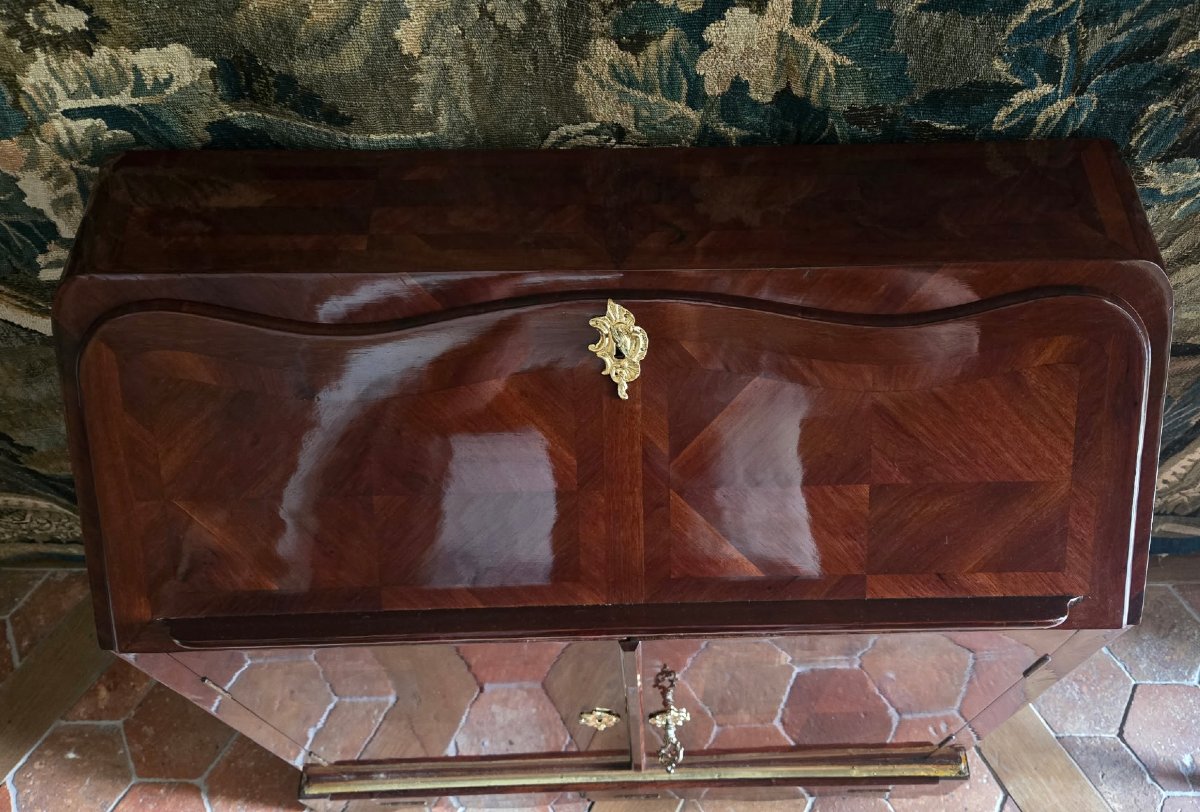
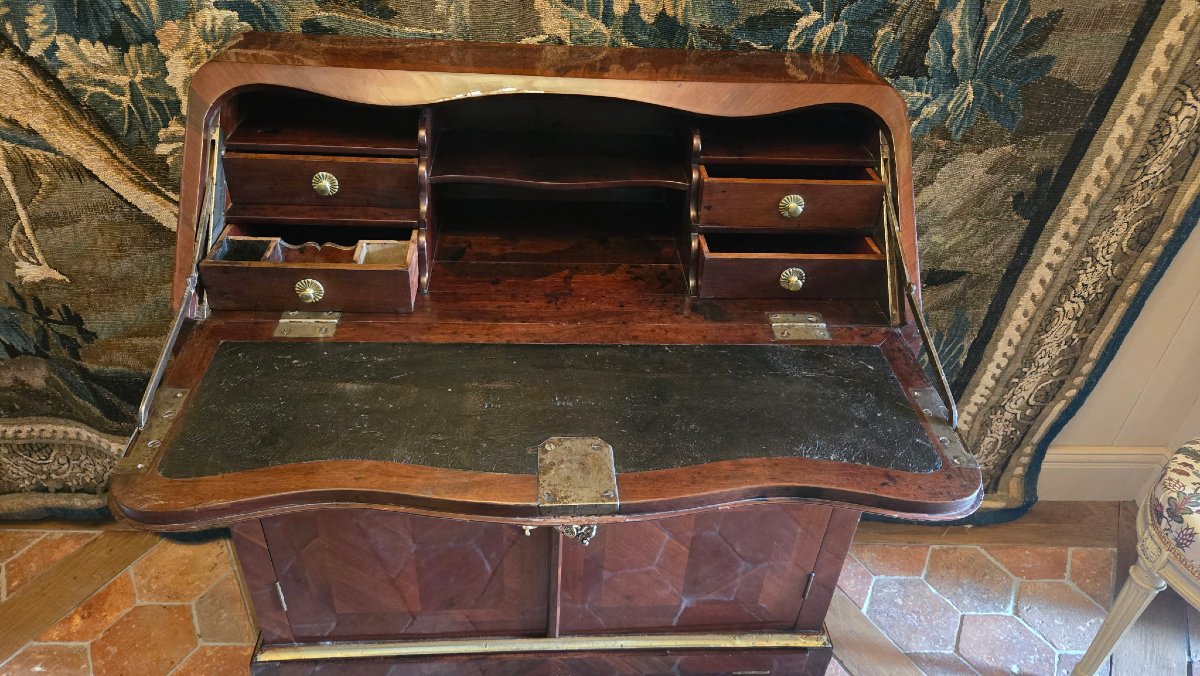
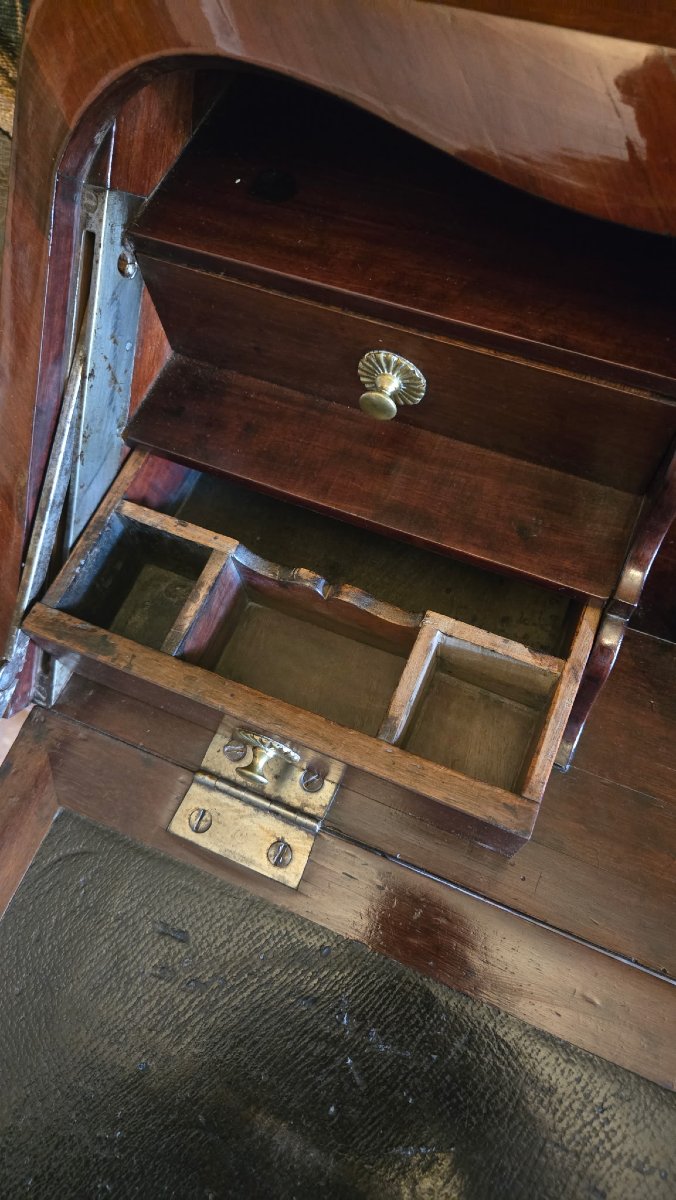
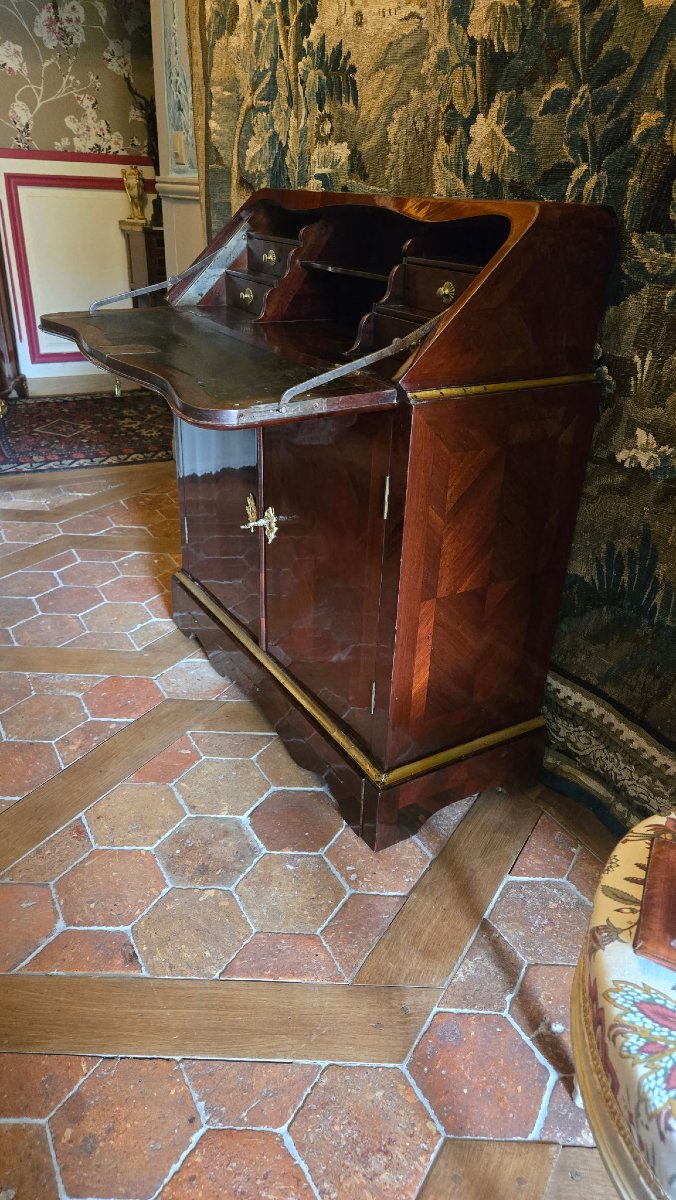
Shallow in depth and with particularly compact proportions, it features an upper section with a stepped top that opens via a hinged flap. The top, lined on the inside with leather to serve as a writing surface, is held open by two metal hinges and reveals an interior featuring a central niche and four small drawers arranged in tiers, two on each side.
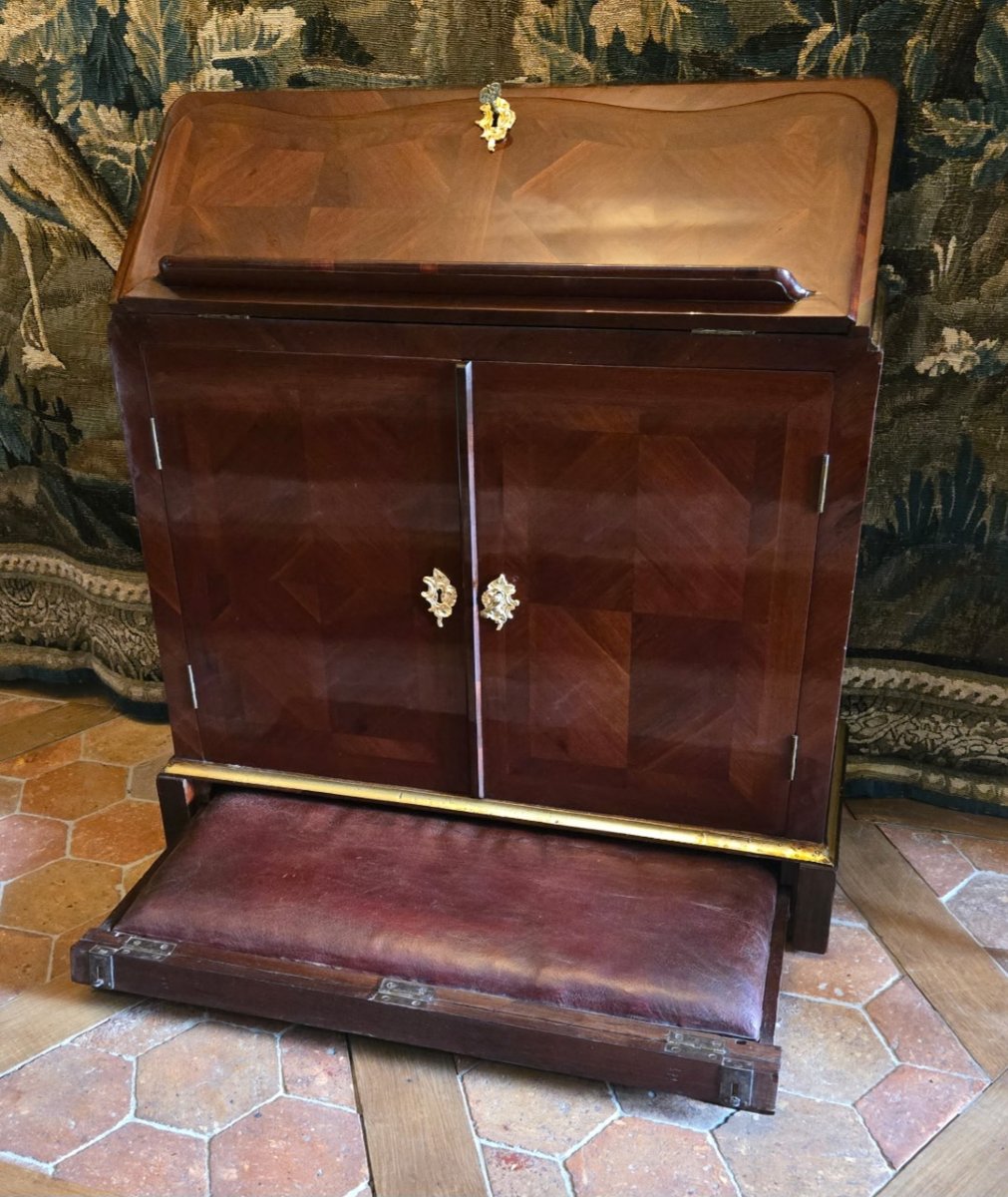
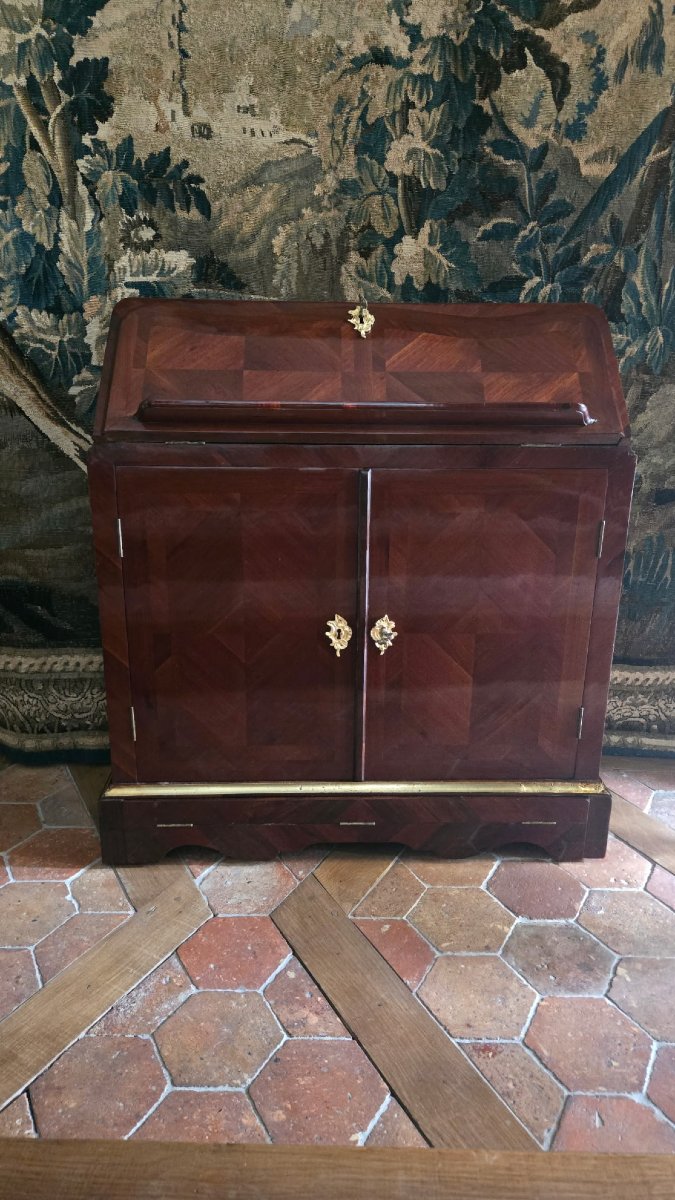
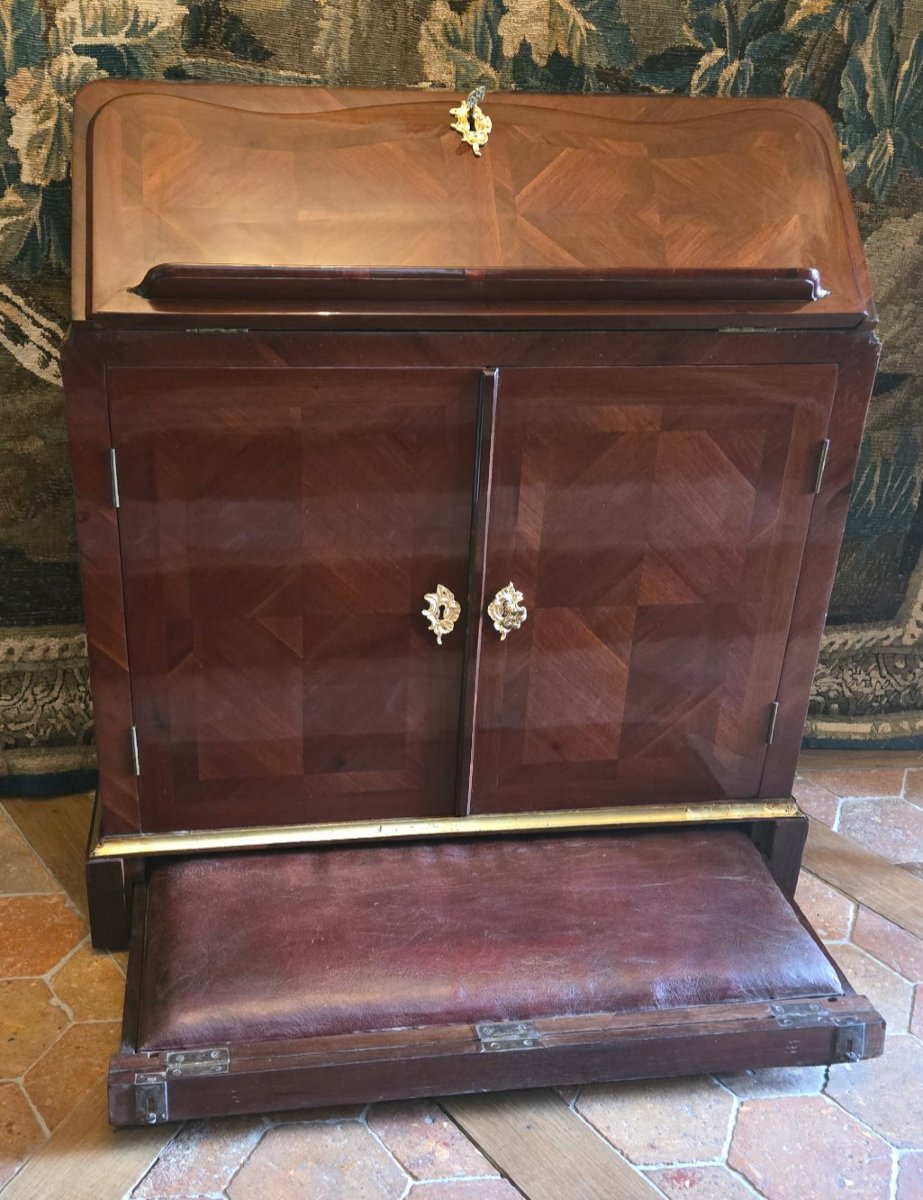
The lower section forms a small cabinet that opens with two doors, revealing two shelves.
The lower part of the piece conceals one of its most interesting features. The scalloped baseboard on the front is actually the front crossbar of a sliding frame that serves as a kneeler. When pulled forward, it reveals a large, leather-upholstered cushion designed for kneeling. The mechanism retains its small iron hinges, latches, and spring-loaded side mechanisms. Pressing these mechanisms allows the frame to be completely detached from its slides and the kneeling bench to be removed from the cabinet. The cushion retains its original straps; when closed, the entire unit disappears completely behind the baseboard.
This design thus combines the functions of a sloping desk, a lectern, and a kneeler in a single piece of furniture.
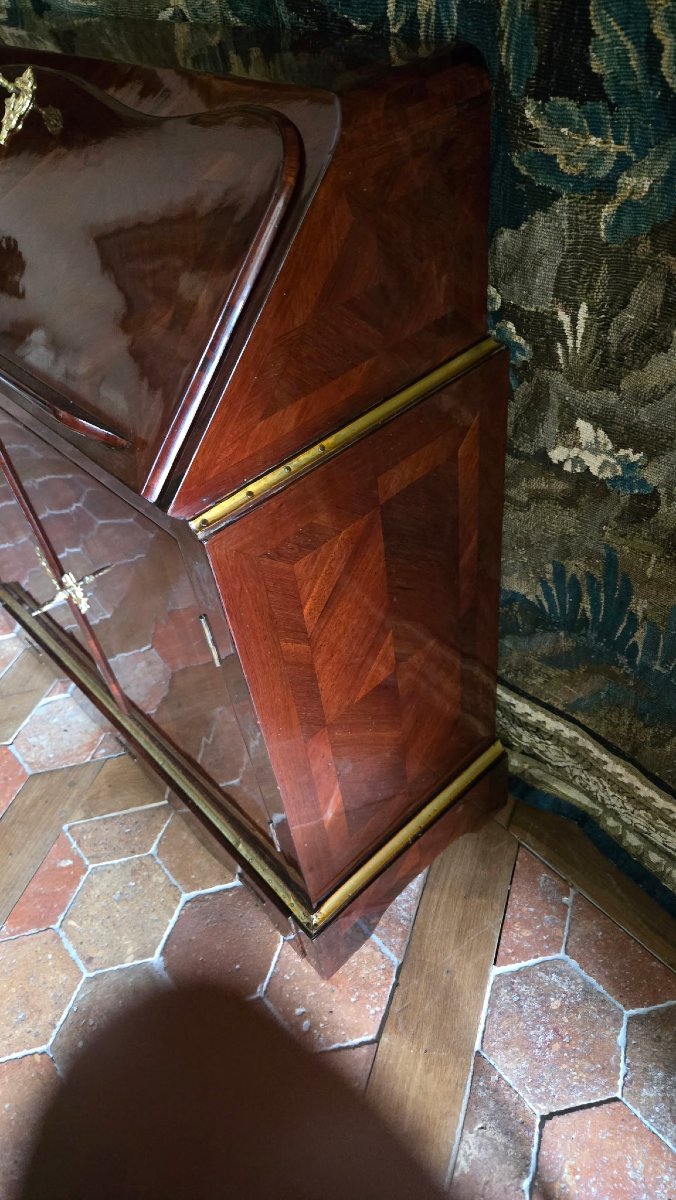
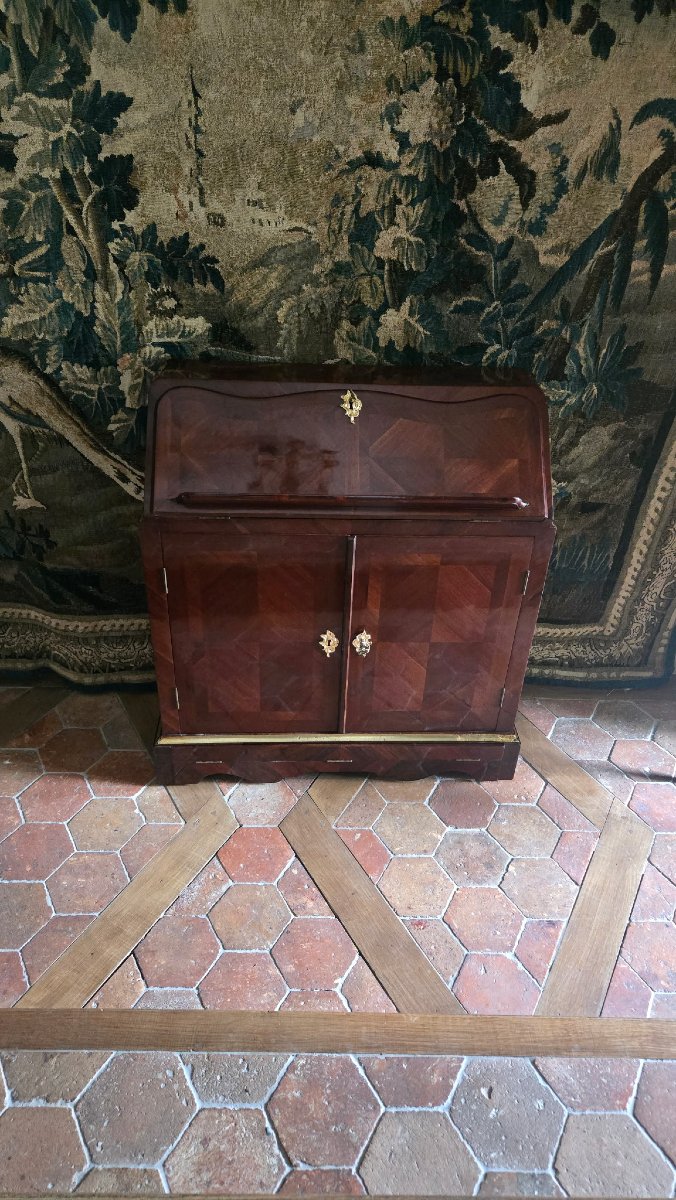
The entire piece is veneered with amaranth in a curly pattern characteristic of Parisian cabinetmaking from the late reign of Louis XIV and the early decades of the 18th century. The panels are composed of amaranth veneer sheets joined together and arranged in different orientations, with the pattern created by the interplay of the grain and the wood’s natural hues. This type of geometric composition bears a particular resemblance to the furniture of Étienne Doirat, a contemporary of Pierre Daneau, and is fully in keeping with the style of Parisian cabinetmakers of that generation.
Brass strips horizontally mark the division between the lower and upper sections. The piece also retains a significant portion of its original hardware.
It bears the “P. DANEAU” mark in several places, stamped on various parts of its structure: on the back, in the lower section of the frame, on the edges of the doors, and on the sliding frame of the kneeler.
This proliferation of marks is particularly interesting. It finds a direct parallel in a pair of chests of drawers from the Daneau workshop, one of which bears seventeen “P. DANEAU” hallmarks and the other fifteen. The repeated presence of the stamp on various components of our piece thus reflects a practice already documented in the production of this workshop.
Pierre Daneau (1673–1735), a Parisian cabinetmaker and marquetry artist, is documented as early as the first years of the 18th century. He belongs to that still relatively small generation of cabinetmakers who marked some of their pieces before the widespread adoption of the stamp in the mid-18th century. Notably, he took Gilles Joubert on as an apprentice between 1702 and 1704; Joubert would later become the king’s cabinetmaker. Documents relating to his workshop also attest to the use of amaranth among the woods employed in his production.
With its design still influenced by the reign of Louis XIV, its amaranth curly grain, the simplicity of its decoration, and the ingenuity of its retractable kneeler, this piece of furniture can be dated to the transition between the end of Louis XIV’s reign and the early years of the Regency, around 1715–1725.
Shallow in depth and with particularly compact proportions, it features an upper section with a stepped top that opens via a hinged flap. The top, lined on the inside with leather to serve as a writing surface, is held open by two metal hinges and reveals an interior featuring a central niche and four small drawers arranged in tiers, two on each side.
The lower section forms a small cabinet that opens with two doors, revealing two shelves.
The lower part of the piece conceals one of its most interesting features. The scalloped baseboard on the front is actually the front crossbar of a sliding frame that serves as a kneeler. When pulled forward, it reveals a large, leather-upholstered cushion designed for kneeling. The mechanism retains its small iron hinges, latches, and spring-loaded side mechanisms. Pressing these mechanisms allows the frame to be completely detached from its slides and the kneeling bench to be removed from the cabinet. The cushion retains its original straps; when closed, the entire unit disappears completely behind the baseboard.
This design thus combines the functions of a sloping desk, a lectern, and a kneeler in a single piece of furniture.
The entire piece is veneered with amaranth in a curly pattern characteristic of Parisian cabinetmaking from the late reign of Louis XIV and the early decades of the 18th century. The panels are composed of amaranth veneer sheets joined together and arranged in different orientations, with the pattern created by the interplay of the grain and the wood’s natural hues. This type of geometric composition bears a particular resemblance to the furniture of Étienne Doirat, a contemporary of Pierre Daneau, and is fully in keeping with the style of Parisian cabinetmakers of that generation.
Brass strips horizontally mark the division between the lower and upper sections. The piece also retains a significant portion of its original hardware.
It bears the “P. DANEAU” mark in several places, stamped on various parts of its structure: on the back, in the lower section of the frame, on the edges of the doors, and on the sliding frame of the kneeler.
This proliferation of marks is particularly interesting. It finds a direct parallel in a pair of chests of drawers from the Daneau workshop, one of which bears seventeen “P. DANEAU” hallmarks and the other fifteen. The repeated presence of the stamp on various components of our piece thus reflects a practice already documented in the production of this workshop.
Pierre Daneau (1673–1735), a Parisian cabinetmaker and marquetry artist, is documented as early as the first years of the 18th century. He belongs to that still relatively small generation of cabinetmakers who marked some of their pieces before the widespread adoption of the stamp in the mid-18th century. Notably, he took Gilles Joubert on as an apprentice between 1702 and 1704; Joubert would later become the king’s cabinetmaker. Documents relating to his workshop also attest to the use of amaranth among the woods employed in his production.
With its design still influenced by the reign of Louis XIV, its amaranth curly grain, the simplicity of its decoration, and the ingenuity of its retractable kneeler, this piece of furniture can be dated to the transition between the end of Louis XIV’s reign and the early years of the Regency, around 1715–1725.
3 800 €
Period: 18th century
Style: Louis 14th, Regency
Condition: Good condition
Material: Wood marquetry
Reference (ID): 1829170
Availability: In stock
Print