

Leclaire House Decorative Project For The 1889 World’s Fair
Decorative Project for the Former Maison Leclaire – Redouly et Cie – Paris Universal Exhibition, 1889
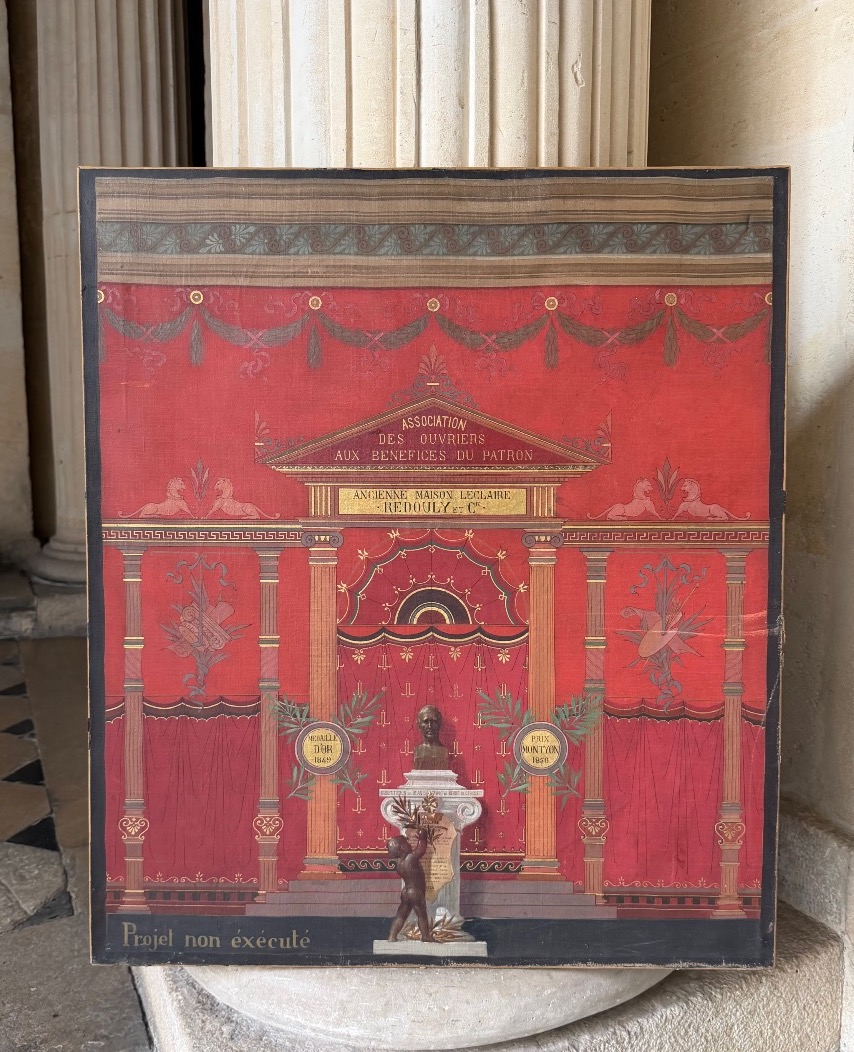
Very good condition. Fine and interesting painted decorative project, created for the former Maison Leclaire, later Redouly et Cie, probably on the occasion of its participation in the Paris Universal Exhibition of 1889.
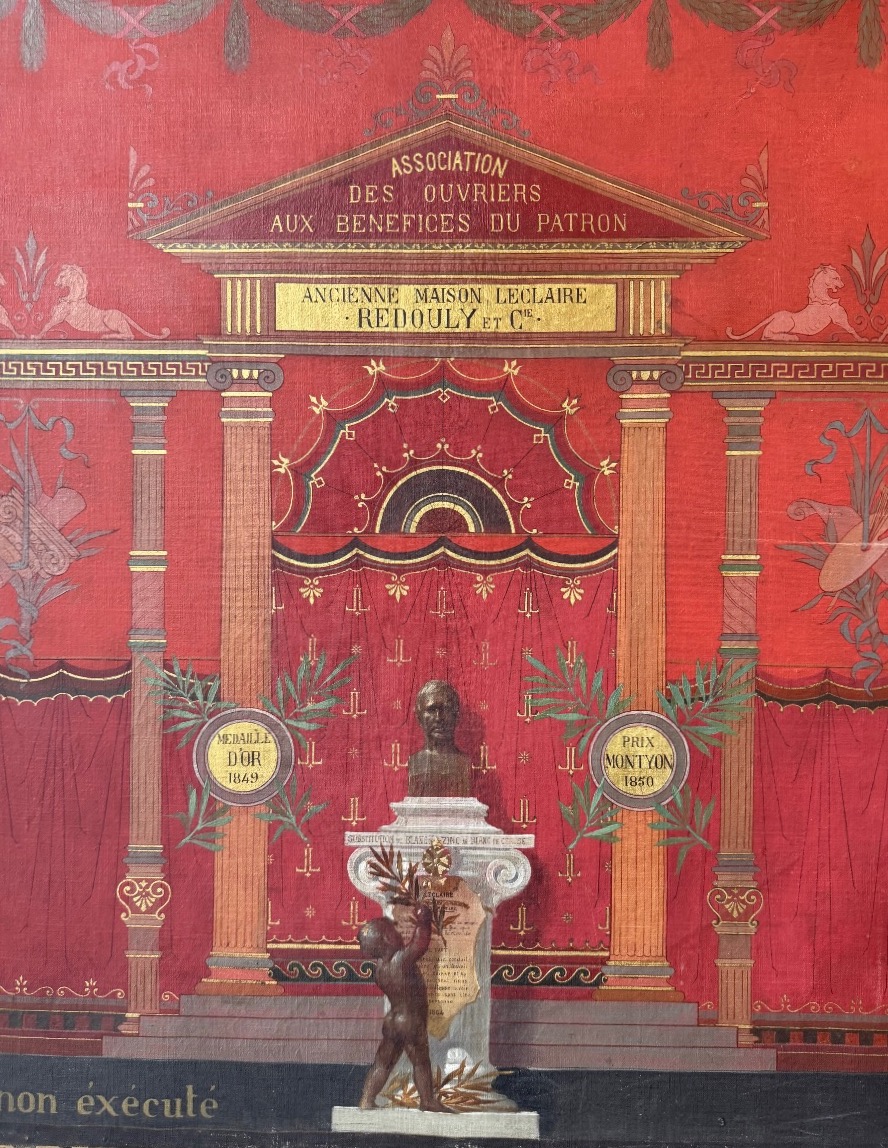
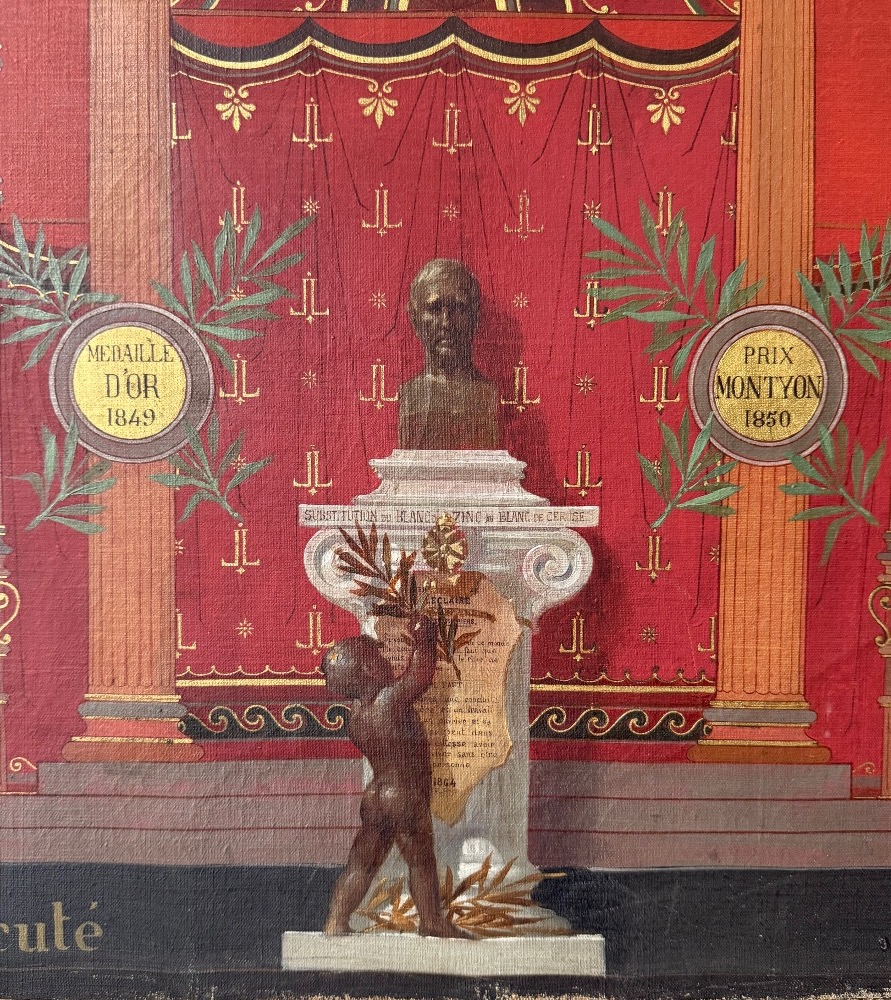
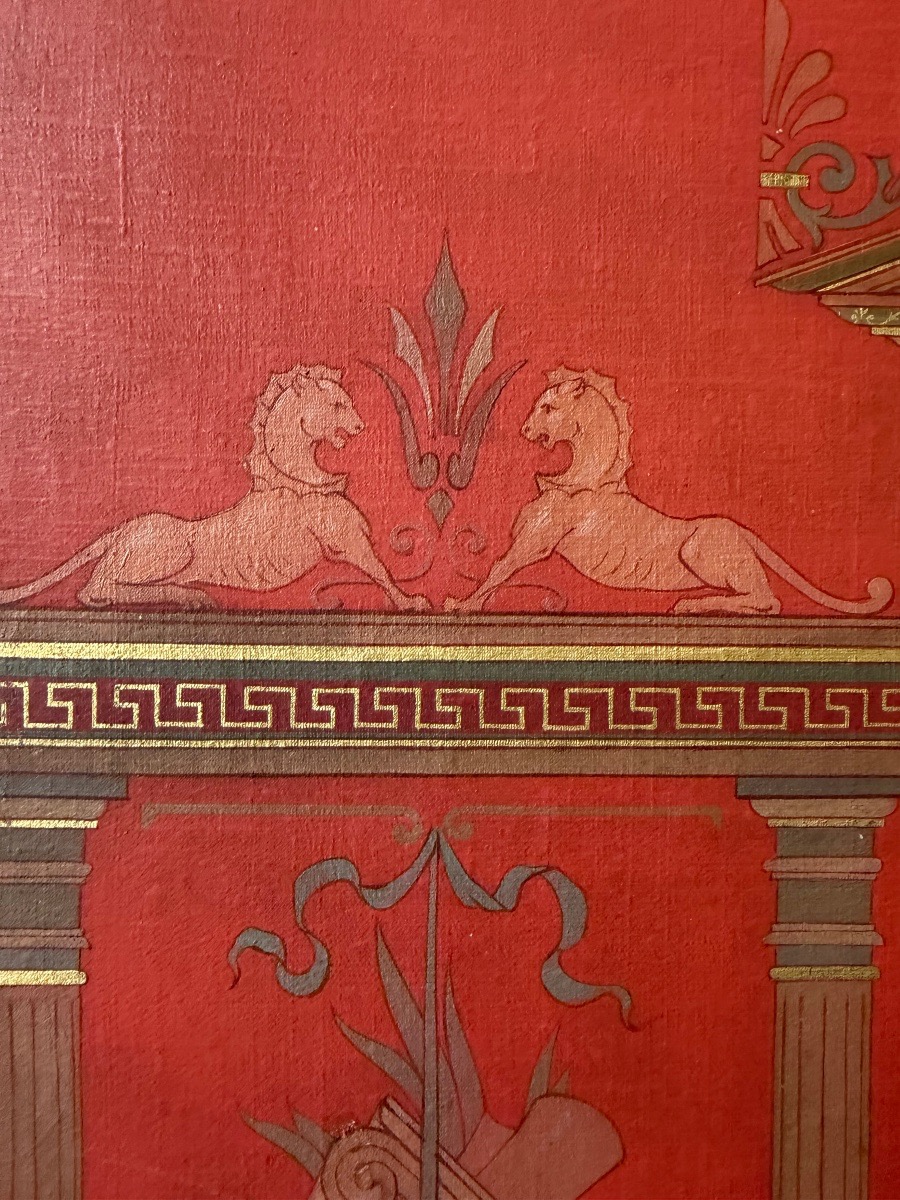
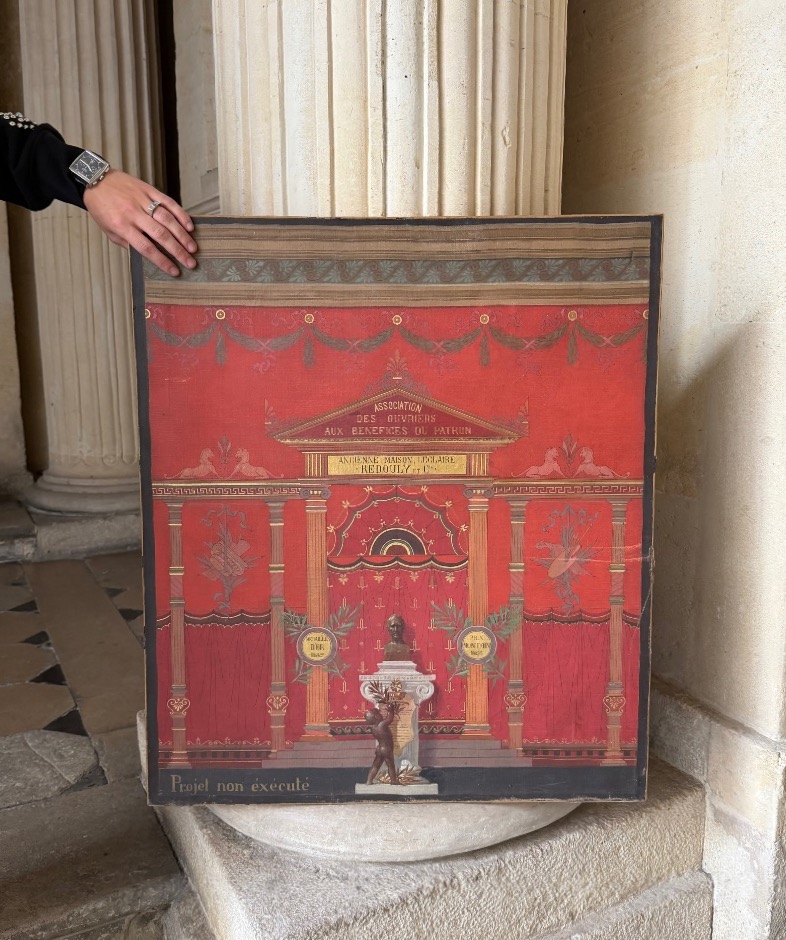
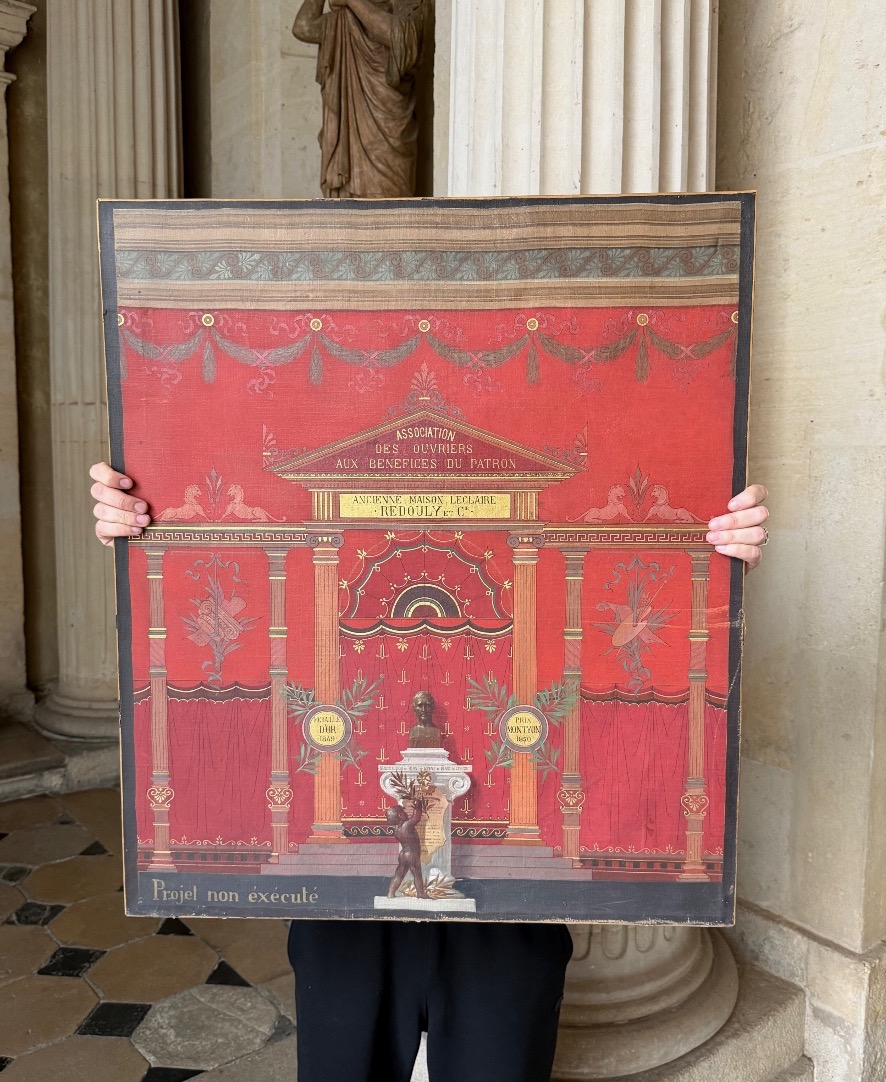
The composition depicts a vast Neoclassical architectural setting conceived as a veritable monument celebrating Maison Leclaire and its founder, Edme-Jean Leclaire (1801–1872). At the top of a columned portico appears the inscription: “ASSOCIATION DES OUVRIERS AUX BÉNÉFICES DU PATRON” (“Association of Workers Sharing in the Employer’s Profits”), and immediately below: “ANCIENNE MAISON LECLAIRE – REDOULY ET Cie” (“Former Maison Leclaire – Redouly et Cie”). Dominated by a deep Pompeian red, the setting is conceived as ephemeral exhibition architecture: columns, draperies, Greek-key friezes, garlands, palms and trophies frame the central section. The side panels display attributes associated with the trades of painting and decoration.
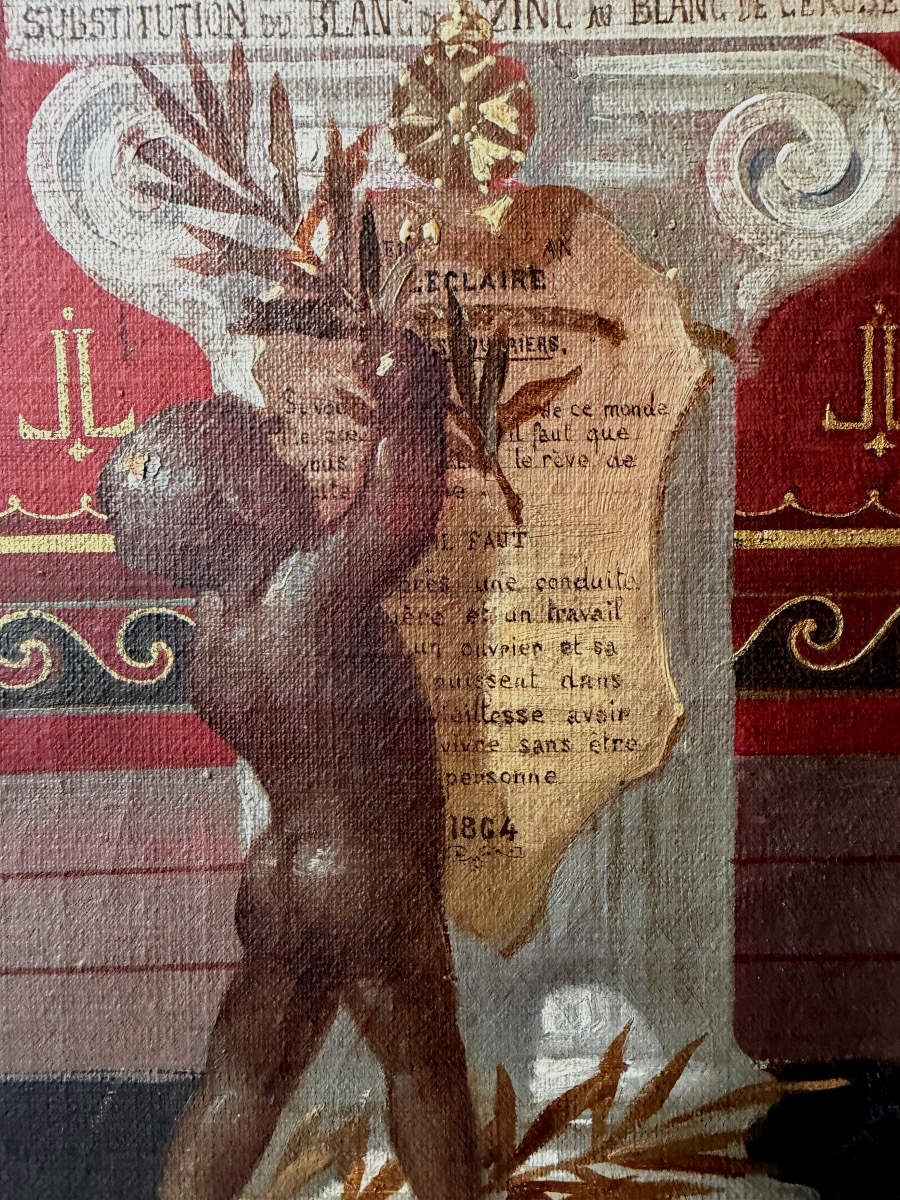
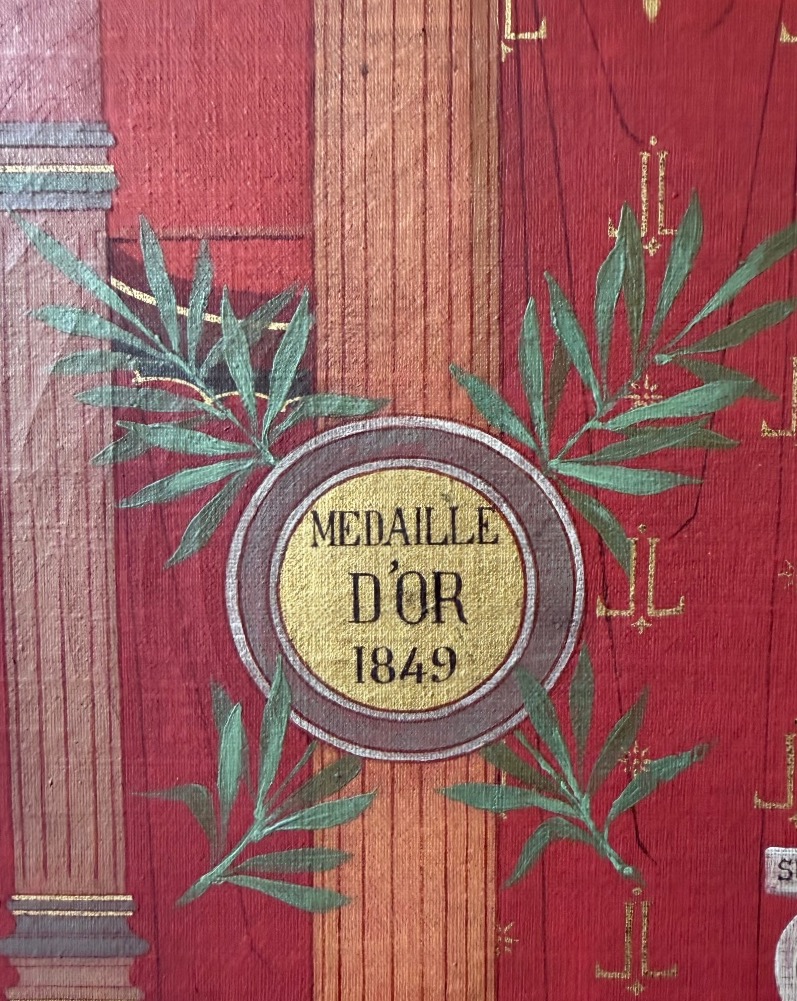
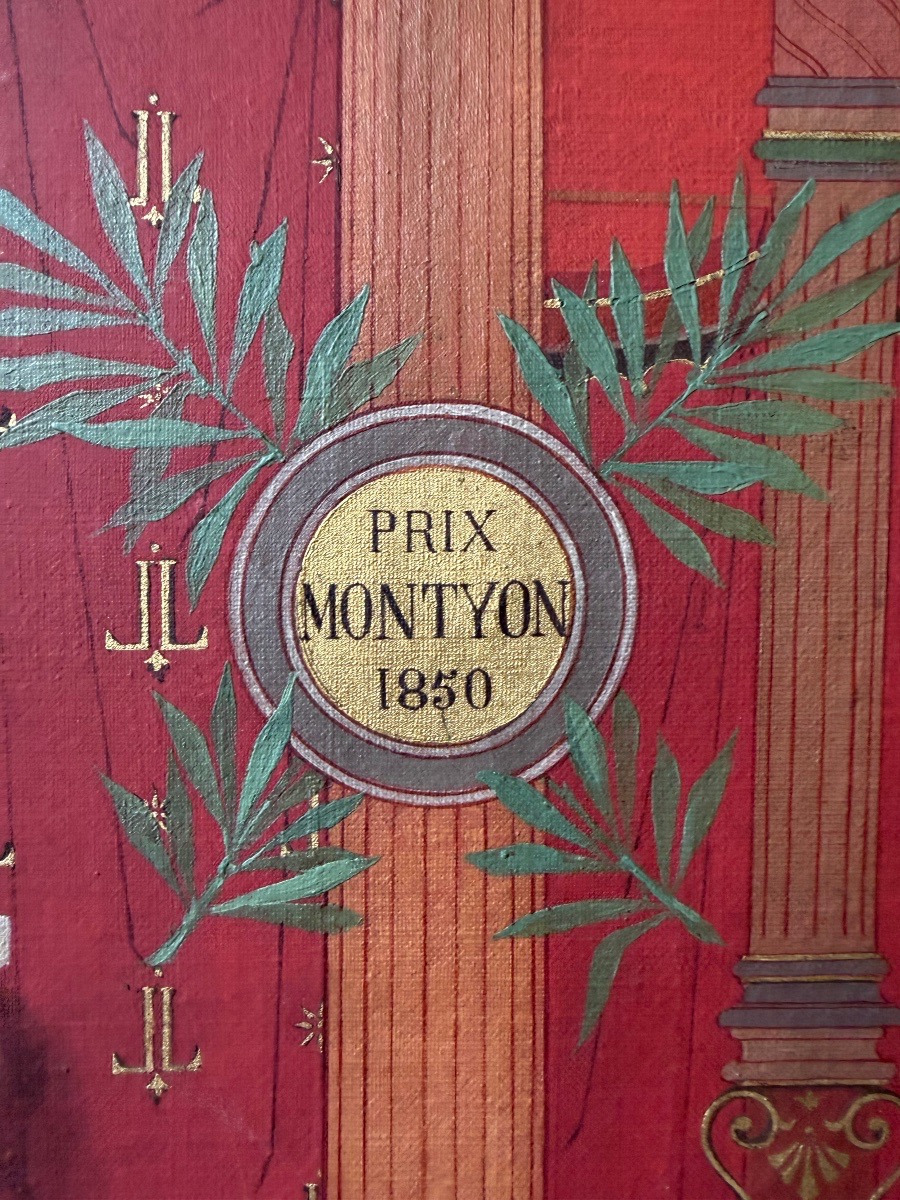
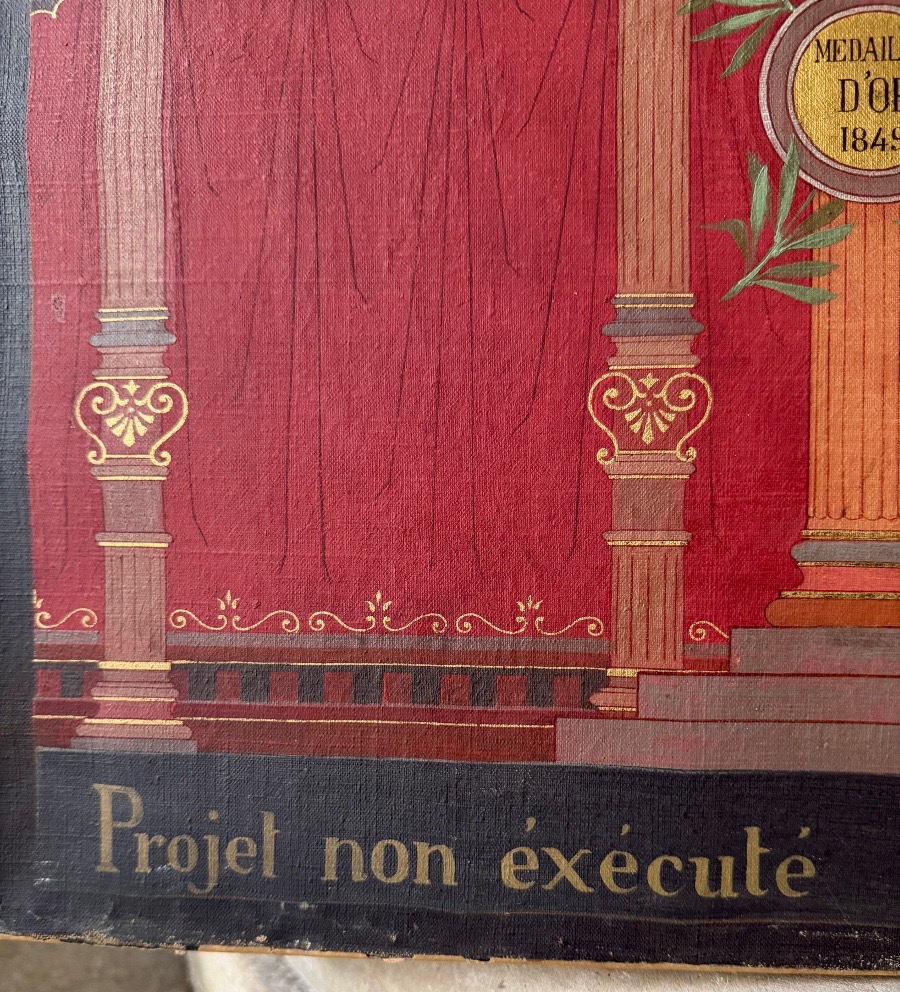
At the centre stands a bust of Jean Leclaire on an imposing commemorative pedestal. In front of it, the figure of a child or genius holds a laurel wreath, reinforcing the allegorical and celebratory character of the painting. Two medallions painted in gold commemorate distinctions awarded to the firm: “Médaille d’or 1849” (“Gold Medal 1849”) and “Prix Montyon 1850” (“Montyon Prize 1850”). The background is patterned throughout with the monogram JL, for Jean Leclaire.
In the lower left-hand corner appears a particularly important inscription: “Projet non exécuté” (“Project not executed”). The painting therefore does not depict a decorative scheme that was actually carried out, but rather a project for a monumental display, probably intended for an exhibition stand or installation. Edme-Jean Leclaire was one of the most interesting figures in nineteenth-century French social and industrial history. Born in the Yonne in 1801 and arriving in Paris at a very young age, he began as an apprentice house painter before establishing his own business in 1826. Documents presented by his successors at the end of the nineteenth century specifically recall the foundation of the firm. He very early developed a particularly innovative social policy, founding a mutual-aid society in 1838 and, from 1842 onwards, introducing a system whereby his workers shared in the profits of the company. The system subsequently developed to the point where the workers’ mutual-aid society itself acquired a stake in the company. The report devoted to the 1889 Universal Exhibition indeed describes Maison Leclaire as having become a “classic” example in the field of profit-sharing.
Leclaire also distinguished himself in the fight against occupational hazards associated with painting. He encouraged the use of zinc white as a substitute for lead-based white lead, which caused lead poisoning among painters. In the late 1840s, together with the Vieille-Montagne company, he contributed to the development of a highly pure zinc white.
After Leclaire, the company retained its distinctive organisation and social identity. Contemporary documentation from the 1889 Exhibition makes it possible to trace precisely the successive changes in the company name: Leclaire from 1826 to 1854; Leclaire & Cie from 1854 to 1869; Leclaire, A. Defournaux & Cie from 1869 to 1872; A. Defournaux & Cie from 1872 to 1875; and Redouly & Cie from 1875 onwards.
In 1889, documents from the International Congress on Profit-Sharing also refer to the firm of Redouly et Marquot, located at 11 rue Saint-Georges in Paris. At that time, the company employed several hundred workers and continued the profit-sharing system established by Leclaire.
This continuity perfectly explains the iconography of the present painting: Leclaire’s successors did not place themselves at the forefront, but instead celebrated Leclaire, his social achievements and the historic awards received by the firm.
The hypothesis that this was a project for the 1889 Exhibition is particularly convincing. The Bibliothèque nationale de France records a brochure printed by Imprimerie Chaix in 1889 for Redouly et Cie, a firm specialising in “painting, gilding, hangings, decoration and glazing”, expressly produced for the 1889 Universal Exhibition – Social Economy – Esplanade des Invalides – Former Maison Leclaire.
Maison Leclaire occupied an important place in the section devoted to profit-sharing. The proceedings of the 1889 congress discuss its organisation at length and indicate that Redouly was then directly continuing the social programme initiated by Leclaire.
The monumentality of the proposed decoration, its demonstrative character, the inscription “Association des ouvriers aux bénéfices du patron”, the references to the firm’s historic awards and, above all, the wording “Ancienne Maison Leclaire – Redouly et Cie” all correspond closely to the context of the Social Economy section of the 1889 Exhibition.
It therefore seems reasonable to present this work as a decorative project probably conceived for the participation of Redouly et Cie, formerly Maison Leclaire, in the Paris Universal Exhibition of 1889, while noting that the painting itself bears the inscription “Projet non exécuté” (“Project not executed”).
Period: 19th century
Style: Napoleon 3rd
Condition: Excellent condition
Material: Oil painting
Length: 83
Width: 72
Reference (ID): 1827288
Availability: In stock