

Alfred Giess (1901–1973) “still Life With Fruit, Flowers, And A Glass Of Wine” – 1939 – Alsace
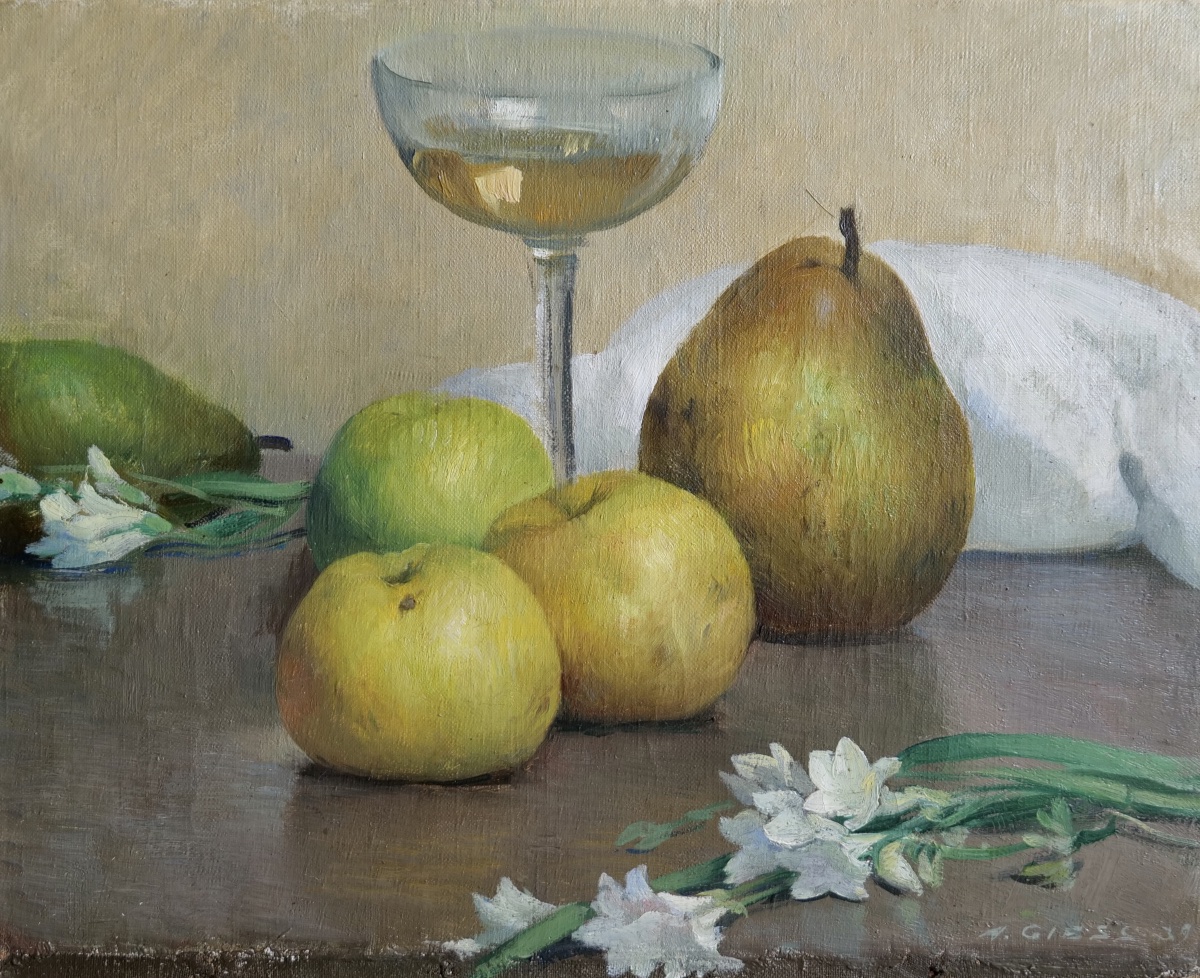
“Still Life with Fruit, Flowers and a Glass of Wine”
Oil on canvas, 33 × 41 cm
Dimensions with frame: 50 × 58 cm
1939
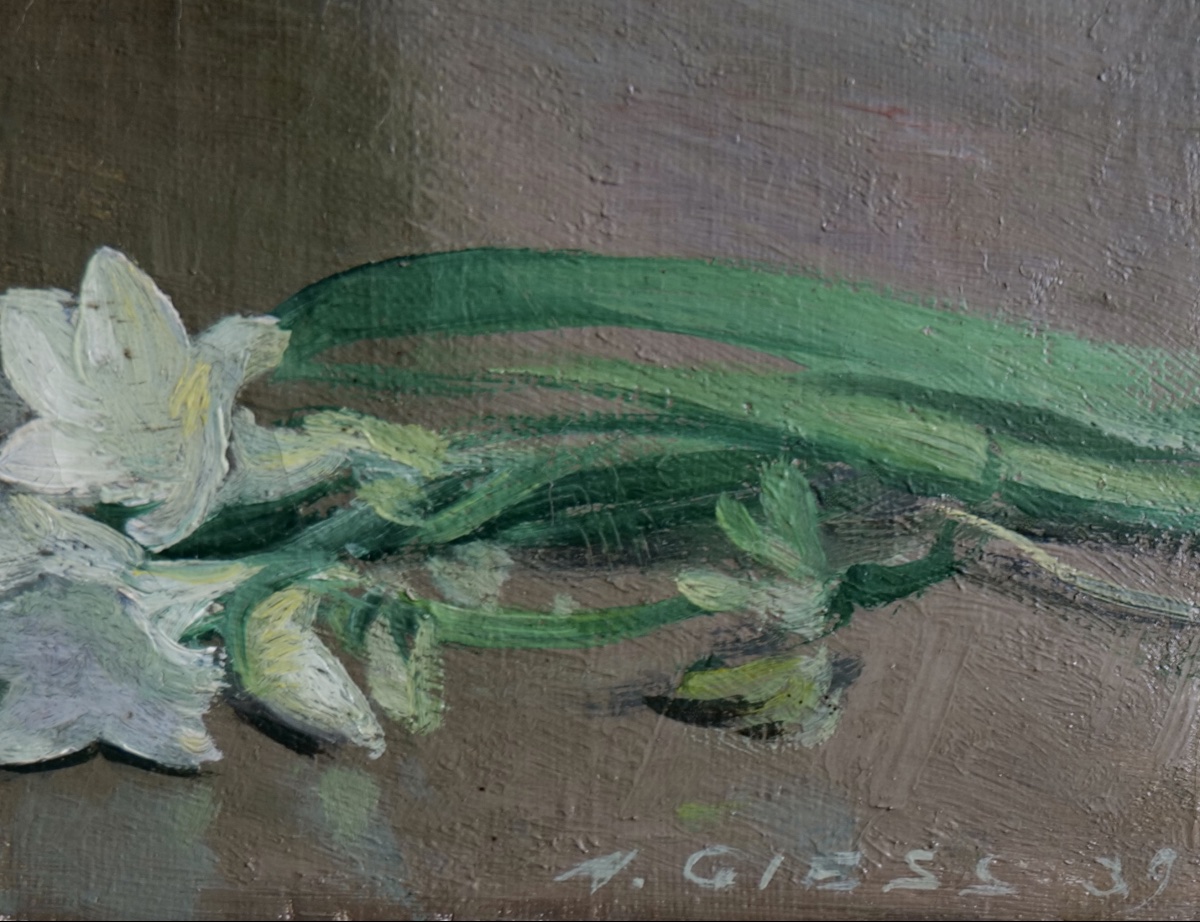
Signed lower right
Dated 1939, this remarkable still life belongs to a particularly accomplished period in Alfred Giess’s career, ten years after he was awarded the Premier Grand Prix de Rome for painting in 1929. This distinction opened the doors of the Villa Medici to him, where he resided from 1930 to 1933, before continuing his artistic training in Spain at the Casa de Velázquez. By the time he painted this canvas, Giess had thus acquired a considerable pictorial culture, nourished both by the French tradition and by his direct encounter with the Italian and Spanish masters.
Still life occupies an important place within his œuvre: Giess found in the genre an ideal field in which to develop the thoughtful, firmly constructed painting and the careful interplay of volumes, textures and light that characterise his art. Compositions of fruit and objects would indeed recur regularly throughout his career. The present canvas offers a particularly appealing example, distinguished by its restraint and the remarkable balance of its arrangement.
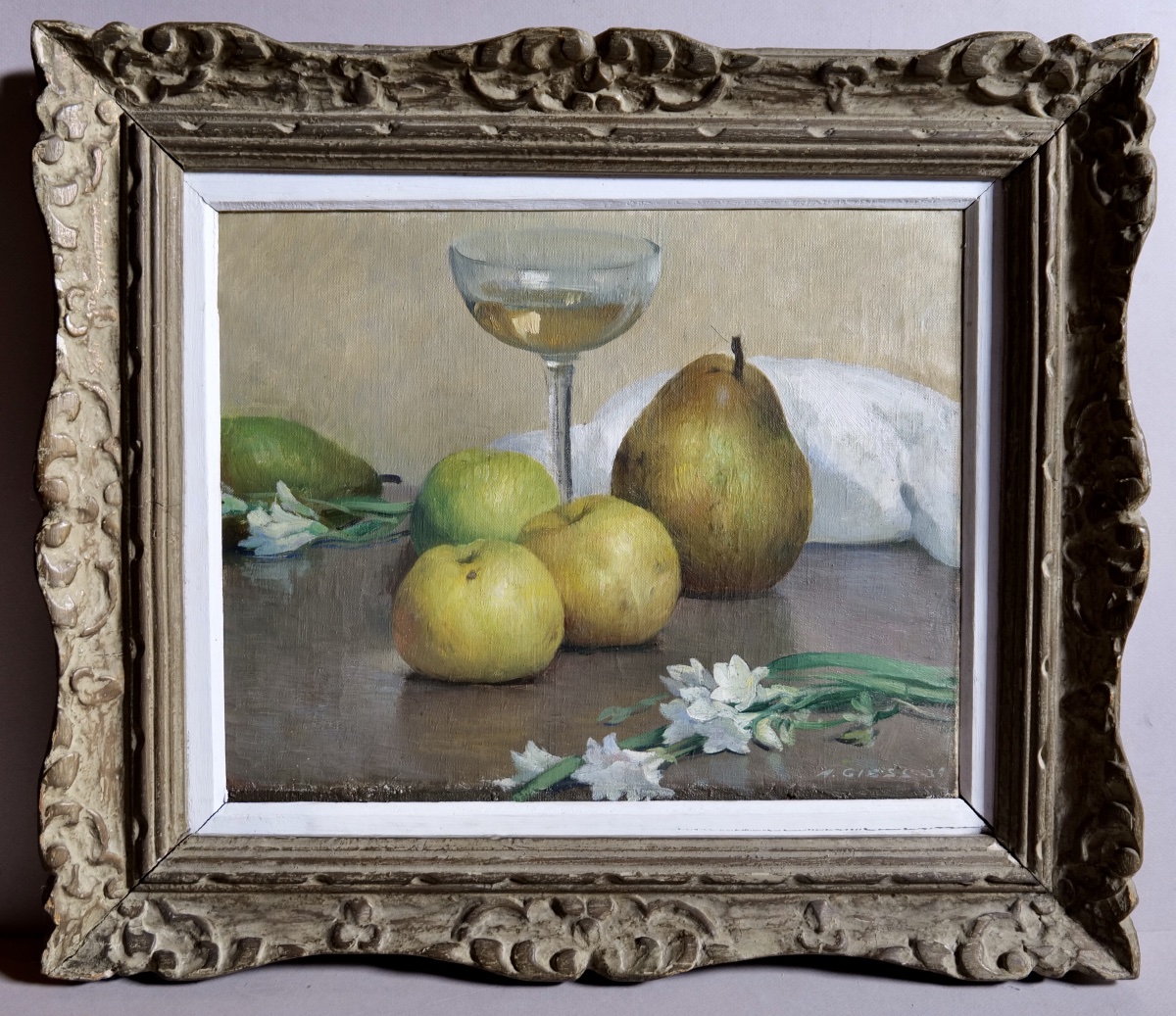
On a bare table, Giess brings together only a handful of elements: apples and pears, a large brown fruit dominating the composition, an elegant stemmed glass containing pale golden wine, a white cloth, and several stems of white flowers arranged across the foreground. No superfluous accessory distracts the eye. The artist works through masses and intervals, making the spaces between the objects as important a component of the composition as the objects themselves.
The construction is remarkably assured. The fruits, grouped in the lower part of the composition, form a compact foundation of spherical and ovoid volumes. Their horizontality is counterbalanced by the slender vertical stem of the glass, while its bowl occupies the upper portion of the canvas. The large pear on the right acts as a pivotal element: its powerful mass balances the glass and lends stability to the whole. The white cloth, casually placed in the background, introduces a luminous breathing space that sets the fruit apart from the ground without ever disturbing the overall harmony.
Yet it is above all in his handling of light and colour that Giess’s subtlety fully reveals itself. The crisp, acidic greens of certain fruits are answered by lemon yellows, ochres and the deeper browns of the large pear. These harmonies are deliberately contained within a muted range of greys, beiges and earthy tones. The wine, an almost golden amber-yellow, consequently becomes a true focal point of light. The painter also excels in differentiating textures: the cool transparency of the glass, the matte density of the fruit skins, the softness of the cloth, and the almost fragile delicacy of the petals.
The foreground deserves particular attention in this respect. The white flowers, laid upon the table rather than arranged in a vase, introduce an oblique line that subtly disrupts the almost architectural stability of the composition. Their long green leaves lead the eye towards the centre of the canvas, while the white touches of the blossoms echo the cloth in the background. This vegetal presence lends an unexpected freshness to the ensemble and prevents any sense of austerity within an otherwise rigorously ordered composition.
There is no pursuit of opulence here. On the contrary, Giess places himself within the great tradition of the quiet still life, in which a few familiar objects are sufficient to create an autonomous pictorial world. The apparent simplicity of the subject conceals an exceptionally sophisticated study of balance. Each fruit seems to have been carefully repositioned until it found its exact place; every interval contributes to the overall rhythm.
It is precisely this restraint that distinguishes Giess’s work from the merely decorative still life. He seeks neither abundance nor spectacular effect: instead, he monumentalises the ordinary. An apple, a pear, a glass and a few flowers become, through the rigour of their arrangement and the quality of their observation, the protagonists of a meditative painting. The modelling remains firm without becoming academic; the handling of paint is tangible yet controlled; the colour luminous without ever becoming strident.
The date of 1939 lends the work particular significance within the artist’s career. Giess was by then a painter at full maturity, enriched by his Grand Prix de Rome, his years in Rome and his Spanish experience. The same decade also saw his growing institutional recognition: from 1937 onwards, he notably served as a member of the Salon jury.
Despite its intimate dimensions of 33 × 41 cm, the canvas concentrates all the qualities of Giess’s painting without ever conveying the impression of a minor work. Quite the contrary: Giess invests these objects with a presence that far exceeds their actual dimensions. In his hands, still life becomes an exercise in pictorial concentration, in which economy of means intensifies the act of looking.
A particularly appreciated subject within Alfred Giess’s œuvre, this Still Life with Fruit, Flowers and a Glass of Wine thus constitutes a particularly fine example of his work from the late 1930s: a mature, restrained and sophisticated painting in which the compositional rigour inherited from his academic training is combined with a profoundly modern sensitivity to colour, light and the silent presence of things.
Period: 20th century
Style: Other Style
Condition: En l'etat
Material: Oil painting
Width: 41cm
Height: 33cm
Reference (ID): 1826213
Availability: In stock