

Marcel Thibault (1898–1944) “souk” — Orientalist — (tunisia ? )
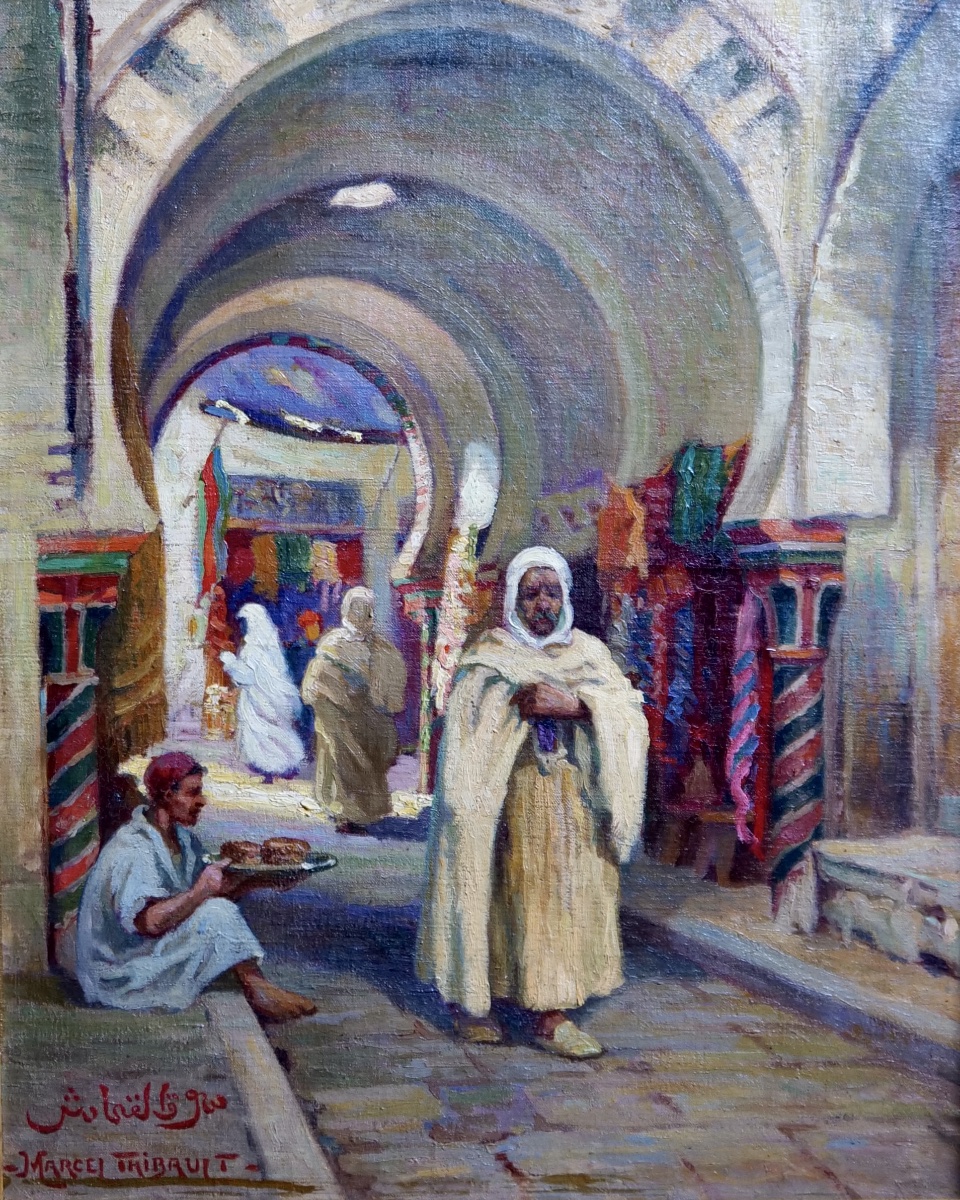
Souk beneath the Arcades, c. 1925–1935
Oil on canvas, 55.5 × 45.5 cm
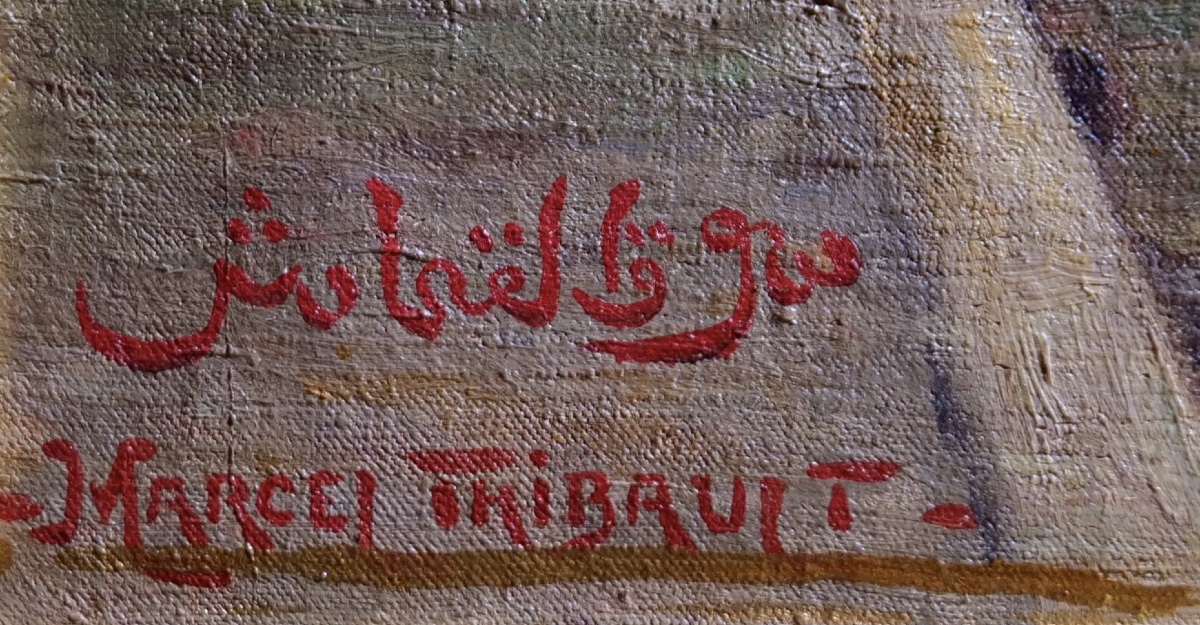
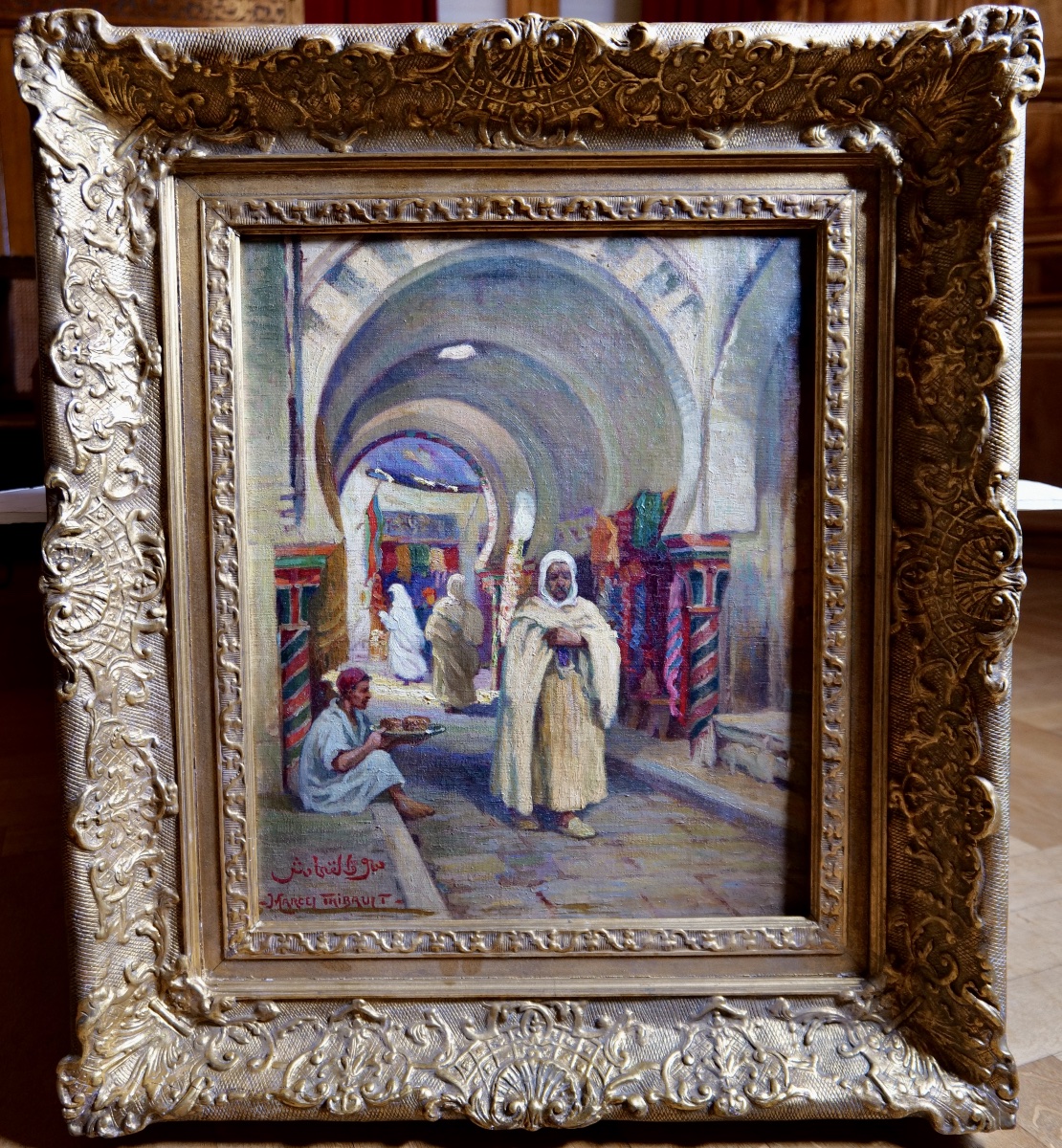
Signed lower left Marcel Thibaut and accompanied by an inscription in Arabic script, most likely a phonetic transliteration of the artist's name.
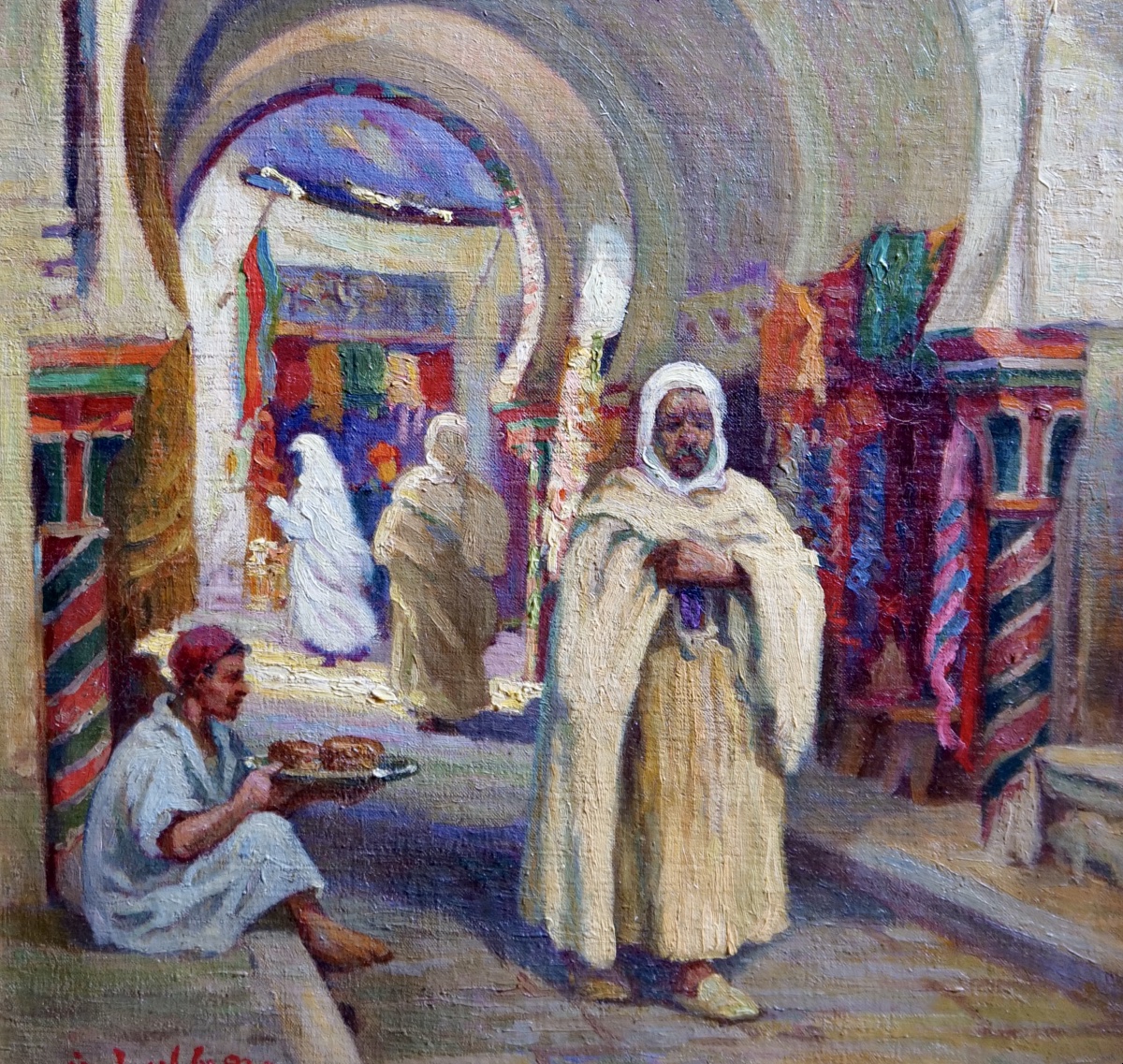
This remarkable oil on canvas by Marcel Thibaut eloquently illustrates the profound fascination that North Africa exerted upon French Orientalist painters during the interwar years. Rather than seeking a theatrical or exotic vision of the East, the artist presents a deeply human interpretation, attentive to the quiet rhythms of everyday life within the medina, where architecture and human presence merge into a harmonious interplay of light.
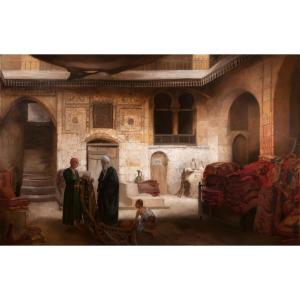
The composition unfolds beneath a majestic succession of rounded arches whose carefully orchestrated perspective naturally draws the viewer's eye into the depths of the souk. Inspired by the medinas of Morocco or Algeria, this architecture serves as far more than a picturesque backdrop: it becomes the structural framework of the painting, organizing the space through an almost musical progression in which each vault establishes an elegant visual cadence.
At the heart of the composition walks a solitary figure draped in a generous ivory-coloured burnous. His dignified, almost hieratic silhouette forms the true axis of the painting. The luminous whiteness of his garment captures the Mediterranean light and contrasts with the richer tones of the surrounding market stalls, immediately commanding the viewer's attention. His measured pace and serene bearing imbue the scene with a timeless, almost contemplative quality.
Around him, life unfolds with characteristic restraint. To the left, a young vendor seated beside the street offers pastries or flatbreads displayed upon a tray, while, in the background, several figures wrapped in white haïks move quietly beneath the arcaded galleries. The activity remains intentionally understated; Marcel Thibaut is less interested in bustling crowds than in the silent poetry of ordinary life.
Here the artist demonstrates an exceptional command of Mediterranean light. It filters gently beneath the arches, delicately modelling the architectural forms while alternating cool passages of shadow with luminous highlights. The palette, dominated by bluish greys, pale ochres, soft off-whites, and enlivened by carefully placed accents of red, green, and turquoise in the hanging textiles, captures with remarkable subtlety the vibrant atmosphere of North African marketplaces. These restrained touches of colour animate the composition without ever disturbing its chromatic harmony.
The handling remains fluid and remarkably assured. The brushwork, visible yet carefully controlled, reflects a sensibility rooted in late Impressionism, enriched by a firm underlying draftsmanship that gives structure to the architectural volumes. The stone vaults, the paved street, and the textiles are rendered with admirable economy, favouring the overall visual impression over minute descriptive detail. The painting thus suggests either direct execution en plein air or a work nourished by vivid memories of travel.
This painting belongs fully within the tradition of early twentieth-century French Orientalism, while distinguishing itself through its remarkable restraint. Whereas many Orientalist painters favoured anecdotal or overtly picturesque scenes, Marcel Thibaut sought a deeper truth—that of light, space, and the quiet dignity of everyday gestures. His Orient is neither theatrical nor imagined; it emerges instead as a living world imbued with serenity, authenticity, and human dignity.
The presence, alongside the French signature, of an inscription painted in Arabic script—almost certainly a phonetic rendering of Marcel Thibaut's name—is an especially noteworthy detail. Relatively uncommon among Orientalist painters, this practice suggests the artist's desire to anchor his work within its local cultural context and may well testify to prolonged stays in the Islamic world, where he appears to have been sufficiently familiar to adapt his signature to his surroundings.
Through the strength of its composition, the subtlety of its light, and the sincerity of its observation, this canvas stands as an outstanding example of Marcel Thibaut's Orientalist production. It reveals an artist equally attentive to formal pictorial values and to the authenticity of the places he encountered, offering a nuanced and profoundly poetic vision of North Africa, far removed from the conventions and stereotypes of late nineteenth-century academic Orientalism. As such, it constitutes a valuable testament to a tradition of travel painting in which close observation, masterful handling of light, and genuine respect for local communities converge in a work of undeniable artistic distinction.
Period: 20th century
Style: Orientalism
Condition: Good condition
Material: Oil painting
Width: 45,5cm
Height: 55,5cm
Reference (ID): 1782730
Availability: In stock