



Empire Period Trumeau - Early 19th Century - Mirror
Artist: Epoque Empire
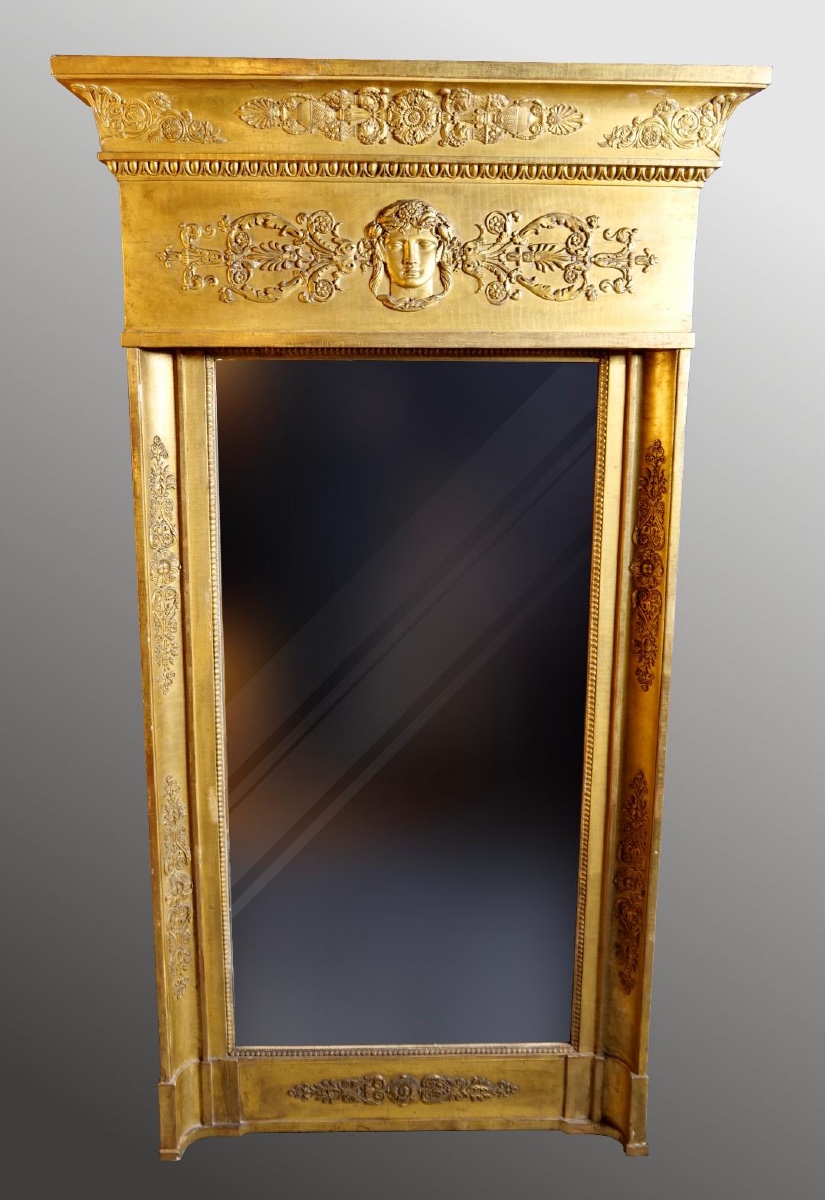
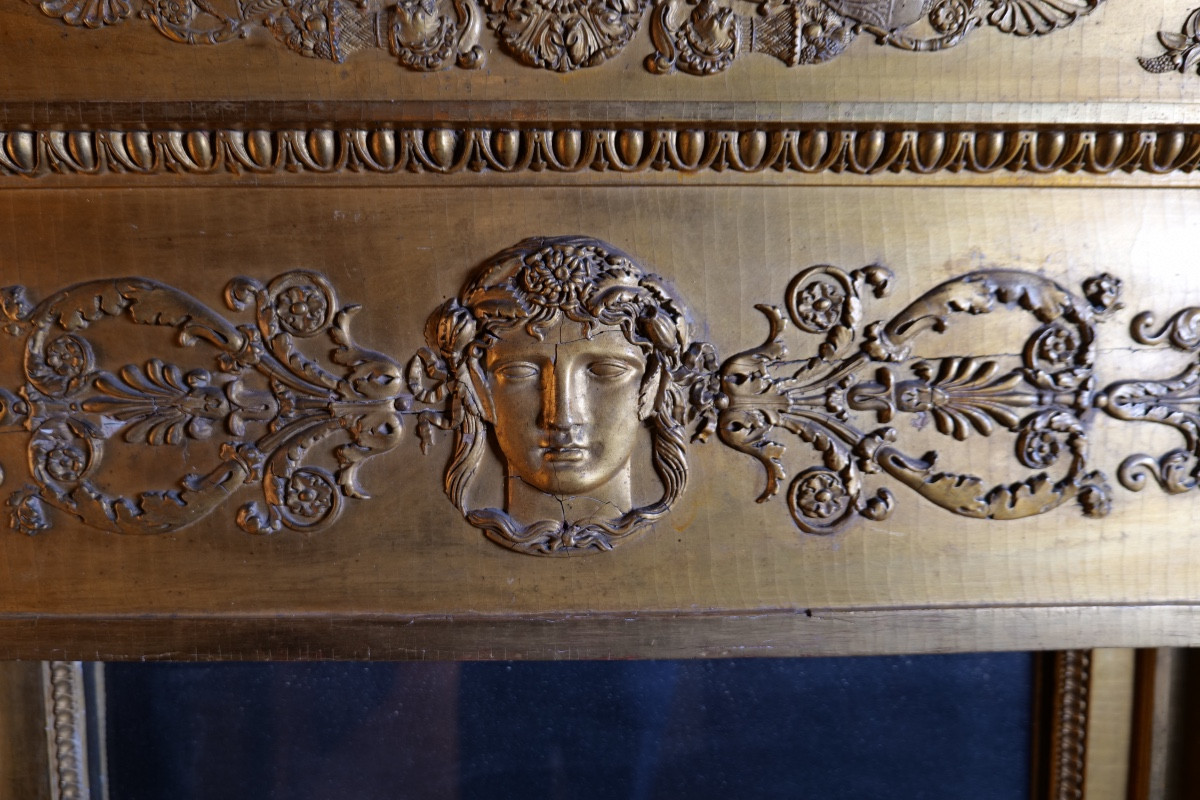
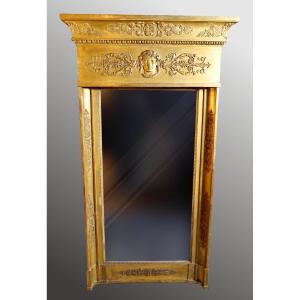
This Empire-era trumeau, retaining its original gilding and mirror, is a remarkable example of the neoclassical ornamental vocabulary that dominated the early decades of the 19th century during the reign of Napoleon I. Through its architectural balance, the rigor of its lines, and the delicacy of its sculpted decoration, it fully illustrates the imperial aesthetic, a direct heir to Antiquity and the decorative arts of the Consulate. The upper section, treated as a wide entablature, is adorned with a bas-relief frieze featuring alternating scrolls, rosettes, and palmettes—emblematic motifs of the Empire style. The side spandrels are embellished with acanthus leaves with deeply carved veins, demonstrating exceptionally fine chasing and gilding. A molding of almond-shaped posts (ovoli), characteristic of official models of the period, elegantly emphasizes the separation between the entablature and the mirror. At the center of the frieze sits an idealized female head, rendered in a decidedly antique style: abundant hair held back by a floral headband, calm and balanced features, and a direct gaze. This figure, often likened to a muse or a classical allegory, embodies the return to Greco-Roman models encouraged by artists of the early 19th century and widely disseminated by the imperial manufactories. The mirror's frame, with its slender proportions, is punctuated by two uprights adorned with stylized vegetal swags, composed of stems, flowers, and palmettes in perfectly controlled symmetry. The base echoes a decorative frieze of stylized flowers and foliage, ensuring visual coherence and overall harmony highly characteristic of the Empire style. The original gilding, patinated by time, retains all its depth and warmth, revealing the subtle nuances of the gold leaf work. It lends the overmantel an aristocratic presence and rare authenticity. The antique mirror, with its slightly altered silvering and subtly darkened reflections, fully contributes to the historical charm of the piece; it is likely a mercury glass, typical of the period. Through its canonical ornamentation, the precision of its proportions, and the exceptional integrity of its original elements, this overmantel stands out as a representative work of Empire decorative arts, combining monumentality, references to Antiquity, and technical perfection. Some wear, cracks, and losses.
2 250 €
Period: 19th century
Style: Consulat, Empire
Condition: En l'etat
Material: Gilted wood
Width: 82,5cm
Height: 150,5cm
Depth: 14cm
Reference (ID): 1652495
Availability: In stock
Print