Henry De Waroquier (1881 - 1970) - Circa 1920
Paris, January 8, 1881 - December 31, 1970, Paris
"Seven Metamorphoses"
mixed media (collage and gouache) , 29x22cm (on view)
Signature lower right
circa 1920
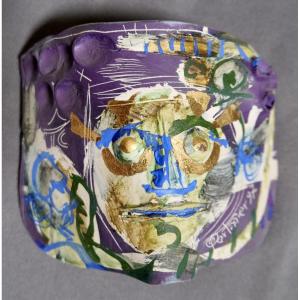
This singular work by Henry de Waroquier, entitled Sept métamorphoses (Seven Metamorphoses), which can be dated to around 1920, is part of the introspective, symbolist vein that runs through his entire production in the aftermath of the First World War. This pivotal period saw an intensification of the artist's inner quest and a monumental simplification of form, nurtured by a discreet dialogue with the avant-gardes without ever fully submitting to them.
The composition, centered on a monumental head occupying almost the entire surface, proceeds from a formal explosion. The face, structured by broad white lines framed in ink, seems fragmented into geometric planes that recall, but do not strictly adhere to, certain contemporary Cubist research. However, Waroquier's decomposition is not analytical but psychic: it evokes a plurality of inner states, a succession of apparitions or "metamorphoses" of being.
The use of collage lends the work a material and polysemic dimension. Fragments of printed paper, with ornamental and floral motifs, are inserted into the compartments of the face, creating a striking contrast between the almost mineral whiteness of the volumes and the chromatic richness of the inlays. Deep blues, nuanced greens, ochres and reds vibrate beneath the surface, as if the face were revealing strata of memory or flashes of inner visions. The pictorial material, worked in gouache and enhanced with ink and pencil, alternates between smooth areas and more nervous passages, accentuating the expressive tension of the whole.
The eyes, dark and intensely fixed, dominate the composition with an almost hypnotic presence. Their immobility contrasts with the surrounding fragmentation. The stylized mouth, lightly hemmed in red, oscillates between archaic mask and expressionist grimace. The whole can evoke at once a primitive idol, a ritual mask or a split mental figure - all resonances that testify to Waroquier's interest in archetypes and the universality of forms.
The title Sept métamorphoses suggests an evolutionary reading: the face would not be a portrait, but the condensation of several successive states of the soul. This plurality echoes the artist's existential preoccupations, for whom art is an exploration of the depths of consciousness. Around 1920, in an artistic climate marked by reconstruction and introspection, this work thus appears as a meditation on the multiplicity of the self and the successive layers that make up human identity.
Thanks to its mixed technique, its chromatic economy dominated by the contrast between black, white and the colorful bursts of collage, and its psychological intensity, this piece powerfully illustrates the singularity of Henry de Waroquier: an independent creator, refusing stylistic orthodoxies, and seeking, through the human figure, an inner truth of universal order.
Additional information(s) : Good condition. Size with frame : 47,5x39cm.
Period: 20th century
Style: Modern Art
Condition: Good condition
Material: Gouache
Width: 22cm
Height: 29cm
Reference (ID): 1747043
Availability: In stock