

Saint Roch Healing A Cardinal Stricken With The Plague Spanish School, C. 1600–1650 Oil On Wood
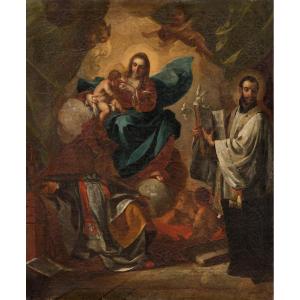
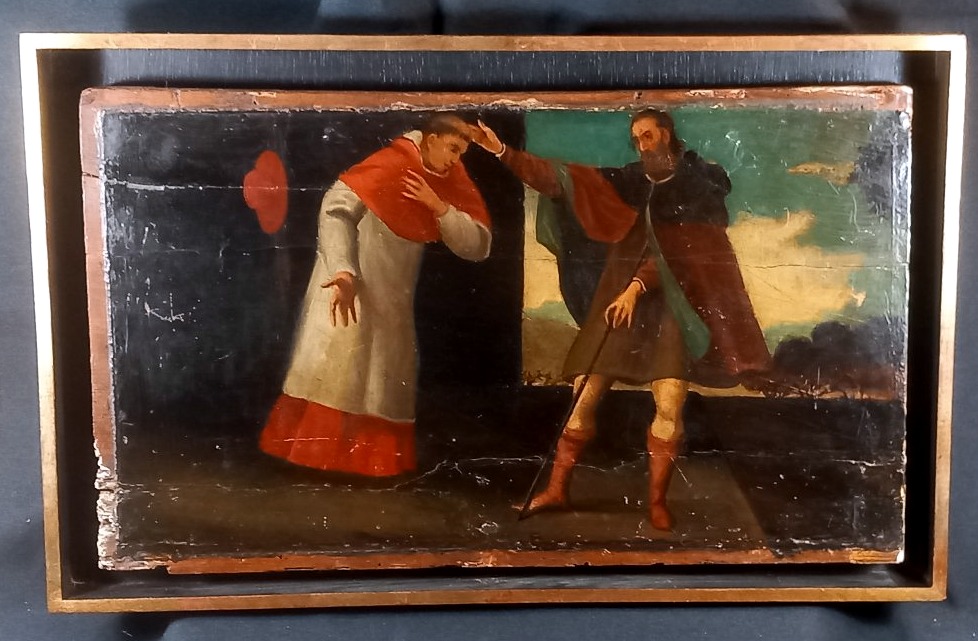
Saint Roch Healing a Cardinal Stricken with the PlagueSpanish School, c. 1600–1650Oil on wood panel.
This painting depicts a particularly powerful episode from the life of Saint Roch, one of the great patron saints invoked for protection against the plague and epidemics.
According to tradition, around 1367–1368, Saint Roch arrived in Rome while the plague was raging. Born in Montpellier and having chosen a life of pilgrimage after distributing his possessions to the poor, Roch devoted his journey to assisting and caring for the sick.
In Rome, he encountered a cardinal stricken with the plague and miraculously cured him by tracing the sign of the cross on his forehead.
Grateful, the cardinal is said to have then introduced him to the pope, who is generally identified in this tradition as Urban V.
The cardinal, dressed in red and white, bows his head while Saint Roch, in his pilgrim’s garb, extends his hand toward the cardinal’s forehead. This gesture forms the true center of the composition: the saint’s hand becomes the instrument of blessing and healing.
In the face of illness, differences in rank seem to fade away: the high-ranking Church dignitary places himself under the protection of the healing pilgrim.The work, associated with the 17th-century Spanish school, takes on special significance in the context of the major epidemics that were then regularly striking Europe and Spain.
Saint Roch is one of the most frequently invoked intercessors against the plague. Such a depiction is therefore not merely an illustration of an ancient miracle: it constitutes a true image of protection and hope intended for a population living under the very real threat of contagion and death.This aspect is all the more powerful given that Saint Roch is said to have contracted the plague himself.
After devoting his life to the sick, he himself became infected with the plague and withdrew to a secluded place so as not to infect others. Tradition has it that a dog then came daily to bring him bread, an episode that has become one of the most famous elements of his iconography.
Roch survived the disease and thus became not only the healer but also the one who had personally experienced the sufferings of those afflicted by the plague.
In this panel, the encounter between the cardinal and Saint Roch thus takes on great symbolic power. The bright red of the prelate’s garments contrasts with the dark, austere silhouette of the pilgrim, while the touch of the hand on the forehead captures the full intensity of the scene.The scene thus transforms the fear of the epidemic into an image of faith, compassion, and hope.
"Caisse Américaine" style frame.
Damage and missing areas; previous restorations.
Panel dimensions: 51.2 x 30.4 cm
This painting depicts a particularly powerful episode from the life of Saint Roch, one of the great patron saints invoked for protection against the plague and epidemics.
According to tradition, around 1367–1368, Saint Roch arrived in Rome while the plague was raging. Born in Montpellier and having chosen a life of pilgrimage after distributing his possessions to the poor, Roch devoted his journey to assisting and caring for the sick.
In Rome, he encountered a cardinal stricken with the plague and miraculously cured him by tracing the sign of the cross on his forehead.
Grateful, the cardinal is said to have then introduced him to the pope, who is generally identified in this tradition as Urban V.
The cardinal, dressed in red and white, bows his head while Saint Roch, in his pilgrim’s garb, extends his hand toward the cardinal’s forehead. This gesture forms the true center of the composition: the saint’s hand becomes the instrument of blessing and healing.
In the face of illness, differences in rank seem to fade away: the high-ranking Church dignitary places himself under the protection of the healing pilgrim.The work, associated with the 17th-century Spanish school, takes on special significance in the context of the major epidemics that were then regularly striking Europe and Spain.
Saint Roch is one of the most frequently invoked intercessors against the plague. Such a depiction is therefore not merely an illustration of an ancient miracle: it constitutes a true image of protection and hope intended for a population living under the very real threat of contagion and death.This aspect is all the more powerful given that Saint Roch is said to have contracted the plague himself.
After devoting his life to the sick, he himself became infected with the plague and withdrew to a secluded place so as not to infect others. Tradition has it that a dog then came daily to bring him bread, an episode that has become one of the most famous elements of his iconography.
Roch survived the disease and thus became not only the healer but also the one who had personally experienced the sufferings of those afflicted by the plague.
In this panel, the encounter between the cardinal and Saint Roch thus takes on great symbolic power. The bright red of the prelate’s garments contrasts with the dark, austere silhouette of the pilgrim, while the touch of the hand on the forehead captures the full intensity of the scene.The scene thus transforms the fear of the epidemic into an image of faith, compassion, and hope.
"Caisse Américaine" style frame.
Damage and missing areas; previous restorations.
Panel dimensions: 51.2 x 30.4 cm
1 400 €
Period: 17th century
Style: Renaissance, Louis 13th
Condition: En l'etat
Material: Oil painting on wood
Reference (ID): 1819266
Availability: In stock
Print