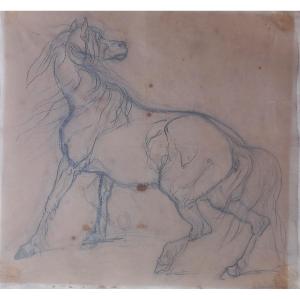


François Hippolyte Lalaisse (1812-1884) Pencil Drawing Rearing Horse
Artist: François Hippolyte Lalaisse (1812-1884)
This drawing is an animal study by Hippolyte Lalaisse (1812-1884), full of movement and character, typical of the influence of 19th-century Romanticism. The sheet depicts a horse in profile, captured in a dynamic pose. The animal appears to be in the act of a sudden halt or the beginning of a rear, with its neck raised and its head turned backward, giving an impression of nervousness and power. The head is fine, suggesting a thoroughbred (Arabian type), with a lively eye and nostrils that appear dilated. The mane and tail are rendered with long, flowing strokes, suggesting the wind or the animal's rapid movement. The drawing is executed in black chalk or blue/gray pencil on tracing paper laid down on a thicker support. The artist used a precise yet fluid outline. Reworkings (pentimenti) are evident, demonstrating that the artist sought to capture the essence of movement rather than a static, finished look. Although stylized, the muscular anatomy of the chest and hindquarters is well-defined, emphasizing the animal's strength. The drawing is fixed to laid paper with four dots of glue in the corners. Note the scattered foxing (brown oxidation spots) on the paper, a common feature for works on paper from this period. Signed "Lalaisse" in the lower right corner. The artist's style strongly resembles the work of artists such as Eugène Delacroix and Théodore Géricault, who revolutionized the representation of the horse in the 19th century, shifting from an academic to a more emotional and primal vision.
250 €
Period: 19th century
Style: Napoleon 3rd
Condition: En l'etat
Material: Paper
Reference (ID): 1697709
Availability: In stock
Print