

Drawing: The Fall Of The Titans - Kremser Schmidt - 18th Century
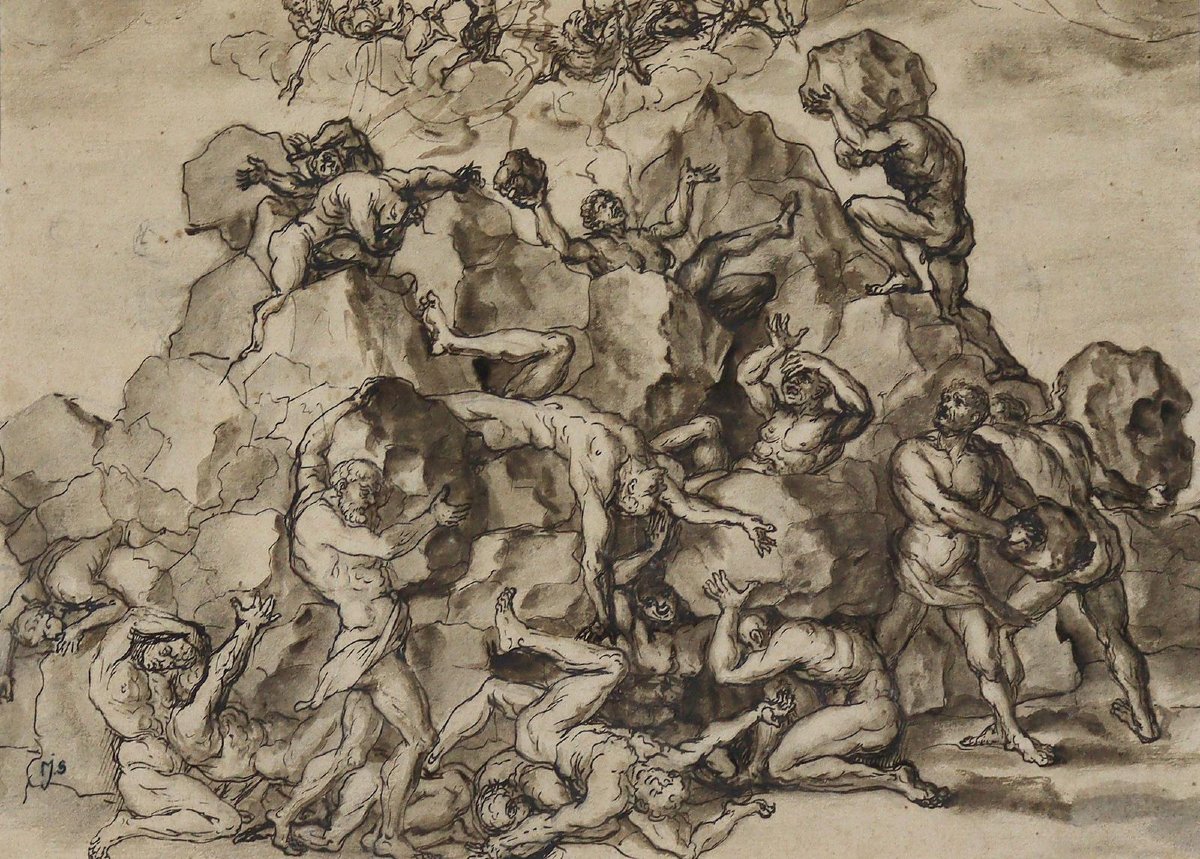
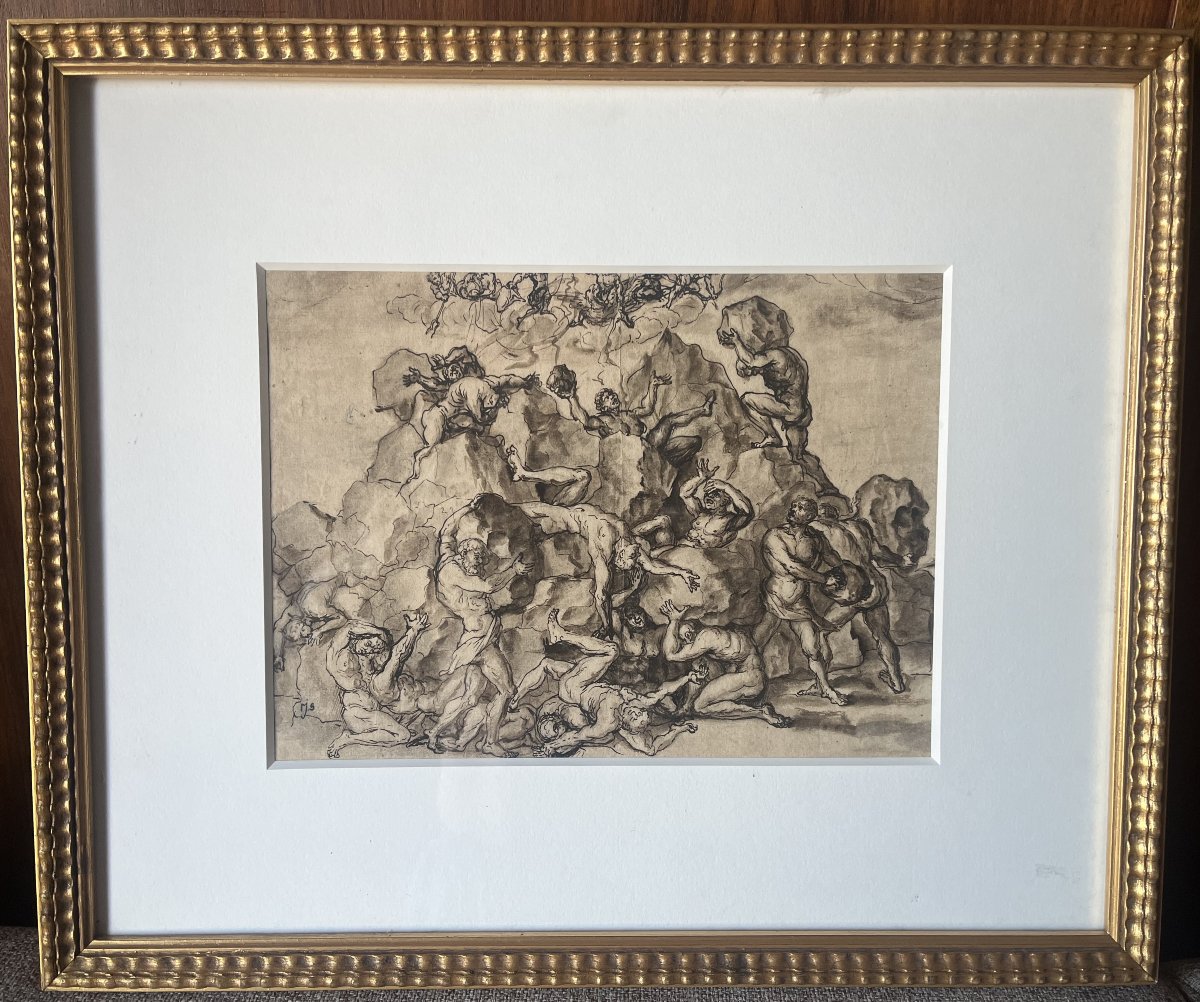
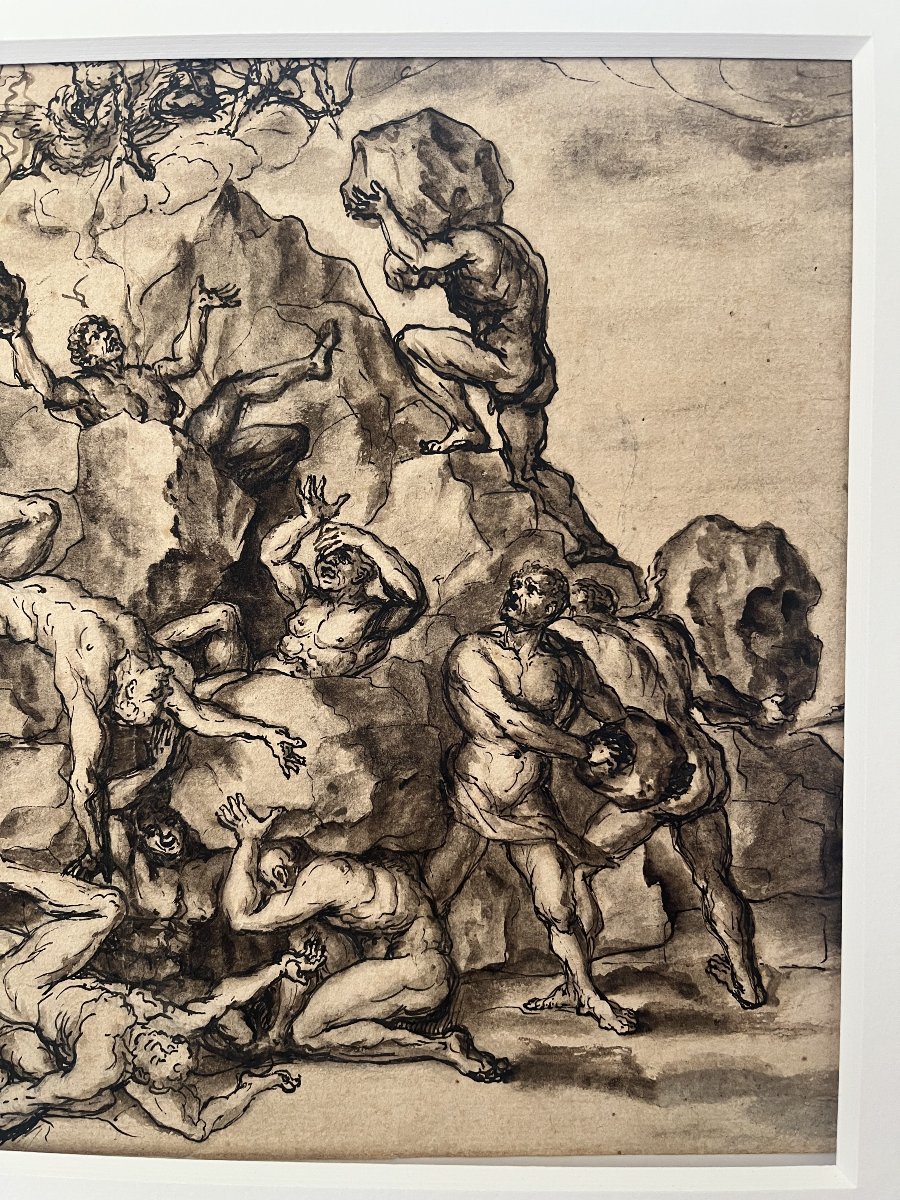
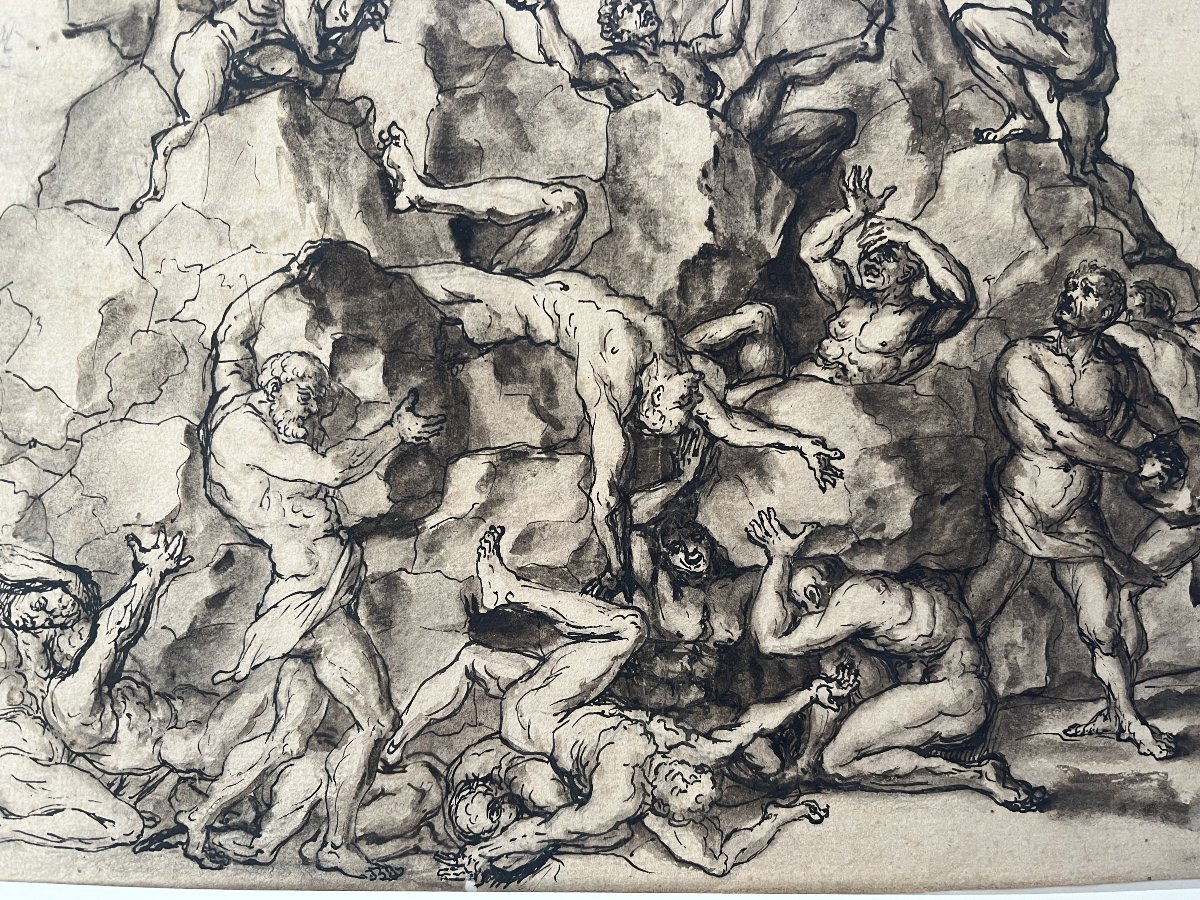
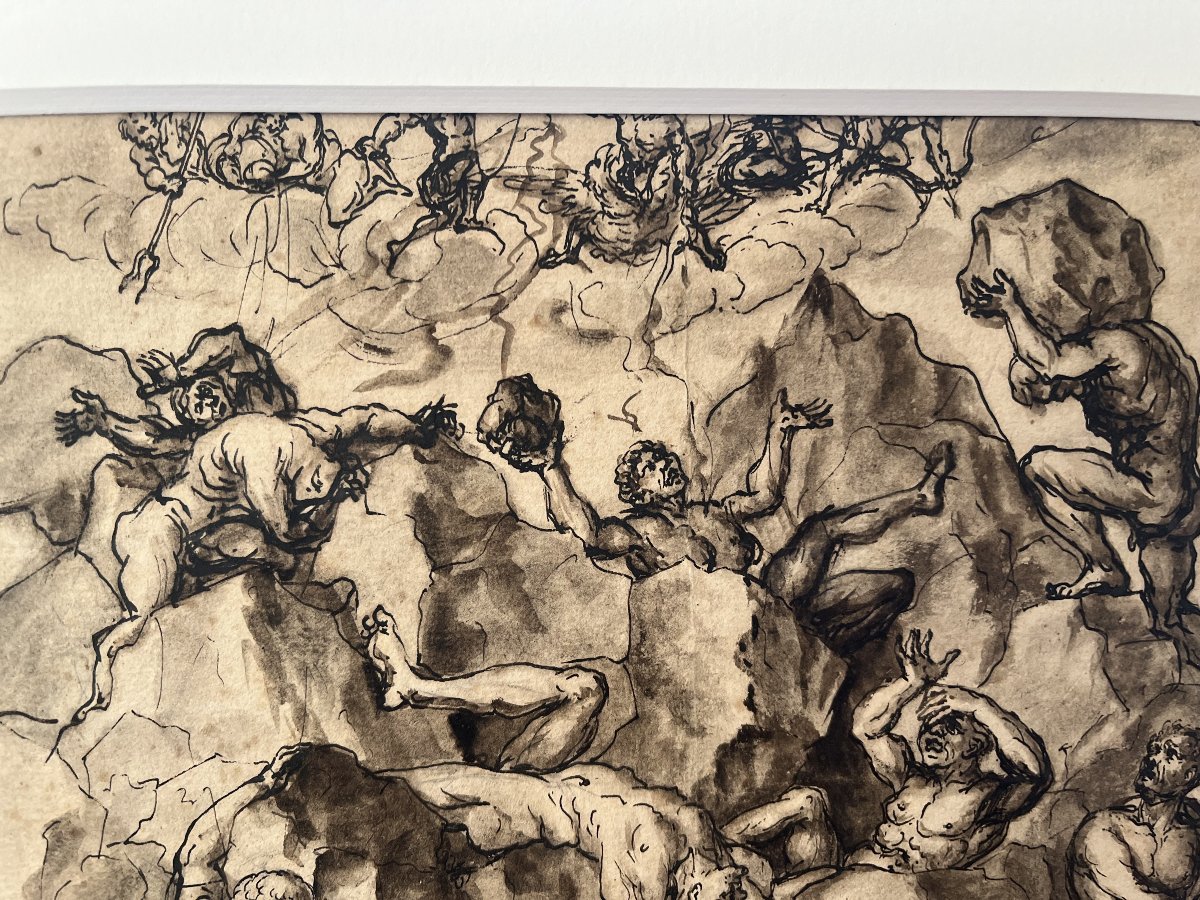
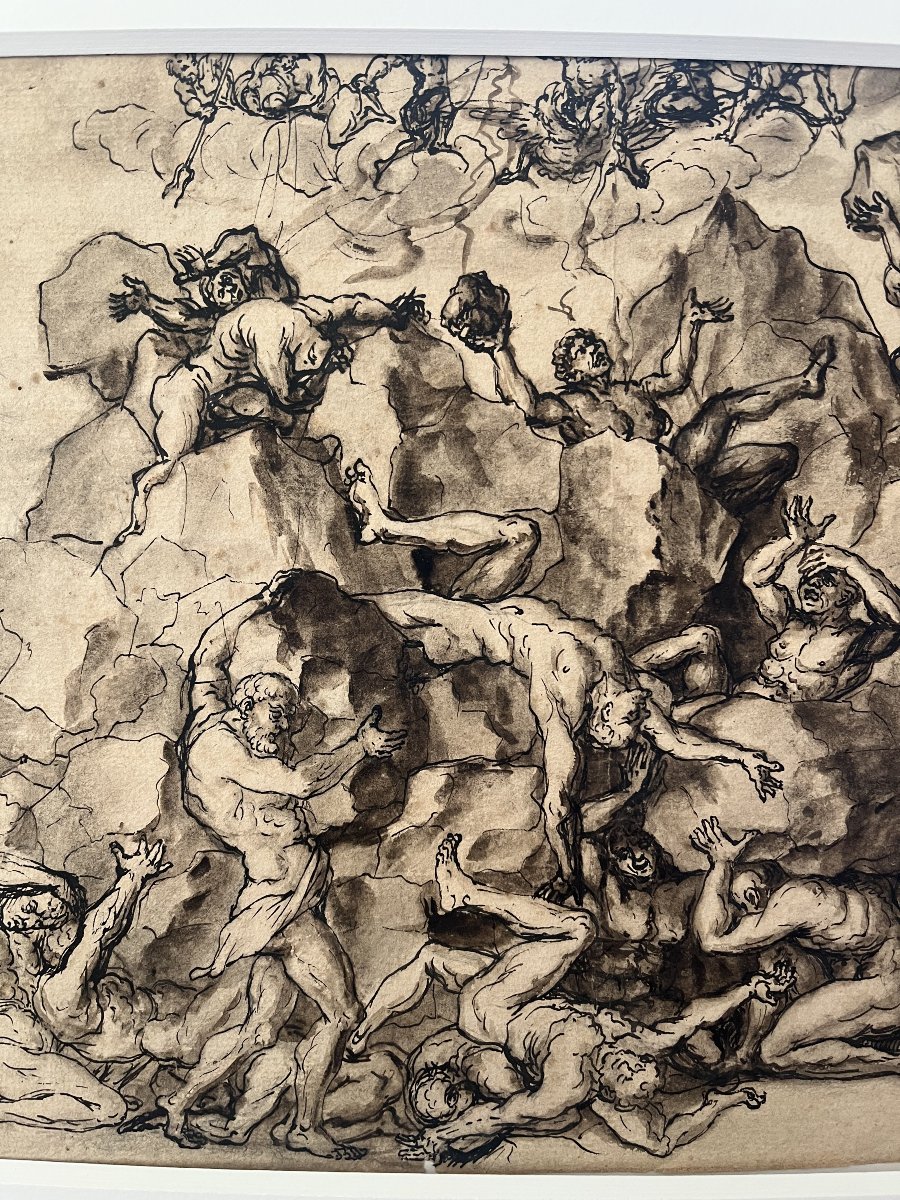
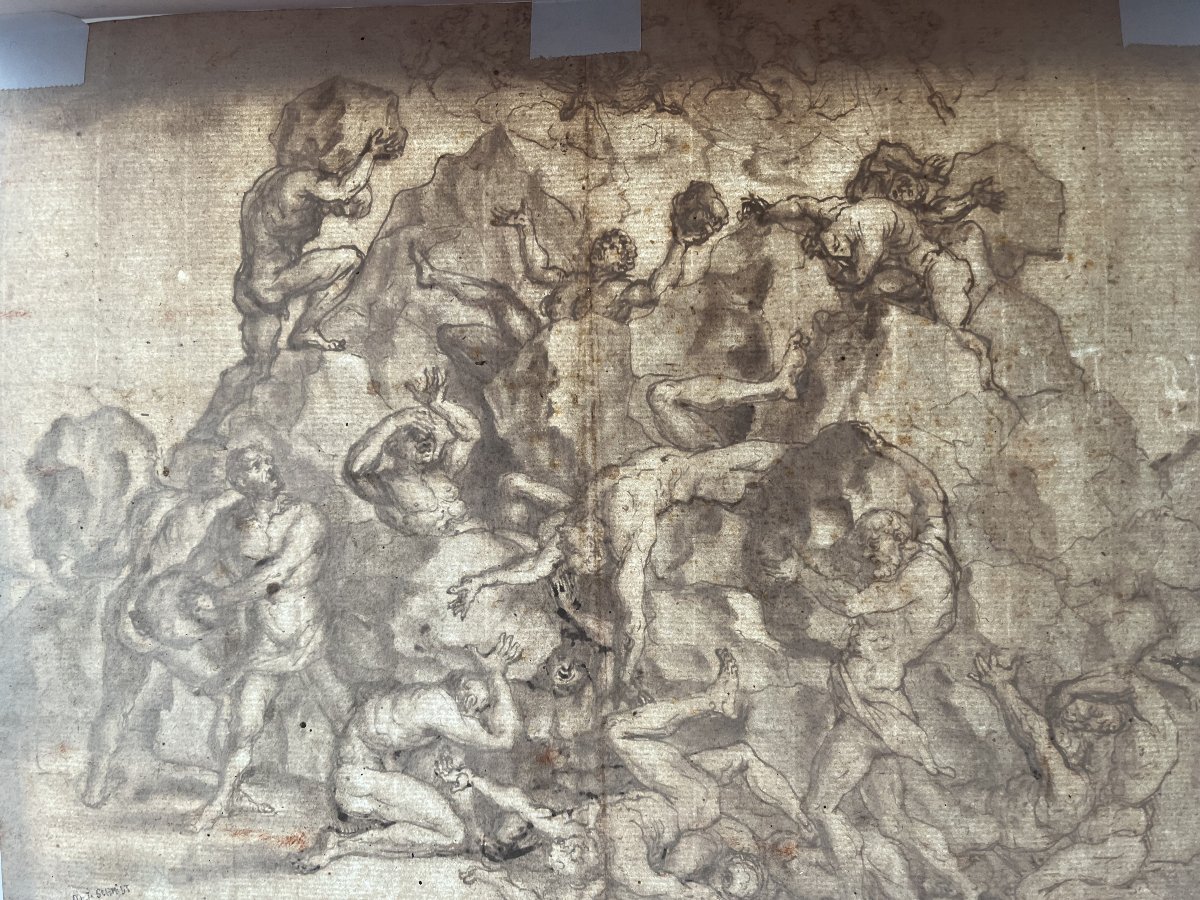
"The Fall of the Titans" – 18th-century drawing
Attributed to Martin Johann Schmidt, known as Kremser Schmidt (Grafenwörth 1718 – Stein an der Donau 1801)
Description
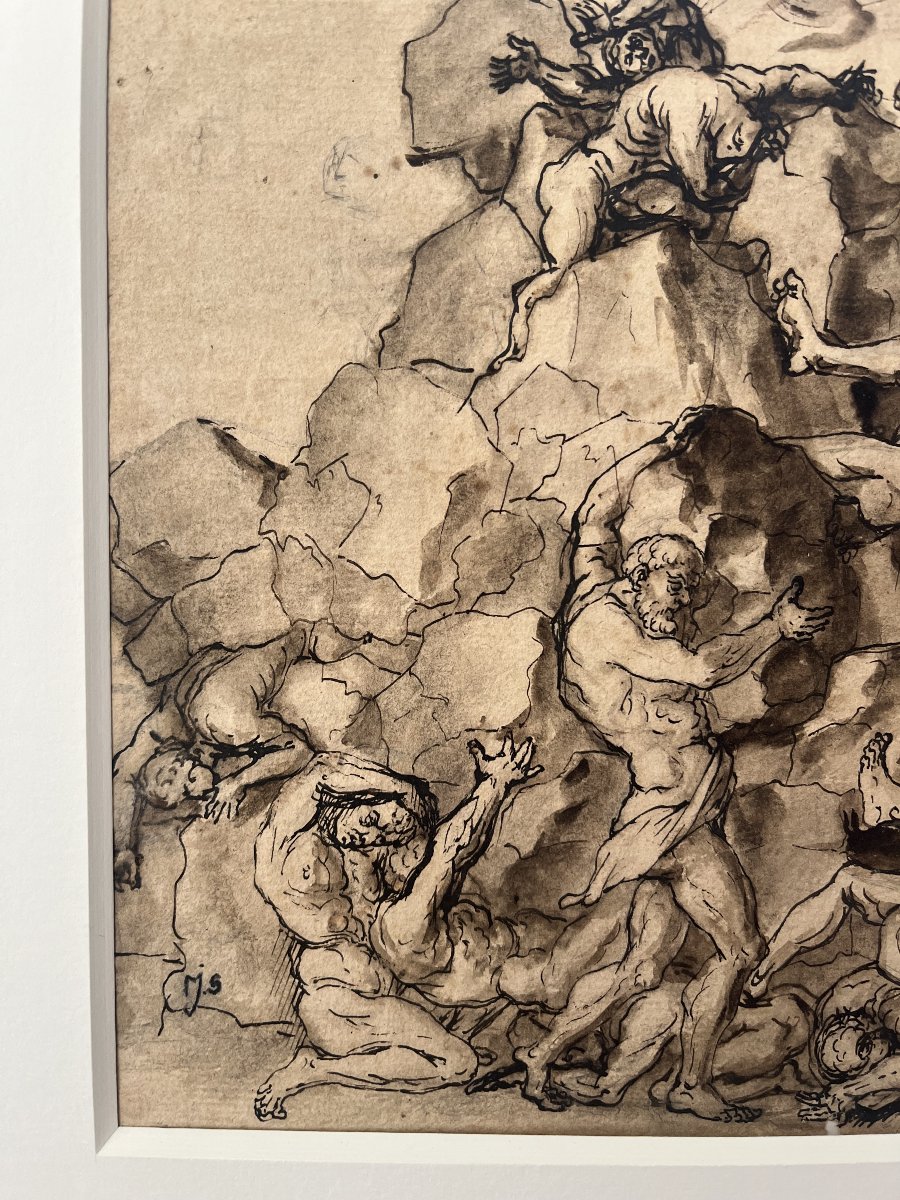
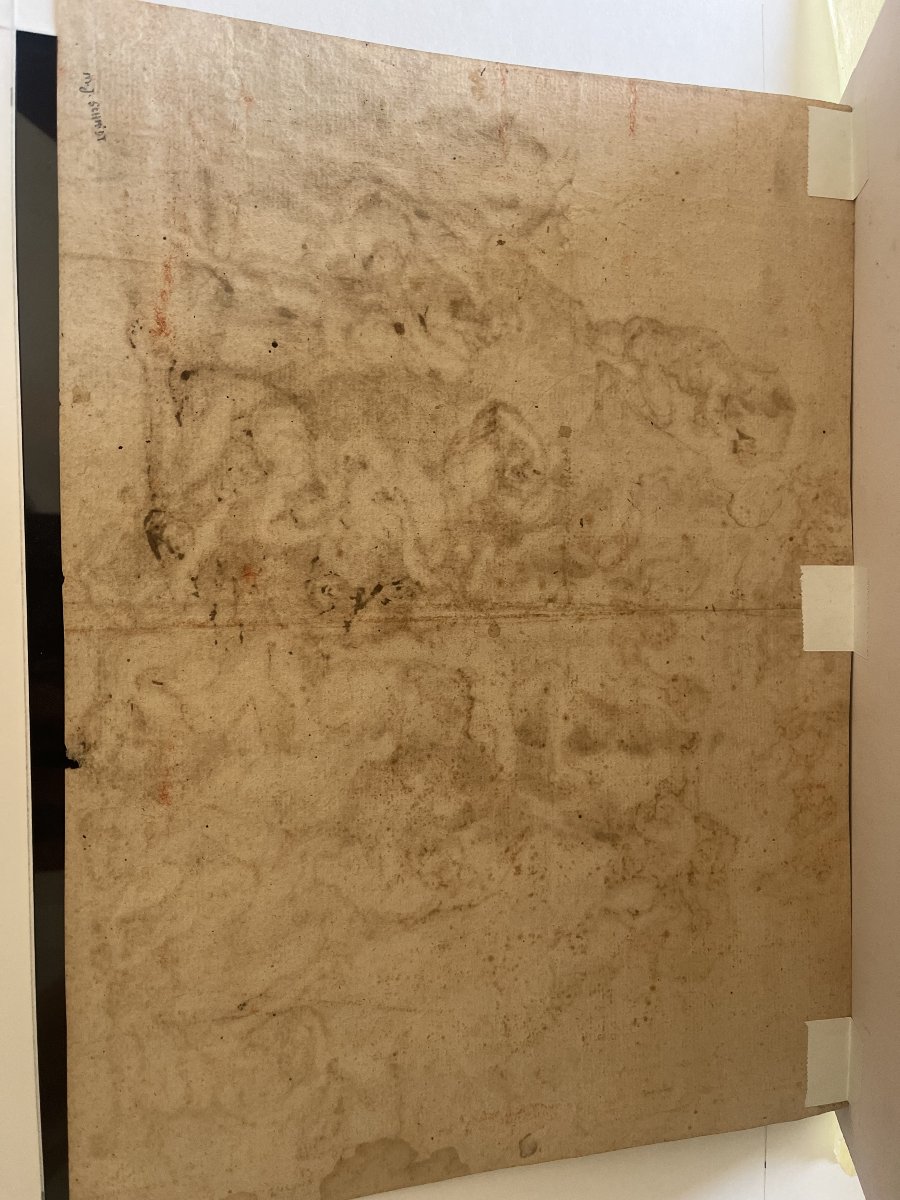
Pen and brown ink, brown brush wash, over a black chalk sketch, on laid paper. 21.5 × 29 cm. Monogrammed in the lower left corner with “MJ” in ligature, followed by “.S.” On the reverse, an old inscription in ink: “M. J. Schmidt.” Framed under glass.
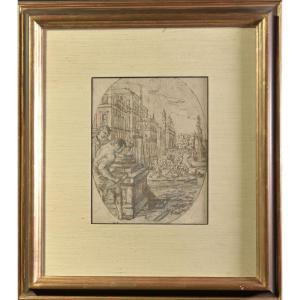
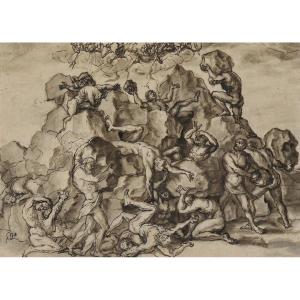
A densely packed horizontal composition, entirely filled with a pile of boulders beneath which some twenty naked giants are crushed. On the right, a standing figure hoists a boulder above his head; in the center, a bearded giant bends under the weight; in the foreground, bodies lie face down, arms outstretched, hands open in a gesture of terror. The wash, applied in broad strokes, builds up the rocky forms and sets the nudes against the background, in an ascending composition of powerful dramatic effect.
Attribution
The attribution is based on two corroborating elements. The monogram on the front, “MJ” in ligature followed by “.S,” corresponds to the artist’s initials. The old inscription on the reverse, “M. J. Schmidt,” reproduces exactly the form in which Martin Johann Schmidt signed his etchings on the plate (“M. J. Schmidt fec.”).
The subject is consistent with the artist’s work: beginning in 1780, mythological themes became common in his work, and he specifically depicted the Gigantomachy in a painting dated 1792 held at the Alte Galerie, Schloss Eggenberg, Universalmuseum Joanneum, Graz (R. Feuchtmüller, Der Kremser Schmidt, Innsbruck-Vienna, 1989, cat. no. 959).
The format and technique are consistent with his documented mythological drawings, notably Jupiter and Semele, pen and wash, 19 × 30.1 cm, Albertina, Vienna, inv. 24698. The sheet’s Germanic provenance supports this conclusion.
It should be noted that an inscription on the reverse could have been made by the artist or by a collector in the past; the work is therefore offered with the designation “attributed to.”
Subject and Comparisons
The Fall of the Titans, or Gigantomachy, depicts the episode from Ovid’s (Metamorphoses, Book I) in which the giants, having piled up mountains to seize Mount Olympus, are struck down by Jupiter and buried beneath the rocks.
The composition follows in the tradition of the Sala dei Giganti painted by Giulio Romano at the Palazzo Te in Mantua (c. 1532–1535), which spread throughout Europe via engravings—notably the print attributed to Cornelis Bos after a drawing by Pieter Coecke van Aelst (Rijksmuseum, RP-T-1951-253)—and taken up by Rubens, as evidenced by the sheet in the Louvre (INV 20177). Our drawing retains the overall composition without reproducing the figures, and is in line with the 18th-century reinterpretations of this repertoire.
Technique and Paper
Handmade laid paper; the paper lines are clearly visible when held up to the light. The outline was drawn in black chalk, then traced with a pen and rendered with wash. Several sections remain in the sketch stage and were not finished in ink—notably a head drawn entirely in black chalk in the upper portion, left uninked—which attests to an original composition rather than a copy. No grid lines. The reverse side retains traces of red chalk.
Condition
Horizontal fold down the center. A few scattered foxing spots and pinholes. Very good overall condition for an 18th-century working drawing.
Provenance
Heidbüchel Gallery, Düren (North Rhine-Westphalia), label on the back.
Period: 18th century
Style: Other Style
Condition: Excellent condition
Material: Paper
Length: 29cm
Height: 21.5cm
Reference (ID): 1817752
Availability: In stock