

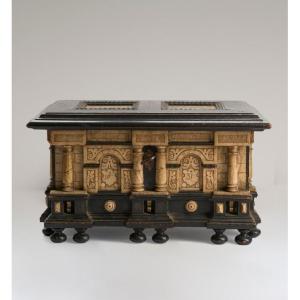


Römhild's Casket, Sometimes Called Maline's Casket - 17th Century
Rectangular Römhild chest (Römhilder Kästchen), Central Germany (Thuringia), first half of the 17th century.
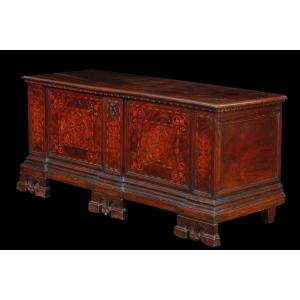
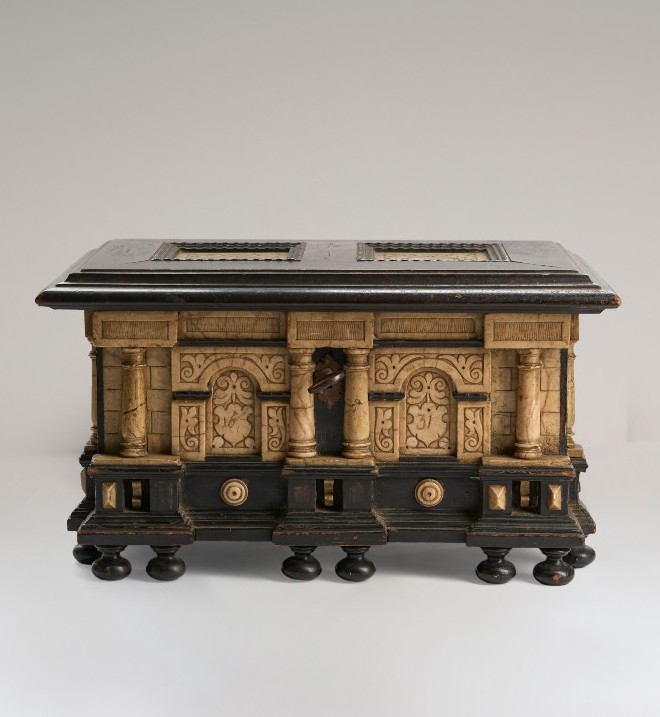
Römhild chests were often formerly attributed to the workshops of Malines or Antwerp. Blackened wood and carved alabaster with architectural decoration, resting on turned feet. The front and sides are decorated with alabaster arches and columns engraved with geometric and plant motifs. The lid, mounted on wrought iron hinges, is lined with polychrome marbled paper; the interior is lined with red velvet. There is an iron lock and key.
Made in 1631 (as indicated on its top), at the height of the production of this type of chest (1600 and 1650), our example has a front whose composition evokes the temples of Greco-Roman Antiquity. The two rounded arches on the facade contain cartouches intended to later receive coats of arms. Members of the nobility and the wealthy bourgeoisie appreciated this type of work for the finesse of its execution and used it to store letters, jewelry, or precious objects.
It should be noted that around fifty of Römhild's chests are known today, present in public museums or private collections.
These chests were long attributed to the workshops of Mechelen or Antwerp because of their architectural decoration in blackened wood and alabaster, very close to the Flemish taste of the 17th century. The similarities in materials, composition, and function have fueled confusion between Flemish productions and those of Thuringia. Research conducted in German public collections has since made it possible to reattribute a coherent set of examples to the Römhild region.
Comparable caskets in public collections
Römhild chests were often formerly attributed to the workshops of Malines or Antwerp. Blackened wood and carved alabaster with architectural decoration, resting on turned feet. The front and sides are decorated with alabaster arches and columns engraved with geometric and plant motifs. The lid, mounted on wrought iron hinges, is lined with polychrome marbled paper; the interior is lined with red velvet. There is an iron lock and key.
Numerous secret drawers are hidden throughout the piece (photos available upon request).
Made in 1631 (as indicated on its top), at the height of the production of this type of chest (1600 and 1650), our example has a front whose composition evokes the temples of Greco-Roman Antiquity. The two rounded arches on the facade contain cartouches intended to later receive coats of arms. Members of the nobility and the wealthy bourgeoisie appreciated this type of work for the finesse of its execution and used it to store letters, jewelry, or precious objects.
It should be noted that around fifty of Römhild's chests are known today, present in public museums or private collections.
These chests were long attributed to the workshops of Mechelen or Antwerp because of their architectural decoration in blackened wood and alabaster, very close to the Flemish taste of the 17th century. The similarities in materials, composition, and function have fueled confusion between Flemish productions and those of Thuringia. Research conducted in German public collections has since made it possible to reattribute a coherent set of examples to the Römhild region.
Comparable caskets in public collections
- Museum Schloss Glücksburg - Römhild (Thuringia)
- Museum Herborn Germanisches Nationalmuseum
- Nuremberg Kunstgewerbemuseum
- Berlin Victoria
- Albert Museum, London – casket formerly attributed to Mechelen, now linked to the Römhild group
Condition: the box has undergone a complete restoration by a specialized cabinetmaker and is in impeccable condition.
5 700 €
Period: 17th century
Style: Renaissance, Louis 13th
Condition: Good condition
Material: Wood marquetry
Length: 35
Width: 23
Height: 20
Reference (ID): 1640989
Availability: In stock
Print