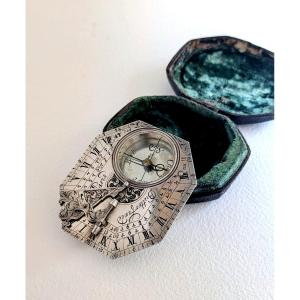


A Silver Sundial (pignerol) By Butterfield, Paris, 1687–1691
Artist: Butterfield
- Portable sundial in its case
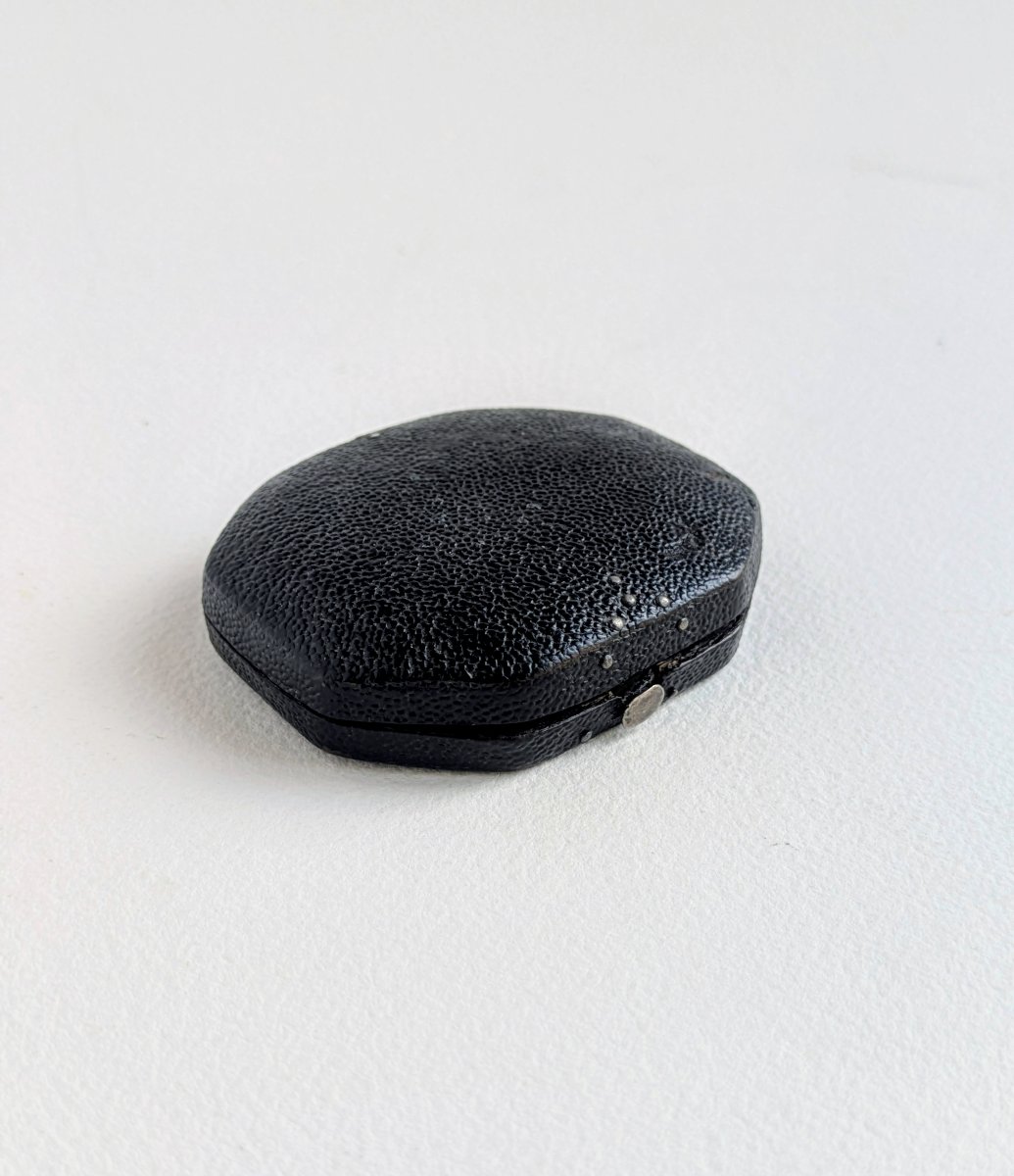
- Silver, black shagreen case, green velvet interior and silver mount
- Paris (France), 1687–1691
- Michael Butterfield, manufacturerof scientific instruments (1635–1724)
- Dial:Length: 59 mm & width: 50 mm, diameter (compass): 23mm; case: Length: 64 mm & width: 57 mm
- Weight:27 g
- Very goodoverall condition, slight soiling on the velvet
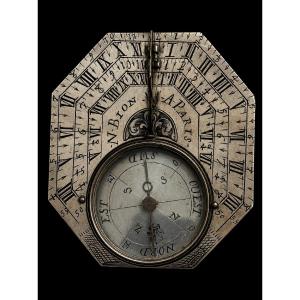
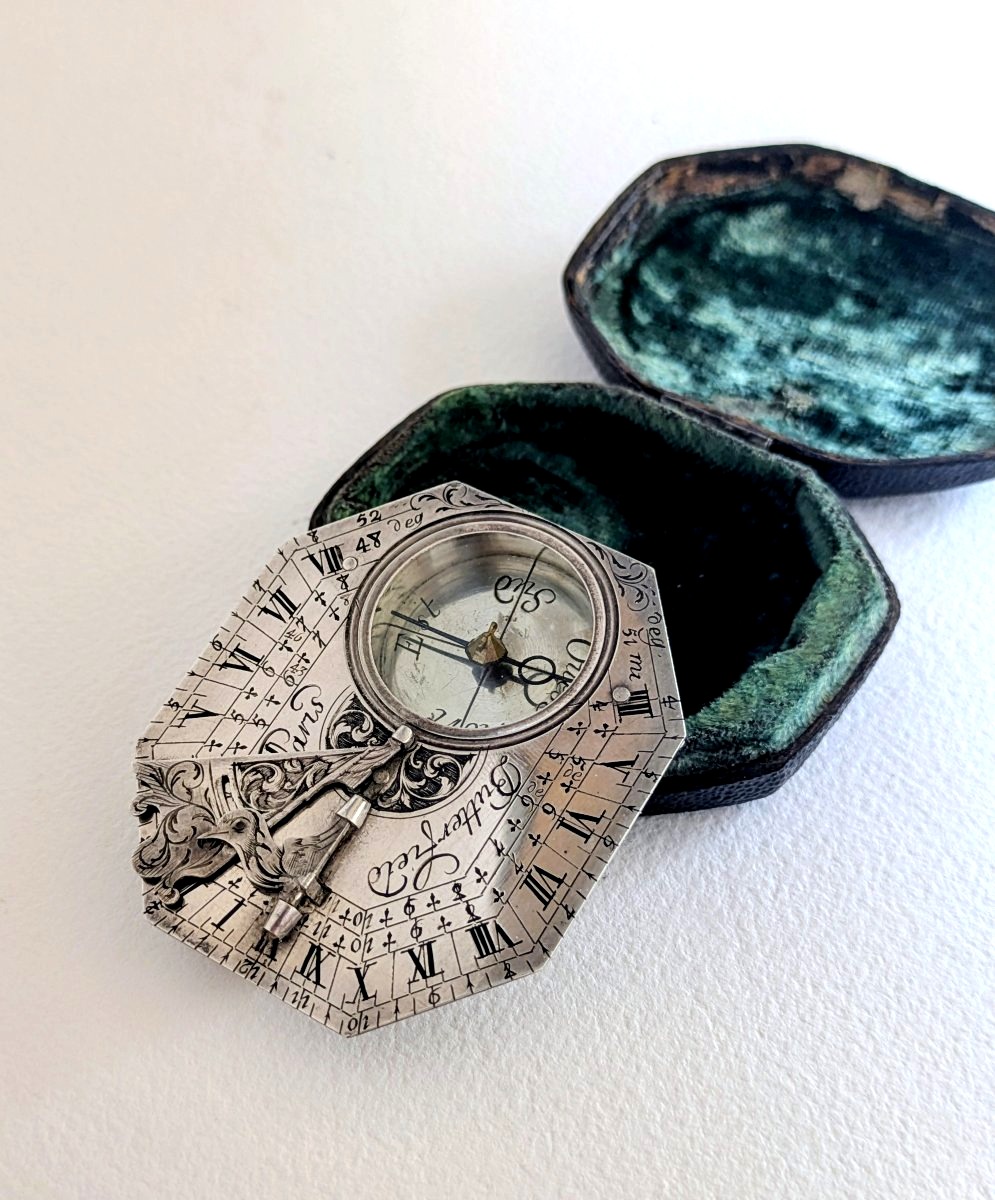
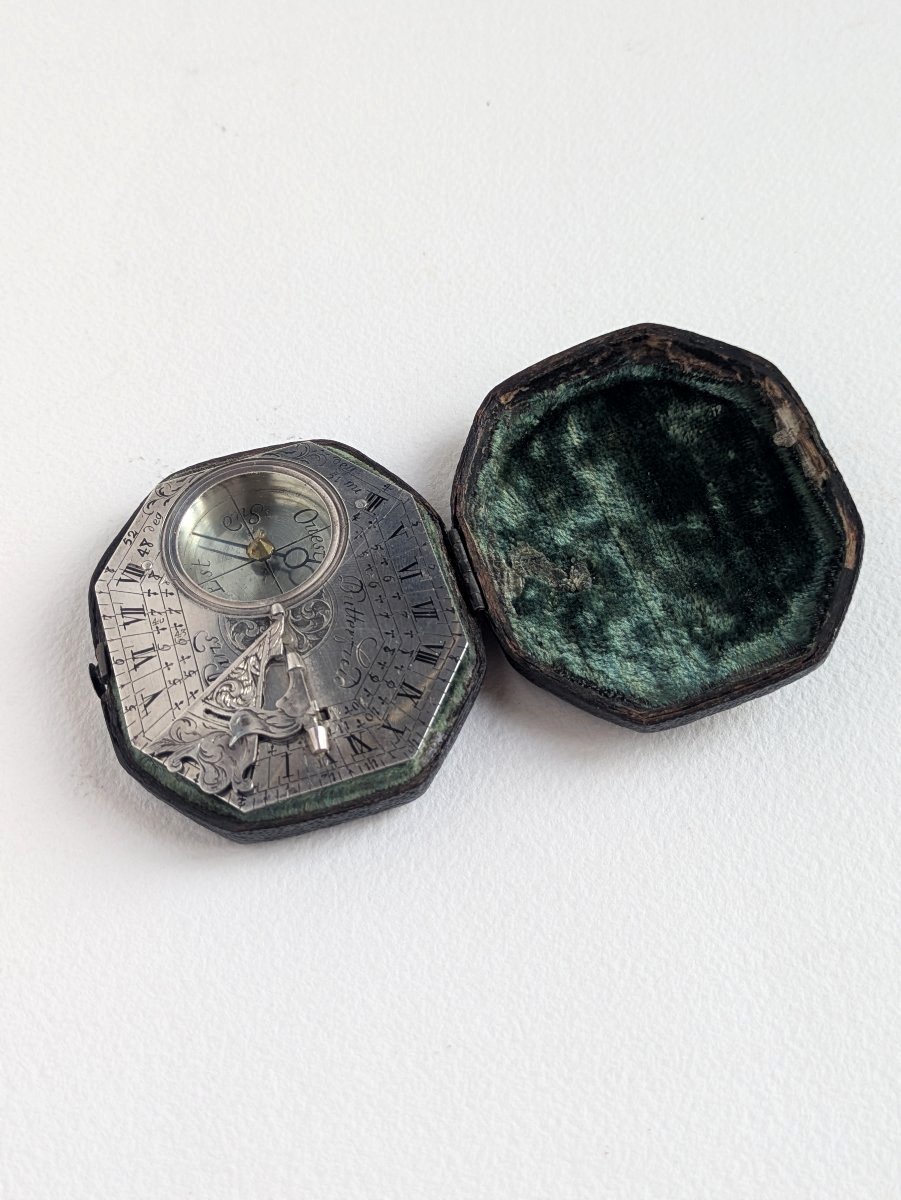
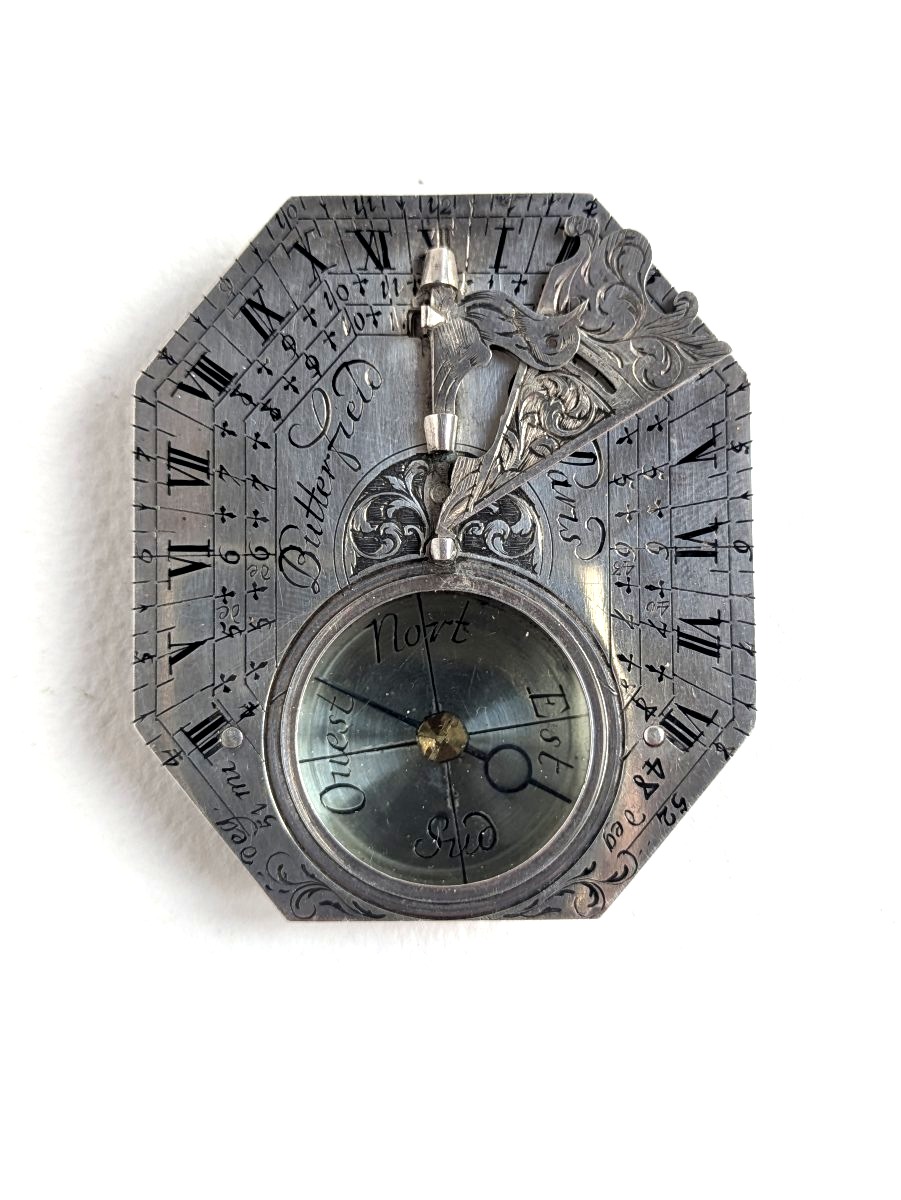
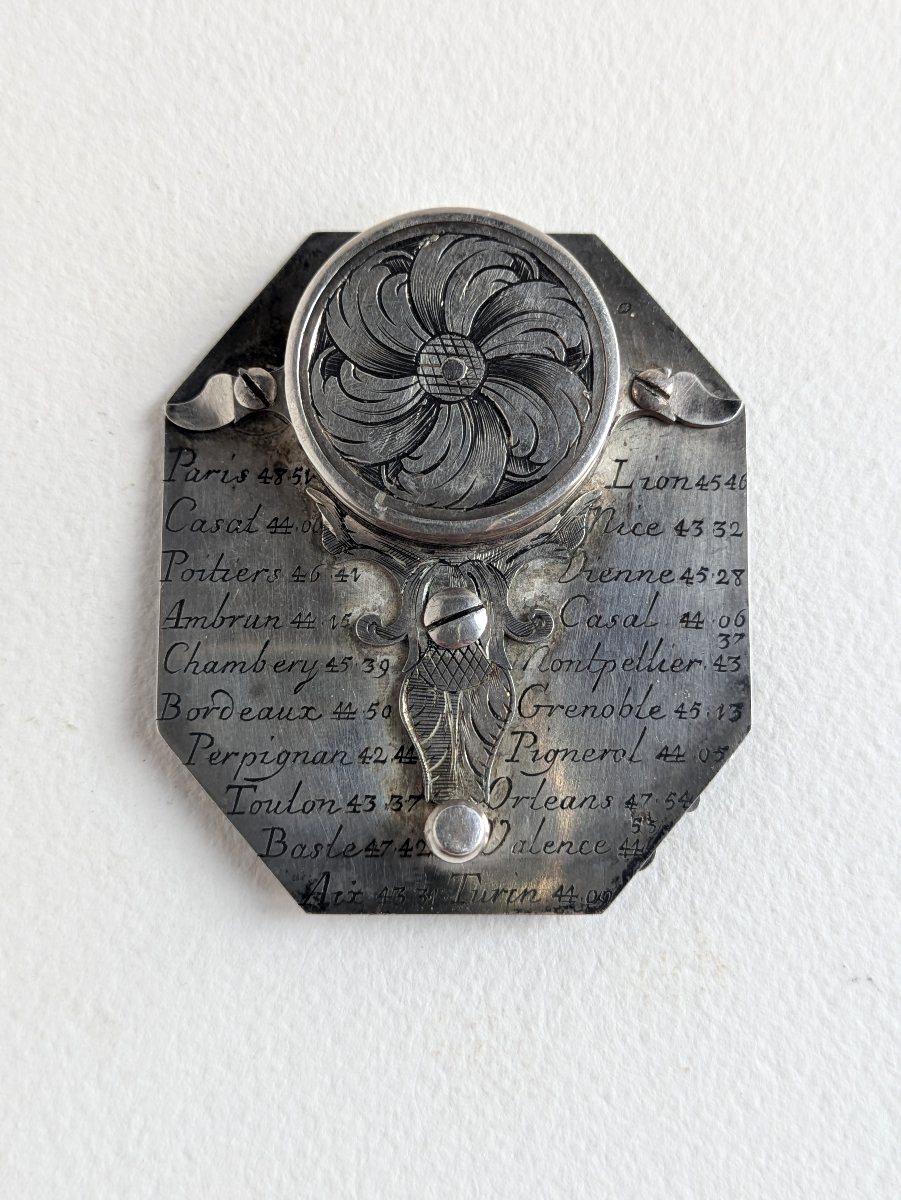
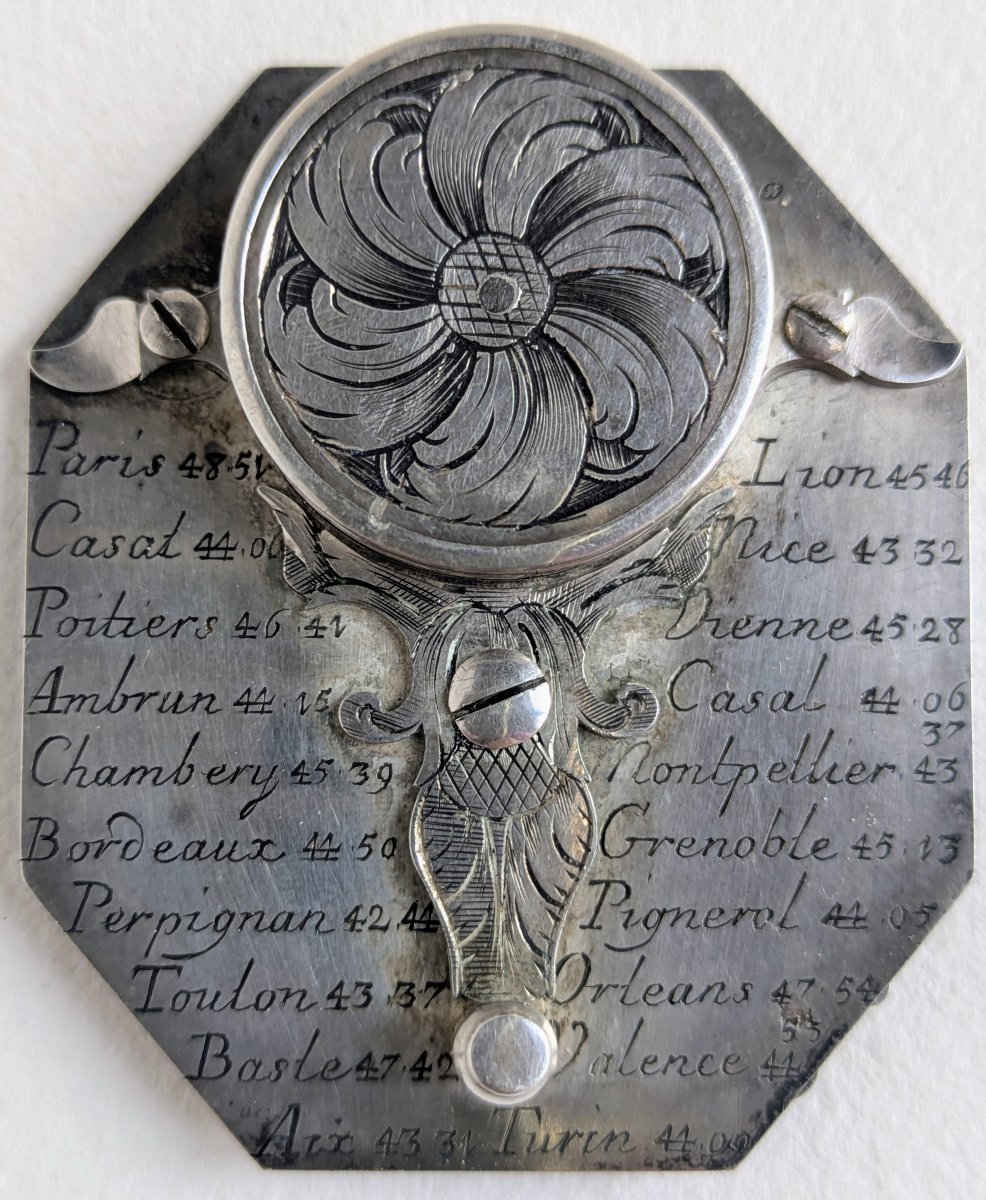
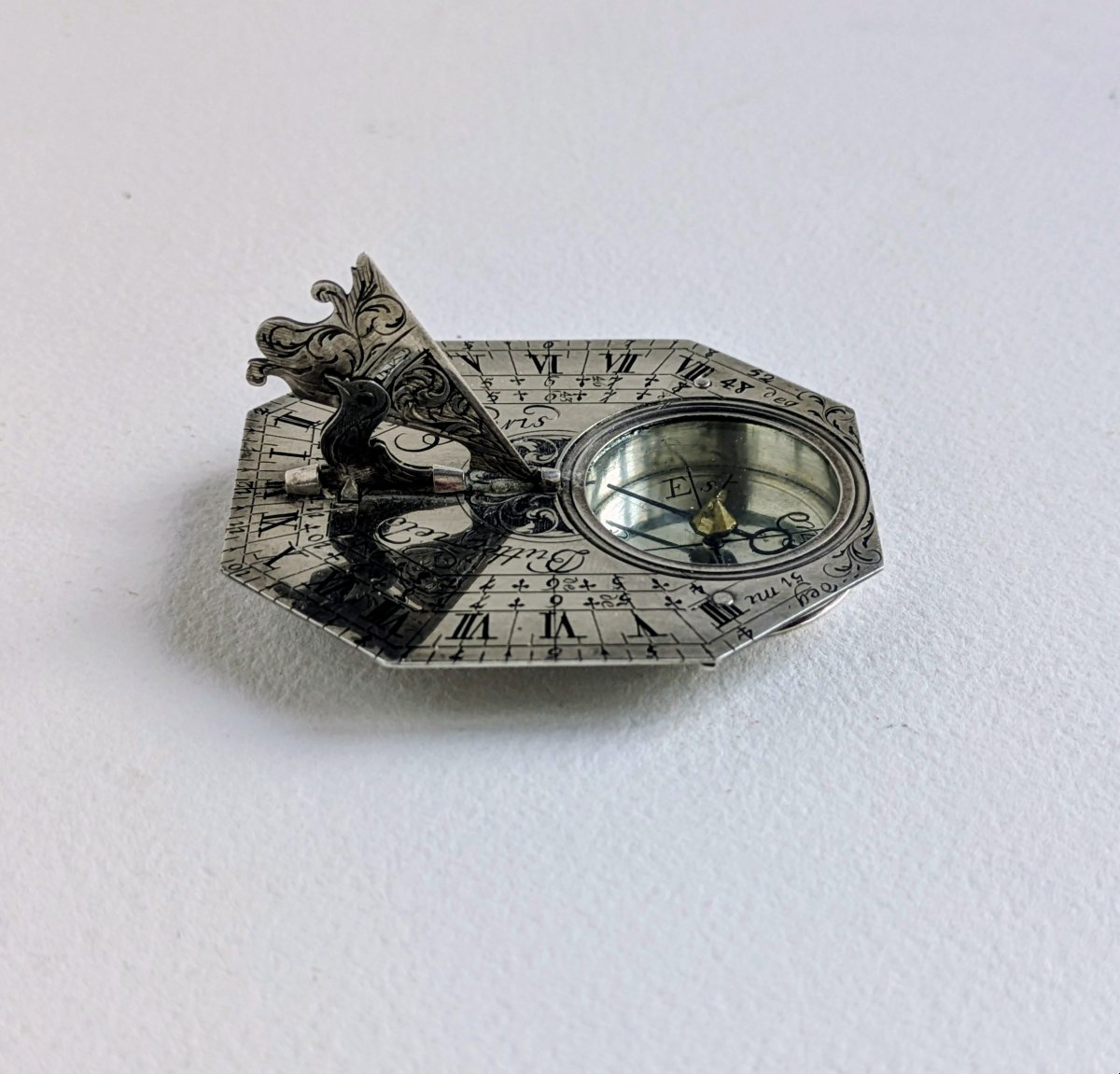
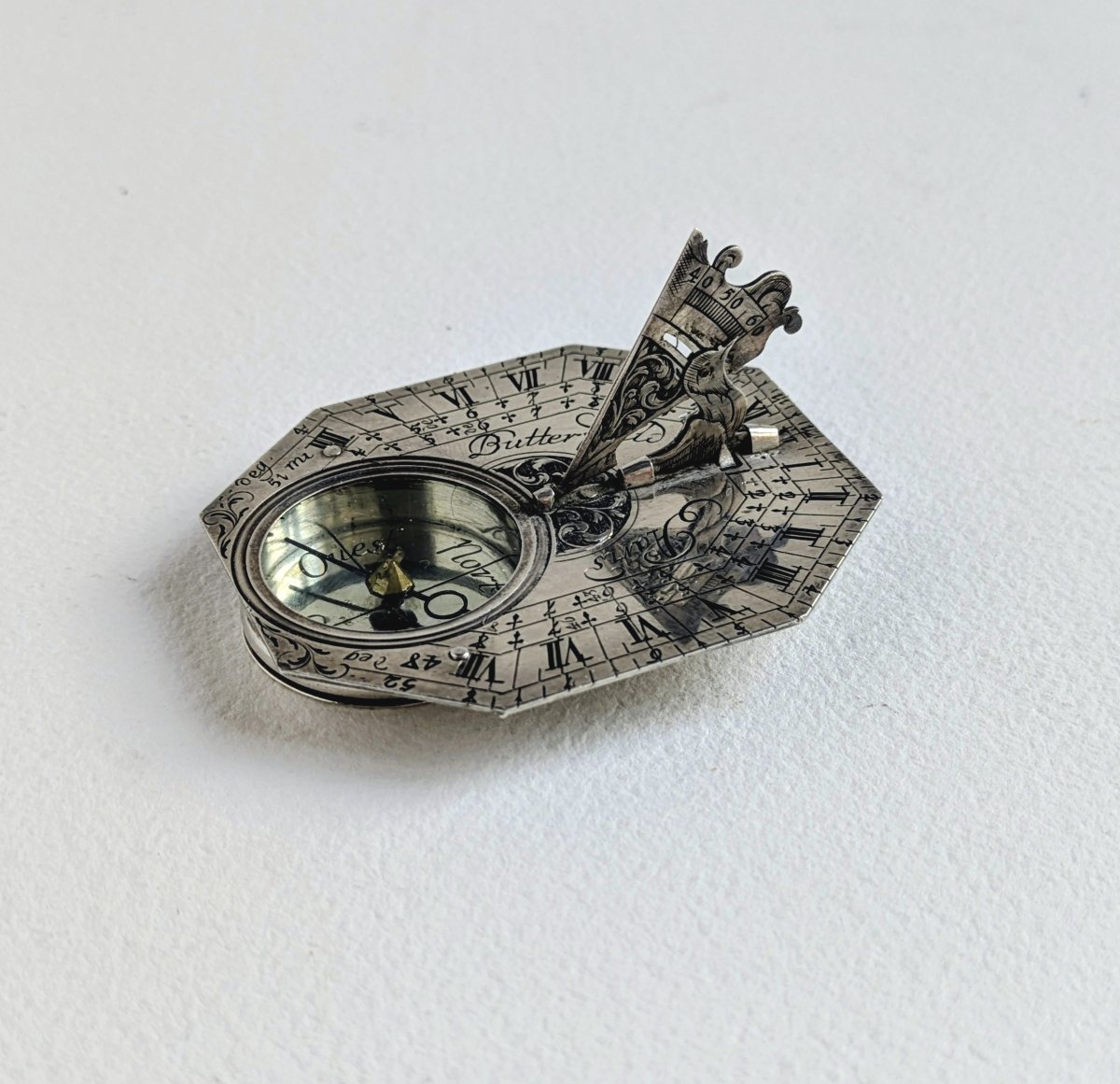
- A finely engraved silver sundial rests on a turned base; it is mounted on an octagonal base with four hour scales—one in Roman numerals and three in Arabic numerals for latitudes 52, 48, 46, and 43. A foliage motif is engraved in the center along with the signature incursive script “Butterfield AParis.” The style, mounted on a hinge, is adorned with foliage and an engraved bird whose beak indicates thee levation range from 40° to 60°. Dry-well compass with four cardinal pointsmarked: “Est,” “Ouest,” “Nord,” and“Sud”; the needle is made of blued steel mounted on a brass pivot. The back of the plate is engraved with a list of 20 European cities along with their latitudes, including the city of Pignerol. The tab serving as a spring is engraved with an acanthus leaf, and the compass with a swirling rose. In its black chagrin case with a silver bezel and push button.
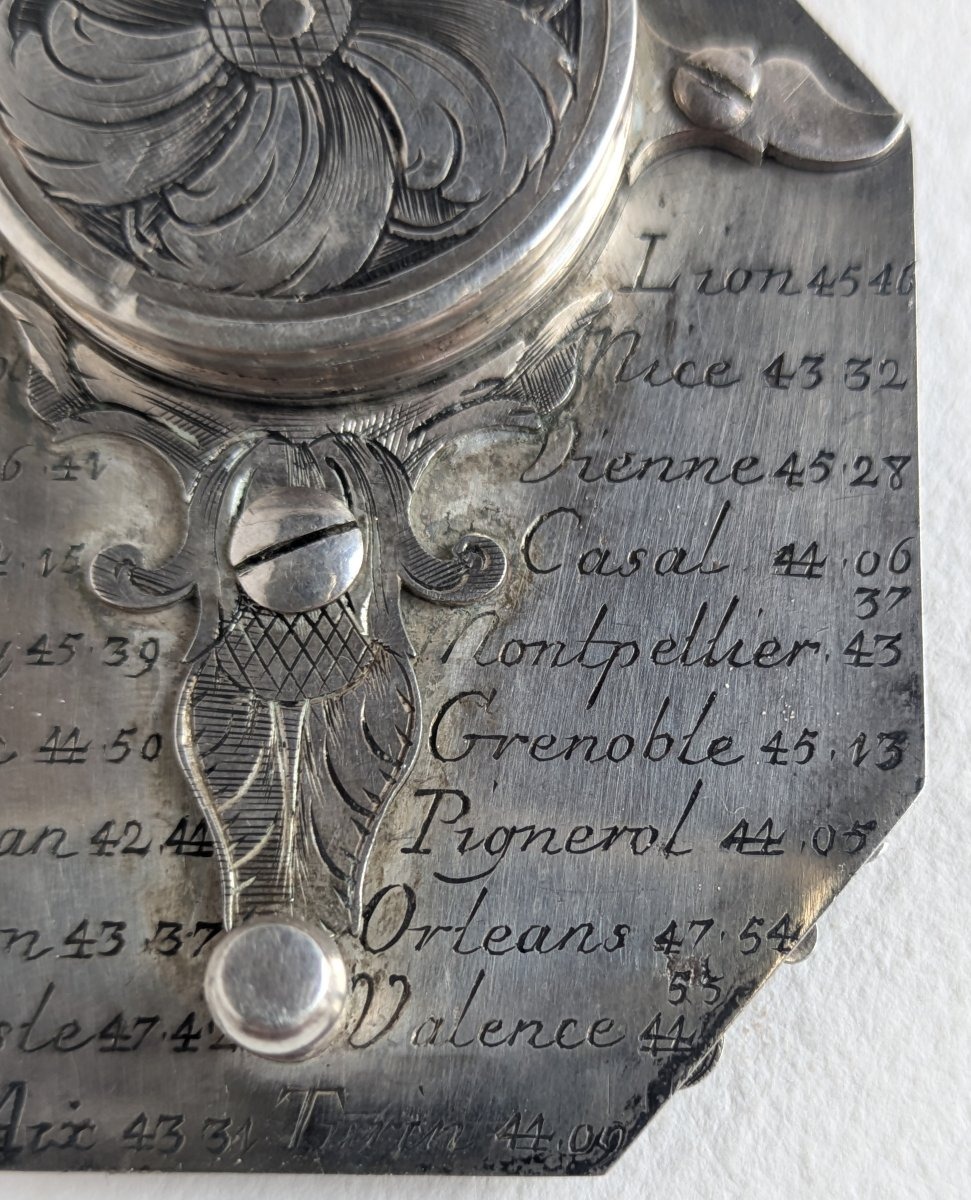
- The rare mention of the city of “Pignerol” inscribed on the reverse side of the dial along with the latitude “44.05,” was home to the famous fortress of Louis XIV, where Fouquet, the Duke of Lauzun, and the Man in the Iron Mask were imprisoned. This city in Piedmont became French in 1631 and a major military fortress before being returned to the Duke of Savoy in 1696. A large sundial model by Ingeneer from the Randier collection also bore this reference to the city of Pignerol (Aguttes Auction of May 15, 2023, Lot 267)
Michael Butterfield (1635–1724), a clockmaker of English origin, settled in Paris around 1663; appointed engineer to the king in 1679, he produced, under the direction ofJean-Dominique Cassini, a planisphere for the Royal Academy of Sciences in Paris. He is listed in 1678 in the Faubourg Saint-Germain under the sign “rue Neuve des Fossés” and in 1697 “Aux Armes d’Angleterre” on the Quai des Morfondus. His sign was adopted by his student, Jean-Jacques Langlois. His name is associated with a particular type of horizontal universal sundial, octagonal in shape with a gnomon adjustable according to latitude.
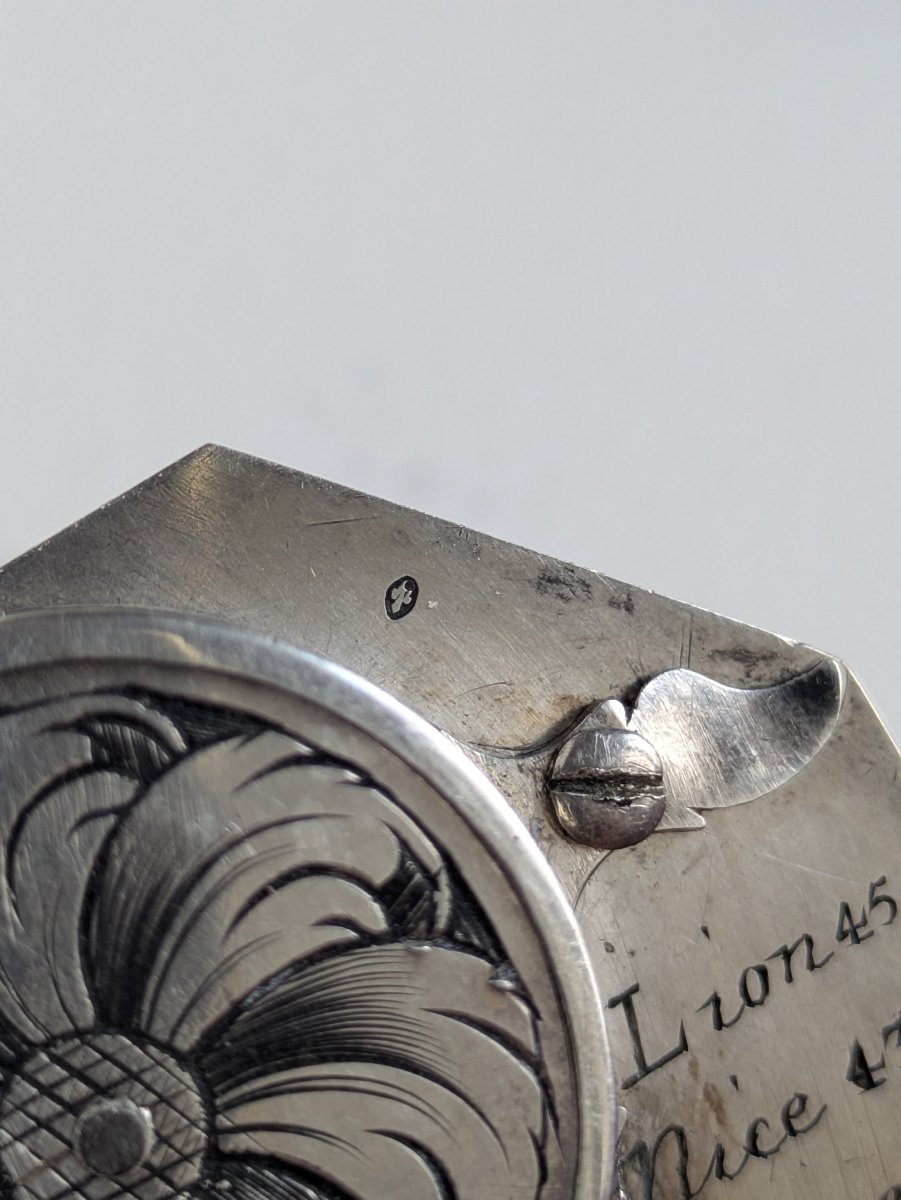
- Hallmarks (under the plate): discharge : fleur-de-lis with a rounded tip, Paris hallmark for small items dated October 1, 1687,to December 18, 1691 [1, no. 249]
- Ref.:[1] Bimbenet-Privat, Michèle & de Fontaines, Gabriel: "La datation de l'orfèvrerie parisienne sous l'ancien régime" Paris musées, 1995
- Silver, black shagreen case, green velvet interior and silver mount
- Paris (France), 1687–1691
- Michael Butterfield, manufacturerof scientific instruments (1635–1724)
- Dial:Length: 59 mm & width: 50 mm, diameter (compass): 23mm; case: Length: 64 mm & width: 57 mm
- Weight:27 g
- Very goodoverall condition, slight soiling on the velvet
- A finely engraved silver sundial rests on a turned base; it is mounted on an octagonal base with four hour scales—one in Roman numerals and three in Arabic numerals for latitudes 52, 48, 46, and 43. A foliage motif is engraved in the center along with the signature incursive script “Butterfield AParis.” The style, mounted on a hinge, is adorned with foliage and an engraved bird whose beak indicates thee levation range from 40° to 60°. Dry-well compass with four cardinal pointsmarked: “Est,” “Ouest,” “Nord,” and“Sud”; the needle is made of blued steel mounted on a brass pivot. The back of the plate is engraved with a list of 20 European cities along with their latitudes, including the city of Pignerol. The tab serving as a spring is engraved with an acanthus leaf, and the compass with a swirling rose. In its black chagrin case with a silver bezel and push button.
- The rare mention of the city of “Pignerol” inscribed on the reverse side of the dial along with the latitude “44.05,” was home to the famous fortress of Louis XIV, where Fouquet, the Duke of Lauzun, and the Man in the Iron Mask were imprisoned. This city in Piedmont became French in 1631 and a major military fortress before being returned to the Duke of Savoy in 1696. A large sundial model by Ingeneer from the Randier collection also bore this reference to the city of Pignerol (Aguttes Auction of May 15, 2023, Lot 267)
Michael Butterfield (1635–1724), a clockmaker of English origin, settled in Paris around 1663; appointed engineer to the king in 1679, he produced, under the direction ofJean-Dominique Cassini, a planisphere for the Royal Academy of Sciences in Paris. He is listed in 1678 in the Faubourg Saint-Germain under the sign “rue Neuve des Fossés” and in 1697 “Aux Armes d’Angleterre” on the Quai des Morfondus. His sign was adopted by his student, Jean-Jacques Langlois. His name is associated with a particular type of horizontal universal sundial, octagonal in shape with a gnomon adjustable according to latitude.
- Hallmarks (under the plate): discharge : fleur-de-lis with a rounded tip, Paris hallmark for small items dated October 1, 1687,to December 18, 1691 [1, no. 249]
- Ref.:[1] Bimbenet-Privat, Michèle & de Fontaines, Gabriel: "La datation de l'orfèvrerie parisienne sous l'ancien régime" Paris musées, 1995
3 300 €
Period: 17th century
Style: Louis 14th, Regency
Condition: Perfect condition
Material: Sterling silver
Length: 59 mm, boitier : 64 mm
Width: 50 mm ; boitier : 57 mm
Diameter: 23 mm
Reference (ID): 1817022
Availability: In stock
Print