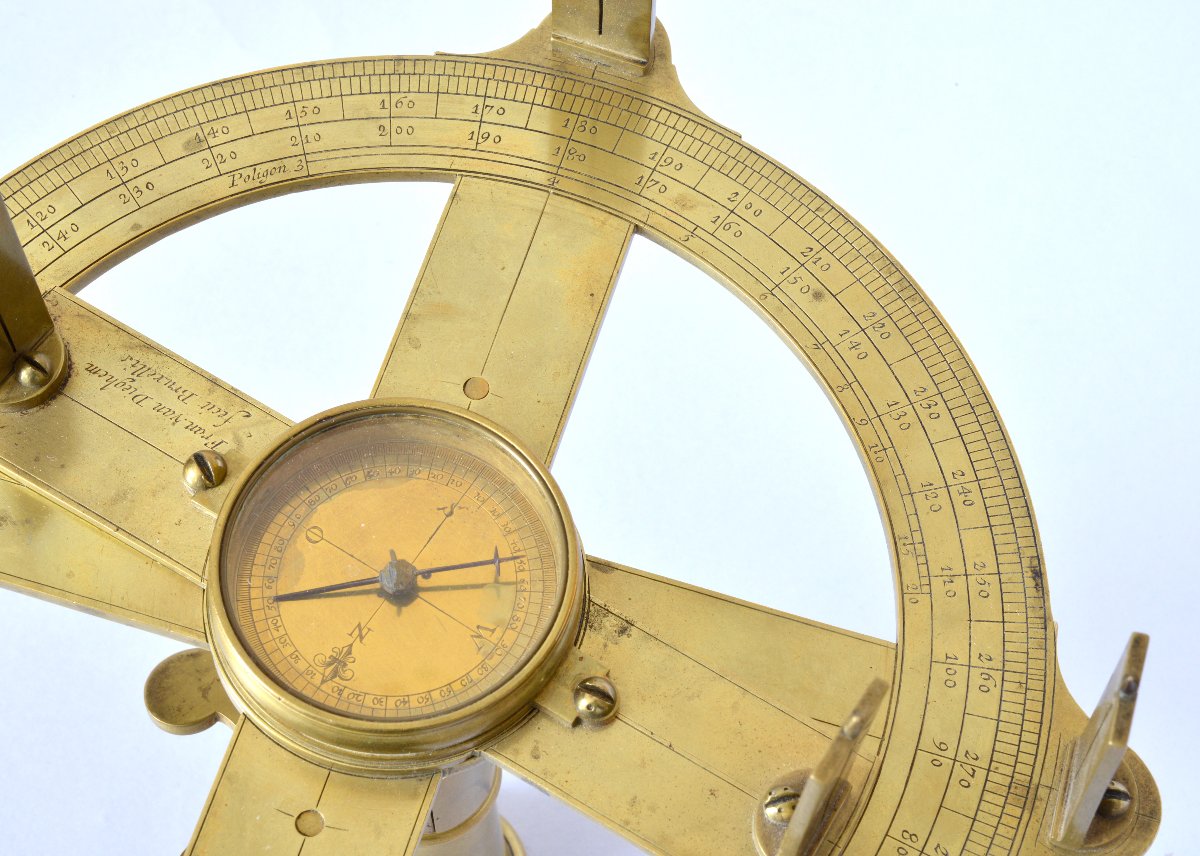


Holland Circle By Francis Van Dieghem Made In Brussels Circa 1684
Exceptional Holland circle signed "Fran. Van Dieghem fecit Bruxellis" in brass.
The instrument is shaped like a Greek cross inscribed within a circle, to which are attached a suspension ring and four fixed sighting vanes (pinnules) topped with a small point.
The compass is engraved with the four cardinal points (N, E, S, W) and a fleur-de-lis, as well as a circular scale graduated four times from 0 to 90 degrees and subdivided into 10-degree and 1-degree increments. A blued steel needle fitted with a brass pivot rotates freely in the center, and the entire compass is topped with a glass cover. On the right side of the alidade (when the compass’s north is at the top), the inscription “Fran. Van Dieghem fecit Bruxellis.”
This Dutch circle (full circle), also known as a simple theodolite or “circumferentor,” characteristic of the 17th century, is an extremely rare instrument.
- This is the third known full circle by Francis Van Dieghem.
- It is also one of the rare 17th-century Flemish theodolites with its characteristic Flemish form, similar to the earliest known models by Damery or Coignet.
- Furthermore, all the scales are very well engraved and highly precise, which is also a hallmark of renowned Flemish workshops.
To our knowledge, only three other instruments signed by Van Dieghem are known: two Dutch circles and a quadrant.
Note1: Gemma Frisius is the inventor of this type of instrument for measuring horizontal and vertical angles. It is described in his *Libellum locorum describandorum ratione* (1553), which was included in the German edition of Peter Appian’s *Cosmographiae* (first edition 1529). Michel Coignet improved the method by adding a tangent ruler in 1613.
Note 2: The full circle allows one to measure the angle formed between two distant points in order to determine their distance. Its point-based operating principle allows it to be used for both terrestrial and celestial purposes (calculating the positions of celestial bodies).
In terms of its shape and function, this instrument is similar to the astrolabe, from which it is derived.
Dimensions: total height of 25.8 cm x diameter of 18.6 cm
Made in Brussels circa 1684.
Period: 17th century
Style: Louis 14th, Regency
Condition: Good condition
Material: Brass
Diameter: 18,6 cm
Height: 25,8 cm
Reference (ID): 1785864
Availability: In stock