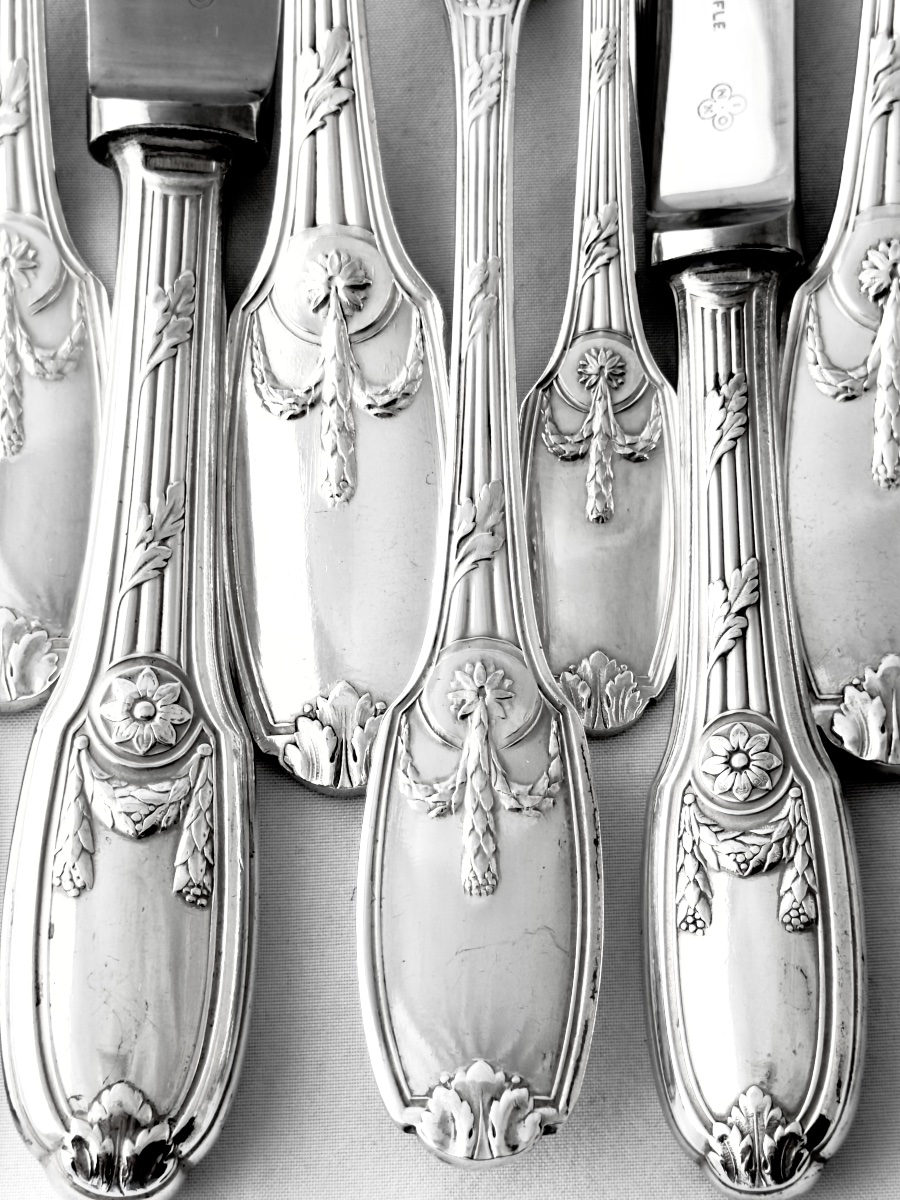
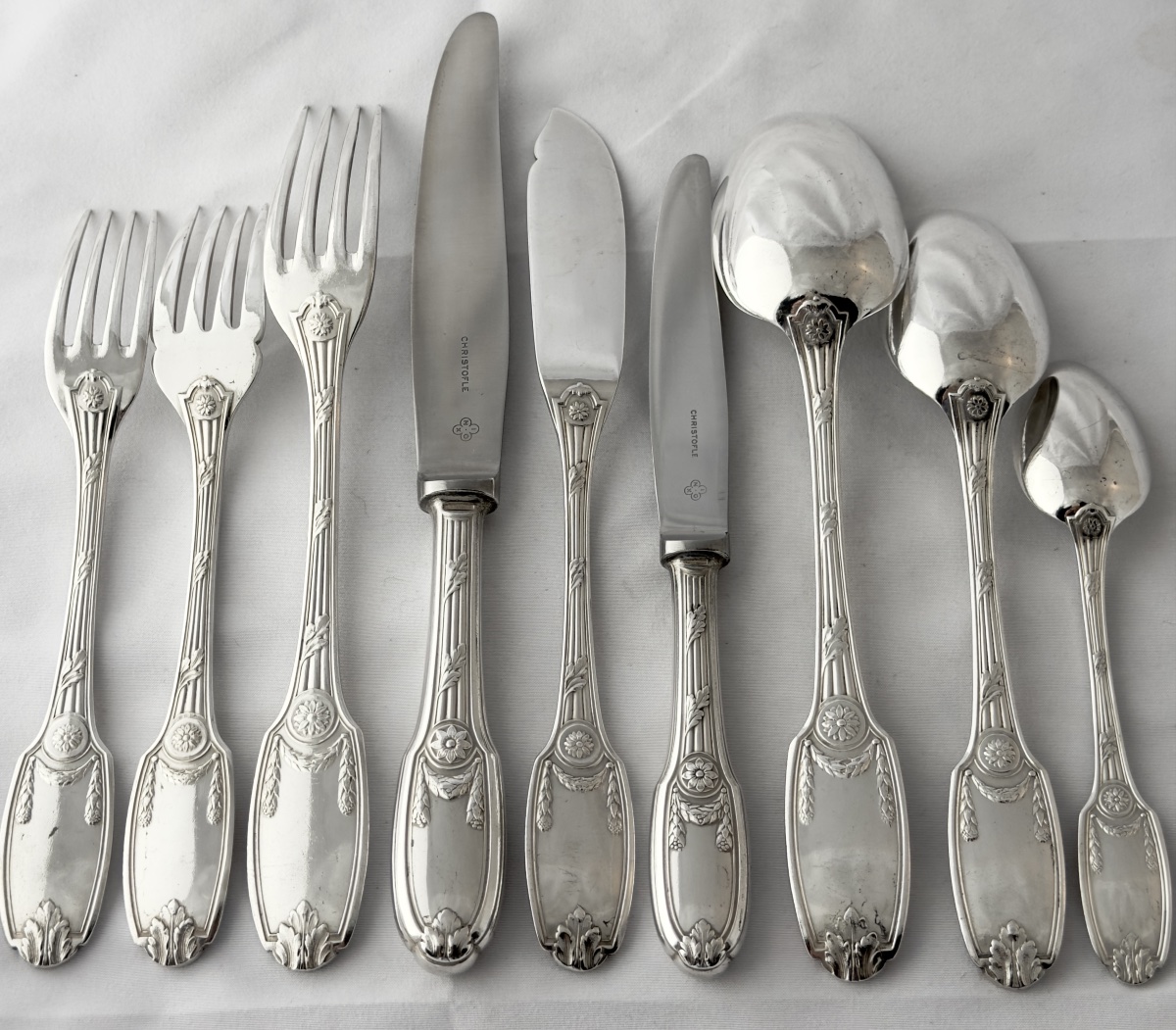
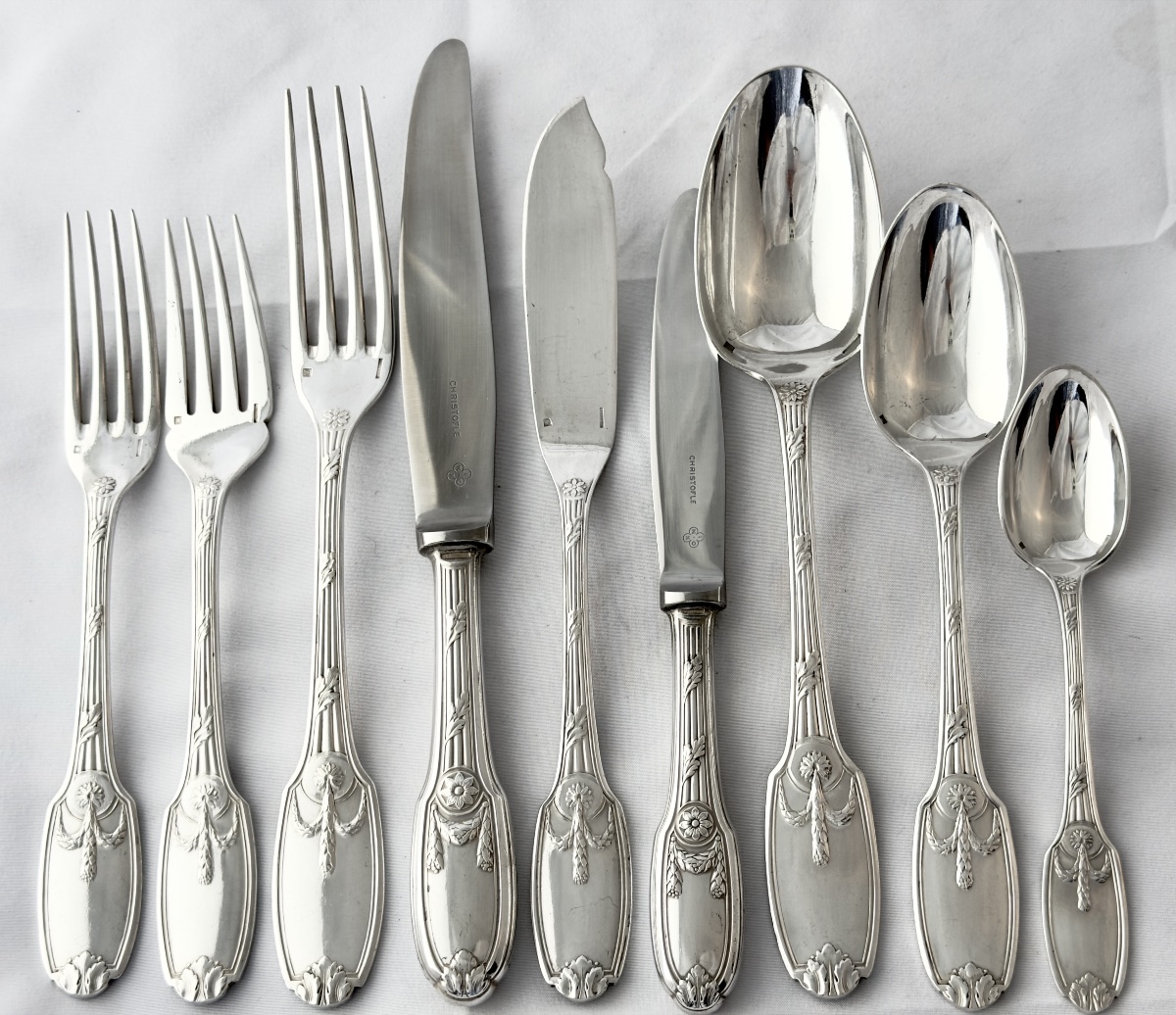
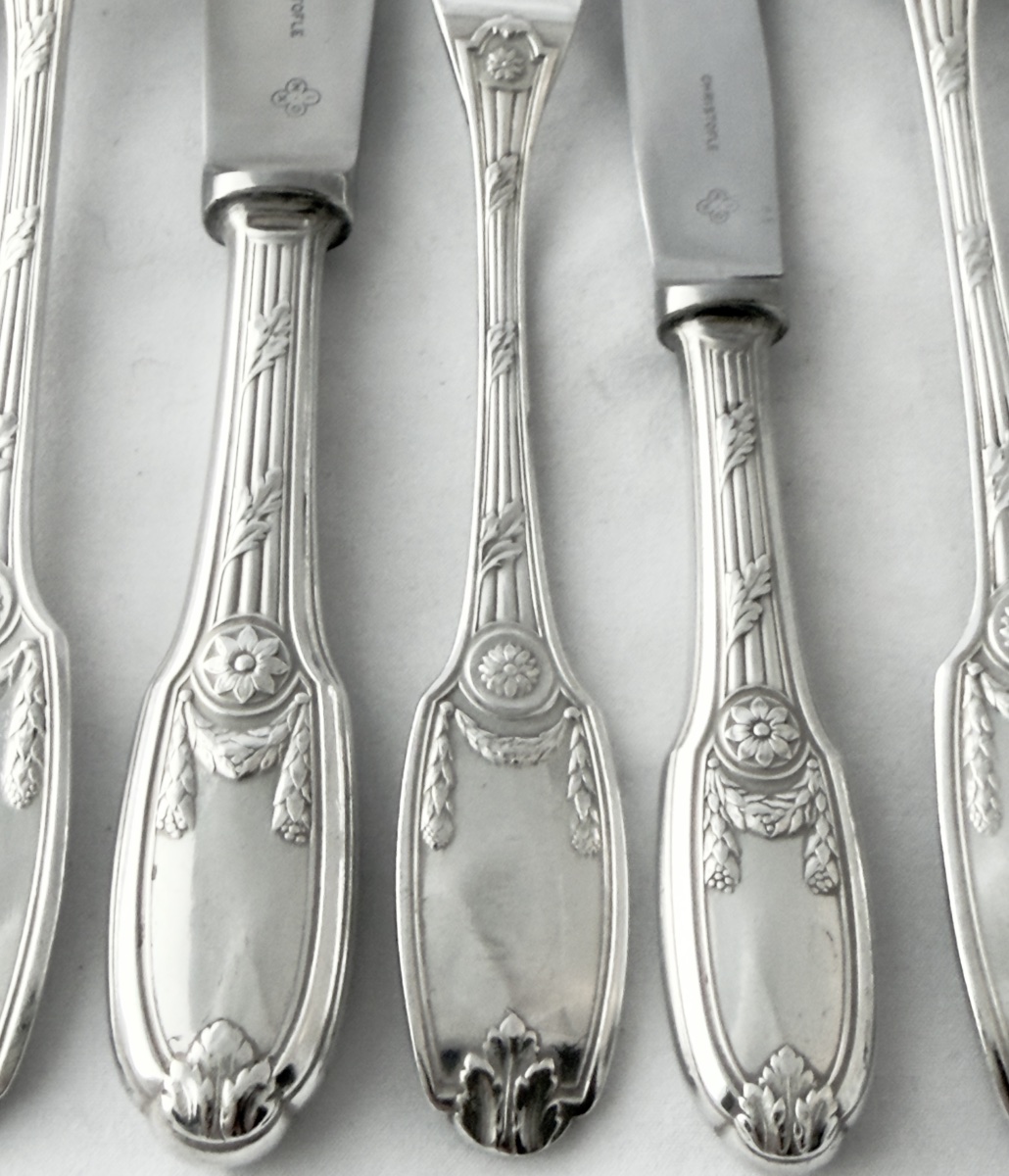
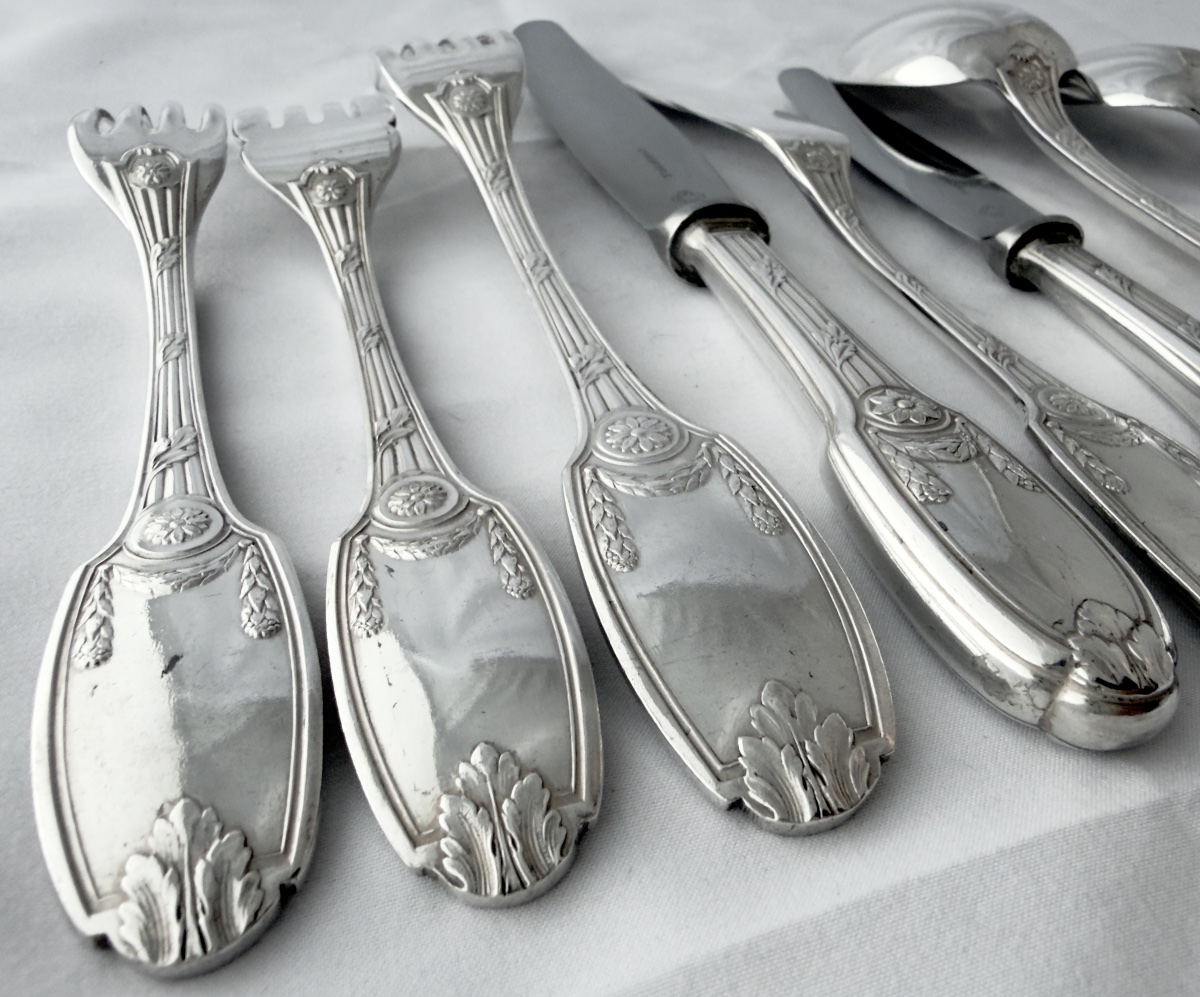
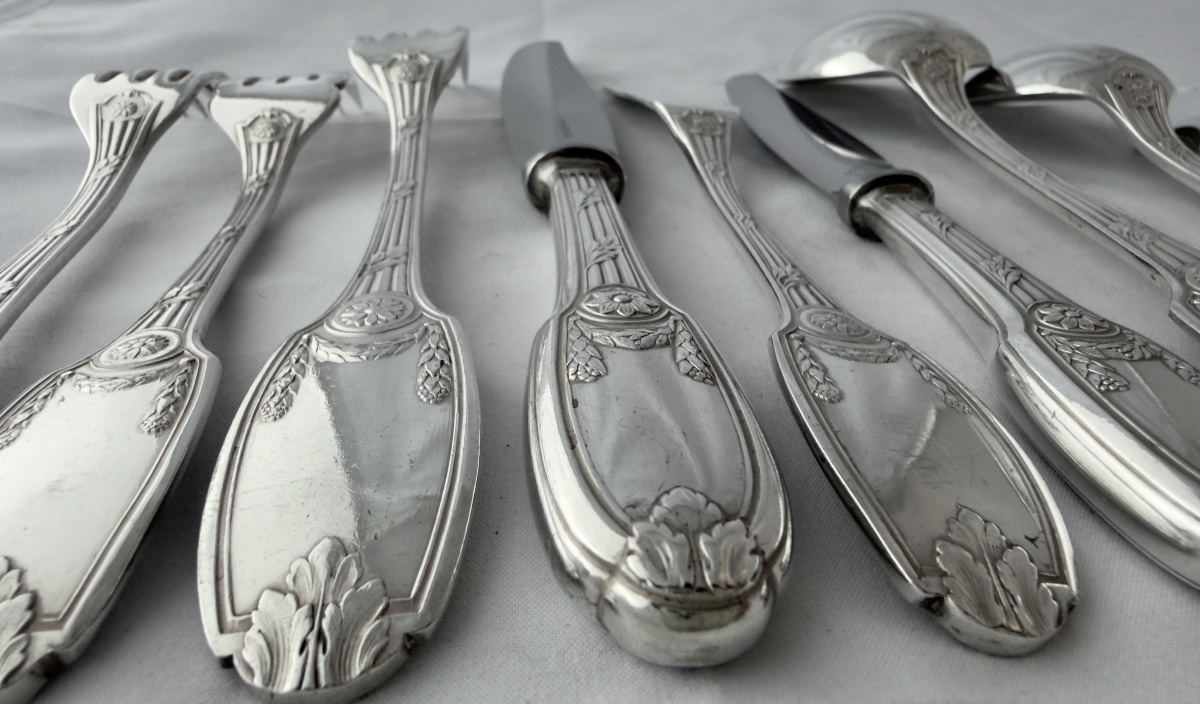
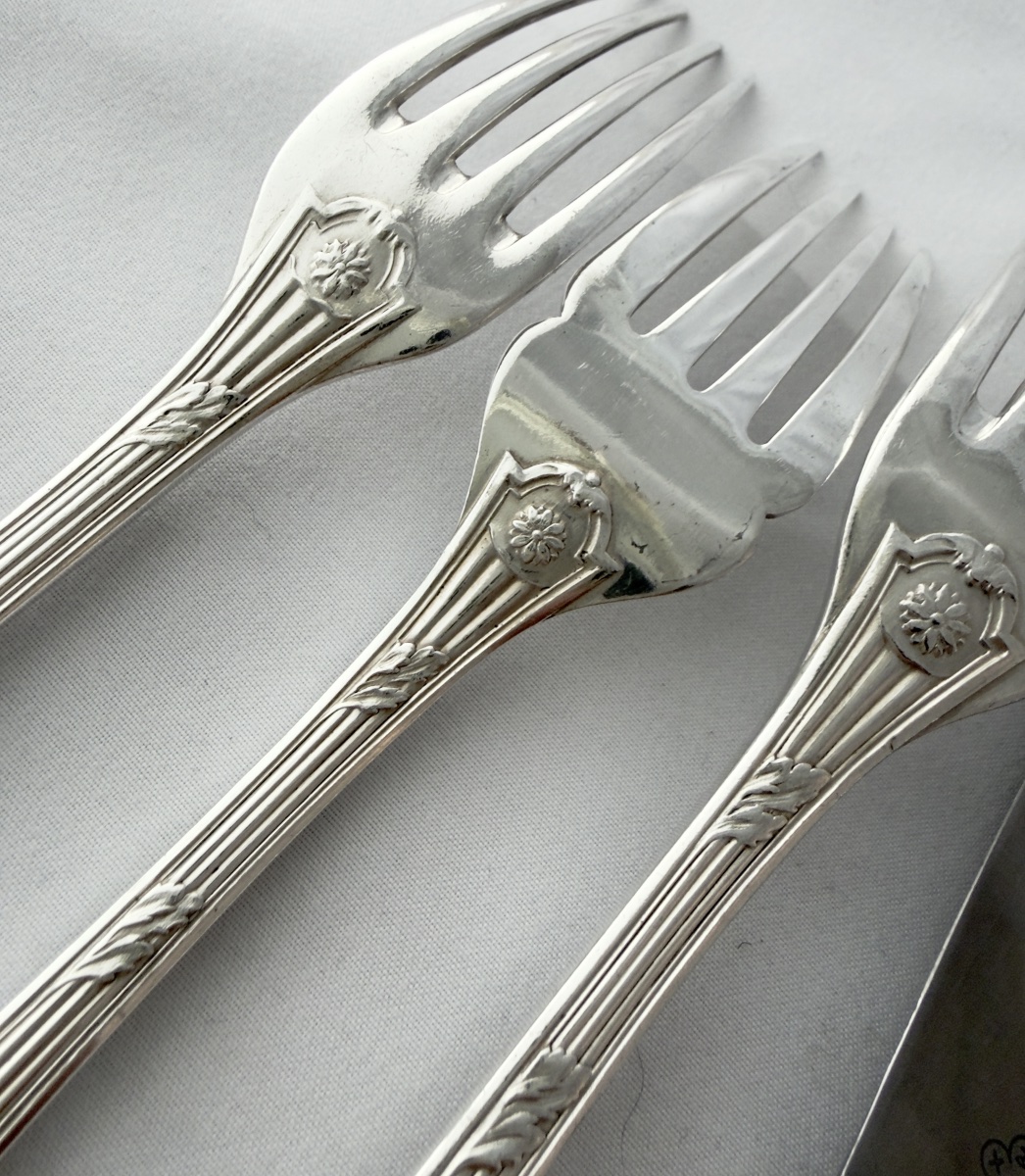
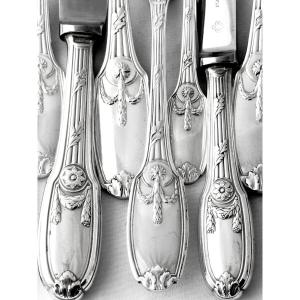


Christofle “delafosse” 106-piece Set In Perfect Condition, Louis XVI Style, For 12 People, Silver-plated
Important Christofle “Delafosse” Silver-Plated Flatware Service – 106 Pieces for Twelve People
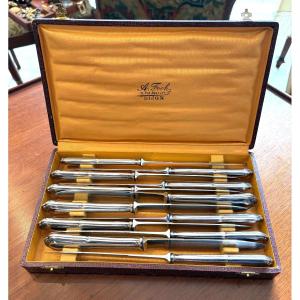
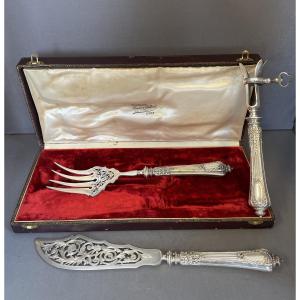
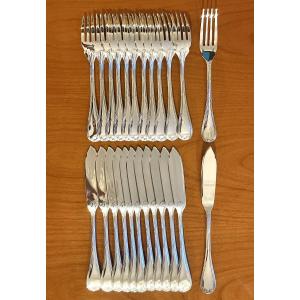
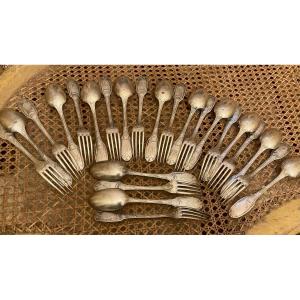
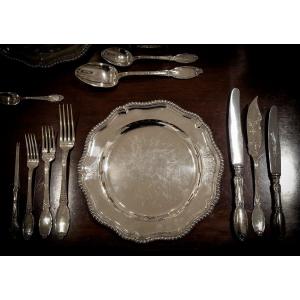
Important silver-plated flatware service by Christofle, in the Delafosse pattern, comprising a complete service for twelve people together with a fine selection of serving pieces.
The service consists of:
- 12 table forks
- 12 table spoons
- 12 table knives
- 12 dessert forks
- 12 dessert spoons
- 12 dessert knives
- 12 coffee spoons
- 6 fish forks
- 6 fish knives
- 1 soup ladle
- 1 large serving spoon
- 1 large serving fork
- 1 large fish serving fork
- 1 large fish serving knife
- 1 large carving knife
- 1 large carving fork
- 1 compote spoon
- 1 salad serving fork
- 1 salad serving spoon
106 pieces in total.
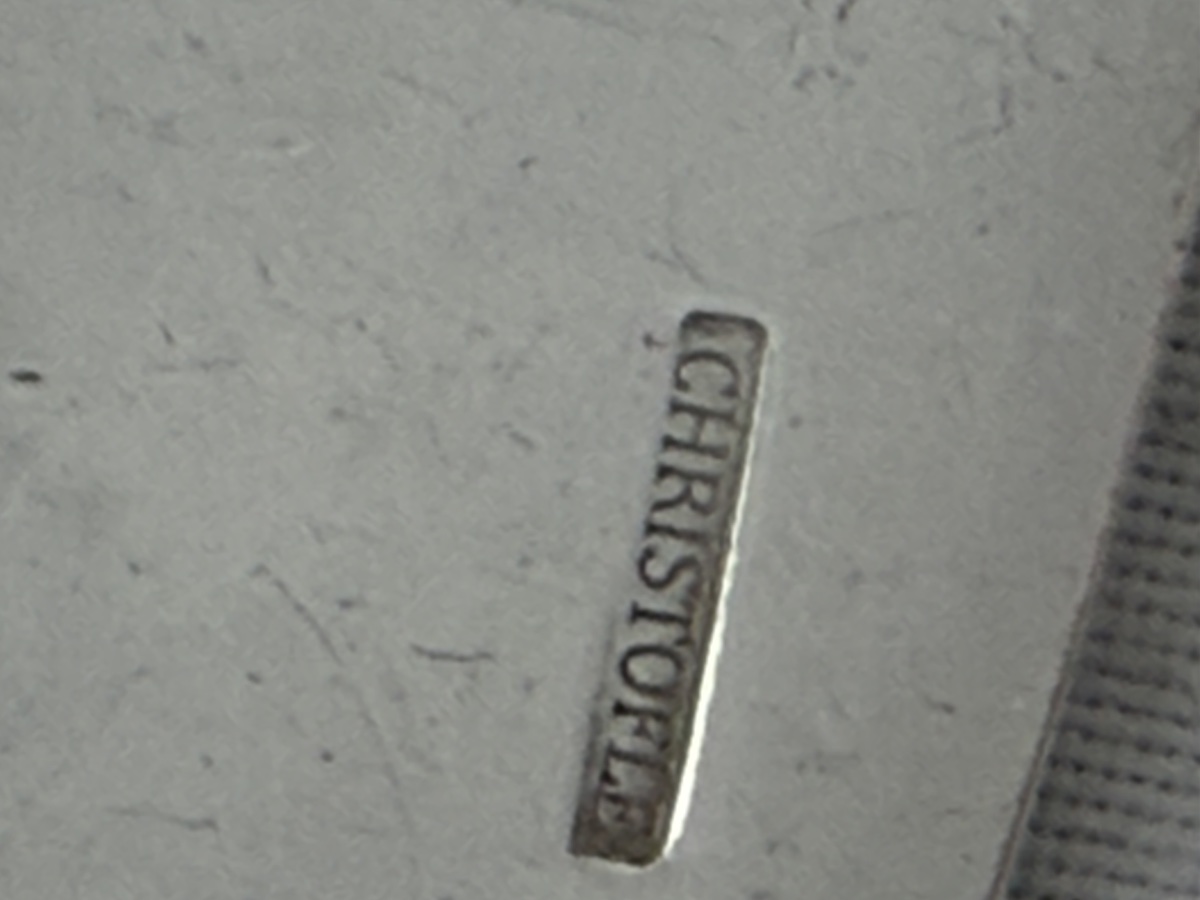
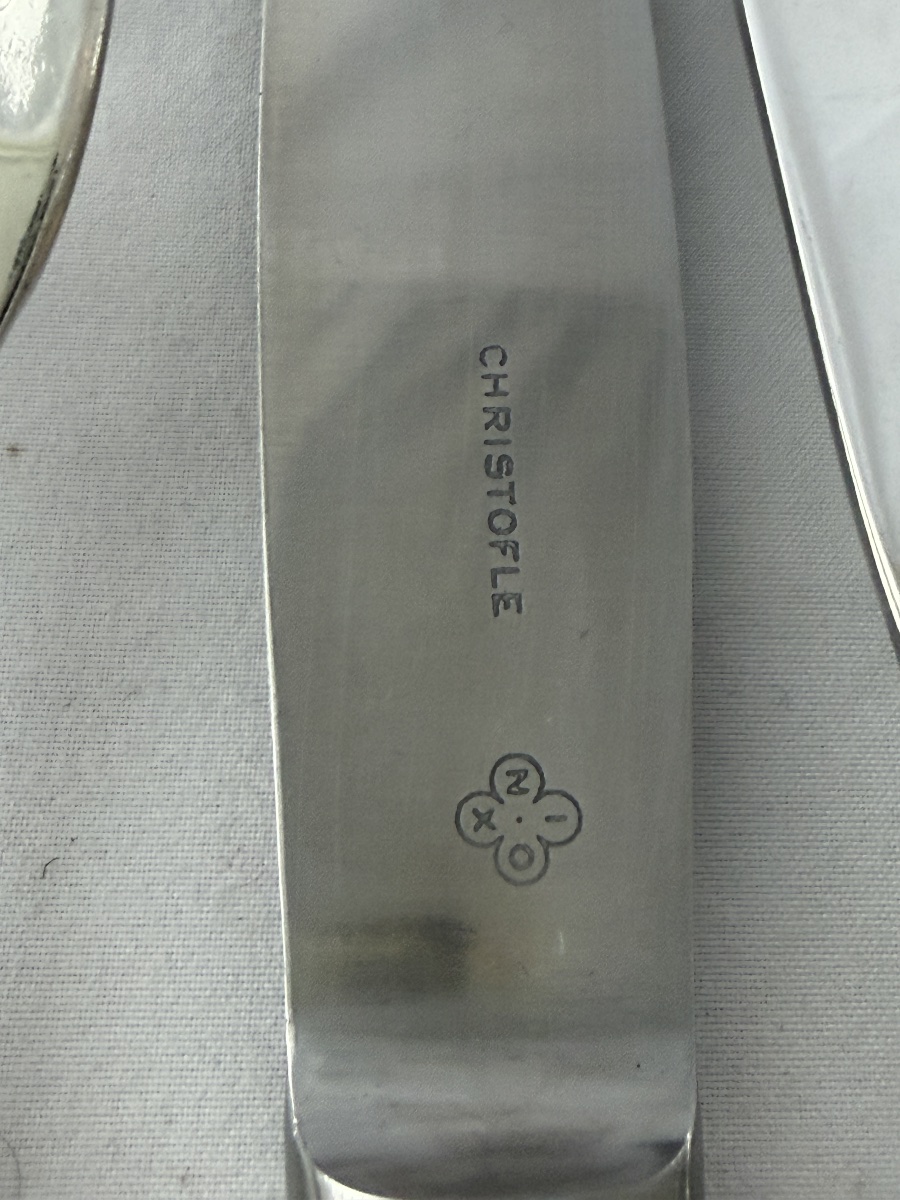
The set probably dates from the 1930s–1950s. The knives are already fitted with stainless-steel blades signed Christofle.
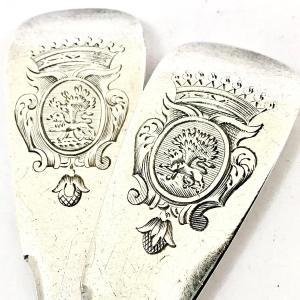
The service is in excellent condition. It has clearly seen relatively little use; only very light surface marks are visible, entirely normal for an antique service that has actually been used at table. The decoration remains perfectly crisp and the silver plating is very well preserved.
The Delafosse Pattern – A Christofle Creation of 1907
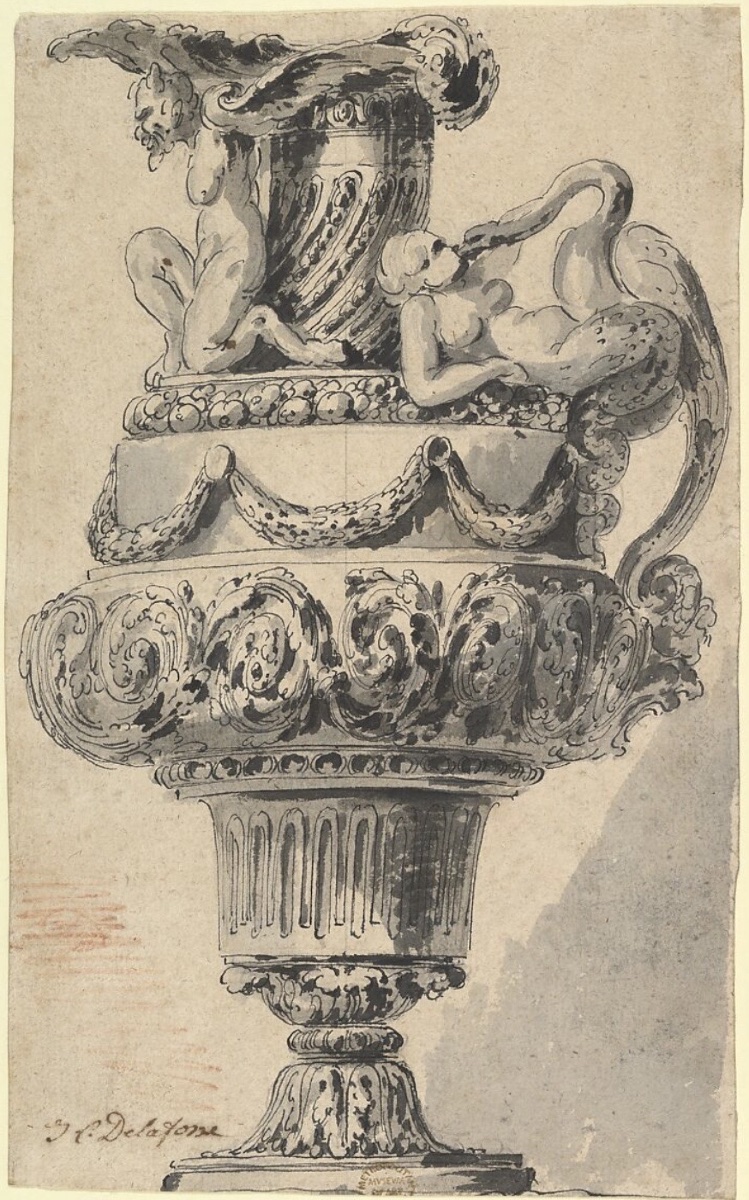
The name “Delafosse” is the name given to this pattern by Christofle itself. Christofle states that the design, created in 1907, was inspired by the work of the French architect, draughtsman and ornamental designer Jean-Charles Delafosse, and in particular by his characteristic decorative vocabulary of rosettes, garlands and Neoclassical vegetal ornament.
The decoration of the flatware perfectly illustrates this return to the ordered forms of Antiquity: symmetrical compositions, garlands, pendant foliage and rosettes replace the lively, asymmetrical curves of the Rococo. The ornament is rich without becoming heavy and follows the elongated shape of the handles with remarkable elegance.
Jean-Charles Delafosse and the “Goût Grec”
Jean-Charles Delafosse, born in Paris in 1734 and died in 1789, was an architect, draughtsman, painter, engraver, decorator and professor of drawing at the Académie de Saint-Luc.
Although he realised relatively few buildings, his influence on the decorative arts of the second half of the eighteenth century was considerable, thanks above all to his drawings and their dissemination through engraved publications.
Delafosse belonged to the generation of artists who, from the 1750s onwards, still during the reign of Louis XV, contributed to the emergence of what was then called the “goût grec”, or Greek taste. This movement marked the gradual abandonment of Rococo fantasy in favour of a return to symmetry, architecture and the decorative repertory of Antiquity. It would eventually lead to the full flowering of the Louis XVI style a few decades later.
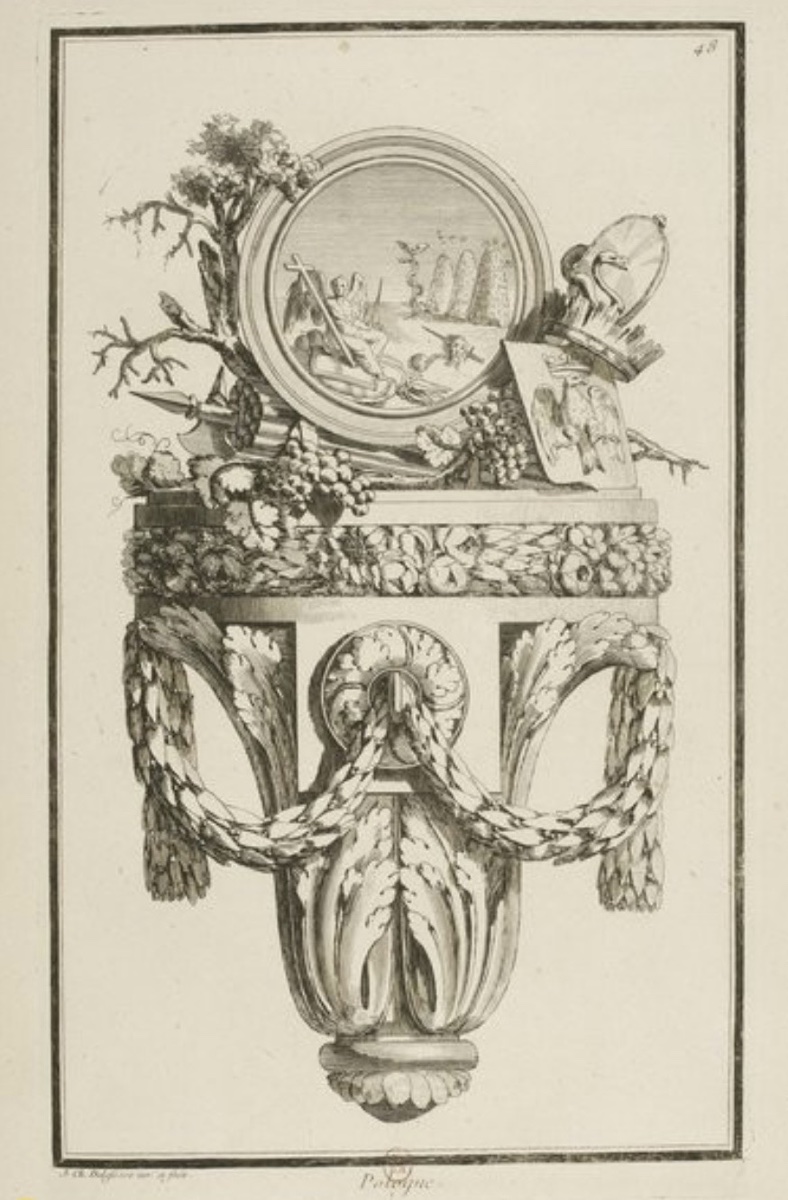
Delafosse’s historical importance lies above all in the numerous decorative designs that he had engraved and published. His most famous work, the Nouvelle Iconologie historique ou Attributs hiéroglyphiques, published from 1768 onwards, brought together a vast repertory of figures, trophies, vases, rosettes, garlands, pendant ornaments, cartouches, architectural elements and allegorical compositions.
Such publications served in the eighteenth century as genuine pattern books. Architects, bronze workers, cabinetmakers, joiners, silversmiths and other craftsmen could draw upon these compositions and adapt them to furniture, panelling, bronze work, silverware and a wide variety of decorative objects.
Delafosse’s engravings circulated far beyond France and therefore played a major role in the international spread of the new Neoclassical language. His influence on the applied arts was, in this respect, far greater than the relatively small number of buildings he personally realised might suggest.
More than a century after his death, Christofle’s designers therefore drew upon an ornamental vocabulary that had originally been conceived precisely to be disseminated and reinterpreted by artists and craftsmen.
Jean-Charles Delafosse’s Nouvelle Iconologie historique can today be consulted freely online in the digitised copy held by the Bibliothèque nationale de France on Gallica:
Gallica – Jean-Charles Delafosse, Nouvelle Iconologie historique
https://gallica.bnf.fr/ark:/12148/btv1b85290227
Looking through these plates immediately reveals the decorative world to which the Christofle pattern created in 1907 refers.
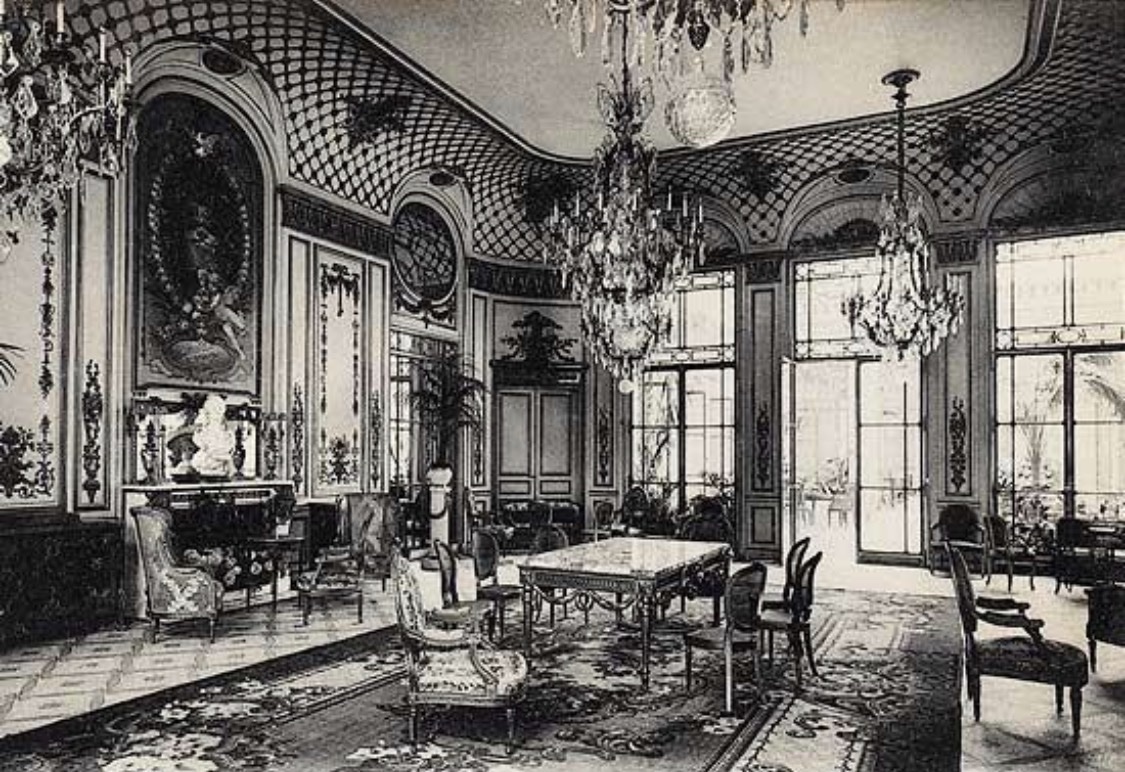
Christofle, Delafosse and the Hôtel Meurice
The history of this pattern acquires an additional dimension through its association with one of the most prestigious hotels in Paris: Le Meurice.
Christofle itself expressly states that the Hôtel Meurice selected the Delafosse pattern for its tables.
This association was certainly no coincidence. The pattern was created in 1907, precisely when the great transformation of Le Meurice was being completed.
The history of the establishment has its origins in the activities of Charles-Augustin Meurice, whose family initially operated a hotel in Calais catering in particular to British travellers arriving on the Continent. In the context of the Grand Tour, these wealthy travellers sought establishments offering the comfort, services and familiar amenities to which they were accustomed in England.
Le Meurice moved in 1835 to its present location on the Rue de Rivoli, opposite the Tuileries Garden, and gradually became one of the great Parisian addresses frequented by aristocrats, royal families and international high society.
At the beginning of the twentieth century, in order to meet the new standards of luxury hospitality, the hotel was considerably enlarged and modernised. The architect Henri-Paul Nénot (1853–1934), also known for the construction of the Nouvelle Sorbonne, was entrusted with this transformation.
The hotel was equipped with the most modern conveniences of the period: electricity, lifts, telephones, heating and sophisticated sanitary installations. Yet this technical modernisation did not lead to an aesthetic break with the past. On the contrary, the principal salons and reception rooms were decorated in a sumptuous Louis XVI style, with panelling, marble, gilt bronze, chandeliers and furniture inspired by the eighteenth century.
The works were completed in 1907.
The choice, in that same year, of Christofle’s Delafosse pattern for the tables of Le Meurice therefore appears particularly appropriate. Its rosettes, garlands and Neoclassical vocabulary extended onto the dining table the Louis XVI decoration of the hotel’s salons, panelling, seating furniture and lighting.
This service is therefore much more than an elegant set of Christofle flatware. Through a design created in 1907, it establishes a remarkable connection between the ornamental inventions of Jean-Charles Delafosse in the eighteenth century, the revival of the Louis XVI style during the Belle Époque, the craftsmanship of Christofle, and the history of Le Meurice, one of the great landmarks of Parisian luxury and the art of living.
Documentation
- Christofle, historical documentation relating to earlier flatware patterns, Delafosse pattern, created in 1907 and selected by the Hôtel Meurice.
- Jean-Charles Delafosse, Nouvelle Iconologie historique ou Attributs hiéroglyphiques, Paris, from 1768 onwards, digitised copy held by the Bibliothèque nationale de France:
https://gallica.bnf.fr/ark:/12148/btv1b85290227 - Metropolitan Museum of Art, New York, collection of plates from Jean-Charles Delafosse’s Nouvelle Iconologie historique.
- Bibliothèque nationale de France, bibliographical record for the Nouvelle Iconologie historique.
- Historical documentation of the Hôtel Meurice concerning the history of the establishment and its transformation at the beginning of the twentieth century.
Period: 20th century
Style: Louis 16th, Directory
Condition: Excellent condition
Material: Silver metal
Reference (ID): 1809672
Availability: In stock