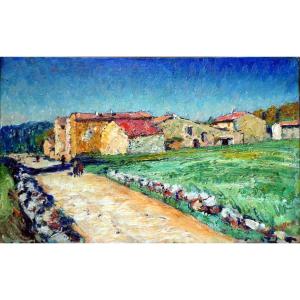


René Seyssaud (1867–1952) Village In Provence
Artist: René Seyssaud (1867-1952)
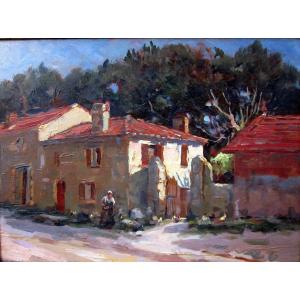
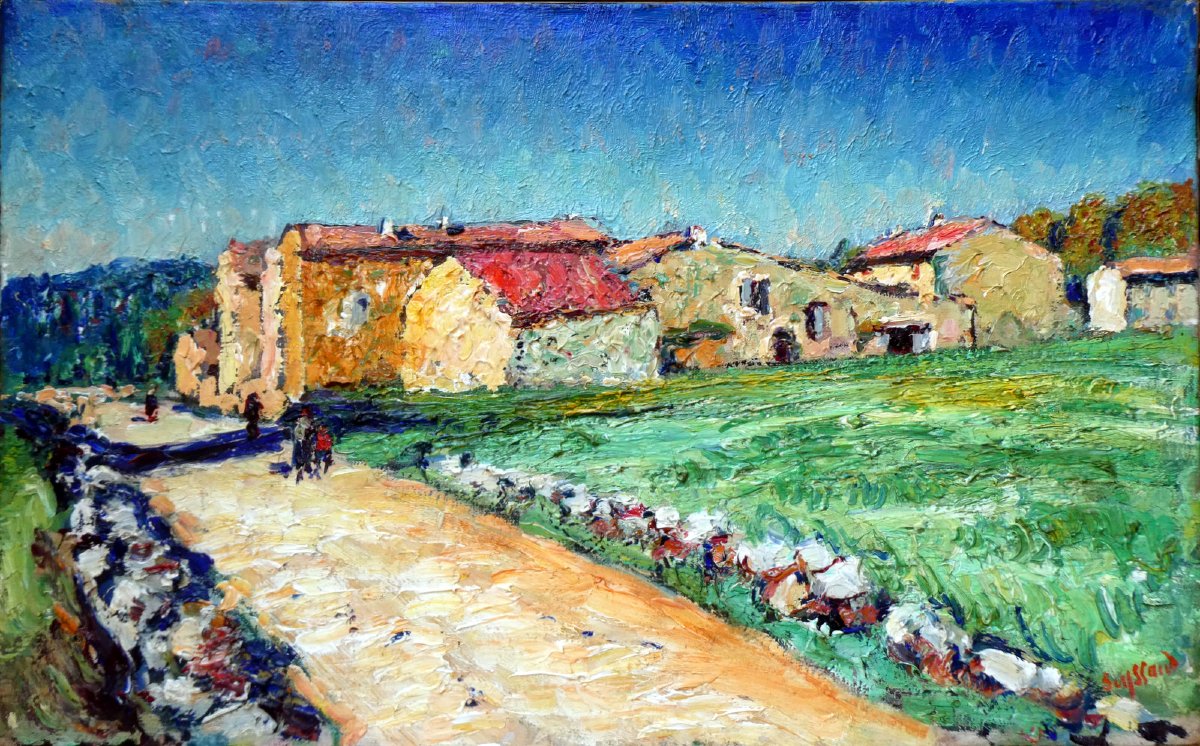
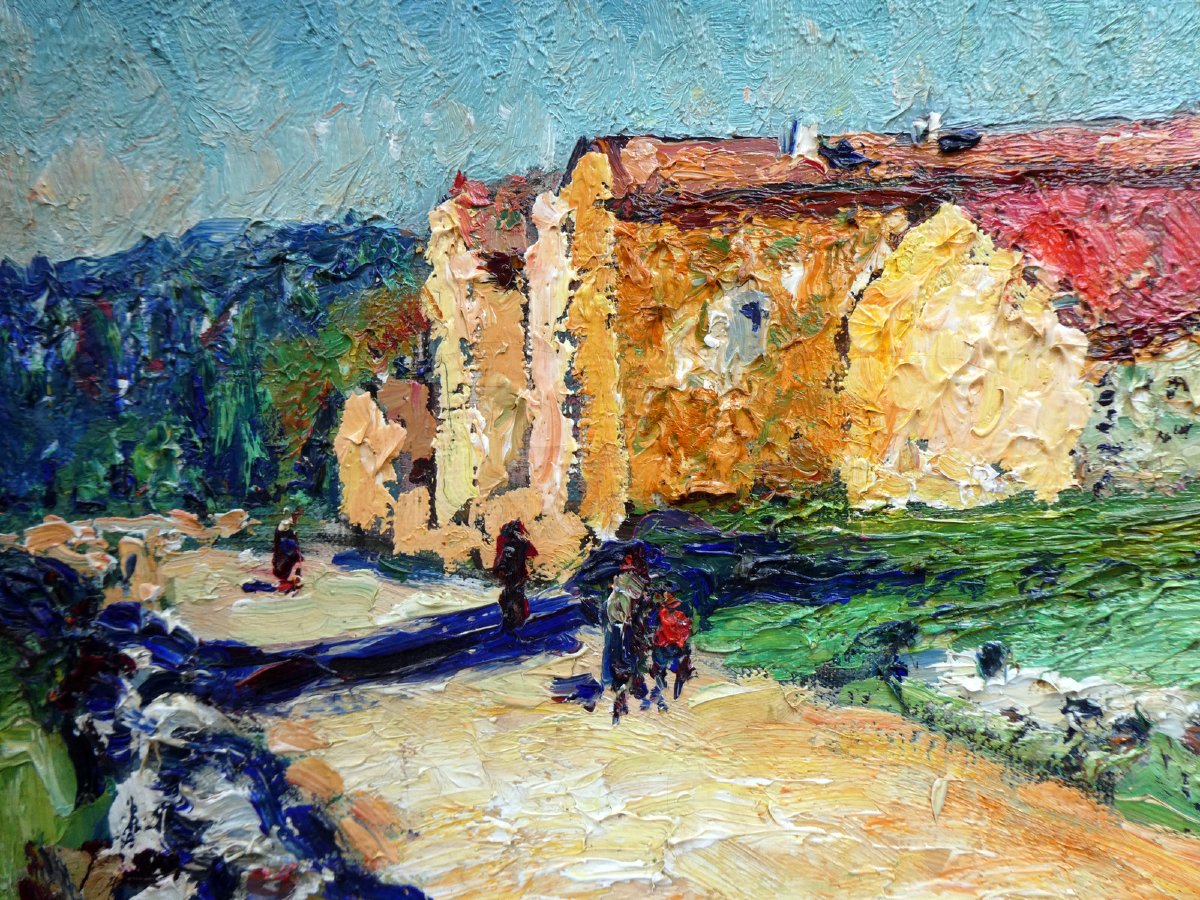
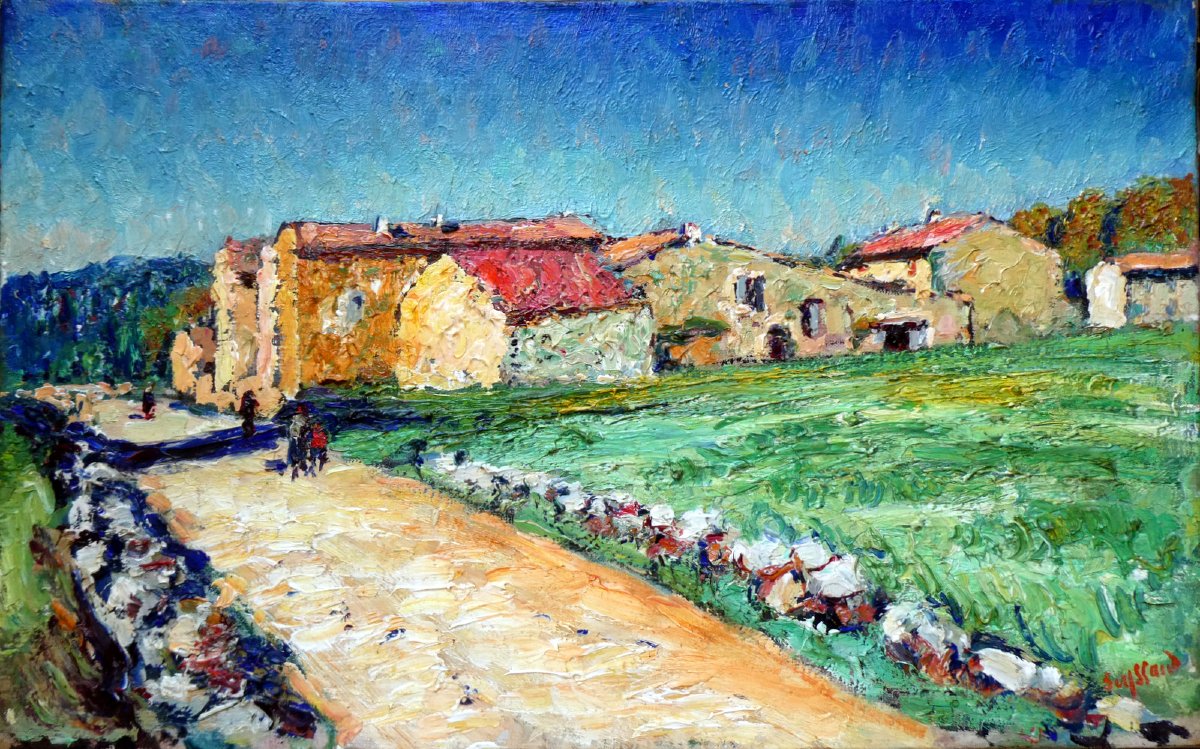
A blond path structures the entire canvas and leads us towards a hamlet in the background.
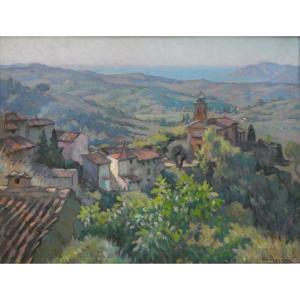
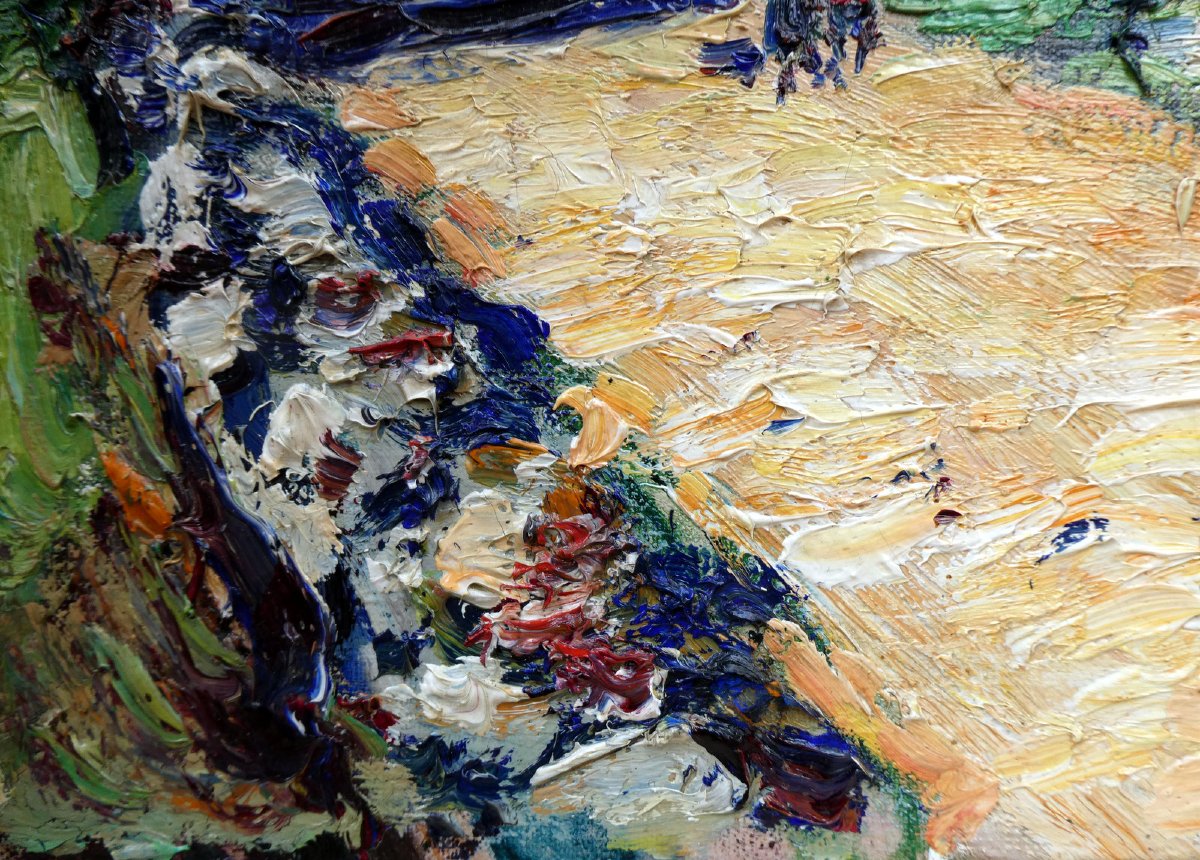
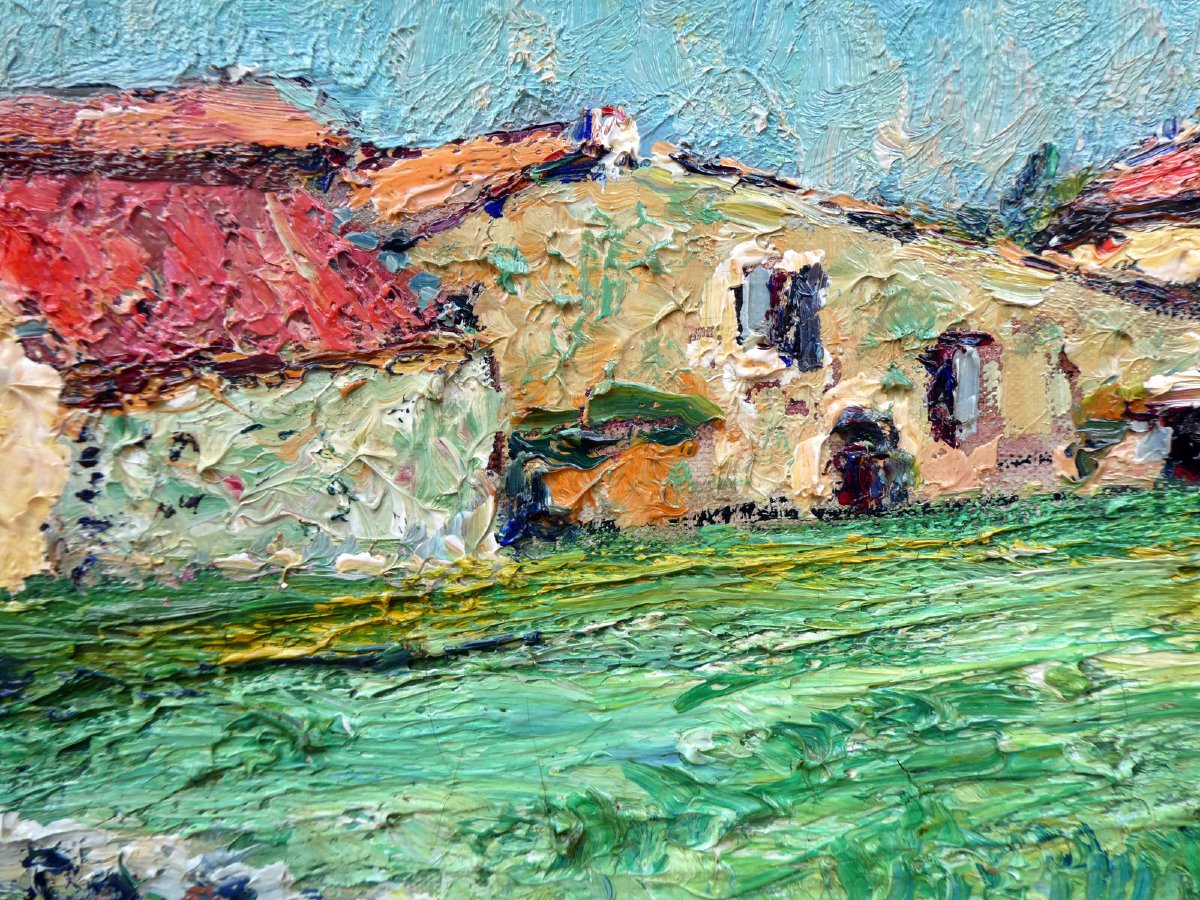
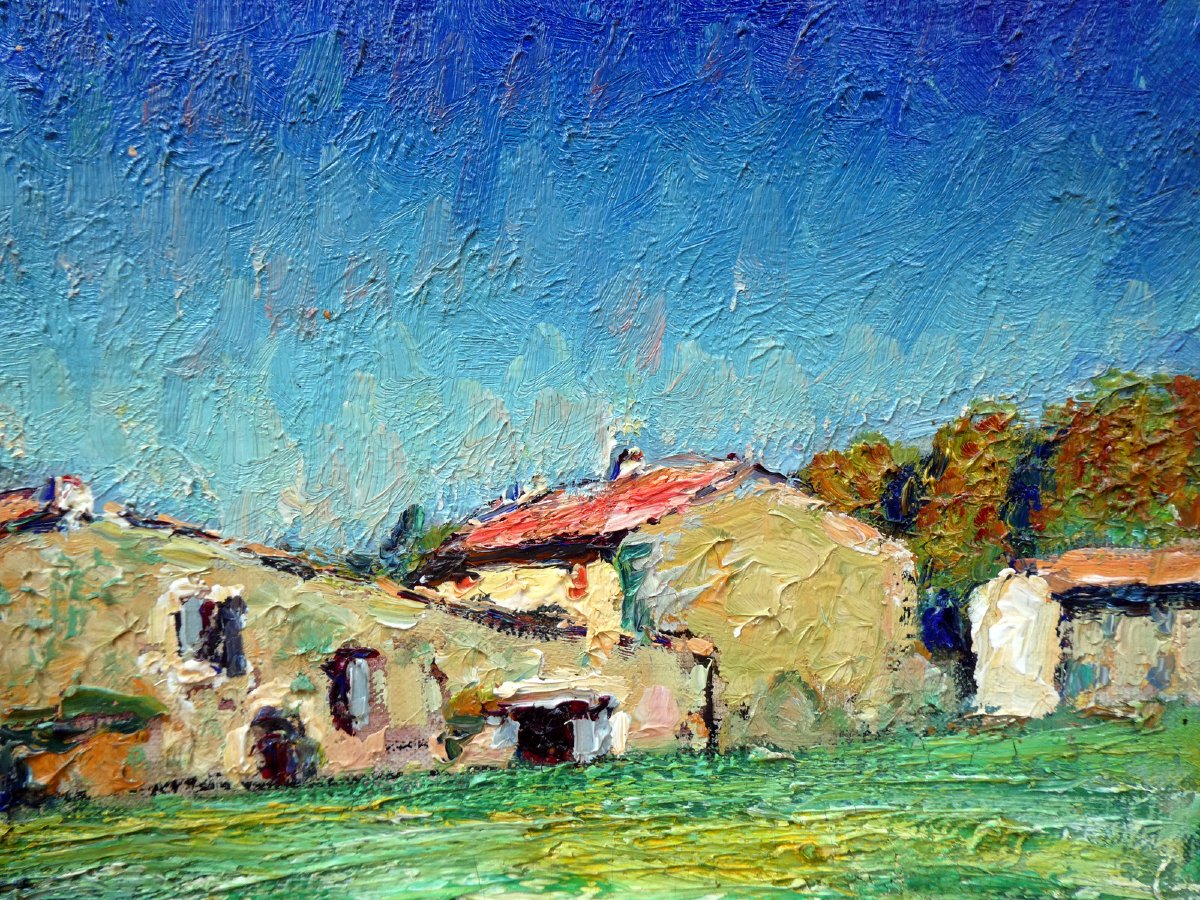
It's a fairly classic Provençal landscape composition with a path, a field, old buildings, and a sky enlivened by the rather high horizon, all rendered with a rich, creamy touch and very pronounced impasto.
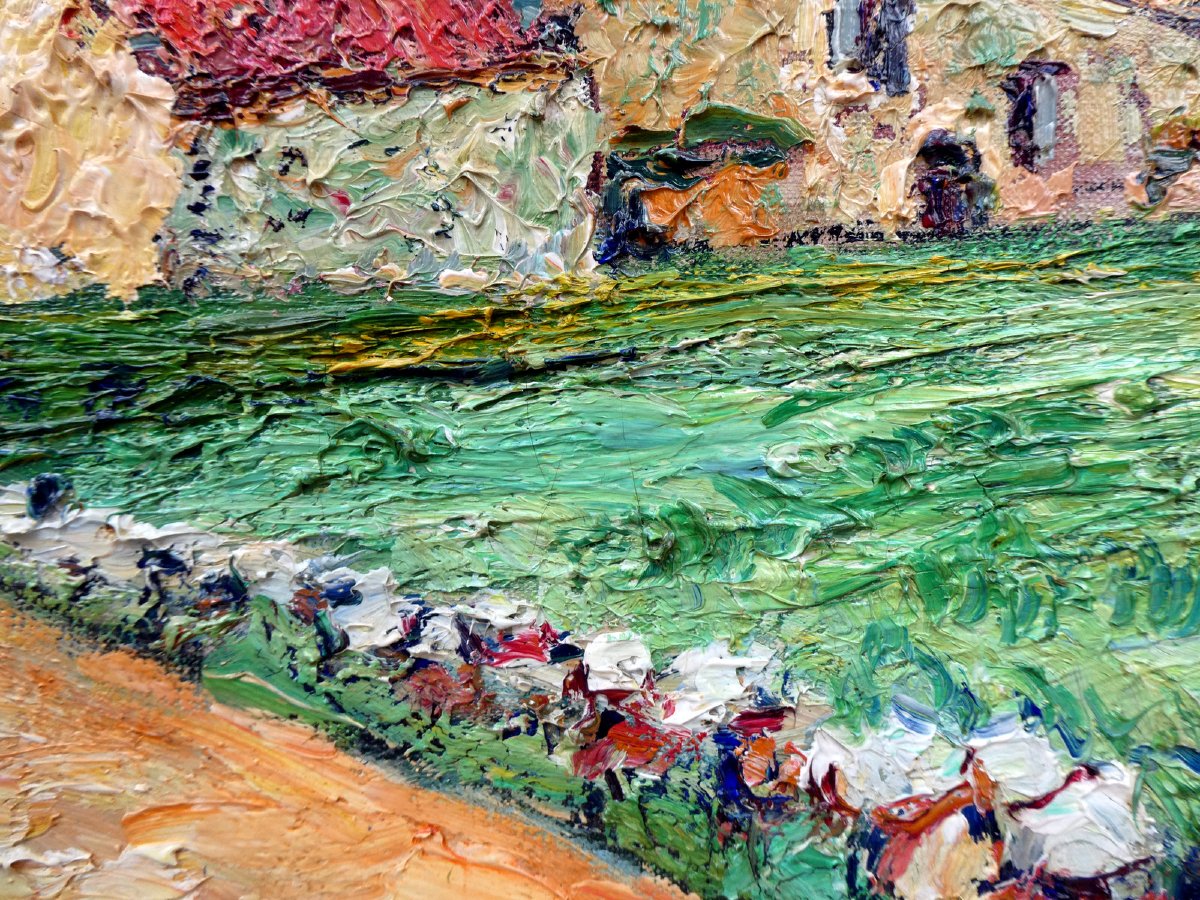
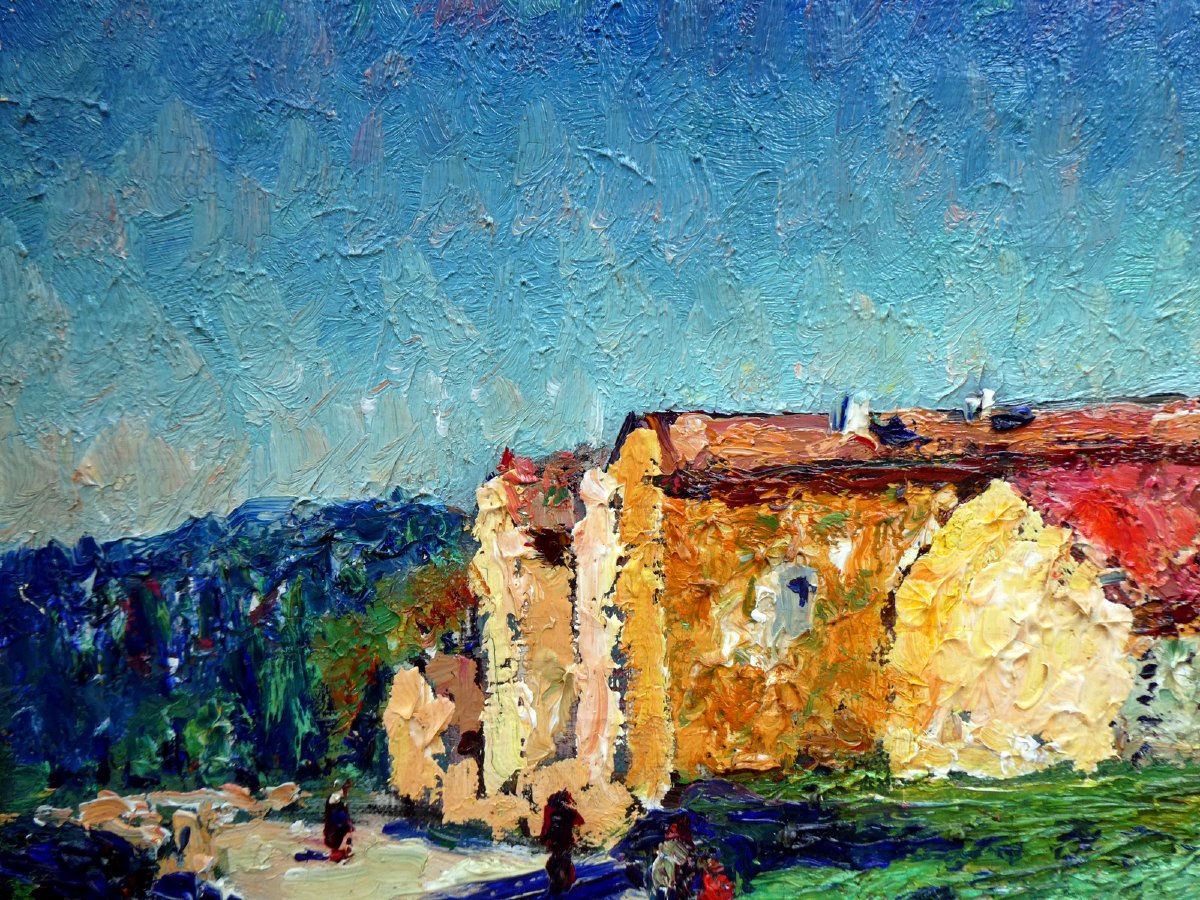
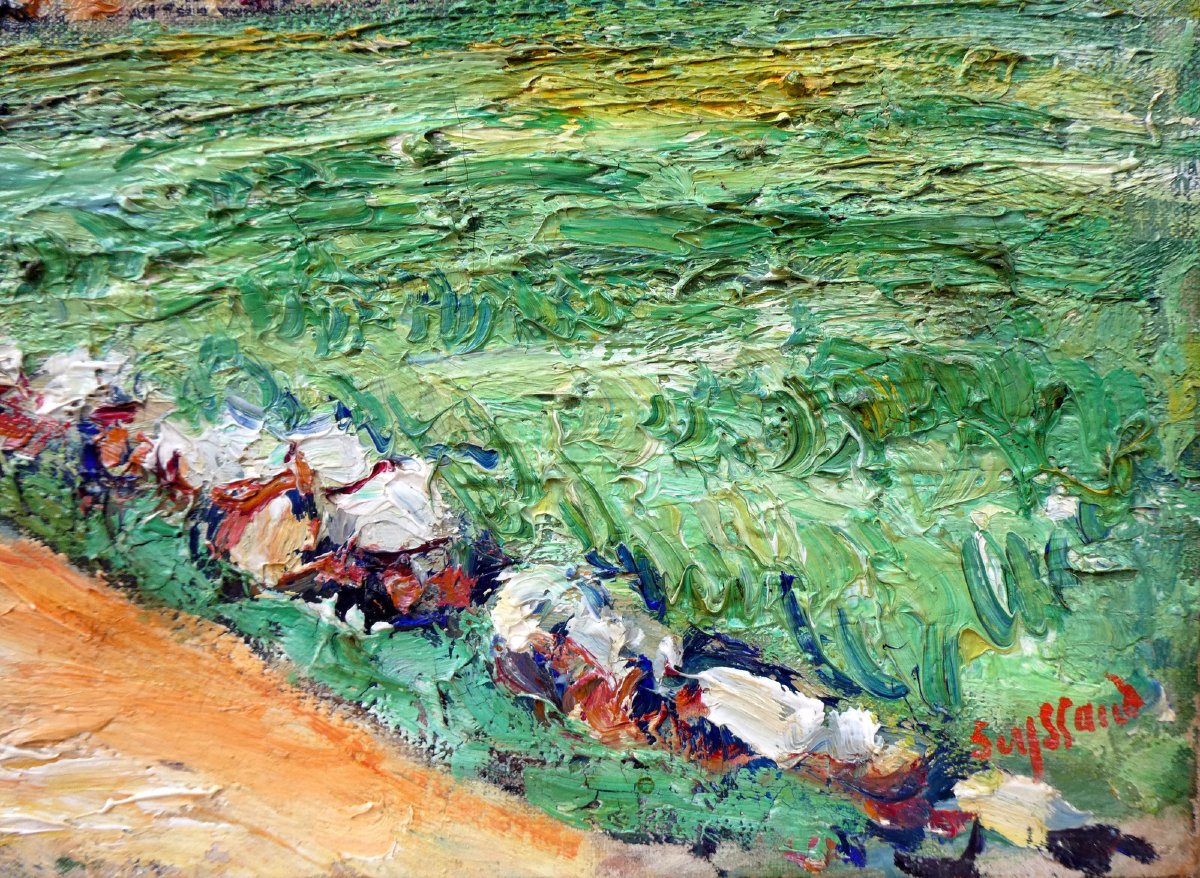
As is his custom, the palette knife and brush are clearly heavy, particularly in the sky where the oblique strokes create an atmospheric vibration, and in the walls of the houses where the thick impasto conveys the harsh light of the South of France. In the foreground, a stone parapet, rendered with short, white strokes, guides us along the path towards anecdotal, almost abstract figures who bring a human presence to the painting and give it depth.
As always with Seyssaud's oil paintings, color is the true strength of the work.
The contrast between the deep blue of the sky (almost ultramarine at the top, lightening towards the horizon) and the rich green of the field creates a chromatic tension that is very Fauvist, ahead of its time.
The ochre yellow and sienna-colored facades of the houses, along with the vermilion roofs, add a third warm note that balances the whole and intensifies the southern light.
This is Seyssaud's true signature: his ability to make a contrasting palette resonate without ever breaking the impression of a unique moment of light.
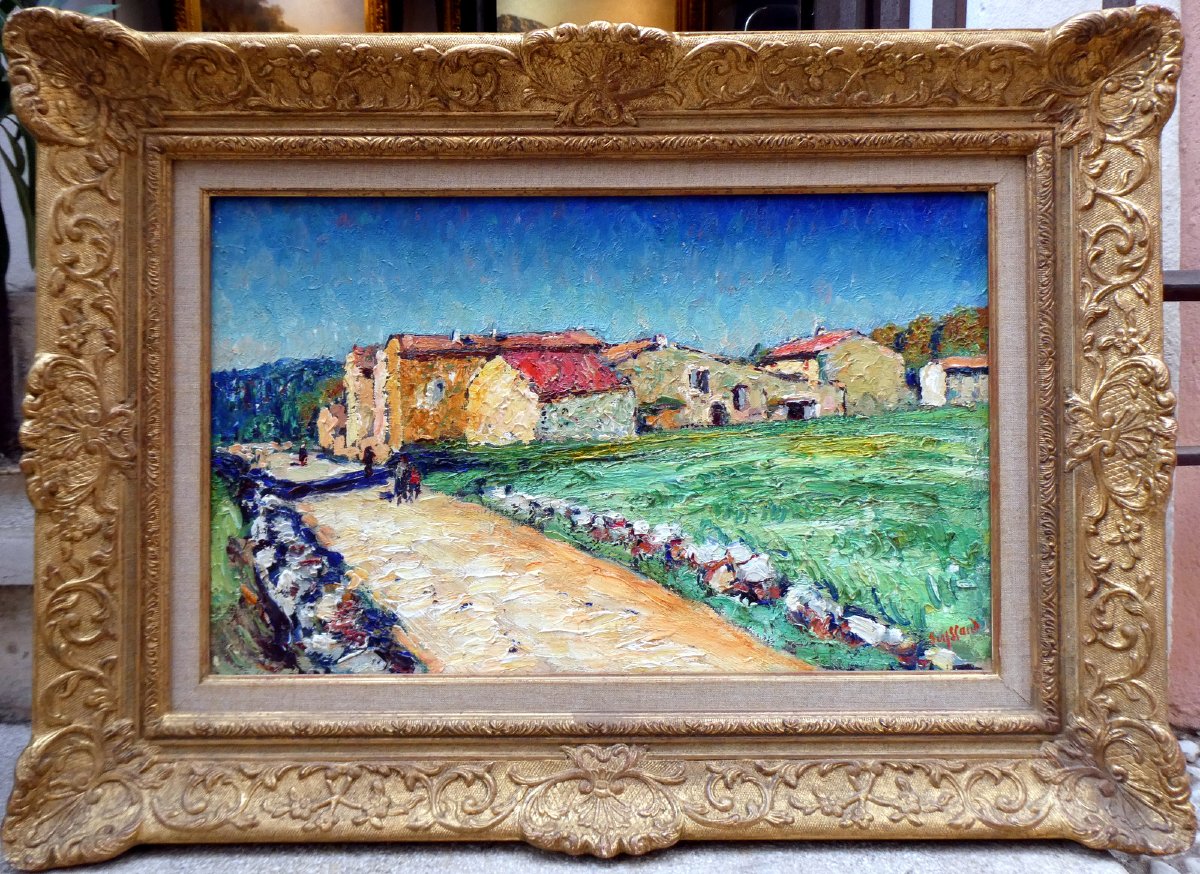
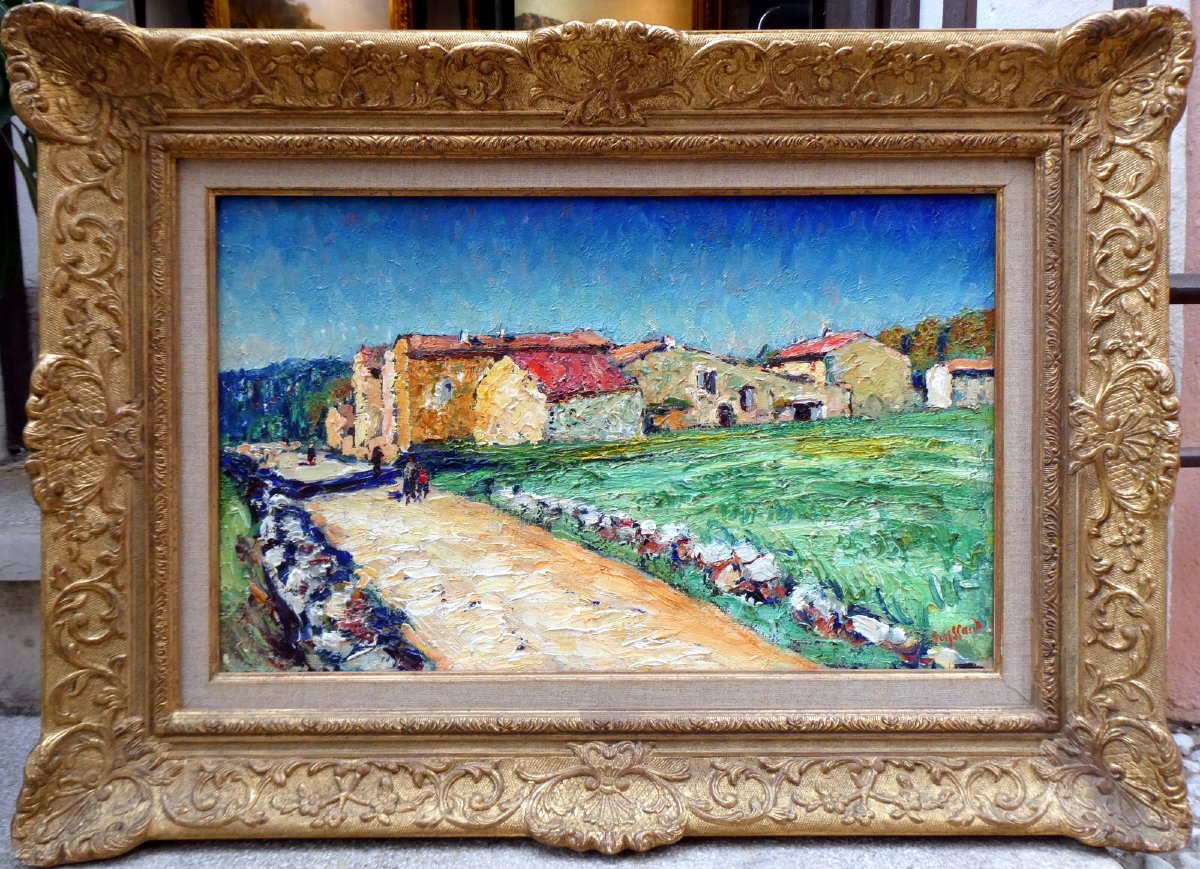
The work is an oil on canvas, signed in the lower right corner, in excellent condition, and presented in a beautiful Louis XIV-style gilt frame measuring 61 cm by 83 cm, with the canvas itself measuring 38 cm by 61 cm.
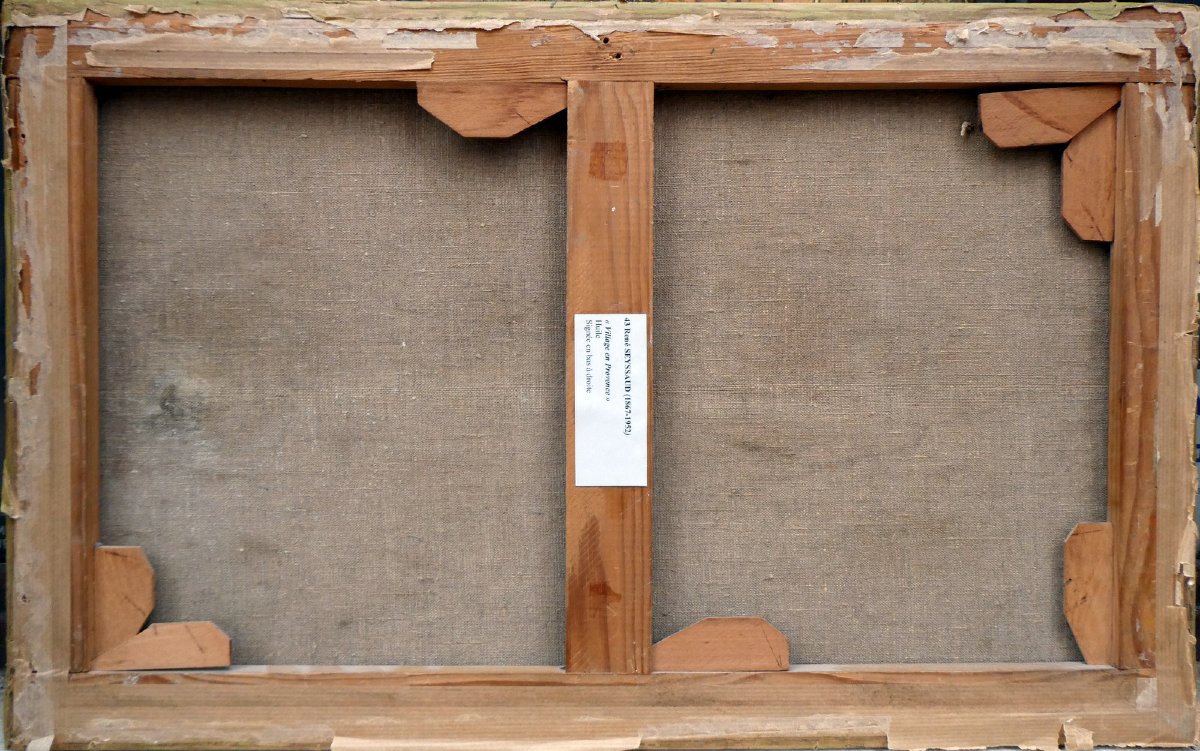
On the back, an exhibition label reads "Village in Provence."
It depicts a hamlet, likely on the foothills of Mont Ventoux, where the artist lived and worked part of the year.
The work of a painter deeply rooted in the Provençal terroir, who produced his own colours, far from Parisian circles, and who refused contract offers from the biggest merchants of the time, who were drawn to his audacity and modernity.
A pioneer of Fauvism and a member of the Nouvelle École d’Avignon in 1892, Seyssaud submitted works to the Indépendants as well as to the Champs de Mars.
He exhibited at the Salon d’Automne from its inception, at the Parc de Bouteville in 1897, and in 1899 at Vollard’s gallery.
He achieved all the success he had hoped for.
Vollard offered Seyssaud a contract, but Seyssaud, out of loyalty to his friend and Marseille-based art dealer François Honnorat, declined.
In 1901, he began exhibiting annually at Bernheim Jeune.
Like Vollard, Bernheim Jeune offered to manage his interests.
Seyssaud again chose to reject this partnership, however lucrative it might have been.
After 1911, Seyssaud stopped exhibiting at Bernheim and chose instead to exhibit at Rosemberg (1914), Druet (1924), (1927), Printz (1929), Georges Petit (1930), Javal and Boudeaix (1933), and Printz (1933).
He exhibited in Marseille in 1905, 1907, 1920, 1921, 1922, 1928, 1947, 1949.
In Avignon, Aix-en-Provence, Tunis, etc...
In America in 1947.
Seyssaudparticipated in official exhibitions in Berlin (1903), Amsterdam (1912), Barcelona (1917, 1929), New York (1929), Wiesbaden (1921), Ghent (1922), Stockholm (1923), Geneva (1923, 1942), Turin (1951), the Colonial Exhibition in Marseille (1922), the Paris International Exhibition (1937), the of Marseille (1949), Menton Biennial (1951), Cantini Museum (1954), Zurich (1955), Galliera Museum (1956), Oxford, London, Edinburgh (1957), Aix-en-Provence, Festival (1957).
His works were acquired by the French government for the Luxembourg Museum (1903, 1904, 1921, 1927, 1929, 1930).
His works were alsoacquired by the museums of Marseille (1908, 1919), Lyon (1924), and Avignon (1920), the Bouches-du-Rhône Prefecture (1933), the City Hall of Saint-Chamas (1909), the National Museum of Modern Art (1957).
His works are on display at the Petit Palais, the Museum of Modern Art, the Léon Dierx Museum (Reunion Island), and in Moscow.
Also in Dijon, Nîmes, Aix-en-Provence, Arles, Grenoble, Montpellier, Albi, etc...
He has received various medals and awards.
Amongothers, the Gold Medal at the 1937 International Exposition in Paris,the Medal of the City of Marseille in 1947, and the Grand Prix of the French Provinces in 1951 at the Menton Biennale.
Seyssaud had been an Officer of the Legion of Honor since 1947.
Among the posthumous
retrospective exhibitions were those at the Calvet Museum (1953), the Cantini Museum (1954), the Salon d’Automne, Château d’Arbon in Switzerland (1955), and the Galliera Museum.
His paintings are included in the collections of Gustave Geffroy, Frantz Jourdain, Vollard, Georges Feydeau, Sacha Guitry, Armand Dayot, Lucien Poincaré, Maurice Sarraut, Albert Sarraut, Paulhan, Bernheim, Estaunié, Descaves, Morsolf, Fernand Bouisson, Drouant, André Marie, the Marquis de Biron, the Princess de la Tour d’Auvergne, de Wagram, etc.
It's a fairly classic Provençal landscape composition with a path, a field, old buildings, and a sky enlivened by the rather high horizon, all rendered with a rich, creamy touch and very pronounced impasto.
As is his custom, the palette knife and brush are clearly heavy, particularly in the sky where the oblique strokes create an atmospheric vibration, and in the walls of the houses where the thick impasto conveys the harsh light of the South of France. In the foreground, a stone parapet, rendered with short, white strokes, guides us along the path towards anecdotal, almost abstract figures who bring a human presence to the painting and give it depth.
As always with Seyssaud's oil paintings, color is the true strength of the work.
The contrast between the deep blue of the sky (almost ultramarine at the top, lightening towards the horizon) and the rich green of the field creates a chromatic tension that is very Fauvist, ahead of its time.
The ochre yellow and sienna-colored facades of the houses, along with the vermilion roofs, add a third warm note that balances the whole and intensifies the southern light.
This is Seyssaud's true signature: his ability to make a contrasting palette resonate without ever breaking the impression of a unique moment of light.
The work is an oil on canvas, signed in the lower right corner, in excellent condition, and presented in a beautiful Louis XIV-style gilt frame measuring 61 cm by 83 cm, with the canvas itself measuring 38 cm by 61 cm.
On the back, an exhibition label reads "Village in Provence."
It depicts a hamlet, likely on the foothills of Mont Ventoux, where the artist lived and worked part of the year.
The work of a painter deeply rooted in the Provençal terroir, who produced his own colours, far from Parisian circles, and who refused contract offers from the biggest merchants of the time, who were drawn to his audacity and modernity.
A pioneer of Fauvism and a member of the Nouvelle École d’Avignon in 1892, Seyssaud submitted works to the Indépendants as well as to the Champs de Mars.
He exhibited at the Salon d’Automne from its inception, at the Parc de Bouteville in 1897, and in 1899 at Vollard’s gallery.
He achieved all the success he had hoped for.
Vollard offered Seyssaud a contract, but Seyssaud, out of loyalty to his friend and Marseille-based art dealer François Honnorat, declined.
In 1901, he began exhibiting annually at Bernheim Jeune.
Like Vollard, Bernheim Jeune offered to manage his interests.
Seyssaud again chose to reject this partnership, however lucrative it might have been.
After 1911, Seyssaud stopped exhibiting at Bernheim and chose instead to exhibit at Rosemberg (1914), Druet (1924), (1927), Printz (1929), Georges Petit (1930), Javal and Boudeaix (1933), and Printz (1933).
He exhibited in Marseille in 1905, 1907, 1920, 1921, 1922, 1928, 1947, 1949.
In Avignon, Aix-en-Provence, Tunis, etc...
In America in 1947.
Seyssaudparticipated in official exhibitions in Berlin (1903), Amsterdam (1912), Barcelona (1917, 1929), New York (1929), Wiesbaden (1921), Ghent (1922), Stockholm (1923), Geneva (1923, 1942), Turin (1951), the Colonial Exhibition in Marseille (1922), the Paris International Exhibition (1937), the of Marseille (1949), Menton Biennial (1951), Cantini Museum (1954), Zurich (1955), Galliera Museum (1956), Oxford, London, Edinburgh (1957), Aix-en-Provence, Festival (1957).
His works were acquired by the French government for the Luxembourg Museum (1903, 1904, 1921, 1927, 1929, 1930).
His works were alsoacquired by the museums of Marseille (1908, 1919), Lyon (1924), and Avignon (1920), the Bouches-du-Rhône Prefecture (1933), the City Hall of Saint-Chamas (1909), the National Museum of Modern Art (1957).
His works are on display at the Petit Palais, the Museum of Modern Art, the Léon Dierx Museum (Reunion Island), and in Moscow.
Also in Dijon, Nîmes, Aix-en-Provence, Arles, Grenoble, Montpellier, Albi, etc...
He has received various medals and awards.
Amongothers, the Gold Medal at the 1937 International Exposition in Paris,the Medal of the City of Marseille in 1947, and the Grand Prix of the French Provinces in 1951 at the Menton Biennale.
Seyssaud had been an Officer of the Legion of Honor since 1947.
Among the posthumous
retrospective exhibitions were those at the Calvet Museum (1953), the Cantini Museum (1954), the Salon d’Automne, Château d’Arbon in Switzerland (1955), and the Galliera Museum.
His paintings are included in the collections of Gustave Geffroy, Frantz Jourdain, Vollard, Georges Feydeau, Sacha Guitry, Armand Dayot, Lucien Poincaré, Maurice Sarraut, Albert Sarraut, Paulhan, Bernheim, Estaunié, Descaves, Morsolf, Fernand Bouisson, Drouant, André Marie, the Marquis de Biron, the Princess de la Tour d’Auvergne, de Wagram, etc.
6 500 €
Period: 20th century
Style: Other Style
Condition: Perfect condition
Material: Oil painting
Length: 61 cm
Height: 38 cm
Reference (ID): 1807699
Availability: In stock
Print